


Related Tags
Entering the market for the first time can be exciting, but watching your digital assets remain idle in a wallet during prolonged market consolidations may feel like a missed opportunity. This raises an important question: what is staking in crypto, and how can token holders put their assets to work while potentially earning additional rewards? In modern decentralized finance, blockchain protocols rely on participants who commit their tokens to support network security, validate transactions, and maintain trust without depending on energy-intensive mining operations.
What Is Staking in Crypto and How Does It Work?
Staking is the process of committing your cryptocurrency holdings as collateral to secure a Proof-of-Stake blockchain network in exchange for regular token rewards.
Instead of requiring energy-heavy computers to solve arbitrary mathematical equations, Proof-of-Stake protocols require validators to post an economic bond directly on-chain. When transactions occur across the network, the protocol pseudo-randomly selects active validators to bundle those transactions into a new block, propose it to the distributed ledger, and verify proposals submitted by peer nodes.
Honest validation is rewarded with newly minted protocol tokens and network transaction fees, while fraudulent or negligent behavior triggers direct penalties against the pledged collateral.
Staking Crypto Meaning and Core Consensus Role
The answer to “what is staking in crypto?” starts with how staking creates economic incentives for honest network participation. Unlike traditional financial systems that rely on central clearinghouses, decentralized blockchains use code and committed capital to maintain trust, validate transactions, and address the Byzantine fault problem (keeping the network in agreement even when some participants are faulty or dishonest) without a central authority.
By locking native tokens into a protocol smart contract, you provide the economic security that prevents malicious actors from reversing confirmed transfers or double-spending digital balances.
If an attacker wished to corrupt a Proof-of-Stake consensus mechanism, they would need to acquire and lock up a controlling majority of all staked capital across the entire network. Doing so would likely prove very costly, as a coordinated attack could sharply reduce the market value of the very assets the attacker pledged.
Staking transforms digital tokens from passive speculative assets into active governance and infrastructure tools that sustain the entire ledger.
Proof of Stake vs. Proof of Work: How Staking Secures the Blockchain
To evaluate how staking secures modern decentralized systems, it helps to compare it directly against the older Proof-of-Work model pioneered by Bitcoin. Proof of Work relies on physical energy and specialized computational rigs to secure ledger entries, requiring miners to continually burn electricity to prove their honest participation.
By contrast, Proof of Stake replaces physical infrastructure with financial collateral, which reduces hardware costs while keeping consensus secure. If you want to understand how baseline networks operate, the guide on how to trade Bitcoin shows how original Proof-of-Work systems function in active markets.
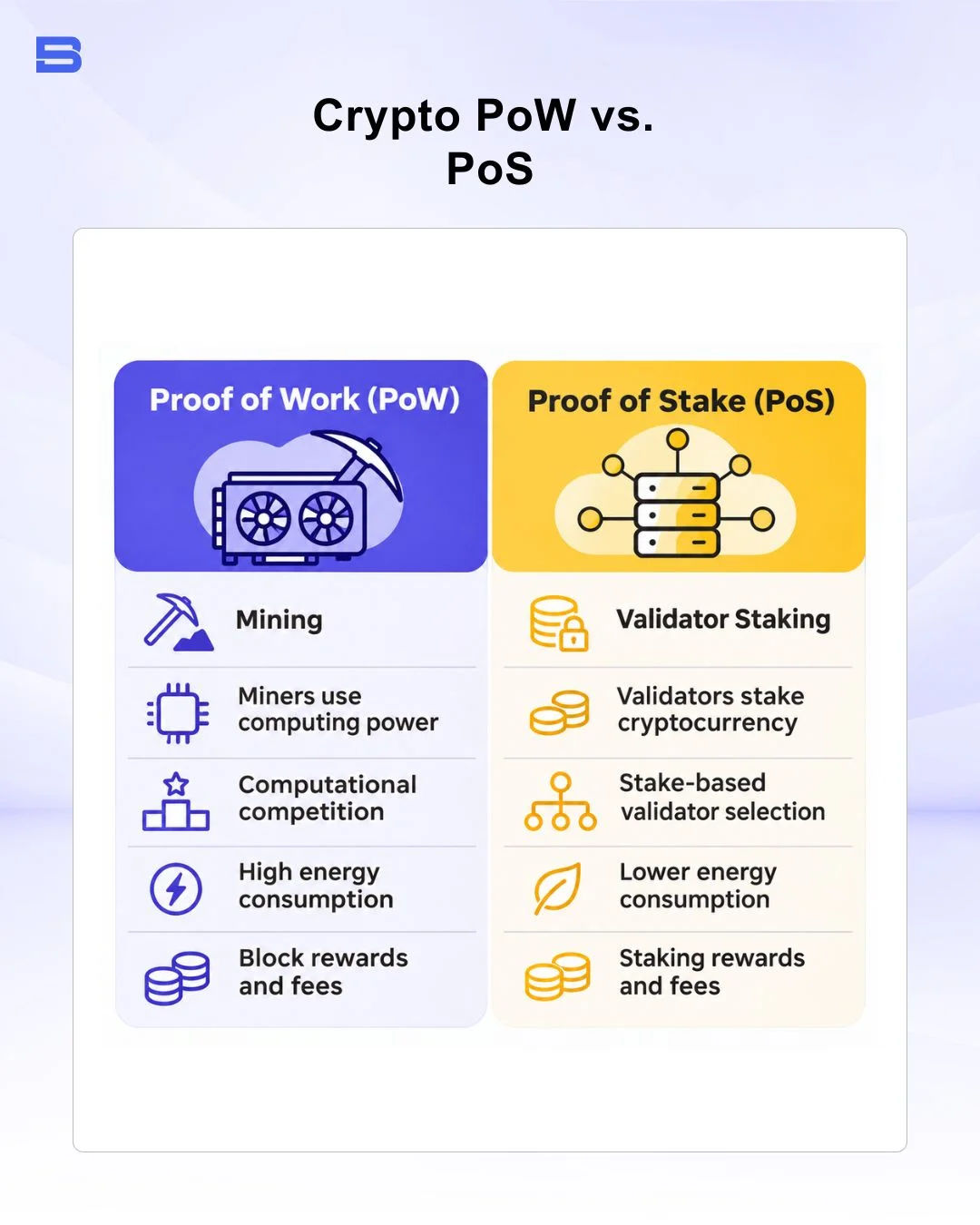
While Proof of Work ties security to the energy and hardware miners spend, Proof of Stake ties it to the value of the tokens validators lock up. This makes modern staking networks significantly more accessible for ordinary market participants who want to support consensus without deploying server racks in high-voltage industrial facilities.
How to Participate in Staking Crypto: 4 Practical Methods
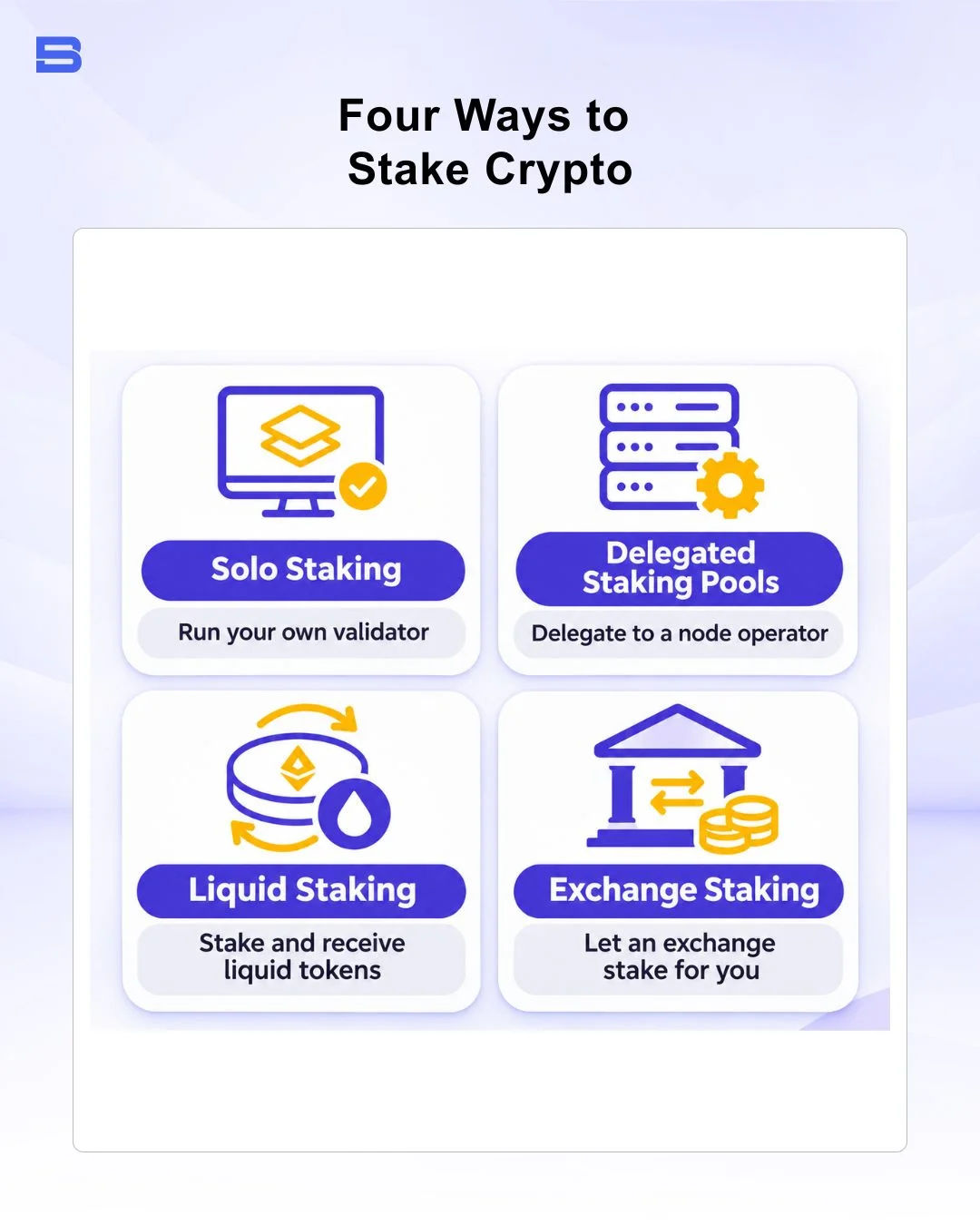
Staking digital assets does not require a uniform approach, allowing you to choose an operational method aligned with your technical background, capital size, and risk appetite.
Solo Staking vs. Delegated Staking Pools
Solo staking sits at the top of the technical hierarchy, requiring you to maintain a dedicated physical or cloud validator node with 24/7 internet connectivity and uninterrupted electrical backup. On Ethereum, for instance, running a solo node requires a minimum protocol stake of 32 native tokens, giving you total sovereign control over your private signing keys without third-party exposure.
For individuals lacking the required threshold or server expertise, delegated staking pools offer a practical alternative. In a pooled architecture, you delegate your voting weight to a reputable third-party node operator while retaining ownership of your assets within your non-custodial wallet. The validator charges an operational commission on generated yield and passes the remaining rewards directly to you without requiring continuous node monitoring.
Liquid Staking vs. Traditional Locked Staking
It also helps to compare traditional locked staking with liquid staking. Traditional staking locks your tokens in protocol contracts, limiting access to your funds during sudden macroeconomic shifts or market volatility. Liquid staking protocols address this liquidity constraint by issuing a representative token, known as a Liquid Staking Token (LST), which reflects your underlying staked assets and accumulated rewards while allowing greater flexibility to use or trade your position.
These derivative tokens can be utilized across decentralized finance, deployed into an automated liquidity pool to generate secondary exchange fees, or posted as loan collateral. Borrowing against an LST adds leverage, so a sharp price drop can trigger liquidation of your collateral.
While liquid staking can reduce the impact of standard unbonding delays (the waiting period before staked tokens can be withdrawn), it introduces smart-contract risk, because any vulnerability in the liquid staking smart contracts could compromise your underlying assets. An LST can also trade below the value of the staked assets it represents during periods of market stress, so selling it quickly may lock in a loss.
Custodial Staking on Centralized Exchanges
Centralized exchanges also provide one-click custodial staking, managing all underlying validator mechanics on your behalf. While this approach offers a simpler onboarding path for beginners than solo or pooled staking, it carries counterparty risk, as you relinquish custody of your private cryptographic keys to an intermediary corporate entity. Before using an exchange’s staking service, check that the exchange is licensed or registered with the securities regulator in your country.
How Crypto Staking Generates Rewards and How to Calculate Real Yield
Staking rewards stem from two distinct structural cash flows built into the blockchain protocol: programmatic token issuance and transaction priority fees. When validators propose and attest to (confirm) transaction blocks, the protocol issues newly created native tokens according to a predetermined inflation timetable. Additionally, network users pay transaction fees, and depending on the protocol, some or all of these fees go to active validators. On Ethereum, for example, the base fee is burned, while priority tips go to the validator that proposes the block.
Staking yield differs fundamentally from decentralized yield farming, which derives returns from borrowing demand and variable liquidity subsidies rather than direct base-layer consensus validation. To evaluate true returns, you must closely examine underlying protocol tokenomics rather than fixating exclusively on high headline figures. High double-digit nominal rates frequently disguise excessive token dilution that rapidly erodes purchasing power.
Consider a scenario where you allocate 1,000 protocol tokens to an active validator offering a nominal 7% Annual Percentage Yield (APY). Over a full 12-month cycle, you accumulate 70 additional tokens, expanding your total holdings to 1,070 tokens.
However, if the network token supply expands by 4% over that same year to fund validator payouts, your share of the total token supply grows by only about 3%, because the new tokens dilute every holder. Furthermore, if broad market volatility causes the token’s fiat market value to drop by 20% over that annual window, your net return in dollar terms is still negative despite earning all scheduled staking rewards. Staking expands your token quantity, but it can never insulate your capital from broad market depreciation.
Key Risks of Crypto Staking: What You Stand to Lose
While the prospect of compounding digital tokens appeals to patient market participants, staking entails substantial operational and systemic risks that require balanced consideration. The regulatory landscape around staking services continues to evolve globally, and retail market participants should review investor warnings issued by major authorities, such as the US Securities and Exchange Commission (SEC), regarding yield promises and custody arrangements.
The primary risk confronting any participant is underlying asset volatility. If a pledged token declines by 40% during a sharp market contraction, a 5% staking yield does virtually nothing to cushion the overall balance sheet loss. Because staking locks tokens into protocol contracts, you cannot quickly sell your position on a spot exchange when the market turns sharply lower.
Staking also carries liquidity risk when you want to withdraw your staked assets. Unbonding periods can increase market exposure, as most major Proof-of-Stake protocols impose a withdrawal cooldown ranging from a few days to several weeks after users request to unstake their tokens. During this period, assets may remain inaccessible, even if market conditions change significantly.
During this lockup window, your capital stops earning protocol yield, yet remains entirely frozen and unsellable, leaving you exposed to severe downward price movements. Sound portfolio execution requires integrating a coherent crypto trading strategy that accounts for liquidity locks rather than treating staked allocations as liquid cash equivalents.
Smart contract vulnerability represents an additional structural hazard. When utilizing decentralized pooling services or liquid staking bridges, any flaw or exploit in the deployed contract logic can result in permanent protocol drainage. Technical exploits in decentralized finance (DeFi) applications are generally irreversible, meaning principal recovery is rarely possible after a serious contract breach.
Slashing Penalties and Validator Downtime
Proof-of-Stake protocols maintain systemic discipline through slashing mechanisms, which automatically confiscate a portion of a validator’s pledged tokens when malicious activity or gross negligence occurs. Protocol architectures impose strict financial sanctions for offenses such as double-signing, which involves proposing two competing blocks at the same height, or signing conflicting ledger states.
The International Organization of Securities Commissions (IOSCO) has highlighted validator operational hazards and infrastructure vulnerabilities in its policy guidance for digital asset markets. Validator downtime caused by server outages or connectivity failures also incurs minor algorithmic penalties, steadily chipping away at principal yields.
Delegating tokens to a shared validator pool carries its own risks. Protocol rules may impose slashing penalties on funds belonging to multiple delegators if an associated validator engages in malicious behavior or fails to meet network requirements. Therefore, carefully evaluating a validator’s reputation, performance, and reliability is essential before committing personal tokens.
Crypto Staking Explained: Key Takeaways
Knowing the answer to “what is staking in crypto?” helps you see how digital assets can serve a purpose beyond simply holding value. Staking allows token holders to support blockchain network security and operations while earning potential rewards that can gradually increase their token holdings. It turns otherwise idle digital assets into productive network resources.
However, staking rewards should never be mistaken for guaranteed profits or risk-free interest, as participants remain exposed to market volatility, liquidity restrictions, and protocol-related risks. Volatility in underlying token prices, rigid unbonding delays, smart contract failure, and node slashing penalties remain structural market realities, making disciplined risk management an absolute necessity.
- What Can You Trade? A Guide to Forex, Stocks, and More
- CFD Trading for Beginners
- What is CFD Trading and How Does It Work?
- Forex vs. Stocks: Which Market Suits You Best?
- How to Diversify a Portfolio Across Asset Classes
- How Dividend Stocks Work: Yields, Risks, and Strategies
- Silver Trading Explained: A Guide for Retail Investors
- Precious Metals Trading: A Complete Guide for Beginners
- Natural Gas Trading: A Guide to the Market
- Structured Warrants Malaysia: How They Work and Risks
- What Is the KLCI Index and How to Trade It
- Gold Investment in Malaysia: A Complete Guide for Beginners
- What Is Kijang Emas and How to Invest in It
- Value Investing Explained: How to Find Undervalued Stocks
- How to Trade Bitcoin Safely: A Complete Market Guide
- Growth Investing Explained: Strategies, Metrics, and Risks
- What Is Digital Gold Malaysia and How to Invest
- Crypto Trading Strategies for Beginners
- Gold vs Bitcoin: Key Differences, Risks, and Strategies
- Sukuk: A Guide for Beginners to Islamic Bonds
- What Is FCPO (Crude Palm Oil Futures) and How to Trade It
- How to Identify and Invest in Shariah-Compliant Stocks
- Timber Investment: Is It Worth It?
- Gold ETF Malaysia: A Guide for Beginners
- What Are Malaysian Government Securities (MGS)?
- Corporate Bonds Malaysia: A Guide for Beginners
- China A-Shares Trading Guide for Malaysian Investors
- What Is a Silver ETF and How to Invest in It?
- How to Trade XRP: A Practical Guide for Retail Investors
- How to Trade Solana (SOL): A Guide for Beginners
- What Are Gold Futures and How Do They Work?
- Money Market Fund in Malaysia: A Guide for Beginners
- Property Investment Malaysia: Direct Real Estate or M-REITs?
- What Is Binance Coin and How Does It Work?
- Green Sukuk: A Guide for Beginners to Islamic ESG Investing
- What Is Shiba Inu (SHIB) and How to Trade It
- What Is USDT? A Complete Guide to Tether for Beginners
- What Is Dogecoin and How to Trade It Safely for Beginners
- Cardano: A Guide for Beginners to Trade This Cryptocurrency
- Polkadot: A Guide to Trading This Cryptocurrency
- Tron: A Guide for Beginners to Trading This Cryptocurrency
- What Is Litecoin (LTC)? A Guide to Trading Digital Silver
- What Is Chainlink (LINK) and How to Trade It
- How to Trade Pepe Coin: Spot, Leverage, and Risk Management
- Near Protocol: A Guide to Trading This Cryptocurrency
- Trading Polygon Crypto: A Practical Guide for Beginners
- Trade Toncoin: Understanding the TON Ecosystem and Risks
- Cosmos Crypto: Ecosystem Architecture, Tokenomics, and Risks
- Stellar Crypto: A Guide to Trading This Cryptocurrency
- Avalanche Crypto Explained: A Practical Guide for Traders
- What Is Worldcoin? How to Trade WLD and Manage Risk
- Aptos: A Guide for Beginners to Trading This Cryptocurrency
- Sui Crypto Explained: Tokenomics and Trading Guide
- Celestia: A Guide to Trading This Cryptocurrency
- Decentraland: A Guide to Trading This Cryptocurrency
- What Is Arbitrum? How to Trade the Leading Layer 2 Network
- Sei Crypto: A Guide to Trading This Cryptocurrency
- What Is Injective Protocol and How to Trade INJ Safely
Disclaimer: The content on this page is intended for educational and informational purposes only. It does not constitute financial, investment, tax, or legal advice, and should not be interpreted as a recommendation to buy, sell, or hold any financial instrument or asset. Trading and investing involve significant risk, including the possible loss of your entire capital. Products such as forex, CFDs, and cryptocurrencies carry additional risks due to leverage, high volatility, and limited regulatory protection in some jurisdictions. Past performance of any financial instrument does not guarantee future results. Any market views, forecasts, or opinions expressed are those of the author at the time of writing and may not reflect current market conditions. Platform features, fees, and regulatory status are subject to change — always verify information directly with the relevant provider or regulator before making any financial decision. BrokerSpecs may receive compensation from third parties featured on this site. Always conduct your own due diligence and consider seeking advice from a licensed financial professional before investing. Portions of this article were prepared with the assistance of AI tools and reviewed by our editorial team before publication.