


Related Tags
Navigating high-throughput Layer 1 blockchains often leaves traders frustrated by network congestion, fluctuating gas fees, and transaction bottlenecks during peak volatility. While early smart contract platforms introduced decentralized finance to the world, their sequential execution models frequently struggle when trading volume surges.
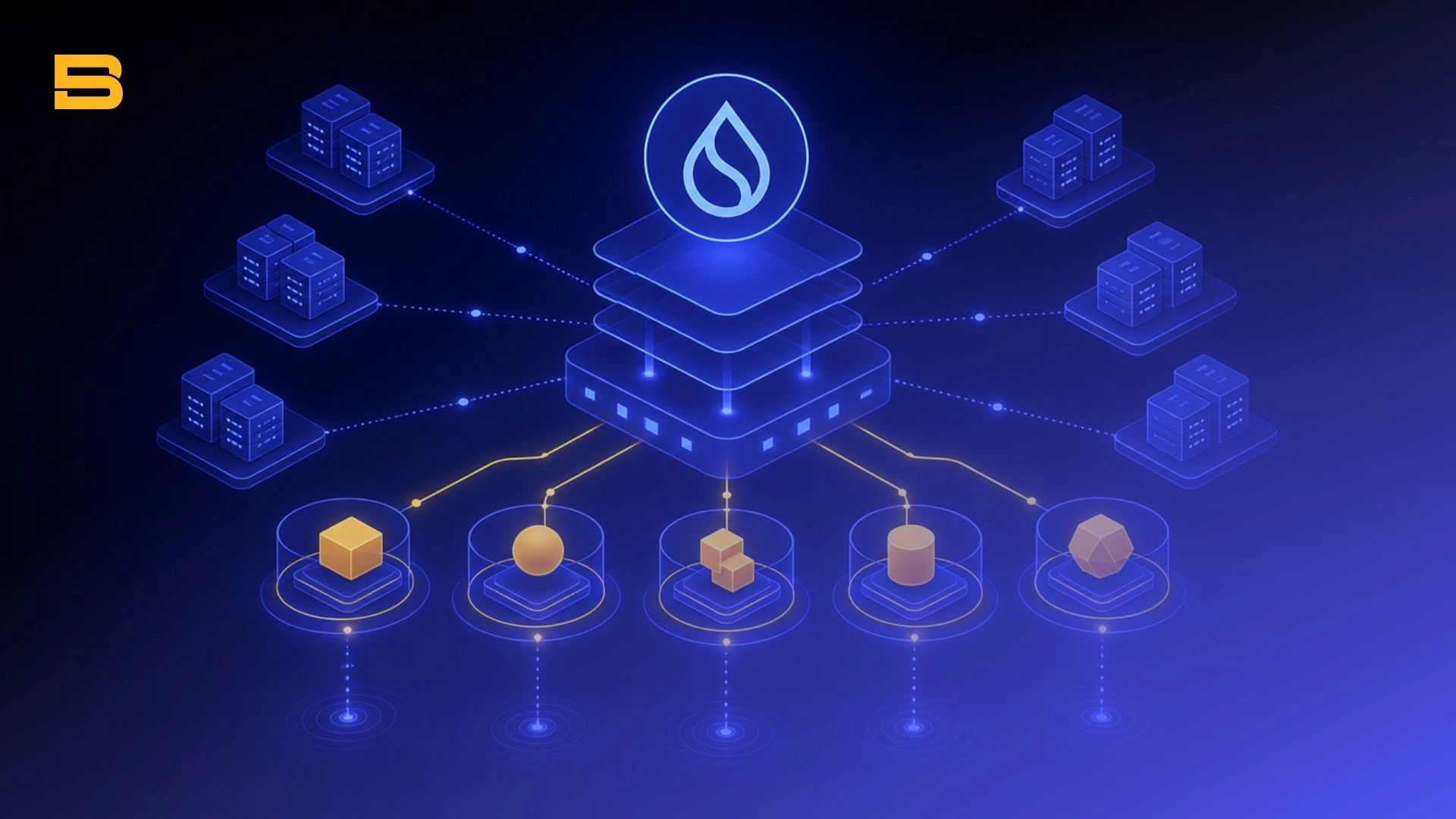
Sui crypto introduces a fundamental departure from traditional blockchain architecture. By organizing data around individual objects rather than cumulative account balances, the network processes independent transactions simultaneously. Understanding how this system works, alongside its tokenomics and structural risk factors, helps you evaluate whether the SUI token fits your trading strategy.
What Is Sui Crypto? Understanding Object-Centric L1 Blockchain
Sui crypto is a high-throughput, delegated proof-of-stake (DPoS) Layer 1 blockchain designed to deliver sub-second transaction finality and predictable execution fees. Developed by Mysten Labs—a team founded by former senior engineers from Meta’s Novi research division—the protocol is built to support latency-sensitive applications like decentralized exchanges, gaming environments, and micro-transaction networks.
The core innovation of Sui crypto lies in its object-centric data model. Traditional networks like Ethereum track state using an account-based ledger, updating global balances sequentially whenever a transaction occurs. Sui treats smart contract assets as discrete "objects" with specific ownership properties.
If two transactions touch completely unrelated objects—such as two traders swapping different tokens—the network executes them in parallel without forcing one to wait for the other.
The platform's smart contracts are written in the Move programming language, originally developed for Meta's Diem project. Move treats assets as native resource types that cannot be cloned, accidentally dropped, or double-spent, drastically reducing common smart contract vulnerability vectors.
Combined with the Mysticeti consensus protocol, launched on Sui Mainnet in July 2024, Sui crypto can achieve sub-second consensus latency for transactions involving shared objects. This low-latency architecture supports high-performance applications, including DeFi and on-chain trading.
Tokenomics, Gas Fees, and Staking Mechanics
The native asset of the network is the SUI token, which serves three primary functions: paying transaction gas fees, staking to secure the Delegated Proof-of-Stake consensus, and voting on on-chain governance proposals. The token has a strict maximum supply cap of 10 billion SUI.
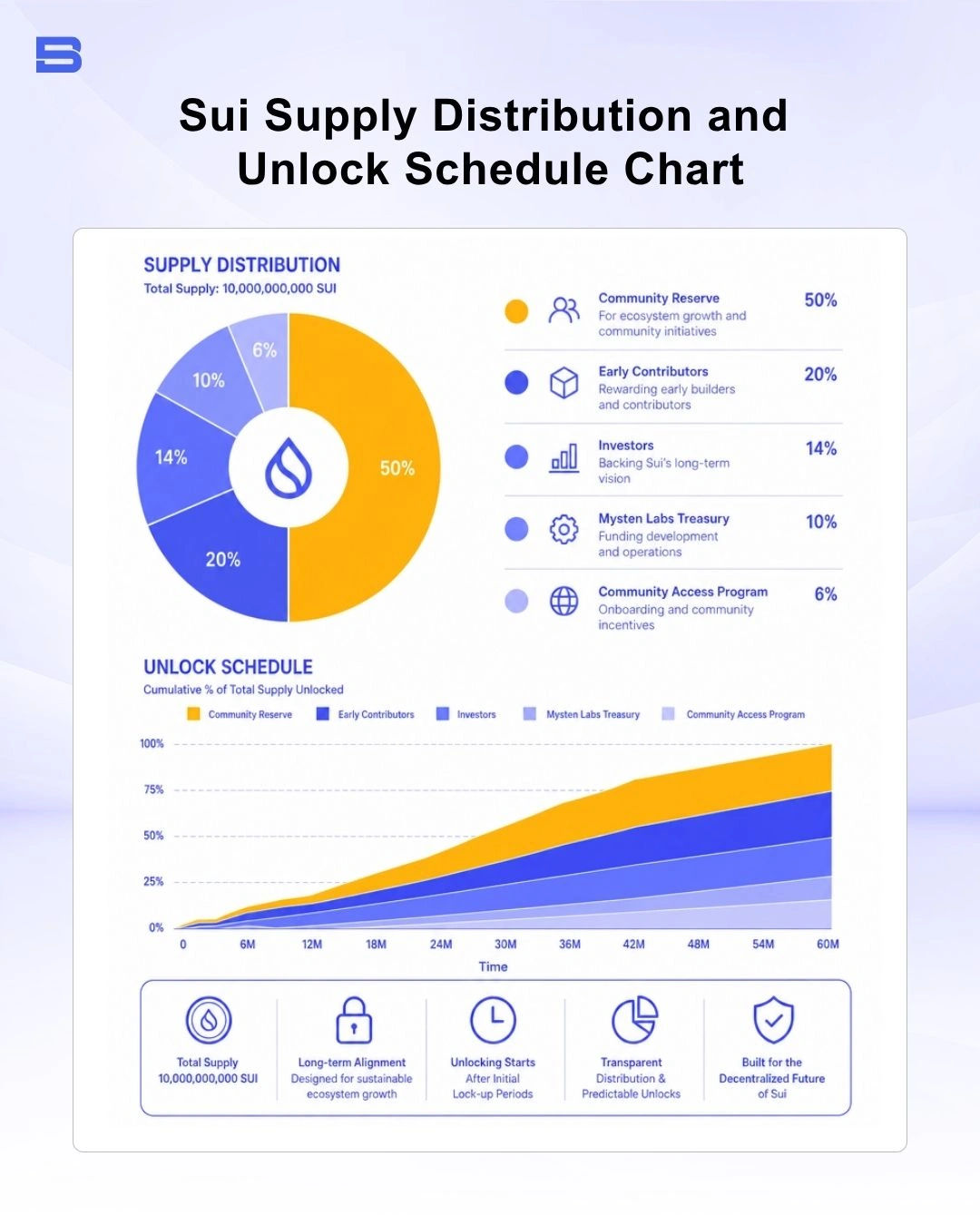
Sui crypto handles transaction fees through a predictable gas pricing mechanism and a dedicated storage fund. Users pay execution fees for computation and a separate storage fee for preserving data on-chain. The storage fund redistributes fees across validators over time, ensuring that current users compensate future node operators for maintaining historical network data.
Evaluating SUI requires weighing staking rewards against the potential dilution from scheduled token releases. At an illustrative 3.5% annual return, staking 1,000 SUI would generate 35 SUI over 12 months. However, 3.5% should be treated as an example rather than the current network-wide rate. SUI has a capped supply of 10 billion tokens, with additional tokens scheduled for release over time, including allocations for early contributors and other ecosystem participants.
SUI is also worth exploring for modern portfolio strategies. Comparing its yield dynamics against traditional macro instruments—such as Gold vs Bitcoin—shows how crypto valuations stay tied to utility and token supply schedules, rather than physical scarcity or a monetary premium.
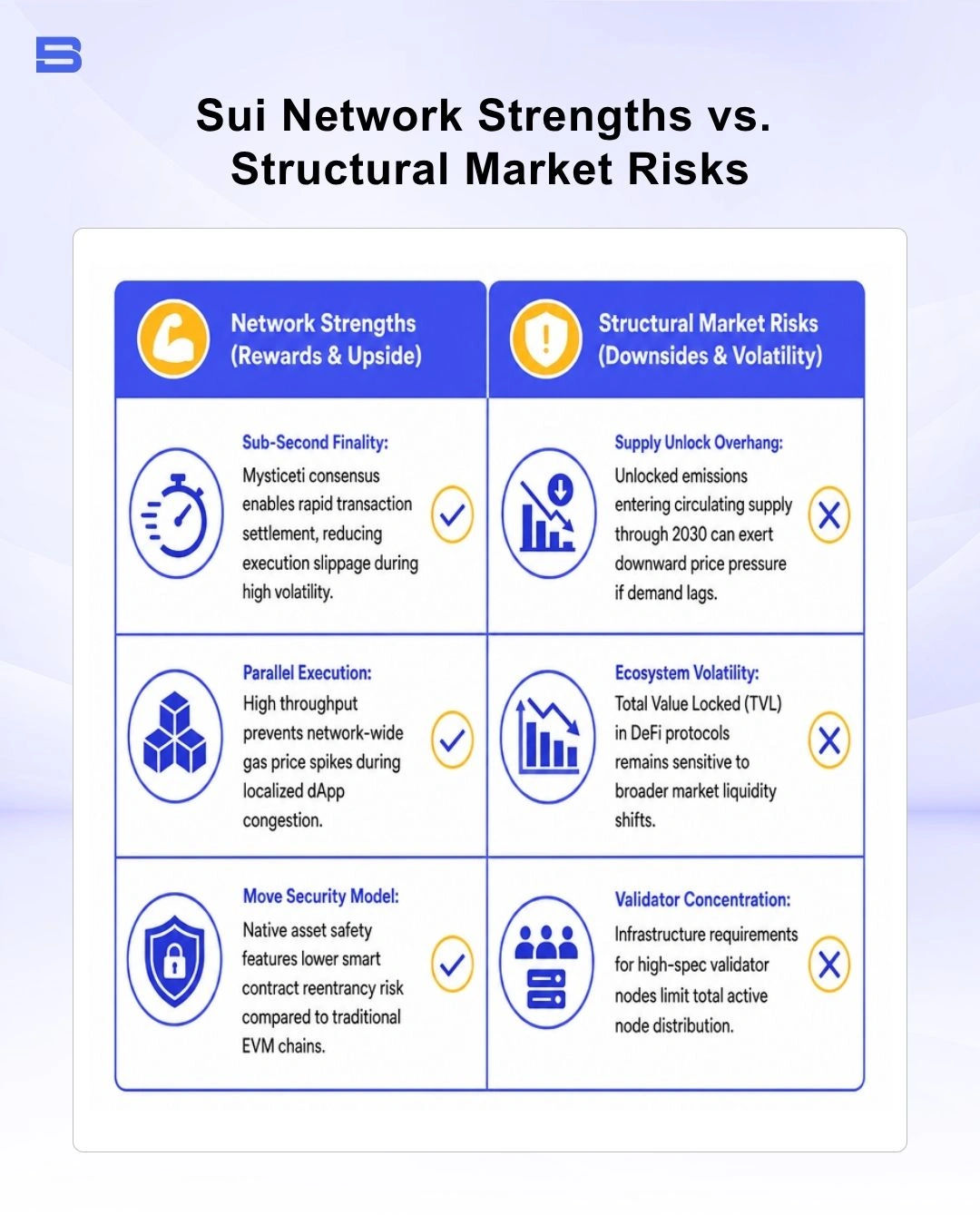
Key Pros and Cons of Sui for Traders
Evaluating SUI requires a balanced view of its technical capabilities alongside its market realities.
How Sui Compares to Aptos and Solana
Sui crypto operates in a competitive segment of high-performance Layer 1 networks. Understanding how its technology compares to alternative high-speed chains helps clarify its relative positioning.
L1 Architecture Comparison
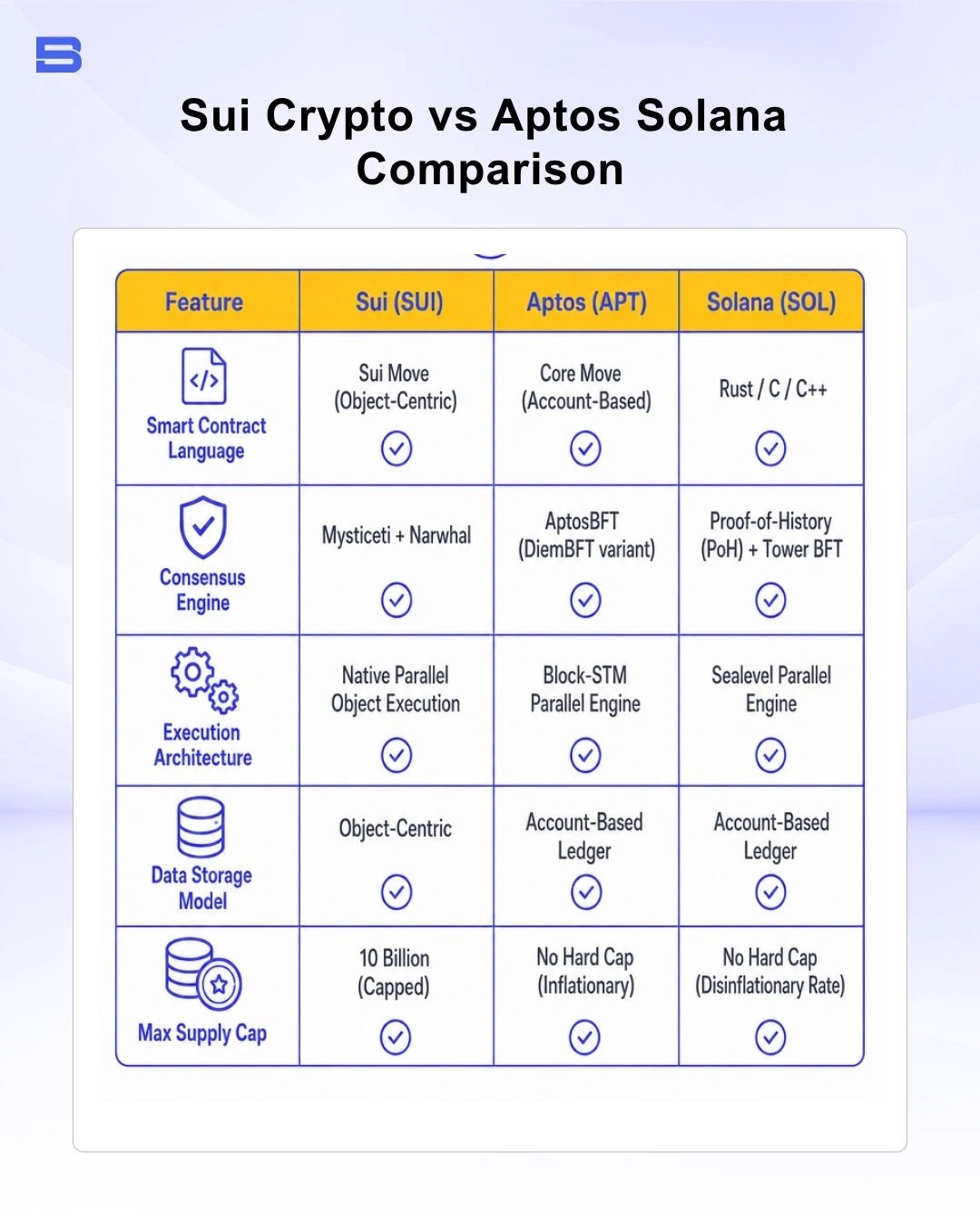
Aptos shares direct historical roots with Sui crypto, as both engineering teams originated from Meta's blockchain research division and leverage Move. However, Aptos utilizes a traditional sequential account model with parallel execution engine extensions, whereas Sui redesigned the underlying data architecture around discrete objects.
Meanwhile, Solana and Near Protocol target similar high-throughput use cases using different architecture choices. Solana achieves high speed through its Proof-of-History timestamping mechanism paired with Rust smart contracts, while Near Protocol utilizes dynamic sharding.
How to Trade SUI: Platforms, Derivatives, and Storage
Trading SUI involves selecting the appropriate venue based on your execution needs, regulatory jurisdiction, and security requirements.
Trading Strategies and Platforms for SUI
You can access SUI through centralized exchanges (CEXs) for spot liquidity or perpetual futures contracts, as well as on-chain decentralized venues. Active traders monitoring market momentum often apply technical principles, much like those used when learning how to trade Bitcoin, to identify key liquidity zones and manage execution risk.
For on-chain execution, Sui features DeepBook, a native central limit order book (CLOB) and liquidity layer built for the Sui ecosystem. DeepBook enables decentralized applications to access shared liquidity and transparent order-book depth, supporting efficient execution and price discovery for traders and DeFi protocols.
When selecting trading venues, traders in Southeast Asia should consult safety guidelines published by local authorities such as the Securities Commission Malaysia (SC) to ensure platform compliance. Storing spot SUI long-term is best managed via self-custodial wallets paired with hardware security modules.
Conclusion
Sui crypto offers a distinct technological framework designed for parallel execution and sub-second transaction finality. By pairing the Move programming language with an object-centric data model, the network resolves major throughput bottlenecks inherent in earlier Layer 1 designs.
However, sustainable value accrual depends on ecosystem adoption outpacing scheduled token unlocks. Traders should carefully weigh execution performance advantages against market risks before allocating capital.
- What Can You Trade? A Guide to Forex, Stocks, and More
- CFD Trading for Beginners
- What is CFD Trading and How Does It Work?
- Forex vs. Stocks: Which Market Suits You Best?
- How to Diversify a Portfolio Across Asset Classes
- How Dividend Stocks Work: Yields, Risks, and Strategies
- Silver Trading Explained: A Guide for Retail Investors
- Precious Metals Trading: A Complete Guide for Beginners
- Natural Gas Trading: A Guide to the Market
- Structured Warrants Malaysia: How They Work and Risks
- What Is the KLCI Index and How to Trade It
- Gold Investment in Malaysia: A Complete Guide for Beginners
- What Is Kijang Emas and How to Invest in It
- Value Investing Explained: How to Find Undervalued Stocks
- How to Trade Bitcoin Safely: A Complete Market Guide
- Growth Investing Explained: Strategies, Metrics, and Risks
- What Is Digital Gold Malaysia and How to Invest
- Crypto Trading Strategies for Beginners
- Gold vs Bitcoin: Key Differences, Risks, and Strategies
- Sukuk: A Guide for Beginners to Islamic Bonds
- What Is FCPO (Crude Palm Oil Futures) and How to Trade It
- How to Identify and Invest in Shariah-Compliant Stocks
- Timber Investment: Is It Worth It?
- Gold ETF Malaysia: A Guide for Beginners
- What Are Malaysian Government Securities (MGS)?
- Corporate Bonds Malaysia: A Guide for Beginners
- China A-Shares Trading Guide for Malaysian Investors
- What Is a Silver ETF and How to Invest in It?
- How to Trade XRP: A Practical Guide for Retail Investors
- How to Trade Solana (SOL): A Guide for Beginners
- What Are Gold Futures and How Do They Work?
- Money Market Fund in Malaysia: A Guide for Beginners
- Property Investment Malaysia: Direct Real Estate or M-REITs?
- What Is Binance Coin and How Does It Work?
- Green Sukuk: A Guide for Beginners to Islamic ESG Investing
- What Is Shiba Inu (SHIB) and How to Trade It
- What Is USDT? A Complete Guide to Tether for Beginners
- What Is Dogecoin and How to Trade It Safely for Beginners
- Cardano: A Guide for Beginners to Trade This Cryptocurrency
- Polkadot: A Guide to Trading This Cryptocurrency
- Tron: A Guide for Beginners to Trading This Cryptocurrency
- What Is Litecoin (LTC)? A Guide to Trading Digital Silver
- What Is Chainlink (LINK) and How to Trade It
- How to Trade Pepe Coin: Spot, Leverage, and Risk Management
- Near Protocol: A Guide to Trading This Cryptocurrency
- Trading Polygon Crypto: A Practical Guide for Beginners
- Trade Toncoin: Understanding the TON Ecosystem and Risks
- Cosmos Crypto: Ecosystem Architecture, Tokenomics, and Risks
- Stellar Crypto: A Guide to Trading This Cryptocurrency
- Avalanche Crypto Explained: A Practical Guide for Traders
- What Is Worldcoin? How to Trade WLD and Manage Risk
- Aptos: A Guide for Beginners to Trading This Cryptocurrency
- Sui Crypto Explained: Tokenomics and Trading Guide
- Celestia: A Guide to Trading This Cryptocurrency
- Decentraland: A Guide to Trading This Cryptocurrency
- What Is Arbitrum? How to Trade the Leading Layer 2 Network
- Sei Crypto: A Guide to Trading This Cryptocurrency
- What Is Injective Protocol and How to Trade INJ Safely
Disclaimer: The content on this page is intended for educational and informational purposes only. It does not constitute financial, investment, tax, or legal advice, and should not be interpreted as a recommendation to buy, sell, or hold any financial instrument or asset. Trading and investing involve significant risk, including the possible loss of your entire capital. Products such as forex, CFDs, and cryptocurrencies carry additional risks due to leverage, high volatility, and limited regulatory protection in some jurisdictions. Past performance of any financial instrument does not guarantee future results. Any market views, forecasts, or opinions expressed are those of the author at the time of writing and may not reflect current market conditions. Platform features, fees, and regulatory status are subject to change — always verify information directly with the relevant provider or regulator before making any financial decision. BrokerSpecs may receive compensation from third parties featured on this site. Always conduct your own due diligence and consider seeking advice from a licensed financial professional before investing.