



Related Tags
Entering the stock market for the first time can feel overwhelming. For Muslim investors, there is an added consideration: ensuring that investment returns, including corporate dividends and capital gains, comply with Islamic principles.
By applying Shariah screening criteria, investors can identify Shariah-compliant stocks that offer opportunities to build wealth while staying aligned with Islamic financial ethics.
What Are Shariah-Compliant Stocks and How Do They Work?
Shariah-compliant stocks are equity shares of publicly traded companies whose core business operations, financial structures, and revenue sources adhere to Islamic jurisprudence. Investing in equities is fundamentally halal in Islam because purchasing a share represents partial ownership in a real enterprise, sharing in its business risks and rewards.
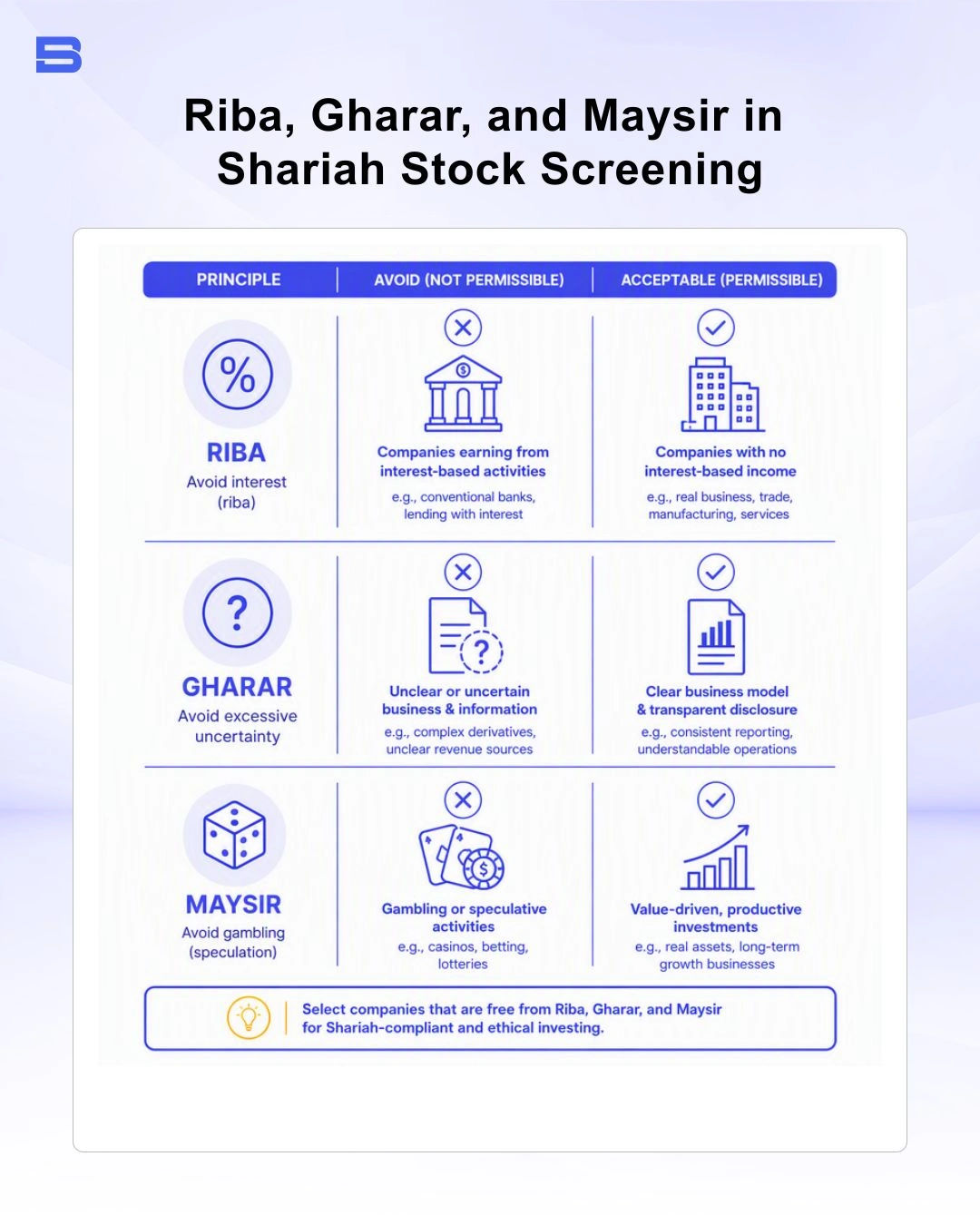
However, not all corporate business models align with Islamic ethics. To remain permissible, an equity investment must avoid three core prohibited elements in Islamic finance:
- Riba (Interest): The paying, receiving, or earning of interest. Islamic principles strictly forbid generating money purely from money without underlying physical assets or real economic activity.
- Gharar (Excessive Uncertainty): Contractual ambiguity or deceit regarding product delivery, pricing, or the existence of assets.
- Maysir (Gambling and Exploitation): Transactions based on pure chance, speculation, or a zero-sum game without real value creation.
Understanding whether a company fits within these boundaries requires an active evaluation of its operations and financial ratios. If you are looking to learn more about basic Islamic trading principles, you can explore our detailed guide on is trading haram.
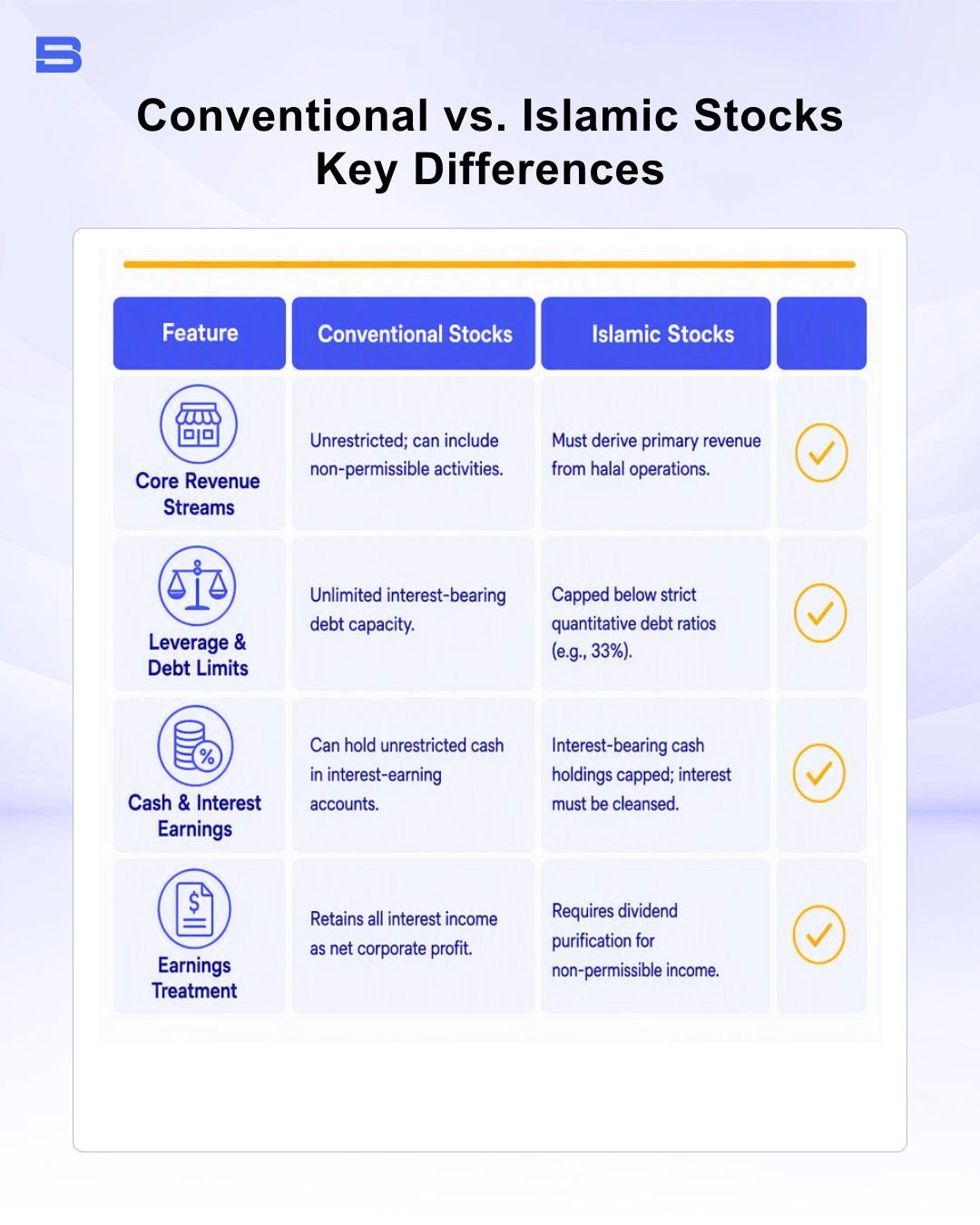
Key Differences Between Conventional and Islamic Stocks
The distinction between conventional equities and Islamic stocks lies primarily in corporate debt structures and business model boundaries. While conventional companies often rely heavily on interest-bearing loans and non-permissible revenue streams to fund expansion, Shariah-screened equities operate within strict operational and financial caps.
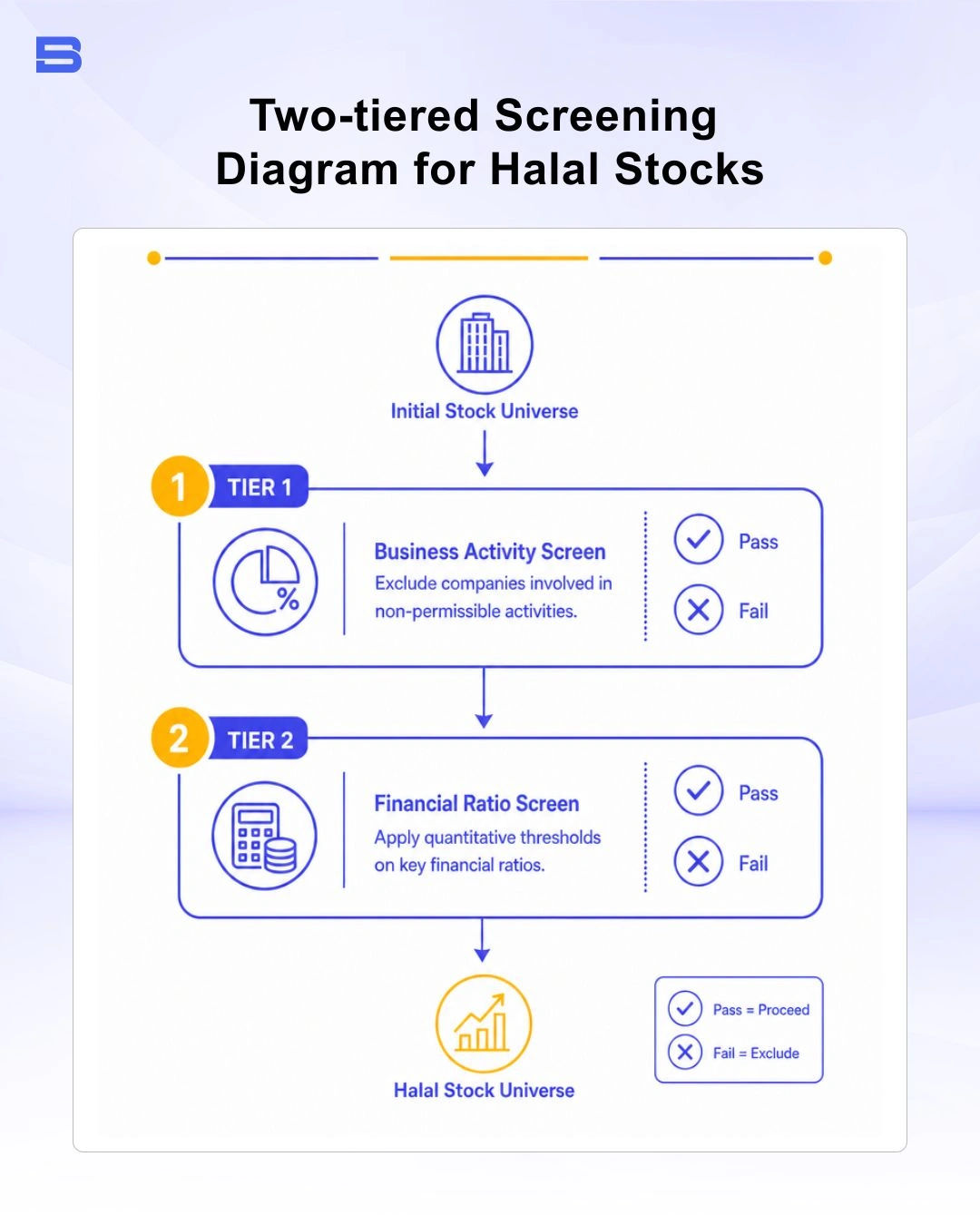
How Screening Works: Business Activity and Financial Ratios
Determining whether a stock is Shariah-compliant requires a structured two-tier screening process. Regulators and Islamic finance screening bodies assess both the company’s core business activities and its financial position to determine whether it qualifies as a Shariah-compliant stock under Islamic investment principles.
Business Activity Screening: The 5% and 20% Rules
The first screening tier reviews corporate revenue streams to ensure non-permissible commercial activities remain within minimal, allowable thresholds. Statutory bodies such as the Securities Commission Malaysia (SC) establish standard business activity benchmarks:
- The 5% Benchmark: Applies to activities strictly prohibited in Islam. Total revenue from conventional banking, interest income, pork production, alcohol, gambling, and non-halal food must not exceed 5% of total corporate revenue.
- The 20% Benchmark: Applies to activities with widespread public usage where mixed elements exist. Total revenue from conventional hotel operations, share brokerage fees, or conventional rental income must remain below 20% of total revenue.
Financial Ratio Benchmarks: Debt, Cash, and Interest Caps
The second screening tier evaluates balance sheet leverage using quantitative ratios such as the Accounting and Auditing Organization for Islamic Financial Institutions (AAOIFI) screening criteria or Morgan Stanley Capital International (MSCI) Islamic Index standards. These limits ensure companies do not rely excessively on interest-bearing structures:
- Interest-Bearing Debt Cap: Conventional interest-bearing debt must not exceed 33% of total assets (or total market capitalization, depending on the standard used).
- Conventional Cash & Liquidity Cap: Cash and interest-bearing deposits held in conventional bank accounts must remain under 33% of total assets.
- Accounts Receivable Cap: Debtors and accounts receivable must stay below a defined threshold (typically 33% to 49% of total assets) to ensure trading reflects real physical assets rather than debt obligations.
Consider a company with $100 million in total assets, $25 million in conventional bank debt (25%), and $3 million in total interest income (3%). Because its leverage stays under 33% and its non-permissible revenue remains below 5%, the company passes quantitative balance sheet screening.
Dividend Purification: Cleaning Non-Permissible Income
Even compliant companies occasionally earn minor interest income on overnight cash deposits held in commercial banks. Dividend purification is the practical process of calculating and removing this non-permissible percentage from your dividend payouts.
Cleanse your investment income by following three simple steps:
- Locate the Purification Percentage: Check the screening report provided by regulatory bodies or Islamic screening apps to find the company's non-permissible income ratio (e.g., 2%).
- Calculate the Non-Permissible Amount: Multiply your total received dividend by that percentage. For instance, if you receive $500 in dividends from a stock with a 2% non-permissible ratio, your cleansing amount is $10 ($500 × 0.02).
- Donate to Charity: Donate the calculated $10 to a charitable cause or public utility without expecting a spiritual or tax benefit.
Building a Balanced Shariah-Compliant Portfolio
Achieving long-term financial security requires diversification across multiple asset classes while maintaining compliance.
How Sukuk and Islamic Exchange-Traded Funds (ETFs) Complement Stock Portfolios
While equities offer long-term capital growth, fixed-income instruments like sukuk (Islamic asset-backed certificates) offer income stability without interest. Combining equities with fixed-income assets and Shariah-compliant ETFs helps manage overall portfolio volatility. Learn how fixed-income asset classes operate in our detailed breakdown of sukuk.
Islamic Unit Trust vs Direct Stock Selection
If you're weighing hands-on stock picking against a managed fund, ask yourself how much time you can realistically dedicate versus letting a professional manager handle it for you. Comparing direct stock management with professional pooled funds like a unit trust in Malaysia helps align your investment execution with your daily schedule.
Liquidity Management with Money Market Funds
Holding cash reserves in conventional checking accounts can expose capital to unwanted interest earnings. Utilizing a Shariah-compliant money market fund in Malaysia ensures your cash buffers yield halal returns while remaining liquid.
Shariah Stocks vs. ESG Investing: Where They Overlap
There is significant alignment between Islamic stock screening and modern ESG investing (Environmental, Social, and Governance). Both frameworks prioritize corporate responsibility, social ethics, and balance-sheet integrity while excluding harmful industries like weapons and gambling. Discover more about ethical frameworks in our guide to ESG investing.
Risks and Limitations of Shariah Stock Investing
While faith-aligned screening offers clear ethical boundaries, investors must navigate specific operational and market risks:
- Sector Concentration Risk: Filtering out conventional financial institutions, insurance providers, and entertainment conglomerates can lead to heavy portfolio concentration in technology, healthcare, and industrial sectors.
- Compliance Status Shifts: Statutory bodies like Bursa Malaysia update Shariah compliance lists semi-annually. A company passing review today may become non-compliant tomorrow if its debt ratios rise above 33%. When a stock becomes non-compliant, investors must execute a structured divestment plan within a designated grace period.
- Liquidity Constraints: Filtering out small-cap stocks with poor cash-to-asset ratios limits the universe of tradable equities, occasionally resulting in wider spreads.
Conclusion
Investing in Shariah-compliant stocks allows Muslim investors to participate in the equity market while staying aligned with Islamic financial principles. By assessing a company’s business activities and financial ratios through Shariah screening, investors can identify suitable opportunities while avoiding prohibited industries and excessive financial risk.
With regular screening and a disciplined investment approach, Shariah-compliant stocks can form part of a diversified portfolio focused on long-term wealth creation and ethical investing.
- What Can You Trade? A Guide to Forex, Stocks, and More
- CFD Trading for Beginners
- What is CFD Trading and How Does It Work?
- Forex vs. Stocks: Which Market Suits You Best?
- How to Diversify a Portfolio Across Asset Classes
- How Dividend Stocks Work: Yields, Risks, and Strategies
- Silver Trading Explained: A Guide for Retail Investors
- Precious Metals Trading: A Complete Guide for Beginners
- Natural Gas Trading: A Guide to the Market
- Structured Warrants Malaysia: How They Work and Risks
- What Is the KLCI Index and How to Trade It
- Gold Investment in Malaysia: A Complete Guide for Beginners
- What Is Kijang Emas and How to Invest in It
- Value Investing Explained: How to Find Undervalued Stocks
- How to Trade Bitcoin Safely: A Complete Market Guide
- Growth Investing Explained: Strategies, Metrics, and Risks
- What Is Digital Gold Malaysia and How to Invest
- Crypto Trading Strategies for Beginners
- Gold vs Bitcoin: Key Differences, Risks, and Strategies
- Sukuk: A Guide for Beginners to Islamic Bonds
- What Is FCPO (Crude Palm Oil Futures) and How to Trade It
- How to Identify and Invest in Shariah-Compliant Stocks
- Timber Investment: Is It Worth It?
- Gold ETF Malaysia: A Guide for Beginners
- What Are Malaysian Government Securities (MGS)?
- Corporate Bonds Malaysia: A Guide for Beginners
- China A-Shares Trading Guide for Malaysian Investors
- What Is a Silver ETF and How to Invest in It?
- How to Trade XRP: A Practical Guide for Retail Investors
- How to Trade Solana (SOL): A Guide for Beginners
- What Are Gold Futures and How Do They Work?
- Money Market Fund in Malaysia: A Guide for Beginners
- Property Investment Malaysia: Direct Real Estate or M-REITs?
- What Is Binance Coin and How Does It Work?
- Green Sukuk: A Guide for Beginners to Islamic ESG Investing
- What Is Shiba Inu (SHIB) and How to Trade It
- What Is USDT? A Complete Guide to Tether for Beginners
- What Is Dogecoin and How to Trade It Safely for Beginners
- Cardano: A Guide for Beginners to Trade This Cryptocurrency
- Polkadot: A Guide to Trading This Cryptocurrency
- Tron: A Guide for Beginners to Trading This Cryptocurrency
- What Is Litecoin (LTC)? A Guide to Trading Digital Silver
- What Is Chainlink (LINK) and How to Trade It
- How to Trade Pepe Coin: Spot, Leverage, and Risk Management
- Near Protocol: A Guide to Trading This Cryptocurrency
- Trading Polygon Crypto: A Practical Guide for Beginners
- Trade Toncoin: Understanding the TON Ecosystem and Risks
- Cosmos Crypto: Ecosystem Architecture, Tokenomics, and Risks
- Stellar Crypto: A Guide to Trading This Cryptocurrency
- Avalanche Crypto Explained: A Practical Guide for Traders
- What Is Worldcoin? How to Trade WLD and Manage Risk
- Aptos: A Guide for Beginners to Trading This Cryptocurrency
- Sui Crypto Explained: Tokenomics and Trading Guide
- Celestia: A Guide to Trading This Cryptocurrency
- Decentraland: A Guide to Trading This Cryptocurrency
- What Is Arbitrum? How to Trade the Leading Layer 2 Network
- Sei Crypto: A Guide to Trading This Cryptocurrency
- What Is Injective Protocol and How to Trade INJ Safely
Disclaimer: The content on this page is intended for educational and informational purposes only. It does not constitute financial, investment, tax, or legal advice, and should not be interpreted as a recommendation to buy, sell, or hold any financial instrument or asset. Trading and investing involve significant risk, including the possible loss of your entire capital. Products such as forex, CFDs, and cryptocurrencies carry additional risks due to leverage, high volatility, and limited regulatory protection in some jurisdictions. Past performance of any financial instrument does not guarantee future results. Any market views, forecasts, or opinions expressed are those of the author at the time of writing and may not reflect current market conditions. Platform features, fees, and regulatory status are subject to change — always verify information directly with the relevant provider or regulator before making any financial decision. BrokerSpecs may receive compensation from third parties featured on this site. Always conduct your own due diligence and consider seeking advice from a licensed financial professional before investing.