


Related Tags
You find an emerging crypto protocol with growing transaction volume, an active online following, and easy-to-use design. Convinced it is fundamentally undervalued, you acquire its native token and expect strong financial gains. Months later, adoption metrics have doubled, yet the token price has steadily dropped by 70%.
This disconnect between protocol usage and token performance usually traces back to tokenomics. Tokenomics represents the underlying mathematical engine that dictates whether user activity translates into capital appreciation or rapid dilution.
What Is Tokenomics and How Does It Work?
Tokenomics is the mathematical architecture governing a cryptocurrency’s issuance, total supply, incentive distribution, and economic utility. It combines "token" and "economics" to describe how digital assets function as independent economic micro-systems.
In traditional finance, sovereign central banks adjust interest rates and print fiat currency to steer economic health. In decentralized finance, immutable smart contracts replace discretionary policy with algorithmic rules. These rules determine exact block issuance schedules, reward allocations, and transactional fee structures from the initial line of code.
Evaluating tokenomics allows you to look past marketing hype and analyze whether a project’s financial design is sustainable. Even a functionally sound decentralized application may struggle to prevent severe price depreciation if its monetary policy rapidly expands the token supply at the expense of secondary market holders.
The Core Components: Utility, Distribution, and Governance
A sustainable tokenomics model requires genuine demand drivers to absorb newly minted tokens. Utility represents the functional justification for holding an asset beyond short-term market speculation.
Tokens typically provide native utility through transaction settlement fees, access tiers, and platform incentives. Many protocols require users to lock assets into a liquidity pool (a shared reserve of tokens that enables automated trading on decentralized exchanges). Others offer yield incentives through staking (locking tokens to help validate a network), so it is essential to understand how staking lockups restrict the supply of immediately liquid tokens.
Equally vital is initial token allocation: how the total supply is divided among founders, private venture funds, development reserves, and the general public. If early insiders control a large share of the initial supply, secondary buyers may face concentrated exposure to early selling.
Furthermore, governance utility gives holders voting power over protocol parameter changes, though governance alone rarely generates sustainable organic buy-side liquidity without underlying fee distribution.
Supply Metrics: Circulating, Total, and Max Supply
Understanding token availability requires separating headline numbers into distinct supply metrics. Circulating supply measures the number of tokens actively tradeable and moving across public markets right now.
In contrast, total supply reflects the total quantity of tokens generated, subtracting coins provably removed or burned from the ledger. Max supply represents the absolute algorithmic cap encoded into the software that can ever exist. Bitcoin enforces a strict max supply of 21 million units, whereas networks like Ethereum operate without a hard cap, instead adjusting active supply dynamically via continuous validation issuance and gas fee burn mechanisms.
Token Emission Models: Inflationary vs. Deflationary Dynamics
Every crypto asset’s tokenomics includes an emission profile that directly impacts holding power over extended market cycles. Inflationary tokens expand their active supply continuously to incentivize network validators, secure consensus, and support ecosystem grants.
When annual issuance outpaces real organic demand, persistent structural selling can emerge as validators liquidate rewards to cover operational compute overhead. This imbalance resembles leveraged perpetual swap markets (contracts with no expiry date), where a periodic payment called the funding rate keeps the contract price close to the spot price. A persistently high funding rate can signal crowded leveraged positions, which may amplify selling pressure if token supply keeps expanding.
Conversely, deflationary mechanics seek to reduce supply over time. The primary mechanisms are token burns, where a percentage of network transaction fees is permanently removed from the ledger, and periodic halving schedules that slash block emissions in half. While deflationary branding sounds enticing, artificial burn mechanisms may not rescue a token if underlying transaction demand deteriorates into illiquidity.
Vesting Schedules and Token Unlocks: Tracking Dilution Risk
A token vesting schedule dictates when restricted tokens allocated to early investors and core team members are legally released and technically unlocked on-chain. Private venture allocations generally feature a cliff period—a complete lockup lasting six to 12 months—followed by linear monthly releases spread across several years.
When substantial lockups expire, large amounts of new supply can enter public order books. If open-market buyer depth is insufficient, these unlocks can create sharp downward price pressure as early seed buyers cash out large paper profits. Global authorities, including the International Organization of Securities Commissions (IOSCO), have flagged insider dealing, conflicts of interest around token issuance and listing, and insufficient disclosure as risks in crypto asset markets.
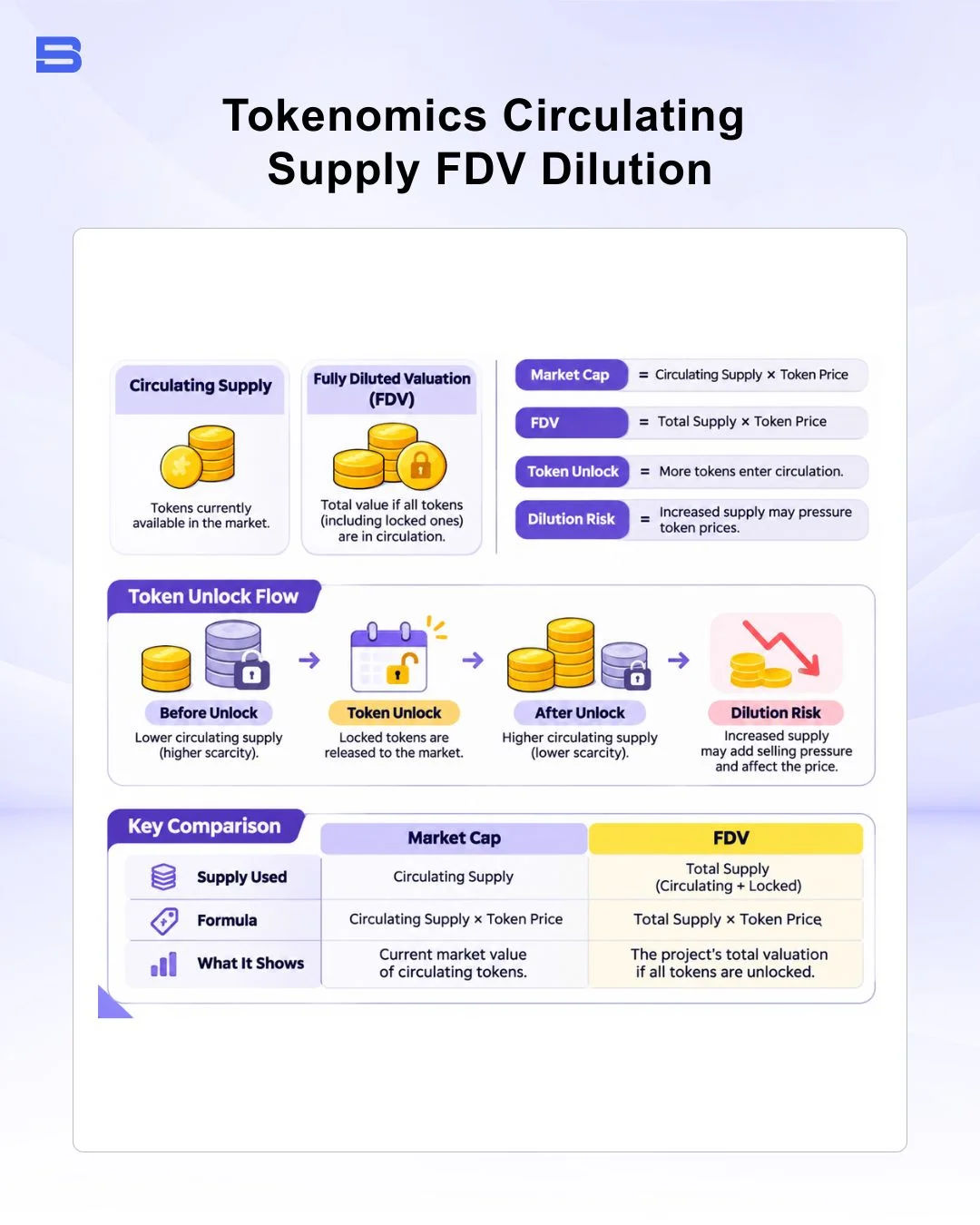
To identify this risk in a project’s tokenomics, compare market capitalization against Fully Diluted Valuation (FDV). Market capitalization equals circulating supply multiplied by current price, while FDV calculates theoretical capitalization if 100% of the max supply were unlocked today.
Consider this concrete scenario: A project launches with an initial circulating supply of 10 million tokens for $1.00, yielding a market capitalization of $10 million. Its max supply, however, is 100 million tokens, translating to an FDV of $100 million.
Over the next 12 months, team and investor vesting unlocks inject 40 million new tokens into circulation, expanding the circulating supply from 10 million to 50 million.
If the broader market valuation remains flat at a constant $10 million market capitalization, the price per token must mathematically adjust downward to absorb the fivefold supply expansion:
Adjusted Price = $10,000,000 / 50,000,000 tokens = $0.20
Even though the protocol’s total network valuation did not decline, your individual tokens lost 80% of their unit value because of insider dilution.
How to Verify a Project’s Tokenomics
Before risking capital on any crypto asset, systematically evaluate its core economic mechanics. You can integrate this assessment alongside proven crypto trading strategies for beginners to align timing with token release cycles.
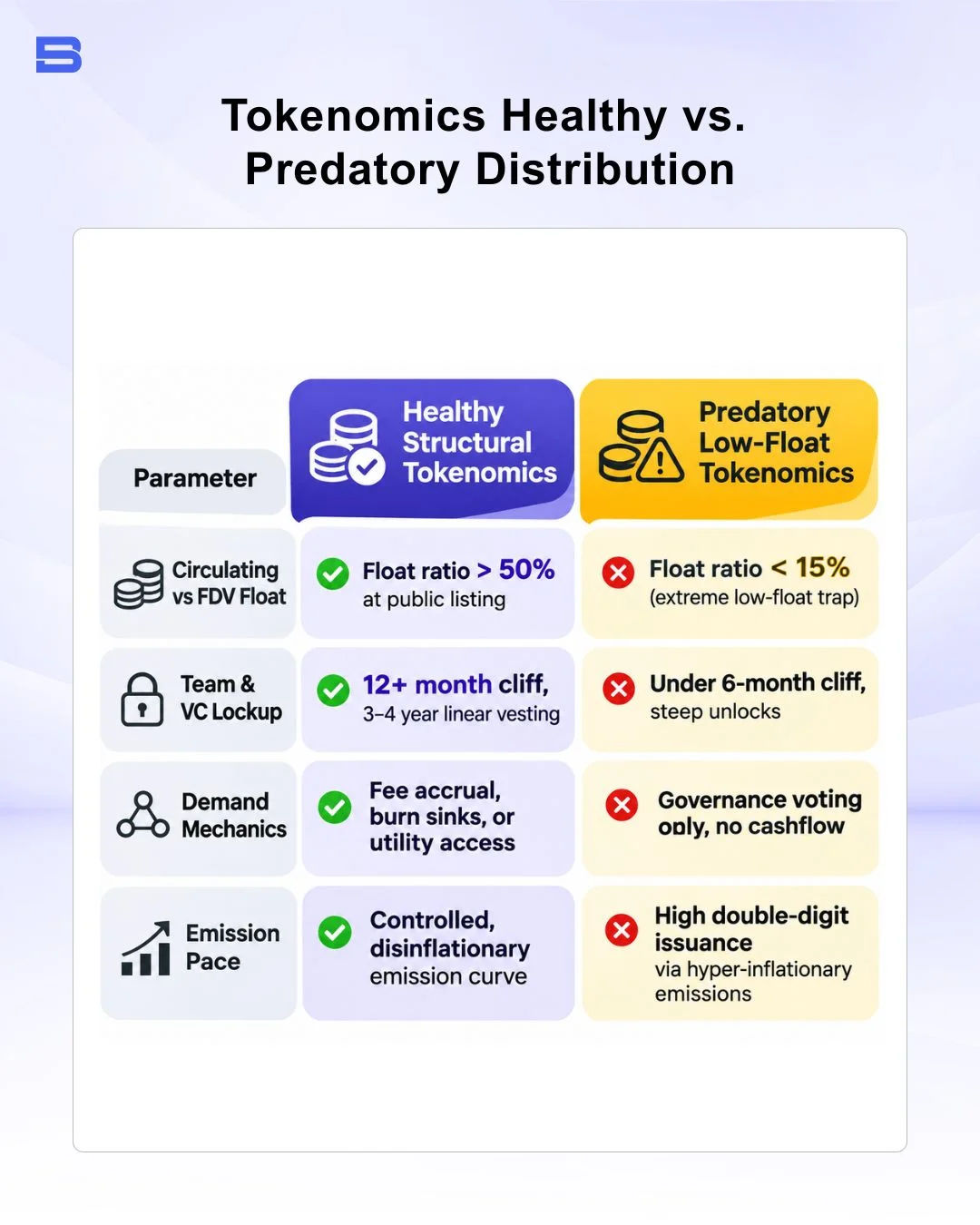
When auditing a project, trace its yield mechanics carefully. Participating in high-yield decentralized applications often requires navigating complex protocols, and understanding the mechanics of yield farming (earning token rewards for supplying assets to a protocol) can help you recognize whether advertised token rewards are backed by actual fee revenue or by unsustainable inflationary minting.
Cross-reference all documentation with independent sources. Review the official whitepaper, trace smart contract unlock wallets on public blockchain explorers, and verify whether the asset is traded on platforms recognized by regional regulators, such as the Securities Commission Malaysia (SC).
Conclusion
A cryptocurrency’s underlying technology represents only one half of its market profile, and its economic architecture can strongly influence its investment survivability. Even well-built software may struggle to overcome the downward drag of a steep emission curve or large insider unlocks. By auditing circulating-to-total supply ratios, mapping team vesting schedules, and demanding authentic protocol utility, you may reduce your exposure to avoidable dilution risk.
- What Can You Trade? A Guide to Forex, Stocks, and More
- CFD Trading for Beginners
- What is CFD Trading and How Does It Work?
- Forex vs. Stocks: Which Market Suits You Best?
- How to Diversify a Portfolio Across Asset Classes
- How Dividend Stocks Work: Yields, Risks, and Strategies
- Silver Trading Explained: A Guide for Retail Investors
- Precious Metals Trading: A Complete Guide for Beginners
- Natural Gas Trading: A Guide to the Market
- Structured Warrants Malaysia: How They Work and Risks
- What Is the KLCI Index and How to Trade It
- Gold Investment in Malaysia: A Complete Guide for Beginners
- What Is Kijang Emas and How to Invest in It
- Value Investing Explained: How to Find Undervalued Stocks
- How to Trade Bitcoin Safely: A Complete Market Guide
- Growth Investing Explained: Strategies, Metrics, and Risks
- What Is Digital Gold Malaysia and How to Invest
- Crypto Trading Strategies for Beginners
- Gold vs Bitcoin: Key Differences, Risks, and Strategies
- Sukuk: A Guide for Beginners to Islamic Bonds
- What Is FCPO (Crude Palm Oil Futures) and How to Trade It
- How to Identify and Invest in Shariah-Compliant Stocks
- Timber Investment: Is It Worth It?
- Gold ETF Malaysia: A Guide for Beginners
- What Are Malaysian Government Securities (MGS)?
- Corporate Bonds Malaysia: A Guide for Beginners
- China A-Shares Trading Guide for Malaysian Investors
- What Is a Silver ETF and How to Invest in It?
- How to Trade XRP: A Practical Guide for Retail Investors
- How to Trade Solana (SOL): A Guide for Beginners
- What Are Gold Futures and How Do They Work?
- Money Market Fund in Malaysia: A Guide for Beginners
- Property Investment Malaysia: Direct Real Estate or M-REITs?
- What Is Binance Coin and How Does It Work?
- Green Sukuk: A Guide for Beginners to Islamic ESG Investing
- What Is Shiba Inu (SHIB) and How to Trade It
- What Is USDT? A Complete Guide to Tether for Beginners
- What Is Dogecoin and How to Trade It Safely for Beginners
- Cardano: A Guide for Beginners to Trade This Cryptocurrency
- Polkadot: A Guide to Trading This Cryptocurrency
- Tron: A Guide for Beginners to Trading This Cryptocurrency
- What Is Litecoin (LTC)? A Guide to Trading Digital Silver
- What Is Chainlink (LINK) and How to Trade It
- How to Trade Pepe Coin: Spot, Leverage, and Risk Management
- Near Protocol: A Guide to Trading This Cryptocurrency
- Trading Polygon Crypto: A Practical Guide for Beginners
- Trade Toncoin: Understanding the TON Ecosystem and Risks
- Cosmos Crypto: Ecosystem Architecture, Tokenomics, and Risks
- Stellar Crypto: A Guide to Trading This Cryptocurrency
- Avalanche Crypto Explained: A Practical Guide for Traders
- What Is Worldcoin? How to Trade WLD and Manage Risk
- Aptos: A Guide for Beginners to Trading This Cryptocurrency
- Sui Crypto Explained: Tokenomics and Trading Guide
- Celestia: A Guide to Trading This Cryptocurrency
- Decentraland: A Guide to Trading This Cryptocurrency
- What Is Arbitrum? How to Trade the Leading Layer 2 Network
- Sei Crypto: A Guide to Trading This Cryptocurrency
- What Is Injective Protocol and How to Trade INJ Safely
Disclaimer: The content on this page is intended for educational and informational purposes only. It does not constitute financial, investment, tax, or legal advice, and should not be interpreted as a recommendation to buy, sell, or hold any financial instrument or asset. Trading and investing involve significant risk, including the possible loss of your entire capital. Products such as forex, CFDs, and cryptocurrencies carry additional risks due to leverage, high volatility, and limited regulatory protection in some jurisdictions. Past performance of any financial instrument does not guarantee future results. Any market views, forecasts, or opinions expressed are those of the author at the time of writing and may not reflect current market conditions. Platform features, fees, and regulatory status are subject to change — always verify information directly with the relevant provider or regulator before making any financial decision. BrokerSpecs may receive compensation from third parties featured on this site. Always conduct your own due diligence and consider seeking advice from a licensed financial professional before investing. Portions of this article were prepared with the assistance of AI tools and reviewed by our editorial team before publication.