



Related Tags
Entering the financial market for the first time can feel overwhelming when Ringgit fluctuations and persistent inflation continually erode your hard-earned cash savings. You want a reliable store of value, but figuring out where to start among physical gold bars, e-wallets, bank accounts, and exchange-traded funds often creates decision paralysis. Gold has long served as a foundational safe-haven asset for investors looking to protect their wealth across generations. This guide breaks down the five core avenues for gold investment in Malaysia so you can choose the strategy that best fits your capital, liquidity needs, and risk profile.
Understanding Options for Gold Investment in Malaysia
Malaysian retail investors historically turn to gold to hedge against local currency depreciation, buffer against systemic market volatility, and achieve strategic portfolio diversification. Gold operates independently of corporate earnings or dividend yields, drawing its intrinsic value from global supply-demand dynamics and market confidence.
Before committing capital, you must understand that gold investment in Malaysia is no longer restricted to storing heavy bullion in home safes. Today, five distinct vehicles exist locally:
- Bank Gold Investment Accounts (GIA): Paper-gold accounts offered by commercial banks for convenient online accumulation.
- Physical Gold Bars, Coins, and Bullion: Direct asset ownership held in your custody or private vaults.
- Digital Gold Apps and E-Wallets: Micro-investing mobile platforms designed for fractional allocations.
- Gold Exchange-Traded Funds (ETFs) Listed on Bursa Malaysia: Shariah-compliant paper-gold securities traded via stockbrokerage accounts.
- Gold Futures Derivatives: Leverage-based trading contracts for short-term tactical positioning.
Choosing the right avenue requires weighing transaction costs, buy-sell spreads, custody risks, and regulatory backing.
Bank Gold Investment Accounts (GIA)
A bank account gold investment in Malaysia allows you to buy, sell, and accumulate gold recorded in grams or ounces without physical possession. You gain financial exposure to prevailing international spot gold prices converted into Ringgit, while the institution acts as the asset custodian.
Leading Malaysian commercial banks offer dedicated paper-gold programs tailored to both conventional and Shariah-compliant preferences:
- Maybank Islamic Gold Account-i (MIGA-i): A Shariah-compliant account allowing digital gold purchases starting from as low as RM10. It features physical gold conversion options if you wish to redeem your paper holdings for physical bars.
- CIMB e-Gold Investment Account (CIMB eGIA): Enables seamless online buying and selling via CIMB Clicks, tracking international gold spot movements daily with minimum entry allocations from 1 gram.
- Public Bank e-Gold Investment Account (PBB eGIA): Provides transparent pricing linked to international market rates, catering to conservative savers seeking systematic monthly accumulation.
- UOB Gold Savings Account: An established conventional option offering gold-backed paper investment without interest returns or physical delivery fees.
Physical Gold Bars, Coins, and Bullion
Direct ownership of physical gold remains a traditional favorite for investors who prioritize full asset custody free from counterparty risk. When you buy physical gold, you pay a premium above the live spot price to cover refining, minting, distribution, and vendor margins.
Established local dealers and jewellers serve the Malaysian physical market:
- Public Gold: Offers an extensive range of investment-grade gold bars and Dinar coins, featuring a buy-back policy across nationwide branches.
- Habib Jewels & Poh Kong: Premium jewelers supplying investment bullion bars (such as Bunga Raya bars) alongside retail gold jewelry. Note that retail jewelry carries significantly higher craftsmanship fees (workmanship costs) and wider spreads, making standard bullion bars far better suited for wealth preservation.
Bank Negara Malaysia Kijang Emas and Minted Bullion
The Kijang Emas is the official Malaysian gold bullion coin issued by Bank Negara Malaysia and minted by the Royal Mint of Malaysia. Available in 1 oz, 1/2 oz, and 1/4 oz denominations, it can be purchased directly through designated Maybank branches.
Physical gold ownership introduces storage and security costs. Storing high-value bullion at home exposes investors to theft and loss risks, while renting a safe-deposit box involves recurring fees that can reduce overall investment returns. Smaller gold bars can also carry relatively wide buy-sell spreads.
For example, Public Gold’s listed 5g 24K gold bar showed a spread of about 9% based on its RM2,876 selling price and RM2,617 buyback price on 29 July 2026. Other Malaysian bullion dealers, such as Habib Jewels, list spreads above 10% for some 1g products.
Digital Gold Apps and E-Wallets in Malaysia
Digital gold platforms cater to micro-investors by allowing physical-backed gold purchases through mobile applications starting from minimal capital thresholds. Digital gold in Malaysia has grown popular thanks to low entry minimums like RM10.
Popular retail platforms include:
- Touch 'n Go e-Mas: Integrated directly into the TNG eWallet ecosystem, enabling micro-purchases starting from just RM10.
- Wahed Gold: Offered within the Securities Commission Malaysia (SC)-regulated Wahed Invest robo-advisory app, holding 999.9 fine physical gold allocated safely in secure vaults.
Bursa Gold Dinar App
Launched by Bursa Malaysia, the Bursa Gold Dinar app represents a Shariah-compliant digital gold platform tailored for retail investors.
- Entry Minimums: Start investing with as little as RM10.
- Trading Hours: Extended digital trading accessibility throughout the week.
- Physical Redemption: Option to convert accumulated digital balances into physically minted Bursa Gold Dinar coins, delivered to your address or collected at authorized hubs.
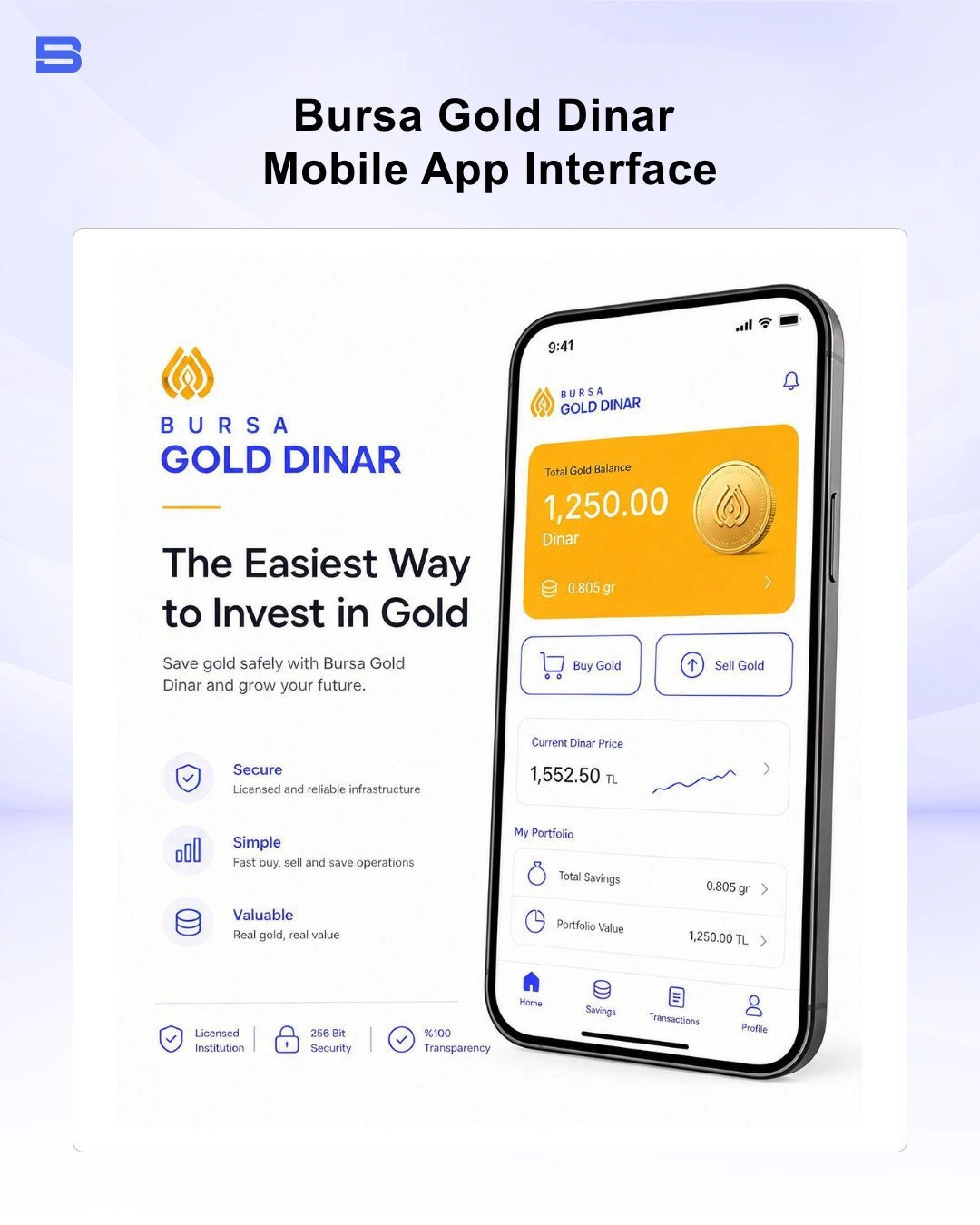
While digital gold offers exceptional entry accessibility, always check underlying management fees and spread markups embedded within the platform's quote rates.
Gold ETFs Listed on Bursa Malaysia
For investors seeking exchange-traded market access, gold exchange-traded funds (ETFs) offer paper-gold exposure directly through a standard stockbrokerage account. Trading an ETF mirrors buying equity stock units on the stock market.
The primary gold ETF in Malaysia is the TradePlus Shariah Gold Tracker (Stock Code: 0828EA), listed on Bursa Malaysia:
- Structure: It is an open-ended fund backed by physical gold bars securely vaulted in Singapore.
- Shariah Compliance: Fully audited and vetted by appointed Shariah advisors.
- Cost Efficiency: Tracks international spot gold prices without requiring you to pay personal insurance or home storage fees. Annual management fees remain low, at approximately 0.50% per annum, according to AHAM Asset Management's TradePlus fund fact sheet.
Trading gold ETFs via a CDS (Central Depository System) account incurs standard stockbroker transaction commissions and clearing fees rather than heavy retail buy-sell spreads. Brokerage commissions often fall below 0.30% (subject to minimum transaction charges), based on standard equity brokerage rate cards published by Bursa Malaysia-registered stockbrokers.
Comparing Gold Avenues: Spreads, Liquidity, and Risk
Selecting the ideal method of gold investment in Malaysia depends on balancing your available capital, preferred investment horizon, and tolerance for bid-ask spreads.
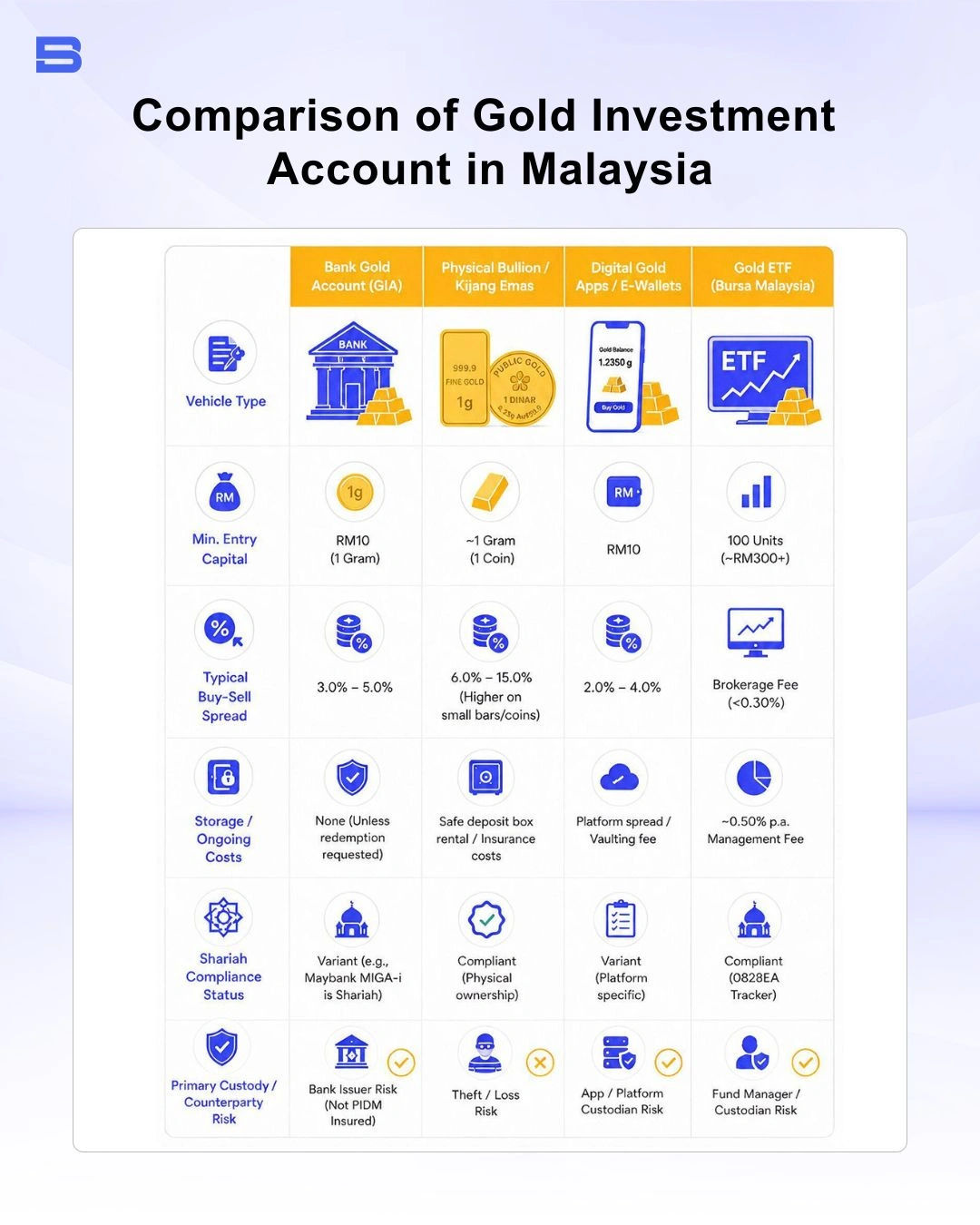
Buy-sell spreads act as a hidden drag on short-term profitability. If a physical bar carries an 11% spread, gold prices must appreciate by 11% simply for your investment to reach its break-even threshold. For long-term capital preservation, lower-spread vehicles like gold ETFs or large-bar bullion provide better net compounding efficiency.
Alternative Gold & Precious Metal Derivatives
Tactical traders seeking short-term exposure to intraday volatility often utilize derivatives rather than holding physical or spot gold allocations.
- Bursa Malaysia Derivatives (FGLD): The Gold Futures (FGLD) contract offers Ringgit-denominated leveraged exposure to international spot gold prices. Futures trading uses margin leverage, enabling larger market exposure relative to initial deposit requirements.
- Spot Over-The-Counter CFDs: These are international derivative contracts that allow speculation on gold price swings in both rising and falling markets. Leveraged derivative positions carry high risk; a sudden 5% market move against a 20:1 leveraged position can liquidate your allocated margin buffer entirely.
Traders looking to diversify across the broader precious metals complex often evaluate silver trading or platinum derivatives, which exhibit higher price volatility due to combined industrial and investment demand.
Conclusion
Allocating 5% to 10% of a balanced multi-asset portfolio to gold can effectively cushion your wealth against severe market downturns and currency erosion. Rather than treating gold as a speculative get-rich-quick instrument, view it as a long-term capital preservation tool. Assess your personal risk tolerance, evaluate transaction spreads carefully, and choose the investment vehicle that aligns cleanly with your broader financial objectives.
- What Can You Trade? A Guide to Forex, Stocks, and More
- CFD Trading for Beginners
- What is CFD Trading and How Does It Work?
- Forex vs. Stocks: Which Market Suits You Best?
- How to Diversify a Portfolio Across Asset Classes
- How Dividend Stocks Work: Yields, Risks, and Strategies
- Silver Trading Explained: A Guide for Retail Investors
- Precious Metals Trading: A Complete Guide for Beginners
- Natural Gas Trading: A Guide to the Market
- Structured Warrants Malaysia: How They Work and Risks
- What Is the KLCI Index and How to Trade It
- Gold Investment in Malaysia: A Complete Guide for Beginners
- What Is Kijang Emas and How to Invest in It
- Value Investing Explained: How to Find Undervalued Stocks
- How to Trade Bitcoin Safely: A Complete Market Guide
- Growth Investing Explained: Strategies, Metrics, and Risks
- What Is Digital Gold Malaysia and How to Invest
- Crypto Trading Strategies for Beginners
- Gold vs Bitcoin: Key Differences, Risks, and Strategies
- Sukuk: A Guide for Beginners to Islamic Bonds
- What Is FCPO (Crude Palm Oil Futures) and How to Trade It
- How to Identify and Invest in Shariah-Compliant Stocks
- Timber Investment: Is It Worth It?
- Gold ETF Malaysia: A Guide for Beginners
- What Are Malaysian Government Securities (MGS)?
- Corporate Bonds Malaysia: A Guide for Beginners
- China A-Shares Trading Guide for Malaysian Investors
- What Is a Silver ETF and How to Invest in It?
- How to Trade XRP: A Practical Guide for Retail Investors
- How to Trade Solana (SOL): A Guide for Beginners
- What Are Gold Futures and How Do They Work?
- Money Market Fund in Malaysia: A Guide for Beginners
- Property Investment Malaysia: Direct Real Estate or M-REITs?
- What Is Binance Coin and How Does It Work?
- Green Sukuk: A Guide for Beginners to Islamic ESG Investing
- What Is Shiba Inu (SHIB) and How to Trade It
- What Is USDT? A Complete Guide to Tether for Beginners
- What Is Dogecoin and How to Trade It Safely for Beginners
- Cardano: A Guide for Beginners to Trade This Cryptocurrency
- Polkadot: A Guide to Trading This Cryptocurrency
- Tron: A Guide for Beginners to Trading This Cryptocurrency
- What Is Litecoin (LTC)? A Guide to Trading Digital Silver
- What Is Chainlink (LINK) and How to Trade It
- How to Trade Pepe Coin: Spot, Leverage, and Risk Management
- Near Protocol: A Guide to Trading This Cryptocurrency
- Trading Polygon Crypto: A Practical Guide for Beginners
- Trade Toncoin: Understanding the TON Ecosystem and Risks
- Cosmos Crypto: Ecosystem Architecture, Tokenomics, and Risks
- Stellar Crypto: A Guide to Trading This Cryptocurrency
- Avalanche Crypto Explained: A Practical Guide for Traders
- What Is Worldcoin? How to Trade WLD and Manage Risk
- Aptos: A Guide for Beginners to Trading This Cryptocurrency
- Sui Crypto Explained: Tokenomics and Trading Guide
- Celestia: A Guide to Trading This Cryptocurrency
- Decentraland: A Guide to Trading This Cryptocurrency
- What Is Arbitrum? How to Trade the Leading Layer 2 Network
- Sei Crypto: A Guide to Trading This Cryptocurrency
- What Is Injective Protocol and How to Trade INJ Safely
Disclaimer: The content on this page is intended for educational and informational purposes only. It does not constitute financial, investment, tax, or legal advice, and should not be interpreted as a recommendation to buy, sell, or hold any financial instrument or asset. Trading and investing involve significant risk, including the possible loss of your entire capital. Products such as forex, CFDs, and cryptocurrencies carry additional risks due to leverage, high volatility, and limited regulatory protection in some jurisdictions. Past performance of any financial instrument does not guarantee future results. Any market views, forecasts, or opinions expressed are those of the author at the time of writing and may not reflect current market conditions. Platform features, fees, and regulatory status are subject to change — always verify information directly with the relevant provider or regulator before making any financial decision. BrokerSpecs may receive compensation from third parties featured on this site. Always conduct your own due diligence and consider seeking advice from a licensed financial professional before investing.