


Related Tags
You are looking for international payment settlement speed compared to traditional banking lag. Sending money across borders often feels like stepping back into the 20th century, with wire transfers taking days to settle while racking up hefty intermediary fees. XRP was designed specifically to address this friction, functioning as a fast, high-liquidity digital asset tailored for institutional cross-border settlement rather than speculative retail hype.
What Is XRP and How Does It Differ From Ripple?
XRP is an open-source, decentralized cryptographic digital asset natively deployed on the XRP Ledger. It serves primarily as a bridge currency to facilitate efficient, low-cost liquidity transfers across different fiat assets globally.
To trade XRP effectively, you must first separate the digital token from Ripple Labs. Ripple Labs is a private financial technology software company that develops payment solutions for corporate banking networks. XRP, by contrast, is an independent cryptocurrency operating on a public blockchain network. While Ripple Labs uses XRP within its enterprise products, the company does not directly control the decentralized ledger itself.
The Technology Behind the XRP Ledger
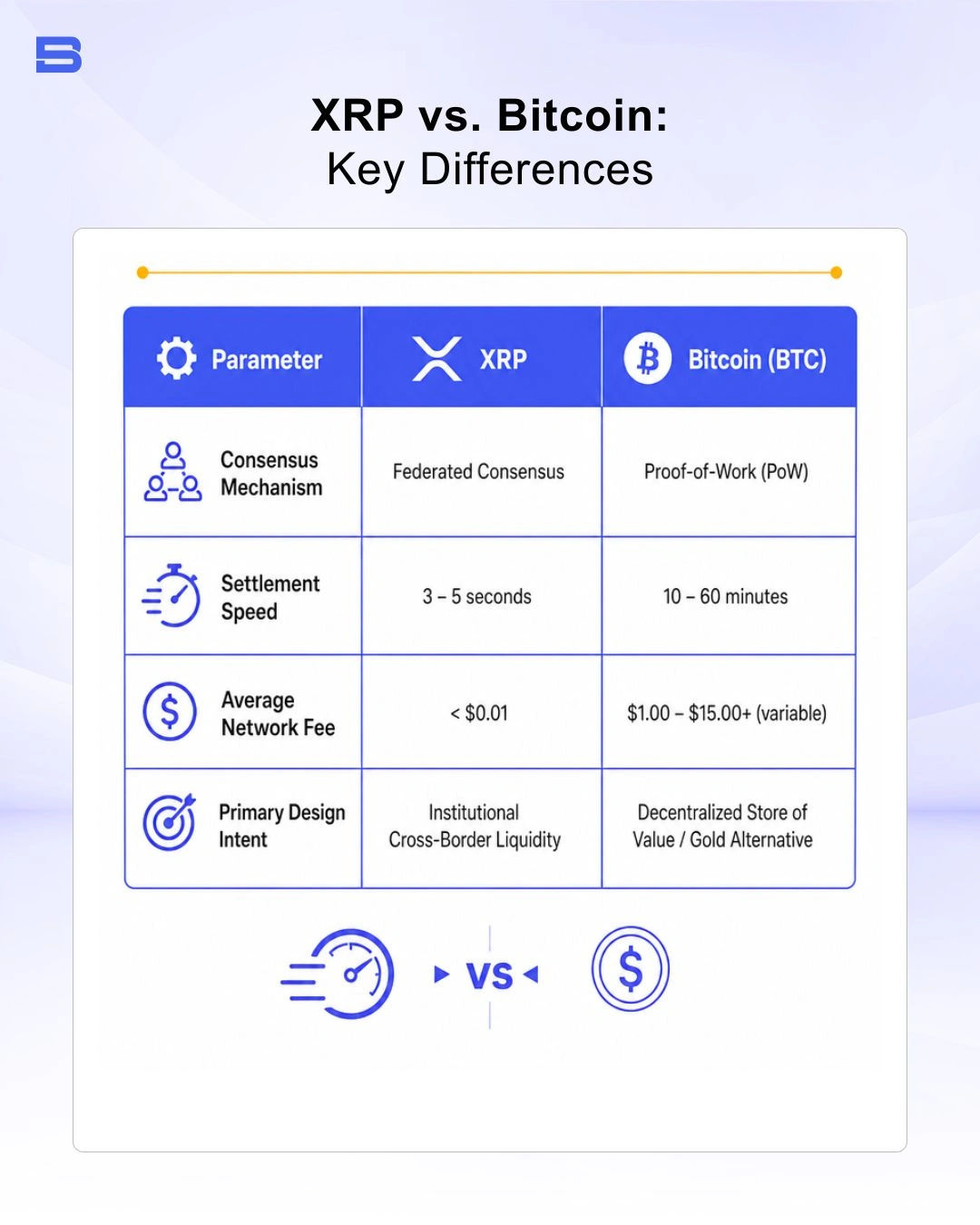
Unlike Bitcoin’s Proof-of-Work and Ethereum’s Proof-of-Stake, the XRP Ledger uses a distinct Federated Consensus mechanism to validate transactions. Independent validator nodes reach agreement on transaction data without relying on energy-intensive mining, offering a different blockchain architecture for users exploring digital assets, including Ethereum Malaysia.
According to the XRP Ledger's official documentation, the consensus protocol typically achieves transaction finality within 3 to 5 seconds and can process up to 1,500 transactions per second, with average network fees amounting to a fraction of a cent, making high-frequency settlement viable.
Institutional Use Cases and Settlement
At an enterprise level, financial institutions utilize XRP through On-Demand Liquidity (ODL) payment frameworks. Instead of holding pre-funded fiat accounts in target foreign jurisdictions—which ties up capital—institutions convert local fiat into XRP, transfer the token instantly across the XRP Ledger, and convert it into the recipient currency.
XRP Market Dynamics and Liquidity
XRP ranks among the largest cryptocurrencies by market capitalization, offering deep liquidity across major global exchanges. High trading volume ensures tight bid-ask spreads, allowing traders to execute market orders with minimal slippage.
When trading XRP, positions are primarily quoted against stablecoins like Tether or traditional fiat pairs such as the US dollar (USD) and Euro (EUR). Regulatory developments have historically introduced significant price volatility to the asset. Following prolonged legal scrutiny from the US Securities and Exchange Commission (SEC) regarding token classification, key judicial rulings provided enhanced legal clarity, though regulatory policy shifts worldwide continue to influence short-term price dynamics.
Comparing Crypto Trading Mechanics: XRP vs Bitcoin
When comparing execution mechanics between assets, XRP and Bitcoin serve fundamentally different market functions. While Bitcoin operates primarily as a decentralized store of value, XRP functions as a specialized payment routing tool.
Understanding these differences can help traders develop informed strategies when learning how to trade Bitcoin alongside other cryptocurrencies.
XRP vs Alternative Layer-1 Assets (Solana, Cardano)
XRP is frequently compared against smart-contract platforms like Solana and Cardano, yet their architectural priorities diverge significantly.
Solana and Cardano prioritize hosting complex decentralized applications (dApps), non-fungible tokens (NFTs), and yield-generating decentralized finance (DeFi) protocols. XRP's primary design remains optimized for streamlined value transfer and liquidity bridging. Consequently, smart-contract platforms carry risks tied to software bugs and network congestion, whereas XRP's primary operational risks revolve around institutional adoption rates and global financial compliance rules.
Accessing Digital Assets: Local Exchange and CFD Options
Retail traders in Southeast Asia and Malaysia can access XRP through two primary execution pathways: spot cryptocurrency exchanges registered with local regulators such as the Securities Commission Malaysia (SC), or global derivative platforms offering Contracts for Difference (CFDs).
Spot Trading vs CFD Trading on XRP
Spot trading involves purchasing the actual underlying XRP tokens, which you can store securely in a private digital wallet or sell on an exchange spot market. CFD trading, by contrast, allows you to speculate on XRP price movements without taking physical delivery of the token.
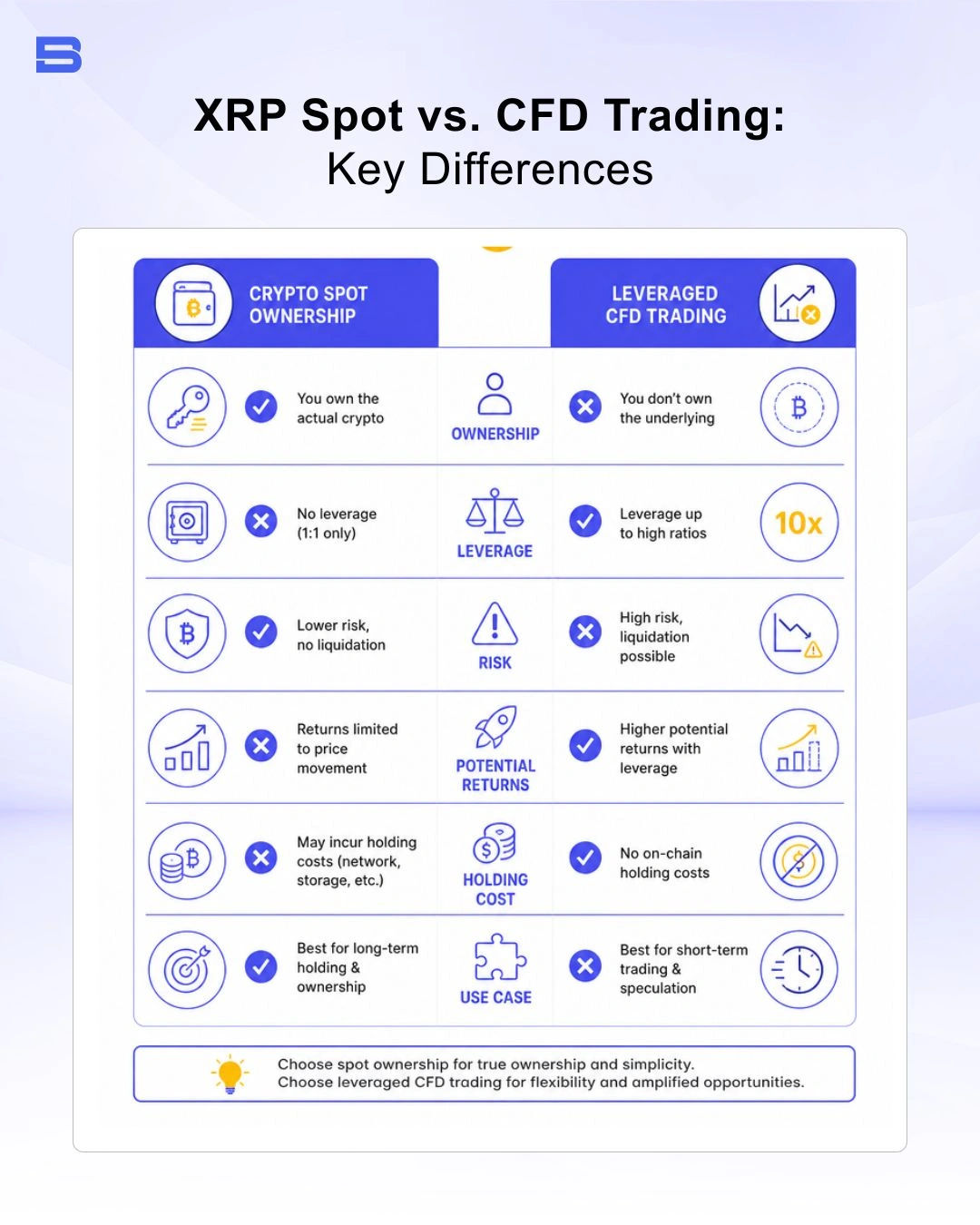
CFDs often provide access to financial leverage, allowing you to control a larger market exposure with a smaller initial deposit (margin). While leverage amplifies potential profits when the market moves in your favor, it accelerates capital losses just as quickly when price trends reverse against your position.
Consider a $1,000 margin allocation on an XRP CFD position using 1:2 leverage, giving you $2,000 in total market exposure. If the price of XRP rises by 10%, your position gains $200—yielding a 20% return on your invested margin. Conversely, if XRP falls by 10%, your position loses $200, representing a 20% loss of your account capital. If price volatility triggers an extended downward move without an active stop-loss, margin depletion can lead to rapid position liquidation.
The Bottom Line
Trading XRP requires a clear understanding of its distinct design as a payment settlement bridge rather than a general-purpose smart-contract network. Whether you hold spot tokens on a regulated exchange or trade price movements through derivative instruments, implementing robust risk management—including strict stop-loss orders and defensive leverage usage—is vital to navigating crypto market volatility safely.
- What Can You Trade? A Guide to Forex, Stocks, and More
- CFD Trading for Beginners
- What is CFD Trading and How Does It Work?
- Forex vs. Stocks: Which Market Suits You Best?
- How to Diversify a Portfolio Across Asset Classes
- How Dividend Stocks Work: Yields, Risks, and Strategies
- Silver Trading Explained: A Guide for Retail Investors
- Precious Metals Trading: A Complete Guide for Beginners
- Natural Gas Trading: A Guide to the Market
- Structured Warrants Malaysia: How They Work and Risks
- What Is the KLCI Index and How to Trade It
- Gold Investment in Malaysia: A Complete Guide for Beginners
- What Is Kijang Emas and How to Invest in It
- Value Investing Explained: How to Find Undervalued Stocks
- How to Trade Bitcoin Safely: A Complete Market Guide
- Growth Investing Explained: Strategies, Metrics, and Risks
- What Is Digital Gold Malaysia and How to Invest
- Crypto Trading Strategies for Beginners
- Gold vs Bitcoin: Key Differences, Risks, and Strategies
- Sukuk: A Guide for Beginners to Islamic Bonds
- What Is FCPO (Crude Palm Oil Futures) and How to Trade It
- How to Identify and Invest in Shariah-Compliant Stocks
- Timber Investment: Is It Worth It?
- Gold ETF Malaysia: A Guide for Beginners
- What Are Malaysian Government Securities (MGS)?
- Corporate Bonds Malaysia: A Guide for Beginners
- China A-Shares Trading Guide for Malaysian Investors
- What Is a Silver ETF and How to Invest in It?
- How to Trade XRP: A Practical Guide for Retail Investors
- How to Trade Solana (SOL): A Guide for Beginners
- What Are Gold Futures and How Do They Work?
- Money Market Fund in Malaysia: A Guide for Beginners
- Property Investment Malaysia: Direct Real Estate or M-REITs?
- What Is Binance Coin and How Does It Work?
- Green Sukuk: A Guide for Beginners to Islamic ESG Investing
- What Is Shiba Inu (SHIB) and How to Trade It
- What Is USDT? A Complete Guide to Tether for Beginners
- What Is Dogecoin and How to Trade It Safely for Beginners
- Cardano: A Guide for Beginners to Trade This Cryptocurrency
- Polkadot: A Guide to Trading This Cryptocurrency
- Tron: A Guide for Beginners to Trading This Cryptocurrency
- What Is Litecoin (LTC)? A Guide to Trading Digital Silver
- What Is Chainlink (LINK) and How to Trade It
- How to Trade Pepe Coin: Spot, Leverage, and Risk Management
- Near Protocol: A Guide to Trading This Cryptocurrency
- Trading Polygon Crypto: A Practical Guide for Beginners
- Trade Toncoin: Understanding the TON Ecosystem and Risks
- Cosmos Crypto: Ecosystem Architecture, Tokenomics, and Risks
- Stellar Crypto: A Guide to Trading This Cryptocurrency
- Avalanche Crypto Explained: A Practical Guide for Traders
- What Is Worldcoin? How to Trade WLD and Manage Risk
- Aptos: A Guide for Beginners to Trading This Cryptocurrency
- Sui Crypto Explained: Tokenomics and Trading Guide
- Celestia: A Guide to Trading This Cryptocurrency
- Decentraland: A Guide to Trading This Cryptocurrency
- What Is Arbitrum? How to Trade the Leading Layer 2 Network
- Sei Crypto: A Guide to Trading This Cryptocurrency
- What Is Injective Protocol and How to Trade INJ Safely
Disclaimer: The content on this page is intended for educational and informational purposes only. It does not constitute financial, investment, tax, or legal advice, and should not be interpreted as a recommendation to buy, sell, or hold any financial instrument or asset. Trading and investing involve significant risk, including the possible loss of your entire capital. Products such as forex, CFDs, and cryptocurrencies carry additional risks due to leverage, high volatility, and limited regulatory protection in some jurisdictions. Past performance of any financial instrument does not guarantee future results. Any market views, forecasts, or opinions expressed are those of the author at the time of writing and may not reflect current market conditions. Platform features, fees, and regulatory status are subject to change — always verify information directly with the relevant provider or regulator before making any financial decision. BrokerSpecs may receive compensation from third parties featured on this site. Always conduct your own due diligence and consider seeking advice from a licensed financial professional before investing.