



Related Tags
Proprietary trading firms, often called prop firms, have seen sudden growth in popularity over the past few years. The sales talk is incredibly captivating, like “prove you can trade, and we’ll give you a hundred thousand dollars. You keep 90% of the profits; we’ll take on the risk.” With such a tempting offer, many traders will fall for this kind of marketing.
It sounds like too good an offer, especially for retail traders. But let’s be real; there’s no such thing as a free lunch. First, let’s pull back the curtain and see if prop firms are actually right for you.
What is Prop Trading?
Prop trading is an activity in which financial institutions invest their own capital to profit directly from market movements, rather than relying on thin profit margins through client commissions. This can span a wide range of financial instruments you can trade, including stocks, bonds, currencies, and commodities.
The concept can be divided into two primary categories:
Traditional Institutional Prop Trading
Banks and hedge funds set aside their own capital to give priority to internal teams that trade stocks, bonds, currencies, and commodities for profits. The objective is to generate higher returns through complex strategies like statistical arbitrage or market-making.
Retail Prop Firms
It allows you to trade using the firm’s funds remotely through its online prop firms. You usually need to pay upfront evaluation fees to pass the process that demonstrates you can reach the profit targets while managing risk.
It’s important to differentiate between the two categories so that you know if a prop firm suits you.
Benefits of Proprietary Trading
Proprietary trading offers massive benefits over traditional commission-based trading from the perspectives of major financial institutions and retail traders.
Here are the key benefits of prop trading:
Access to Massive Capital
Instead of being held in a small personal account, you can use the firm’s capital to scale position size and pull in much larger profits.
High Profit Splits
Most prop firms let you keep the share of your gains. However, profit splits usually range from 70% to 90% in favor of the trader.
Built-in Risk Management
Prop firms implement strict risk parameters, stop-loss orders, and extensive risk management frameworks that protect your account and the firm’s bottom line.
Advanced Technology and Infrastructure
You can benefit from high-speed execution and advanced algorithms, as well as observe real-time data feeds that are usually too expensive for retail traders to subscribe to.
Diversification and Hedging
Prop trading offers financial institutions an additional profit center and an effective mechanism for offsetting systemic market exposure.
Support and Mentorship
You can benefit from a structured environment, data-driven performance analytics, and ongoing mentorship to systematically refine your edge and trading discipline.
Prop trading offers unique opportunities, giving you the power to leverage massive capital, scale your earnings, and sharpen your edge without putting a single dollar of your own money at risk.
How does it work?
A proprietary trading financial institution invests its own capital rather than clients’ assets, allowing the firm to retain 100% of the generated returns to maximize profitability. To maintain regulatory compliance and prioritize client interest, these proprietary desks operate independently and are segregated from client-facing operations.
Here’s how it works:
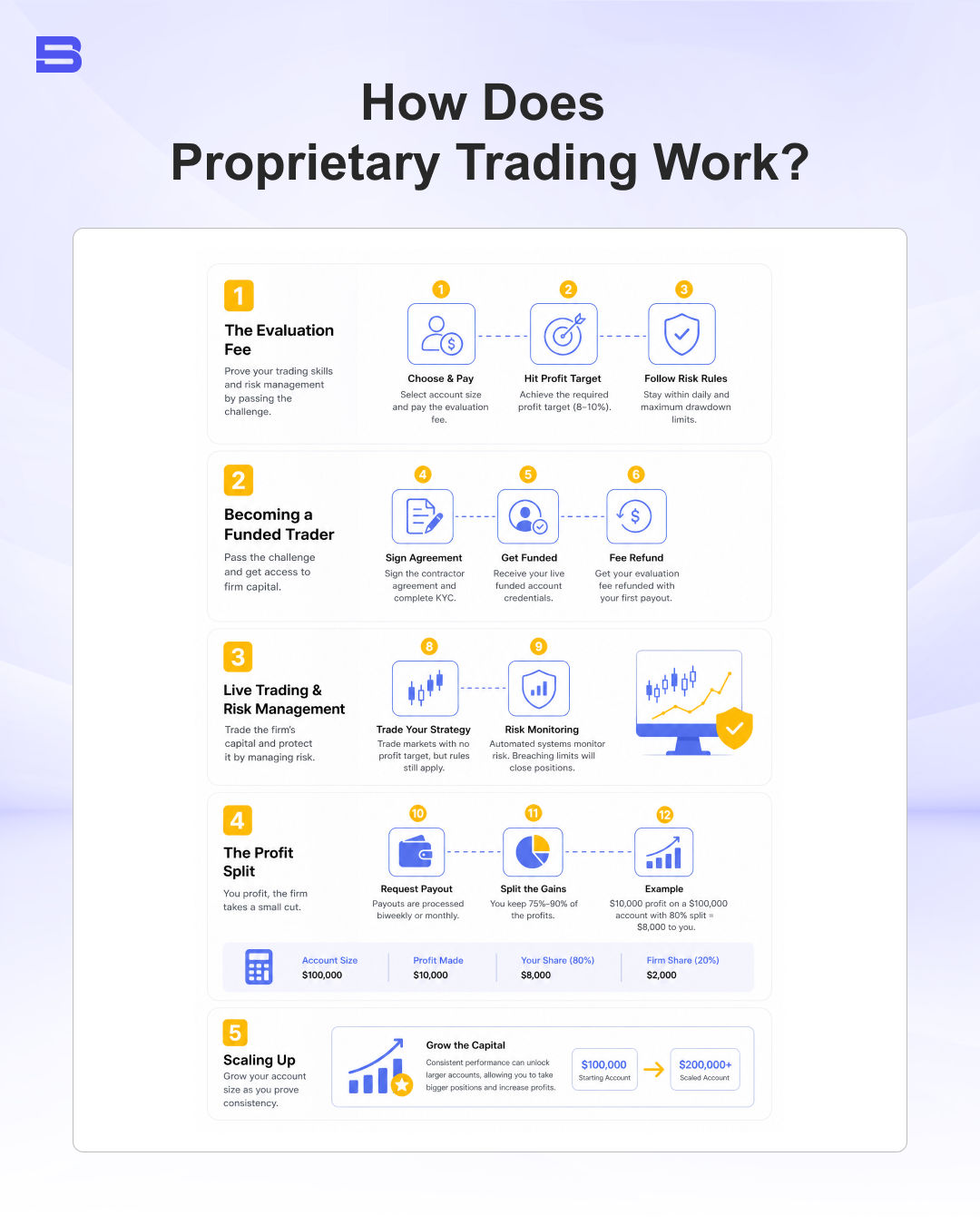
Prop trading is a model where financial firms use their own capital to trade markets instead of managing clients’ money. It has expanded through online funded trader programs, allowing individuals to trade a firm’s capital remotely after passing an evaluation process.
Misunderstanding About Prop Trading
Despite the growing popularity of proprietary trading, many misconceptions still surround how prop firms operate and what it takes to succeed as a funded trader. Some people assume prop trading offers easy profits with little risk, while others believe only professional traders can qualify for funded accounts.
Understanding these common misconceptions can help you develop more realistic expectations before joining a prop firm.
Prop Firms Provide Free Capital
It’s very rare for prop firms to give free capital with no strings attached. You need to follow the strict rules, drawdown limits, and pay the evaluation fee to access the firm’s capital. These typically offset the advantages.
Prop Firms Provide Real Capital
Most proprietary firms utilize simulated demo environments instead of funding traders with real money to trade in the market. Funded traders interact with virtual capital, and actual payouts are structured based on their performance in the simulation.
Profits Can Be Achieved Quickly
In reality, trading success takes time, years of learning, proper risk management, and strategy refinement to minimize losses. Prop firms may give the illusion of real-life situations, but the statistics tell a different story.
Is Prop Trading Right For Me?
In the trading world, prop firms have their place and their own audience. Prop trading typically suits traders who have a proven strategy but lack the capital to trade bigger positions.
Funded trading programs can provide access to larger accounts, scaling opportunities, and profit-sharing without risking your personal savings. However, prop trading is not ideal for everyone, as the evaluation process can be demanding, and even small, common mistakes can potentially lead to account failure.
Before deciding, you need to consider many factors— trading experience, risk tolerance, trading strategies, discipline, long-term goals, and the drawdown limit, as it’s different from traditional retail trading.
- Proprietary Trading Explained: What It Is and Its Key Benefits
- TradingView: Features, Broker Integration, and Strategies
- cTrader: How It Works and How It Compares
- What Is a VPS for Trading and Do You Need One?
- Thinkorswim Trading: Features, Tools, and Availability
- Trading Platform Malaysia: What to Look For
- Bursa Anywhere: A Guide to Managing Shares in Malaysia
- What Is Forex Factory and How Do Traders Use It?
- Delta App: Multi-Asset Portfolio Tracker for Crypto & Stocks
- What Is Trading Central and How to Use It?
- What Is Simply Wall St and How to Use It
- What Is Seeking Alpha and How to Use It
- What Is MarketWatch and How to Use It
- What Is Barchart and How to Use It
- Google Finance Explained: How to Track Stocks and Markets
- What Is Finviz and How to Use It for Stock Screening
- What Is Yahoo Finance and How to Use It
- What Is TradingEconomics and How to Use It
- StockCharts Review 2026: Features, Pricing, and Performance
- What Is ZuluTrade and How Does Copy Trading Work on It?
- What Is Investing.com and How to Use It?
- What Is Myfxbook and How Do Traders Use It?
- What Is CoinGecko? A Complete Guide to Crypto Data Tracking
- What Is CoinMarketCap and How to Use It
- What Is CoinStats and How to Use It for Portfolio Tracking
- What Is Sharesight and How to Use It for Portfolio Tracking
- What Is Personal Capital and How to Use It
- What Is a Low Spread Broker? How It Affects Your Trading
- What Is an Introducing Broker (IB) in Forex?
- What Is Social Trading? How Copy Trading Platforms Work
- What Is a PAMM Account? How Managed Forex Accounts Work
- What Is a Margin Account and How Does Margin Trading Work?
- What Are Trading Signals and How Do They Work?
- What Is an Expert Advisor (EA) in Forex Trading?
Disclaimer: The content on this page is intended for educational and informational purposes only. It does not constitute financial, investment, tax, or legal advice, and should not be interpreted as a recommendation to buy, sell, or hold any financial instrument or asset. Trading and investing involve significant risk, including the possible loss of your entire capital. Products such as forex, CFDs, and cryptocurrencies carry additional risks due to leverage, high volatility, and limited regulatory protection in some jurisdictions. Past performance of any financial instrument does not guarantee future results. Any market views, forecasts, or opinions expressed are those of the author at the time of writing and may not reflect current market conditions. Platform features, fees, and regulatory status are subject to change — always verify information directly with the relevant provider or regulator before making any financial decision. BrokerSpecs may receive compensation from third parties featured on this site. Always conduct your own due diligence and consider seeking advice from a licensed financial professional before investing. Portions of this article were prepared with the assistance of AI tools and reviewed by our editorial team before publication.