


Related Tags
You are browsing your favorite Telegram channel, and with a single tap, you transfer digital funds to a peer or interact with a built-in decentralized application. There are no clunky browser extensions to install, no wallet addresses to copy painstakingly, and no visible network congestion. This frictionless experience represents the core ambition behind Toncoin (TON), a Layer-1 blockchain project designed to bridge mainstream messaging users into the decentralized economy.
However, navigating the crypto market requires looking past seamless interfaces to evaluate underlying infrastructure, market liquidity, and asset volatility. Whether you are curious about decentralized mini-apps or exploring spot and derivative trading, understanding how Toncoin operates—and the financial risks involved—is essential before allocating capital.
What Is Toncoin and How Does It Work?
Toncoin (TON) is the native cryptocurrency of The Open Network, a high-throughput, Layer-1 Proof-of-Stake (PoS) blockchain. Originally developed by Telegram in 2018 under the name Telegram Open Network (TON), the project faced regulatory action from the US Securities and Exchange Commission (SEC) in 2019.
Following a court injunction, Telegram ceased involvement in 2020. An open-source developer community subsequently continued development using the project's original codebase, architecture, and documentation, operating independently from Telegram.
Telegram Integration and Mini-App Ecosystem
Despite the corporate separation, Toncoin's market presence remains deeply tied to Telegram's messaging infrastructure. TON serves as the official Web3 infrastructure for Telegram, powering an integrated ecosystem of mini-apps, user handles, and digital identity tools.
This integration enables seamless peer-to-peer transfers within messaging threads and fuels viral "tap-to-earn" games and Web3 utilities. By embedding non-custodial wallets (such as TON Space) directly into Telegram's interface, the network lowers the technical entry barriers that historically slowed retail crypto adoption.
Ecosystem Utility: Staking, Fees, and Governance
Within the native network, Toncoin functions as the primary medium of exchange and computational fuel. Key ecosystem use cases include:
- Transaction and Gas Fees: Every smart contract execution, cross-chain bridge transfer, and mini-app interaction requires TON to cover gas fees.
- Staking and Network Validation: As a Proof-of-Stake network, TON relies on validators who lock up substantial amounts of Toncoin to secure the chain and process transactions. Individual holders can pool their assets with validators via Toncoin staking to earn network rewards.
- Ecosystem Payments: TON is used to purchase Telegram usernames, virtual phone numbers, in-app advertising placements, and decentralized storage services.
How to Trade Toncoin: Spot Markets vs. Derivatives
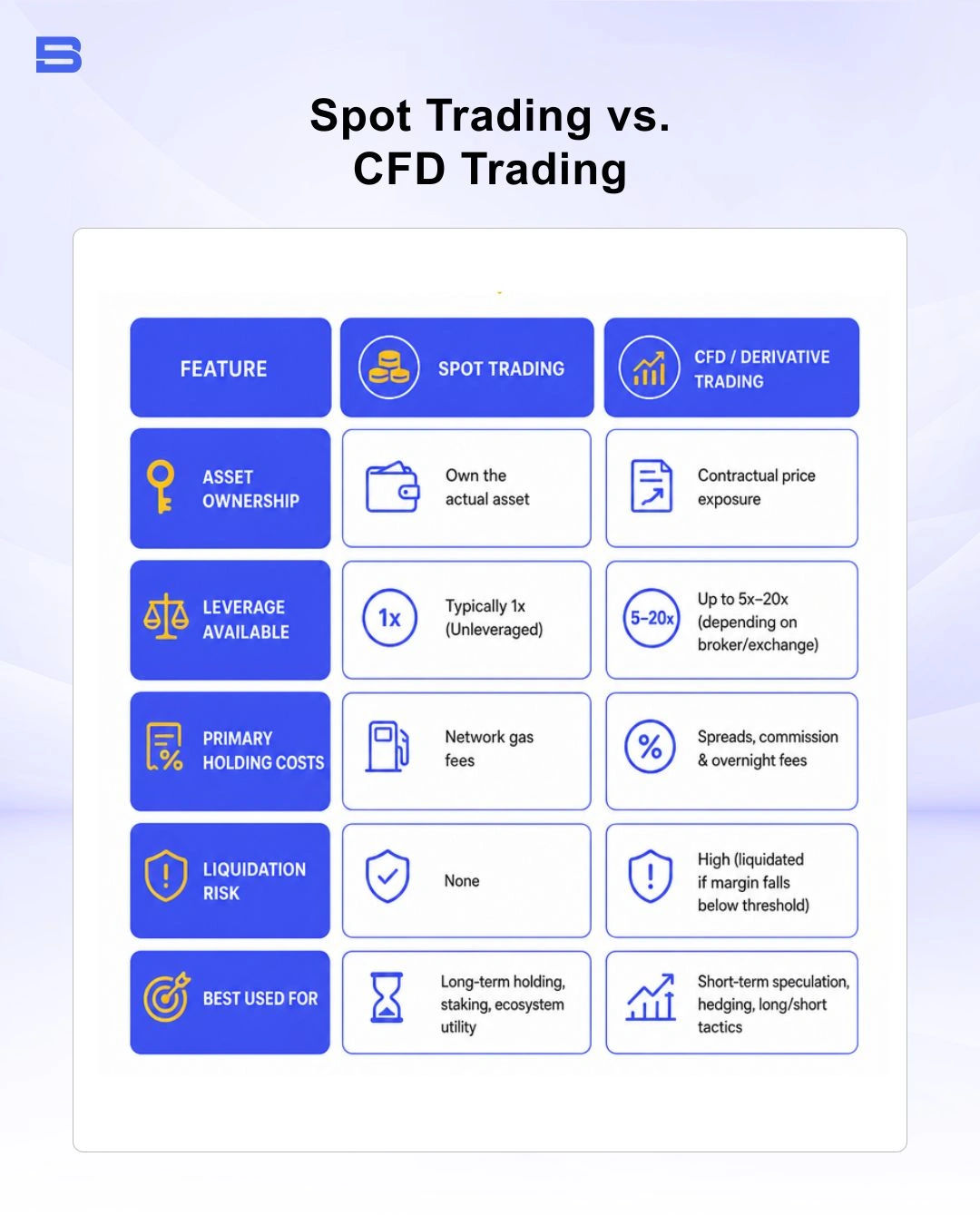
When deciding how to trade Toncoin, traders generally choose between direct spot ownership and trading leverage via derivatives. Selecting the right venue depends on your strategy, risk tolerance, and investment horizon.
Spot Trading: Direct Ownership and Wallet Custody
Spot trading involves purchasing actual Toncoin at the current market price. When you buy spot TON, you gain underlying asset ownership and can transfer the tokens to self-custody wallets like Tonkeeper or TON Space. Spot trading eliminates overnight funding fees and leverage liquidation risk, making it suitable for long-term holding or active participation in staking protocols.
Derivatives and CFDs: Leverage and Two-Way Trading
Contracts for Difference (CFDs) and perpetual futures allow traders to speculate on TON's price movements without taking physical delivery of the token. Derivatives enable the use of leverage—borrowing funds from a broker to open larger positions with smaller initial capital—and allow traders to open short positions during market downturns.
However, derivative trading introduces funding rates, spread costs, and strict margin requirements. Per guidance from the CFA Institute, understanding margin mechanics is vital, as leverage amplifies both potential profits and potential capital losses in equal measure.
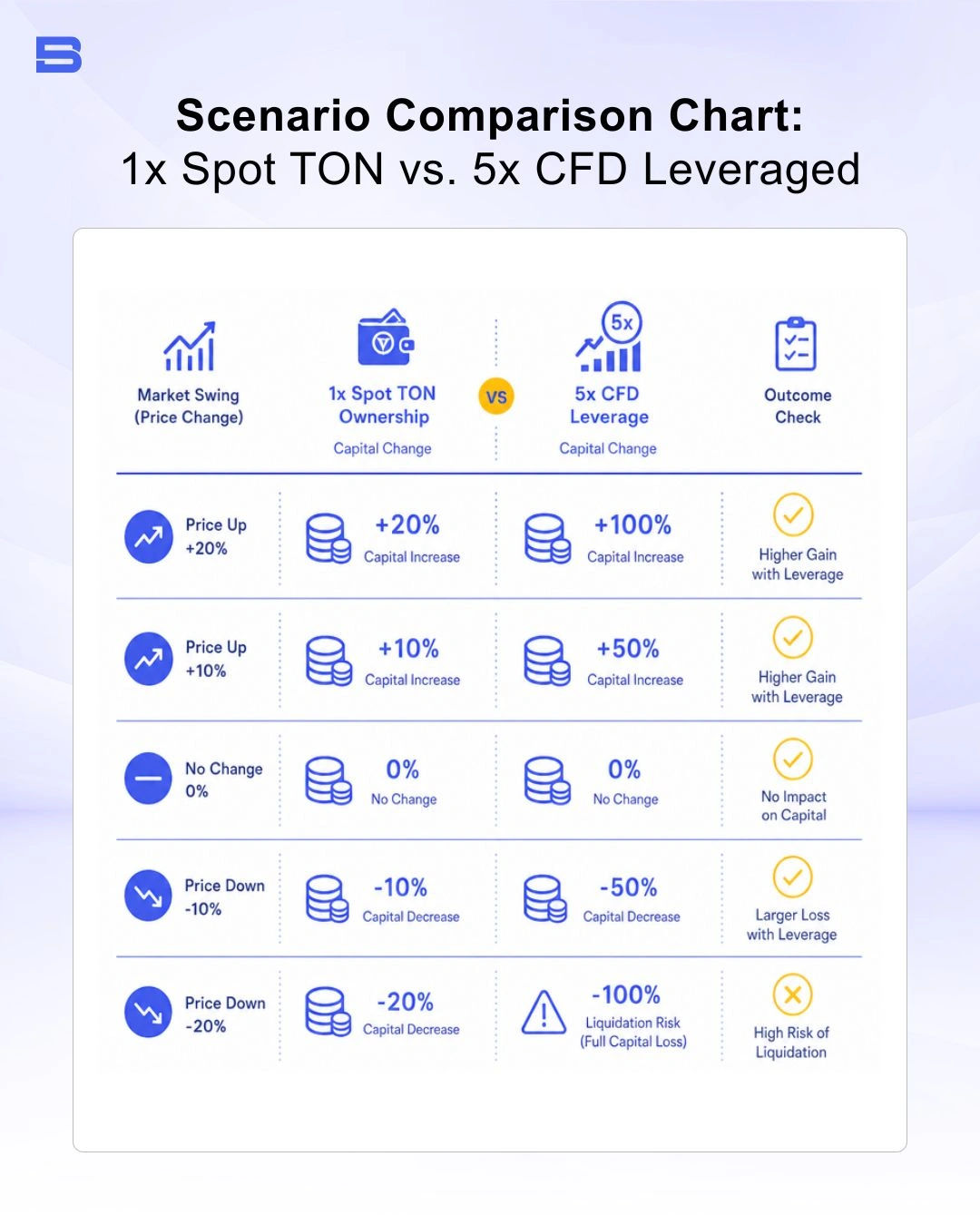
Position Sizing Scenario: Assume a trader has a $1,000 capital base and considers two strategies during a 10% price fluctuation in TON:
- Scenario A (1x Spot Purchase): You buy $1,000 worth of spot TON. If the price increases by 10%, your position gains $100 (a 10% return on capital). If the price falls by 10%, your position drops by $100. Your risk is strictly limited to the initial outlay, and you face zero risk of margin liquidation.
- Scenario B (5x CFD Leverage): You use your $1,000 as margin to open a $5,000 leveraged long position. If TON rises by 10%, your position gains $500—yielding a 50% return on your $1,000 capital (minus spread and overnight holding costs). Conversely, if TON falls by 10%, your position loses $500 (a 50% drawdown on your initial capital). A drawdown approaching your margin threshold triggers a margin call, forcing position closure if additional funds are not deposited immediately.
Market Structure, Liquidity, and Price Drivers
Evaluating Toncoin price prediction models requires analyzing structural adoption metrics rather than relying on speculative forecasts. Key market variables that influence Toncoin's price action include:
- Active Telegram User Conversion: TON's macro value thesis relies heavily on converting Telegram's global user base into active Web3 wallet holders.
- Ecosystem Total Value Locked (TVL): Growth in decentralized exchanges (DEXs), lending platforms, and liquid staking protocol TVL indicates capital retention on the network.
- Tokenomics and Distribution: The total supply structure, community incentives, and validator reward schedules directly impact circulating market supply.
- Regulatory Developments: Changing global frameworks surrounding social media integrated messaging platforms and digital asset transfers can create sudden volatility shocks.
Comparing Layer-1 Ecosystems: Toncoin vs. Cosmos and Avalanche
To understand where Toncoin sits in the broader digital asset market, it helps to compare its technical design against established Layer-1 networks like Cosmos crypto and Avalanche crypto.
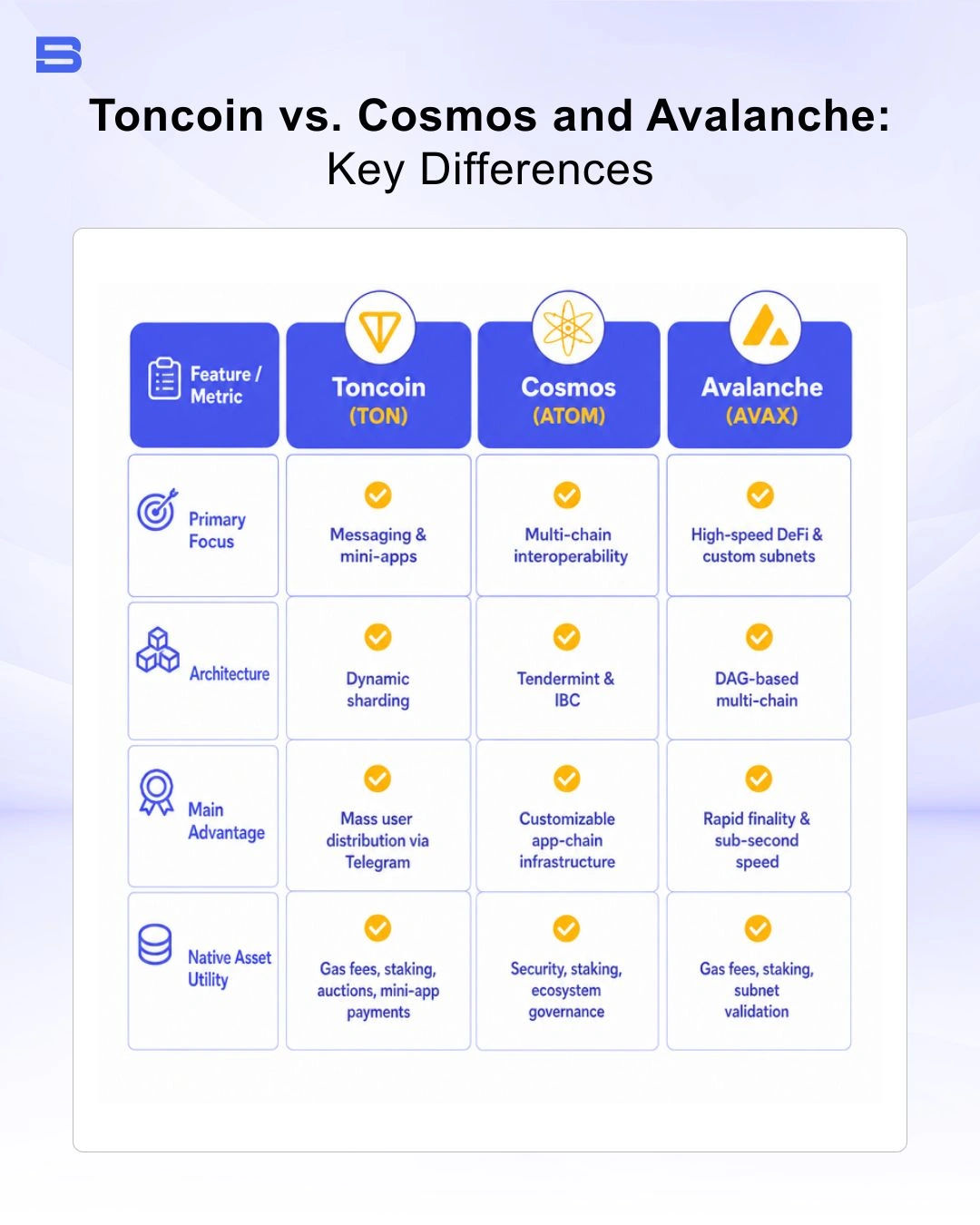
While platforms like Cosmos prioritize sovereign app-chain interoperability and Avalanche targets institutional financial subnets, Toncoin focuses almost entirely on consumer-facing scale and distribution.
Key Risks to Consider Before Trading Toncoin
Trading digital assets involves substantial capital risk. Before opening a position in Toncoin, consider the following structural risk factors:
- Platform Dependency: Although TON operates as an independent decentralized network, its primary adoption catalyst remains its integration with Telegram. Operational, legal, or policy changes affecting the messaging app can severely impact market sentiment.
- Ecosystem Token Volatility: Many viral mini-app and "tap-to-earn" tokens issued on TON experience extreme speculative spikes followed by sharp liquidity contraction, creating spillover volatility for Toncoin.
- Regulatory Exposure: Global regulatory bodies, including the Securities Commission Malaysia (SC), continuously review digital asset frameworks and exchange licensing requirements. Trading on unauthorized or offshore platforms exposes retail investors to counterparty risk.
Summary
Toncoin stands out in the Layer-1 ecosystem by combining high-throughput blockchain infrastructure with an existing global distribution channel through Telegram. While this integration creates compelling utility for microtransactions and consumer dApps, traders must balance upside opportunities with platform dependency risks and high market volatility.
Whether utilizing spot markets for long-term holding or derivative contracts for tactical positions, maintaining disciplined risk management remains essential.
- What Can You Trade? A Guide to Forex, Stocks, and More
- CFD Trading for Beginners
- What is CFD Trading and How Does It Work?
- Forex vs. Stocks: Which Market Suits You Best?
- How to Diversify a Portfolio Across Asset Classes
- How Dividend Stocks Work: Yields, Risks, and Strategies
- Silver Trading Explained: A Guide for Retail Investors
- Precious Metals Trading: A Complete Guide for Beginners
- Natural Gas Trading: A Guide to the Market
- Structured Warrants Malaysia: How They Work and Risks
- What Is the KLCI Index and How to Trade It
- Gold Investment in Malaysia: A Complete Guide for Beginners
- What Is Kijang Emas and How to Invest in It
- Value Investing Explained: How to Find Undervalued Stocks
- How to Trade Bitcoin Safely: A Complete Market Guide
- Growth Investing Explained: Strategies, Metrics, and Risks
- What Is Digital Gold Malaysia and How to Invest
- Crypto Trading Strategies for Beginners
- Gold vs Bitcoin: Key Differences, Risks, and Strategies
- Sukuk: A Guide for Beginners to Islamic Bonds
- What Is FCPO (Crude Palm Oil Futures) and How to Trade It
- How to Identify and Invest in Shariah-Compliant Stocks
- Timber Investment: Is It Worth It?
- Gold ETF Malaysia: A Guide for Beginners
- What Are Malaysian Government Securities (MGS)?
- Corporate Bonds Malaysia: A Guide for Beginners
- China A-Shares Trading Guide for Malaysian Investors
- What Is a Silver ETF and How to Invest in It?
- How to Trade XRP: A Practical Guide for Retail Investors
- How to Trade Solana (SOL): A Guide for Beginners
- What Are Gold Futures and How Do They Work?
- Money Market Fund in Malaysia: A Guide for Beginners
- Property Investment Malaysia: Direct Real Estate or M-REITs?
- What Is Binance Coin and How Does It Work?
- Green Sukuk: A Guide for Beginners to Islamic ESG Investing
- What Is Shiba Inu (SHIB) and How to Trade It
- What Is USDT? A Complete Guide to Tether for Beginners
- What Is Dogecoin and How to Trade It Safely for Beginners
- Cardano: A Guide for Beginners to Trade This Cryptocurrency
- Polkadot: A Guide to Trading This Cryptocurrency
- Tron: A Guide for Beginners to Trading This Cryptocurrency
- What Is Litecoin (LTC)? A Guide to Trading Digital Silver
- What Is Chainlink (LINK) and How to Trade It
- How to Trade Pepe Coin: Spot, Leverage, and Risk Management
- Near Protocol: A Guide to Trading This Cryptocurrency
- Trading Polygon Crypto: A Practical Guide for Beginners
- Trade Toncoin: Understanding the TON Ecosystem and Risks
- Cosmos Crypto: Ecosystem Architecture, Tokenomics, and Risks
- Stellar Crypto: A Guide to Trading This Cryptocurrency
- Avalanche Crypto Explained: A Practical Guide for Traders
- What Is Worldcoin? How to Trade WLD and Manage Risk
- Aptos: A Guide for Beginners to Trading This Cryptocurrency
- Sui Crypto Explained: Tokenomics and Trading Guide
- Celestia: A Guide to Trading This Cryptocurrency
- Decentraland: A Guide to Trading This Cryptocurrency
- What Is Arbitrum? How to Trade the Leading Layer 2 Network
- Sei Crypto: A Guide to Trading This Cryptocurrency
- What Is Injective Protocol and How to Trade INJ Safely
Disclaimer: The content on this page is intended for educational and informational purposes only. It does not constitute financial, investment, tax, or legal advice, and should not be interpreted as a recommendation to buy, sell, or hold any financial instrument or asset. Trading and investing involve significant risk, including the possible loss of your entire capital. Products such as forex, CFDs, and cryptocurrencies carry additional risks due to leverage, high volatility, and limited regulatory protection in some jurisdictions. Past performance of any financial instrument does not guarantee future results. Any market views, forecasts, or opinions expressed are those of the author at the time of writing and may not reflect current market conditions. Platform features, fees, and regulatory status are subject to change — always verify information directly with the relevant provider or regulator before making any financial decision. BrokerSpecs may receive compensation from third parties featured on this site. Always conduct your own due diligence and consider seeking advice from a licensed financial professional before investing.