



Related Tags
Entering the commodity market for the first time can feel overwhelming, especially when navigating global agricultural trends and fast-moving supply chains. If you are looking to trade physical commodities in Southeast Asia, Crude Palm Oil Futures (FCPO) serves as the primary regional benchmark. Traded on Bursa Malaysia Derivatives, FCPO allows market participants to gain exposure to global edible oil price movements without owning raw agricultural goods.
What Is FCPO (Crude Palm Oil Futures)?
FCPO stands for Futures Crude Palm Oil, a standardized derivatives contract traded on Bursa Malaysia Derivatives (BMD). It serves as the global price benchmark for the crude palm oil industry, enabling producers, refiners, and individual traders to discover prices and manage commercial risk.
When you buy or sell an FCPO contract, you enter a legally binding agreement to deliver or accept a specified quantity of crude palm oil at an agreed-upon price on a future date. While commercial entities use FCPO to lock in prices and protect supply chains, retail traders primarily trade these contracts to capitalize on short- to medium-term price swings.
Contract Size and Specification Details
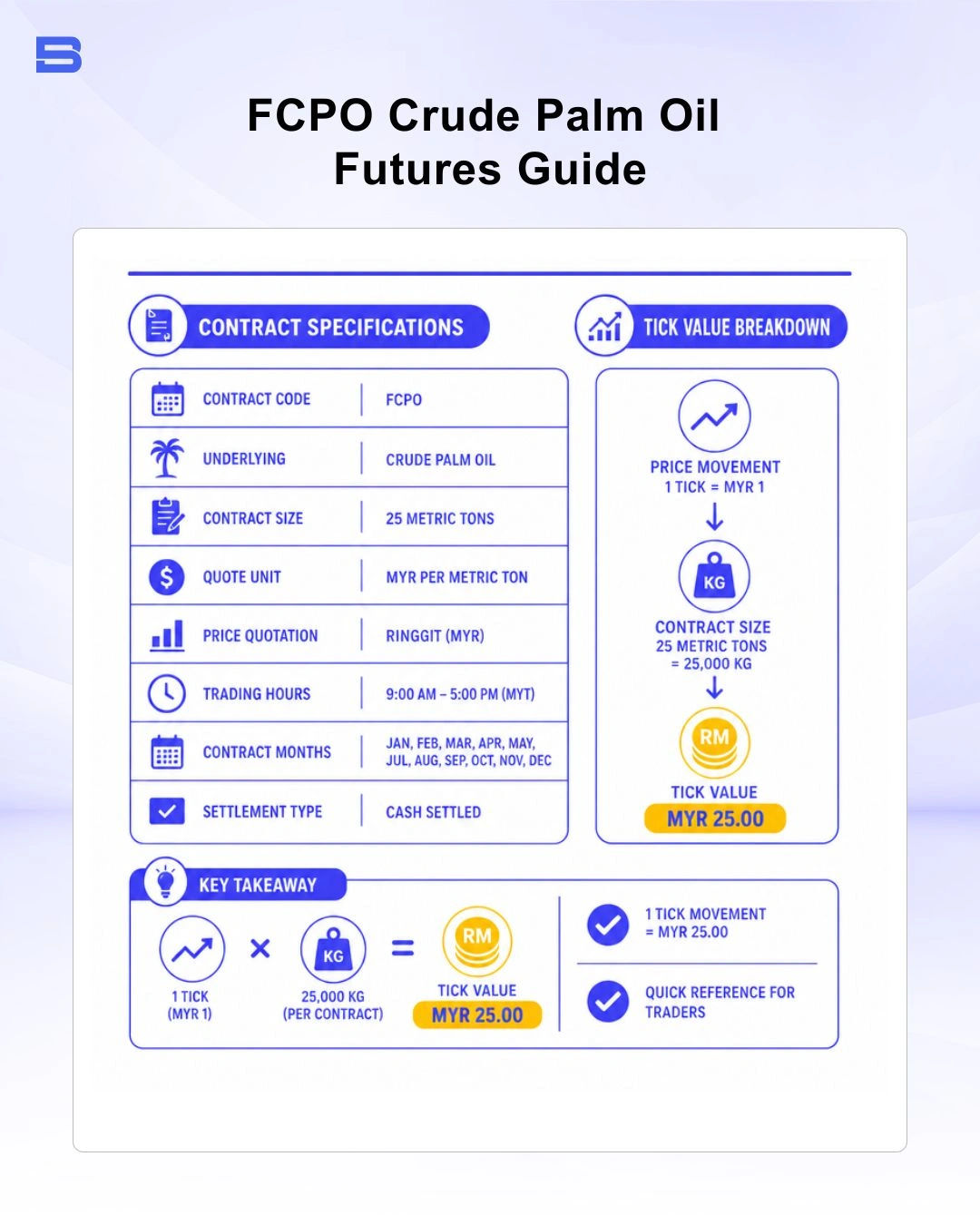
To trade FCPO effectively, you must understand its core contract specifications set by the exchange:
- Underlying Instrument: Crude Palm Oil (delivered at designated port installations in Malaysia).
- Contract Size: 25 metric tons (MT) per contract.
- Pricing Currency: Malaysian Ringgit (MYR) per metric ton.
- Price Limits: If the settlement price of the active month contract moves by 10% in either direction, a 10-minute cooling-off period is triggered, after which price limits expand to 15%.
FCPO Trading Hours and T+1 Night Sessions
FCPO trading occurs across daily sessions, offering flexibility to respond to global market developments:
- Morning Session (Session 1): 10:30 AM – 12:30 PM (MYT).
- Afternoon Session (Session 2): 2:30 PM – 6:00 PM (MYT).
- T+1 Night Session: 9:00 PM – 11:30 PM (MYT).
The night session aligns with European trading hours and early US market releases, allowing traders to react to global macroeconomic news and competing soybean oil price shifts overnight.
Margin Requirements and Leverage Mechanics
Trading FCPO does not require paying the full cash value of 25 metric tons of palm oil. Instead, it operates on a margin system governed by the Standard Portfolio Analysis of Risk (SPAN) margining framework.
To open a position, your broker requires an Initial Margin—a collateral deposit set by Bursa Malaysia Derivatives Clearing Berhad to ensure financial performance. You must also maintain a Maintenance Margin in your account. If market moves push your account equity below the maintenance threshold, your broker issues a margin call requiring immediate additional funds; failure to meet this call results in the mandatory liquidation of your position.
Leverage amplifies your returns when you are right, but it accelerates capital destruction just as quickly when the market moves against you—a sharp price reversal against a leveraged position can wipe out a significant portion of your deposited margin in a single trading session.
Understanding Tick Value and Calculation Example
The minimum price variation for FCPO is RM1.00 per metric ton. Because one contract represents 25 metric tons, each 1-tick movement changes your open contract value by exactly RM25 (RM1.00 × 25 MT).
Worked Calculation Scenario:
Suppose you go long (buy) 1 FCPO contract at RM3,900/MT.
If the price rises to RM3,950/MT, the market has moved up by 50 ticks.
Gross Gain: 50 ticks × RM25 = +RM1,250 (excluding broker commissions and exchange fees).
Conversely, if the market falls to RM3,850/MT (50 ticks down), your account incurs a loss of RM1,250.
Key Trading Dynamics: Expiry, Delivery, and Shariah Status
Before opening your first futures position, you must understand contract settlement mechanics and regulatory guidelines.
Managing Expiry: Physical Delivery vs. Cash Rollover
FCPO is physically settled upon contract expiration. Physical delivery requires handling Malaysian Sustainable Palm Oil (MSPO)-certified crude palm oil at designated port installations—a process meant exclusively for commercial refiners and institutional hedgers.
As a retail trader, you must avoid entering the "spot month" (the delivery month). Brokers typically enforce mandatory position closures or roll obligations before the spot month begins to prevent accidental physical delivery commitments. If you plan to maintain market exposure beyond the active contract month, you must execute a rollover—closing your position in the expiring month and simultaneously opening a position in the next active contract month.
Is FCPO Trading Shariah-Compliant?
Yes, FCPO trading is certified as Shariah-compliant. The Shariah Advisory Council (SAC) of the Securities Commission Malaysia (SC) has reviewed and approved Crude Palm Oil Futures for trading by Muslim investors. Because palm oil is a tangible, real-world commodity with clear contract parameters, trading FCPO satisfies Islamic finance principles regarding transaction clarity and underlying asset ownership.
How Do You Trade FCPO Step-by-Step?
If you are ready to begin trading FCPO, follow this practical process to ensure proper execution and regulatory protection:
- Open a Derivatives Trading Account: Select a broker licensed by the Securities Commission Malaysia (SC) and a participant of Bursa Malaysia Derivatives. Ensure the broker provides access to real-time BMD market data and T+1 night sessions.
- Deposit Initial Margin Capital: Transfer the required margin capital into your segregated derivatives trading account. Always maintain a buffer above the minimum initial margin to absorb intraday volatility without triggering margin calls.
- Conduct Market Analysis: Analyze technical chart setups alongside fundamental drivers, such as monthly Malaysian Palm Oil Board (MPOB) supply-demand reports, rival edible oil price trends (soybean oil on the Chicago Board of Trade, or CBOT), and crude oil price shifts.
- Execute Orders with Risk Controls: Place your trade using your broker’s trading platform. Always submit an accompanying stop-loss order to cap potential downside risk on every open contract.
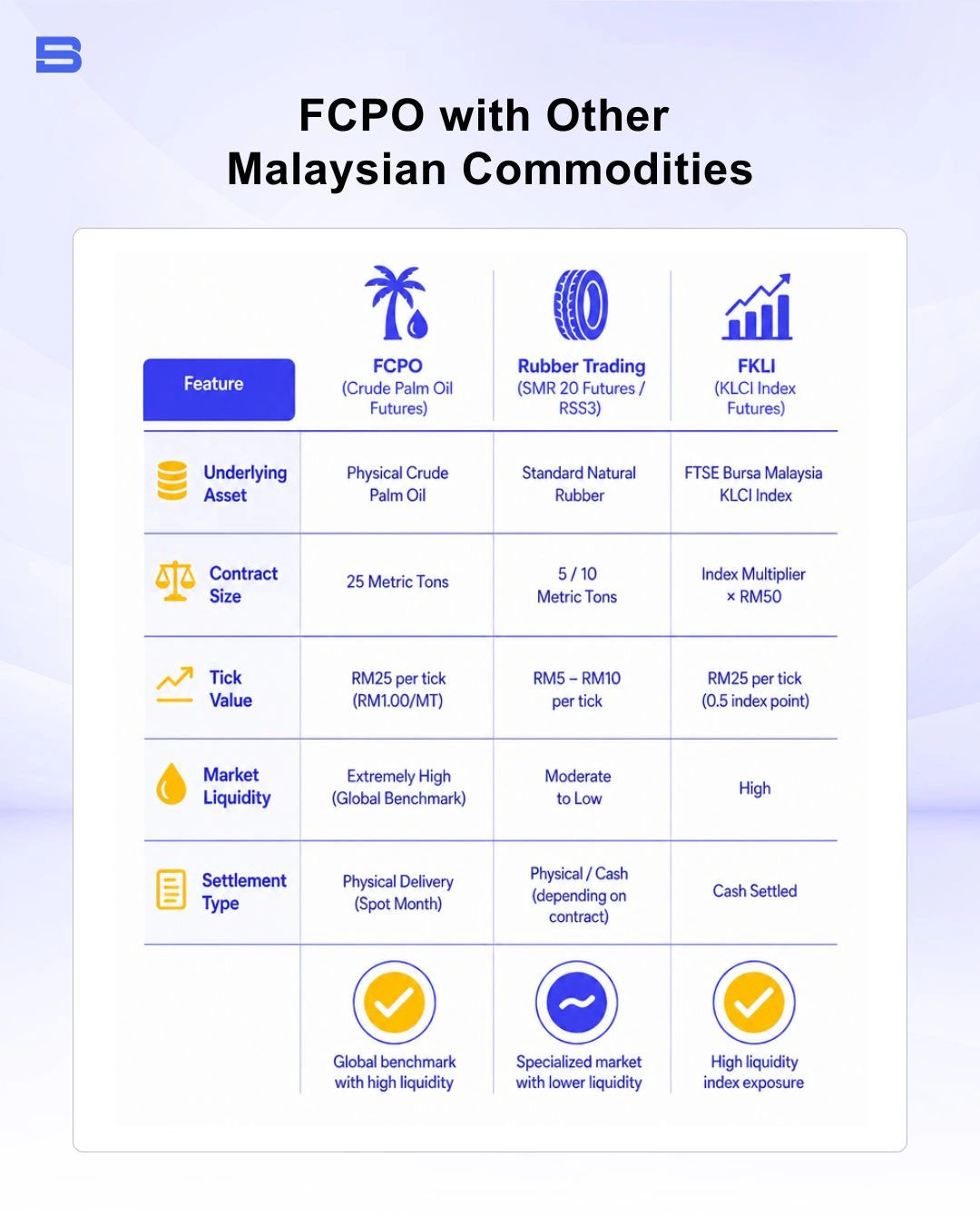
Comparing FCPO with Other Malaysian Commodities
To help you understand how FCPO fits into the local derivatives market, compare its structure against index futures and other agricultural contracts:
The Bottom Line
Crude Palm Oil Futures (FCPO) offers a direct and highly liquid way to trade commodity price movements on Bursa Malaysia Derivatives. While leverage can improve capital efficiency, it also increases risk, making disciplined position sizing and consistent stop-loss management essential. For traders exploring rubber trading alongside palm oil, the same principles of risk control can help manage exposure to volatile commodity markets.
- What Can You Trade? A Guide to Forex, Stocks, and More
- CFD Trading for Beginners
- What is CFD Trading and How Does It Work?
- Forex vs. Stocks: Which Market Suits You Best?
- How to Diversify a Portfolio Across Asset Classes
- How Dividend Stocks Work: Yields, Risks, and Strategies
- Silver Trading Explained: A Guide for Retail Investors
- Precious Metals Trading: A Complete Guide for Beginners
- Natural Gas Trading: A Guide to the Market
- Structured Warrants Malaysia: How They Work and Risks
- What Is the KLCI Index and How to Trade It
- Gold Investment in Malaysia: A Complete Guide for Beginners
- What Is Kijang Emas and How to Invest in It
- Value Investing Explained: How to Find Undervalued Stocks
- How to Trade Bitcoin Safely: A Complete Market Guide
- Growth Investing Explained: Strategies, Metrics, and Risks
- What Is Digital Gold Malaysia and How to Invest
- Crypto Trading Strategies for Beginners
- Gold vs Bitcoin: Key Differences, Risks, and Strategies
- Sukuk: A Guide for Beginners to Islamic Bonds
- What Is FCPO (Crude Palm Oil Futures) and How to Trade It
- How to Identify and Invest in Shariah-Compliant Stocks
- Timber Investment: Is It Worth It?
- Gold ETF Malaysia: A Guide for Beginners
- What Are Malaysian Government Securities (MGS)?
- Corporate Bonds Malaysia: A Guide for Beginners
- China A-Shares Trading Guide for Malaysian Investors
- What Is a Silver ETF and How to Invest in It?
- How to Trade XRP: A Practical Guide for Retail Investors
- How to Trade Solana (SOL): A Guide for Beginners
- What Are Gold Futures and How Do They Work?
- Money Market Fund in Malaysia: A Guide for Beginners
- Property Investment Malaysia: Direct Real Estate or M-REITs?
- What Is Binance Coin and How Does It Work?
- Green Sukuk: A Guide for Beginners to Islamic ESG Investing
- What Is Shiba Inu (SHIB) and How to Trade It
- What Is USDT? A Complete Guide to Tether for Beginners
- What Is Dogecoin and How to Trade It Safely for Beginners
- Cardano: A Guide for Beginners to Trade This Cryptocurrency
- Polkadot: A Guide to Trading This Cryptocurrency
- Tron: A Guide for Beginners to Trading This Cryptocurrency
- What Is Litecoin (LTC)? A Guide to Trading Digital Silver
- What Is Chainlink (LINK) and How to Trade It
- How to Trade Pepe Coin: Spot, Leverage, and Risk Management
- Near Protocol: A Guide to Trading This Cryptocurrency
- Trading Polygon Crypto: A Practical Guide for Beginners
- Trade Toncoin: Understanding the TON Ecosystem and Risks
- Cosmos Crypto: Ecosystem Architecture, Tokenomics, and Risks
- Stellar Crypto: A Guide to Trading This Cryptocurrency
- Avalanche Crypto Explained: A Practical Guide for Traders
- What Is Worldcoin? How to Trade WLD and Manage Risk
- Aptos: A Guide for Beginners to Trading This Cryptocurrency
- Sui Crypto Explained: Tokenomics and Trading Guide
- Celestia: A Guide to Trading This Cryptocurrency
- Decentraland: A Guide to Trading This Cryptocurrency
- What Is Arbitrum? How to Trade the Leading Layer 2 Network
- Sei Crypto: A Guide to Trading This Cryptocurrency
- What Is Injective Protocol and How to Trade INJ Safely
Disclaimer: The content on this page is intended for educational and informational purposes only. It does not constitute financial, investment, tax, or legal advice, and should not be interpreted as a recommendation to buy, sell, or hold any financial instrument or asset. Trading and investing involve significant risk, including the possible loss of your entire capital. Products such as forex, CFDs, and cryptocurrencies carry additional risks due to leverage, high volatility, and limited regulatory protection in some jurisdictions. Past performance of any financial instrument does not guarantee future results. Any market views, forecasts, or opinions expressed are those of the author at the time of writing and may not reflect current market conditions. Platform features, fees, and regulatory status are subject to change — always verify information directly with the relevant provider or regulator before making any financial decision. BrokerSpecs may receive compensation from third parties featured on this site. Always conduct your own due diligence and consider seeking advice from a licensed financial professional before investing.