


Related Tags
Entering the cryptocurrency market can feel like navigating an archipelago of isolated islands. Traditional blockchain networks like Bitcoin and early iterations of Ethereum were designed to operate independently, forcing users to rely on centralized exchanges or risky third-party bridges to move value between them. Polkadot was designed specifically to eliminate these boundaries.
By functioning as a foundational network that connects disparate blockchains, Polkadot aims to build a truly decentralized, multi-chain web. For traders, understanding how this architecture functions is key to evaluating the market movements and risk profile of its native token, DOT.
What Is Polkadot (DOT) and How Does It Work?
Polkadot is often described as a "Layer-0" protocol. Unlike standard Layer-1 blockchains—such as Ethereum or Solana, which host smart contracts directly—Polkadot provides the underlying infrastructure to support an entire ecosystem of connected, custom blockchains. What is Polkadot used for? At its core, it enables independent blockchains to transfer messages, tokens, and data between one another seamlessly and securely.
The native cryptocurrency of the network is DOT. The token serves three primary functions across the ecosystem:
- Governance: Token holders have voting rights on network upgrades, fee structures, and treasury allocations.
- Staking: Holders stake DOT to secure the network and validate transactions in exchange for staking rewards.
- Bonding: Tokens are locked up to connect new custom blockchains to the network or lease computing resources.
Core Architecture: Relay Chain vs Parachains
To understand how Polkadot processes transactions, you must look at its split infrastructure:
- The Relay Chain: This is the central hub of the Polkadot network. It handles consensus, finality, and overall security across the entire ecosystem. To keep performance optimal, the Relay Chain does not execute smart contracts directly; its main focus is coordinating connected networks.
- Parachains and Shared Security: Parachains are specialized, individual blockchains that run in parallel alongside the Relay Chain. Each parachain can be custom-built for specific use cases—such as decentralized finance (DeFi), gaming, or identity management. Crucially, parachains benefit from the "shared security" of the Relay Chain, meaning individual chains do not need to recruit their own set of security validators.
By dividing processing workloads across multiple specialized parachains, Polkadot achieves high throughput without suffering the congestion that often plagues single-chain networks.
Staking and Governance: Role of the DOT Token
Polkadot secures its network using a consensus mechanism known as Nominated Proof-of-Stake (NPoS). Is Polkadot proof of stake? Yes, but its nominated variation is designed to maximize decentralization and network security by dividing responsibilities between two primary roles:
- Validators: High-capacity nodes that run infrastructure, validate transactions on parachains, and produce new blocks on the Relay Chain.
- Nominators: DOT holders who do not wish to run complex validator hardware themselves. Nominators back trusted validators with their staked DOT and receive a portion of the network rewards in return.
How does Polkadot staking work? Nominators select up to 16 reliable validators. If those validators perform their duties accurately, both the validators and nominators earn newly minted DOT rewards. However, if a validator acts maliciously or goes offline for extended periods, a mechanism known as "slashing" takes effect—destroying a percentage of the staked DOT from both the validator and its nominators.
Staking DOT typically yields an annual percentage rate (APR) designed to offset token inflation. However, staking involves an unbonding period before your DOT becomes transferable again. Following Polkadot's 2026 staking reforms, this window was shortened from 28 days to approximately 2 days for nominators — always check Polkadot's official staking documentation for the current duration before planning an exit.
How Polkadot Compares to Other Layer-1 Networks
When deciding how to allocate capital across digital assets, traders frequently compare Polkadot to competing smart contract platforms.
Polkadot vs Ethereum
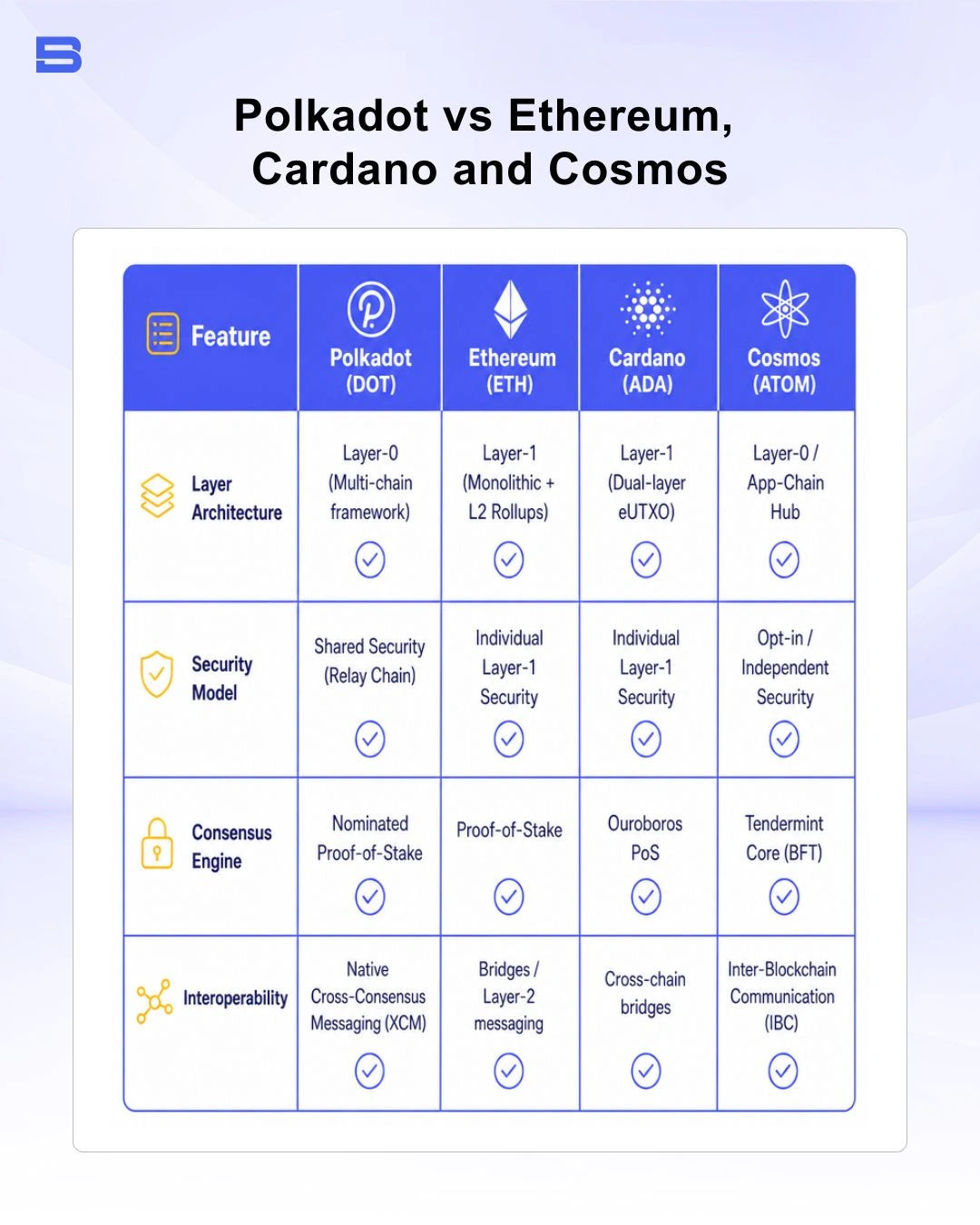
The primary difference in the Polkadot vs Ethereum debate lies in ecosystem design. Ethereum relies on a global Layer-1 ledger, with scaling offloaded to independent Layer-2 rollups. Polkadot was built from day one as a sharded framework where specialized execution environment parachains share native Layer-0 security.
While Ethereum boasts higher total value locked (TVL) and developer adoption, Polkadot offers native cross-chain data transfers without relying on third-party wrapped bridges. Malaysian traders often analyze Ethereum Malaysia liquid markets alongside DOT to balance established market cap with interoperability plays.
Polkadot vs Cardano
Comparing Polkadot to Cardano highlights two distinct philosophical approaches to blockchain design. Cardano utilizes an academic peer-review approach based on an Extended UTXO (eUTXO) model divided into separate settlement and computation layers.
Polkadot uses a heterogeneous multi-chain framework where parachains can run entirely different state execution logic while anchoring consensus to a central Relay Chain.
Polkadot vs Cosmos
The comparison between Polkadot and Cosmos crypto revolves around security models. Cosmos allows developers to build independent app-chains using the Cosmos SDK, connected via the Inter-Blockchain Communication (IBC) protocol.
However, Cosmos chains must secure their own individual validator sets unless they opt into Shared Security. Polkadot automatically provides pooled, shared security to all parachains directly via the Relay Chain.
When evaluating multi-chain assets against established tokens, traders often compare utility-focused coins against major crypto benchmarks like how to trade Bitcoin or enterprise-focused tokens like XRP, Chainlink, and Tron.
Practical Trading Strategies and Risk Management for DOT
Trading DOT requires a disciplined approach that accounts for liquidity, market structure, and position execution type.
When spot trading DOT, you purchase the underlying asset on an exchange registered as a Recognized Market Operator (RMO-DAX) with regulatory oversight, such as the Securities Commission Malaysia (SC). Spot positions carry no liquidation risk from leverage and allow you to transfer tokens off-exchange for staking or governance voting.
Alternatively, trading DOT via Derivatives or Contracts for Difference (CFDs) allows you to speculate on price direction without owning the underlying token. Leverage amplifies your potential returns when you are right, but it accelerates capital destruction just as quickly when the market moves against you—a 10x leverage position can be completely liquidated by a modest 10% adverse price move.
Worked Trading Scenario
Imagine DOT is trading at $10.00. You analyze a support level and decide to open a long CFD position of 500 DOT contracts (total position size = $5,000) using 5:1 leverage.
- Margin Required: $1,000
- Outcome A (Favorable): Price rises 8% to $10.80. Your profit is $400 ($0.80 × 500), generating a 40% return on your $1,000 margin deposit.
- Outcome B (Unfavorable): Price drops 8% to $9.20. Your loss is $400, resulting in a 40% drawdown on your margin capital.
To mitigate downside risk, always set stop-loss orders outside local support/resistance boundaries and avoid risking more than 1–2% of your total account capital on a single DOT trade. Furthermore, remember that staked DOT is still subject to a short unbonding delay (currently around 2 days under Polkadot's post-2026 staking rules) before it becomes liquid again, so factor this into your planning if you need to cover margin calls during a sudden market downturn.
Key Investment Risks and Considerations for DOT Traders
Is Polkadot a good investment? While its technological framework solves real cross-chain bottlenecks, trading DOT carries distinct risks that require careful evaluation:
- Supply Inflation: DOT is an inflationary token, with new issuance primarily used to reward network participants who help secure Polkadot through staking and to fund the Treasury. Since 2024, Polkadot has shifted from a percentage-based inflation model to a fixed annual issuance model, with issuance scheduled to decline over time. If demand for DOT does not keep pace with new token issuance, supply growth can create downward pressure on its price over longer periods.
- Extreme Volatility: Like most altcoins, DOT exhibits significantly higher price volatility than traditional safe-haven assets. Traders evaluating gold vs. Bitcoin as macro hedges should note that smaller-cap utility tokens like DOT carry amplified beta relative to broader equity or commodity markets.
- Regulatory Uncertainty: Regulatory bodies, including the US Securities and Exchange Commission (SEC), continuously monitor proof-of-stake tokens and initial token distribution structures. Regulatory shifts regarding staking rewards or token classifications can trigger sharp market drawdowns.
- Ecosystem Competition: Polkadot faces fierce competition from Layer-1 networks, Layer-2 scaling solutions, and rival interoperability protocols. The financial value of DOT depends heavily on continuous parachain adoption and developer activity across its ecosystem.
Is Polkadot the Right Trading for You?
Trading Polkadot (DOT) offers exposure to a blockchain ecosystem focused on interoperability, staking, governance, and flexible network infrastructure. However, DOT remains a volatile cryptocurrency, and its price can be influenced by broader market sentiment, network adoption, token issuance, and developments across the Polkadot ecosystem.
Before trading DOT, you should understand how the cryptocurrency works, monitor market conditions, and use disciplined risk-management techniques such as appropriate position sizing and stop-loss orders. As a trader, you should also consider DOT's ongoing token issuance and staking dynamics when assessing its long-term supply profile.
- What Can You Trade? A Guide to Forex, Stocks, and More
- CFD Trading for Beginners
- What is CFD Trading and How Does It Work?
- Forex vs. Stocks: Which Market Suits You Best?
- How to Diversify a Portfolio Across Asset Classes
- How Dividend Stocks Work: Yields, Risks, and Strategies
- Silver Trading Explained: A Guide for Retail Investors
- Precious Metals Trading: A Complete Guide for Beginners
- Natural Gas Trading: A Guide to the Market
- Structured Warrants Malaysia: How They Work and Risks
- What Is the KLCI Index and How to Trade It
- Gold Investment in Malaysia: A Complete Guide for Beginners
- What Is Kijang Emas and How to Invest in It
- Value Investing Explained: How to Find Undervalued Stocks
- How to Trade Bitcoin Safely: A Complete Market Guide
- Growth Investing Explained: Strategies, Metrics, and Risks
- What Is Digital Gold Malaysia and How to Invest
- Crypto Trading Strategies for Beginners
- Gold vs Bitcoin: Key Differences, Risks, and Strategies
- Sukuk: A Guide for Beginners to Islamic Bonds
- What Is FCPO (Crude Palm Oil Futures) and How to Trade It
- How to Identify and Invest in Shariah-Compliant Stocks
- Timber Investment: Is It Worth It?
- Gold ETF Malaysia: A Guide for Beginners
- What Are Malaysian Government Securities (MGS)?
- Corporate Bonds Malaysia: A Guide for Beginners
- China A-Shares Trading Guide for Malaysian Investors
- What Is a Silver ETF and How to Invest in It?
- How to Trade XRP: A Practical Guide for Retail Investors
- How to Trade Solana (SOL): A Guide for Beginners
- What Are Gold Futures and How Do They Work?
- Money Market Fund in Malaysia: A Guide for Beginners
- Property Investment Malaysia: Direct Real Estate or M-REITs?
- What Is Binance Coin and How Does It Work?
- Green Sukuk: A Guide for Beginners to Islamic ESG Investing
- What Is Shiba Inu (SHIB) and How to Trade It
- What Is USDT? A Complete Guide to Tether for Beginners
- What Is Dogecoin and How to Trade It Safely for Beginners
- Cardano: A Guide for Beginners to Trade This Cryptocurrency
- Polkadot: A Guide to Trading This Cryptocurrency
- Tron: A Guide for Beginners to Trading This Cryptocurrency
- What Is Litecoin (LTC)? A Guide to Trading Digital Silver
- What Is Chainlink (LINK) and How to Trade It
- How to Trade Pepe Coin: Spot, Leverage, and Risk Management
- Near Protocol: A Guide to Trading This Cryptocurrency
- Trading Polygon Crypto: A Practical Guide for Beginners
- Trade Toncoin: Understanding the TON Ecosystem and Risks
- Cosmos Crypto: Ecosystem Architecture, Tokenomics, and Risks
- Stellar Crypto: A Guide to Trading This Cryptocurrency
- Avalanche Crypto Explained: A Practical Guide for Traders
- What Is Worldcoin? How to Trade WLD and Manage Risk
- Aptos: A Guide for Beginners to Trading This Cryptocurrency
- Sui Crypto Explained: Tokenomics and Trading Guide
- Celestia: A Guide to Trading This Cryptocurrency
- Decentraland: A Guide to Trading This Cryptocurrency
- What Is Arbitrum? How to Trade the Leading Layer 2 Network
- Sei Crypto: A Guide to Trading This Cryptocurrency
- What Is Injective Protocol and How to Trade INJ Safely
Disclaimer: The content on this page is intended for educational and informational purposes only. It does not constitute financial, investment, tax, or legal advice, and should not be interpreted as a recommendation to buy, sell, or hold any financial instrument or asset. Trading and investing involve significant risk, including the possible loss of your entire capital. Products such as forex, CFDs, and cryptocurrencies carry additional risks due to leverage, high volatility, and limited regulatory protection in some jurisdictions. Past performance of any financial instrument does not guarantee future results. Any market views, forecasts, or opinions expressed are those of the author at the time of writing and may not reflect current market conditions. Platform features, fees, and regulatory status are subject to change — always verify information directly with the relevant provider or regulator before making any financial decision. BrokerSpecs may receive compensation from third parties featured on this site. Always conduct your own due diligence and consider seeking advice from a licensed financial professional before investing.