



Related Tags
Entering the world of physical gold investment for the first time often feels overwhelming. With countless private mints, jewelry stores, and online sellers advertising gold bars and coins, knowing which physical asset carries institutional backing can be difficult.
If you are looking for an official physical gold option in Malaysia, Bank Negara Malaysia’s Kijang Emas offers a sovereign-backed bullion coin that trades closely with international spot gold prices.
What Is Kijang Emas?
First launched in July 2001, Kijang Emas is the official Malaysian gold bullion coin issued by Bank Negara Malaysia (BNM) and minted by the Royal Mint of Malaysia. The coin takes its name and primary visual motif from the kijang (barking deer), a symbol historically associated with ancient Malay coinage and Bank Negara Malaysia's official logo.
Unlike commemorative coins produced for collectors at heavy premiums, it was created as an investment-grade bullion coin for retail investors seeking exposure to physical gold.
Although it carries an official legal tender face value denoted in Ringgit Malaysia (RM), its actual market purchasing power is determined by its pure gold content and live global spot prices.
For instance, a 1 oz coin marked with a face value of RM200 trades at thousands of Ringgit, matching the prevailing market price of 1 ounce of pure gold plus the bank's operational margin.
Coin Specifications: Weight, Fineness, and Denominations
Kijang Emas coins are minted in 999.9 fine gold (24-karat purity), making them high-purity physical bullion. Bank Negara Malaysia issues the coin in three standard weight denominations to accommodate different investment capital sizes:
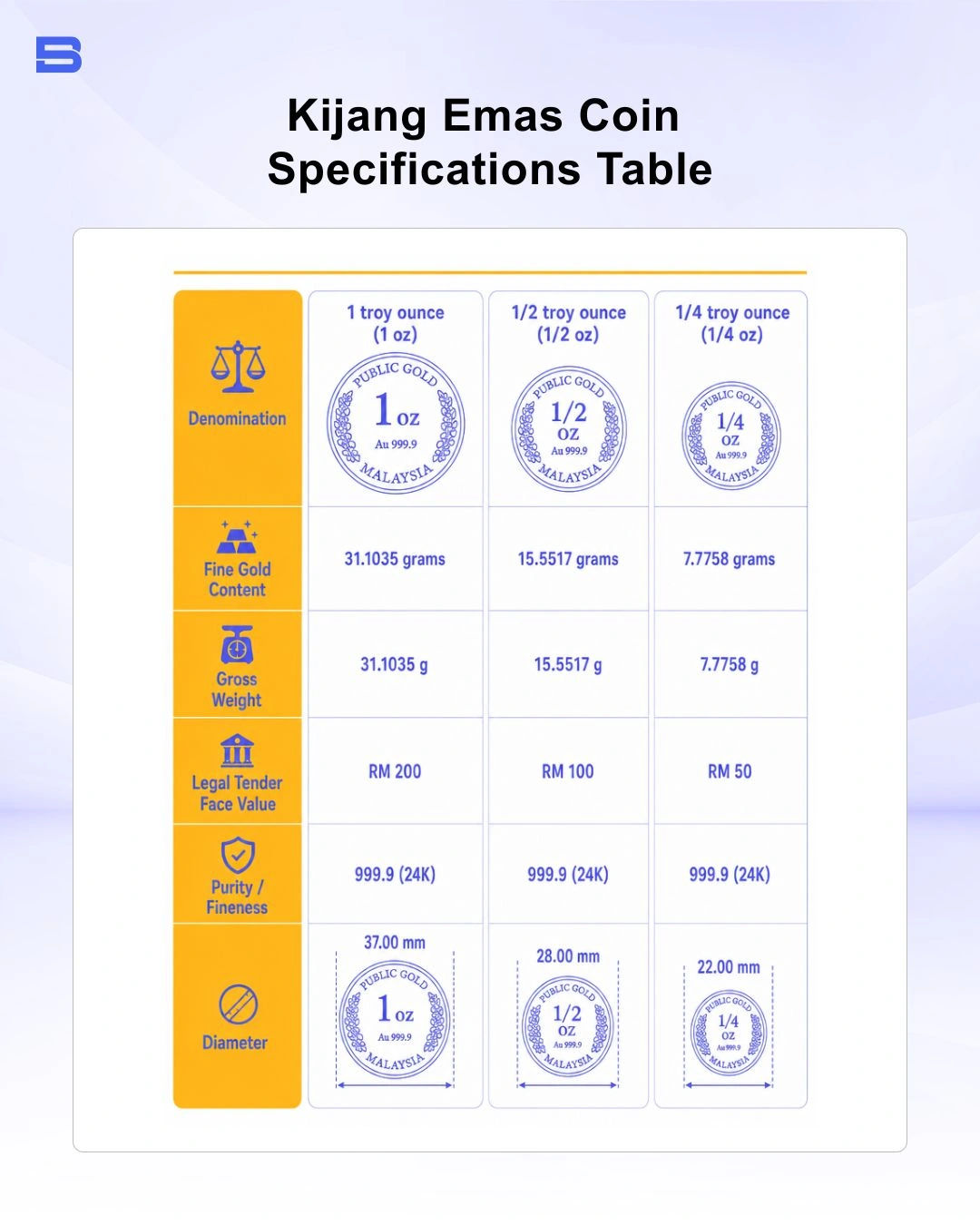
How to Buy Kijang Emas in Malaysia: Step-by-Step
Acquiring physical Kijang Emas coins involves an over-the-counter (OTC) process at authorized banking institutions. Maybank serves as the primary authorized distributor for Kijang Emas bullion coins in Malaysia.
Step 1: Confirm Branch Availability
Not all bank branches hold physical Kijang Emas inventory on site. You need to visit designated Maybank branches (typically main state branches or designated wealth management centers) that maintain gold counter services. Calling the branch in advance is advisable to confirm physical stock availability for your desired denomination.
Step 2: Check Daily Counter Rates
Before heading to the branch, check Maybank's daily gold counter rates, which update around 10:00 AM Malaysia Time (MYT) every business day. Prices fluctuate daily based on international spot gold market conditions and the US Dollar and Malaysian Ringgit (USD/MYR) currency exchange rate.
Step 3: Complete Identity Verification OTC
Visit the authorized branch in person with your original identity card (MyKad for Malaysian citizens) or passport (for foreign residents). Anti-Money Laundering (AML) regulations in Malaysia require full identity verification for physical precious metal purchases.
Step 4: Settle Payment and Receive Bullion
Payment is typically settled via direct debit from your bank account, banker's draft, or cash (subject to branch transaction limits). Once payment is confirmed, the bank hands over the physical Kijang Emas coin in its protective acrylic capsule alongside an official purchase receipt.
Important Storage Tip: Keep the coin inside its original protective capsule. Physical damage, scratches, or handling 24K gold with bare fingers can smudge the soft metal and potentially reduce its buyback value when liquidating.
How to Track Maybank Daily Counter Rates
Maybank publishes daily selling and buying prices for each coin denomination on its official website.
- Selling Price (Bank Sells to You): The price you pay to purchase the coin from the bank.
- Buying Price (Bank Buys from You): The price the bank pays you when you liquidate your coin back to them.
Monitoring these daily counter rates helps you time purchases during price dips or estimate your current liquidation value.
Understanding Kijang Emas Pricing and Buy-Sell Spreads
When investing in physical gold coins, understanding the buy-sell spread (or bid-ask spread) is essential. The spread represents the difference between the bank's selling price and buying price at any given moment, covering minting, handling, transport, and institutional profit margins.
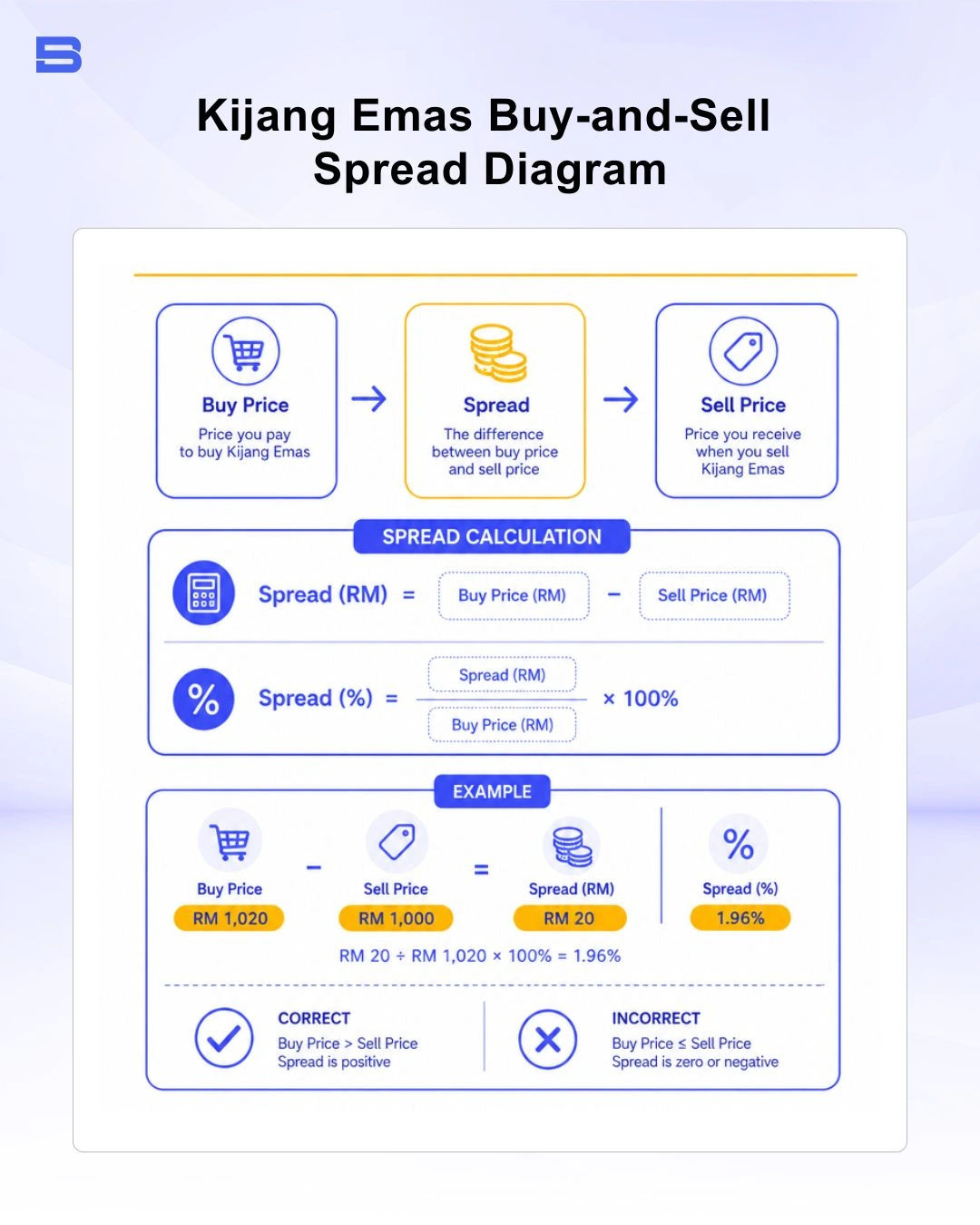
Physical bullion coins inherently carry a wider buy-sell spread than paper gold or digital gold accounts due to physical minting and logistics expenses.
Worked Example: Calculating Break-Even Threshold
Suppose international spot gold trades at a level where Maybank quotes the following daily counter rates for a 1 oz Kijang Emas coin:
- Selling Rate (You Buy): RM 12,500
- Buying Rate (You Sell): RM 11,875
To calculate the bank's spread percentage:
Spread = (Selling Rate - Buying Rate) / Selling Rate x 100
Spread = (RM12,500 - RM11,875) / RM12,500 x 100 = RM625 / RM12,500 x 100 = 5.0%
In this scenario, the initial transaction cost embedded in the spread is 5.0%. This means gold spot market prices must appreciate by at least 5.0% after your purchase just for your physical coin to reach its break-even liquidation value.
Smaller coin denominations (such as 1/4 oz) typically carry higher percentage spreads due to fixed minting costs relative to smaller gold content.
Physical Kijang Emas vs. Digital Gold in Malaysia: Key Differences
Choosing between physical bullion coins and modern digital gold Malaysia accounts (such as Maybank MIGA-i or CIMB e-Gold) depends on your specific holding objectives and security preferences.
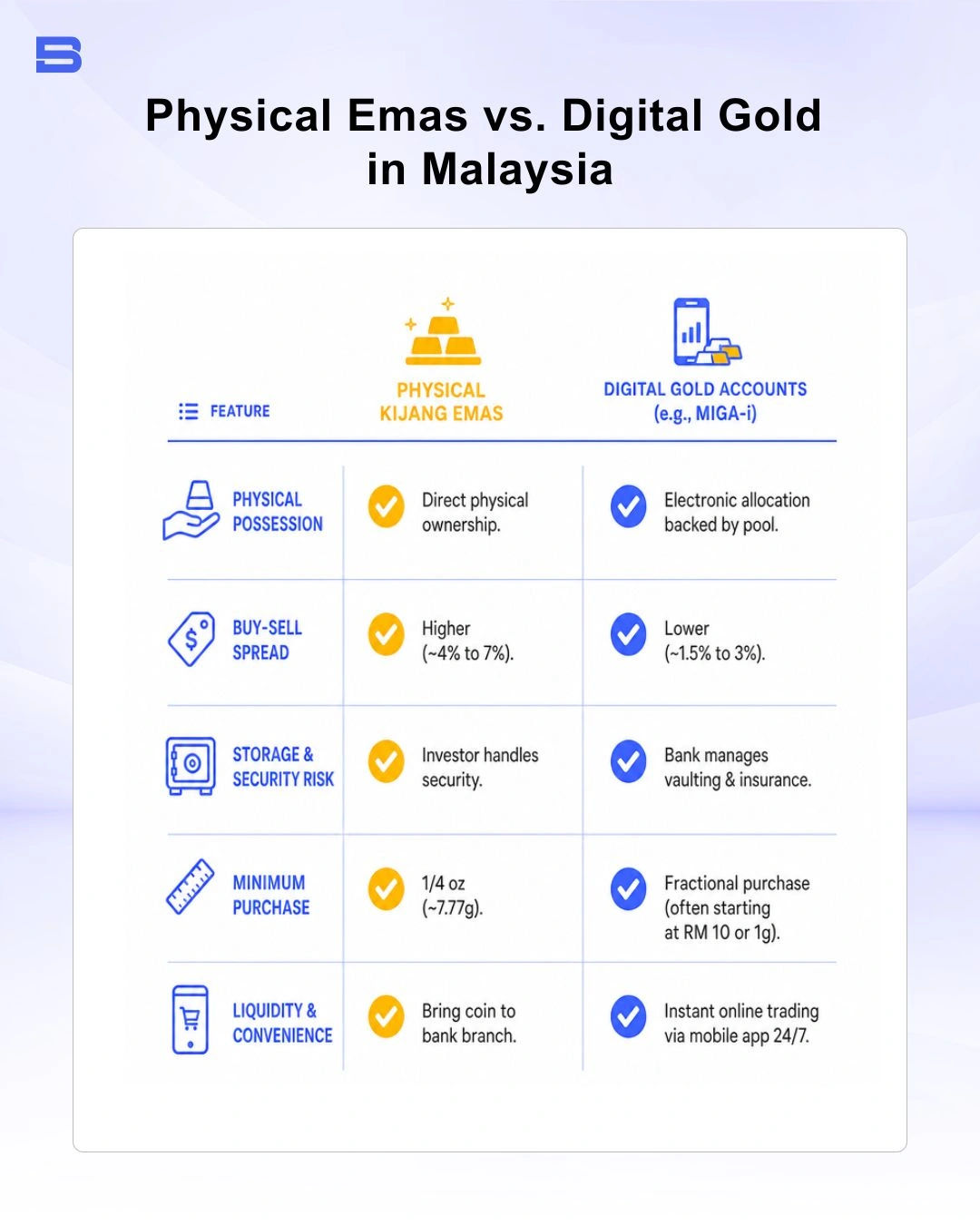
Holding physical coins grants total control free from digital counterparty platform risks. However, holding physical gold requires safe deposit boxes or secure home storage.
Digital gold provides tighter spreads and instant liquidity, but lacks direct physical custody unless requested for physical conversion (which incurs additional conversion fees).
Comparing Kijang Emas to Other Gold Investment Options in Malaysia
Physical coins are just one pathway within broader precious metal market options. Depending on whether your goal is wealth preservation, active short-term trading, or asset allocation, other instruments offer distinct mechanics:
- Gold ETFs (Bursa Malaysia): Exchange-Traded Funds (such as TradePlus Shariah Gold ETF) trade on Bursa Malaysia like regular stocks. They offer low transaction costs and real-time intraday trading, though you hold paper shares rather than physical coins in hand.
- Gold Futures & Commodity Derivatives: For short-term price exposure or active speculation without holding physical metal, instruments like gold futures or Futures Contract for Crude Palm Oil (FCPO) allow leveraged trading. Leverage magnifies both potential gains and potential losses, making derivatives significantly higher risk than physical bullion buy-and-hold strategies.
- Other Precious Metals: Investors looking beyond gold often explore physical silver bullion or how to trade silver for alternative commodity market exposure.
For long-term investors seeking physical safe-haven assets in Malaysia, gold investment Malaysia through Kijang Emas remains a foundational sovereign-backed bullion benchmark.
The Bottom Line
Bank Negara Malaysia's Kijang Emas offers a transparent, sovereign-backed avenue for owning 999.9 fine physical gold bullion in Malaysia. While physical ownership eliminates digital system risks, investors must factor in storage security and account for Maybank's daily buy-sell spreads.
Allocating a portion of your portfolio to physical bullion is often considered a long-term capital protection strategy rather than a short-term speculative vehicle. Always review your investment horizon and total portfolio risk tolerance before purchasing physical precious metals.
- What Can You Trade? A Guide to Forex, Stocks, and More
- CFD Trading for Beginners
- What is CFD Trading and How Does It Work?
- Forex vs. Stocks: Which Market Suits You Best?
- How to Diversify a Portfolio Across Asset Classes
- How Dividend Stocks Work: Yields, Risks, and Strategies
- Silver Trading Explained: A Guide for Retail Investors
- Precious Metals Trading: A Complete Guide for Beginners
- Natural Gas Trading: A Guide to the Market
- Structured Warrants Malaysia: How They Work and Risks
- What Is the KLCI Index and How to Trade It
- Gold Investment in Malaysia: A Complete Guide for Beginners
- What Is Kijang Emas and How to Invest in It
- Value Investing Explained: How to Find Undervalued Stocks
- How to Trade Bitcoin Safely: A Complete Market Guide
- Growth Investing Explained: Strategies, Metrics, and Risks
- What Is Digital Gold Malaysia and How to Invest
- Crypto Trading Strategies for Beginners
- Gold vs Bitcoin: Key Differences, Risks, and Strategies
- Sukuk: A Guide for Beginners to Islamic Bonds
- What Is FCPO (Crude Palm Oil Futures) and How to Trade It
- How to Identify and Invest in Shariah-Compliant Stocks
- Timber Investment: Is It Worth It?
- Gold ETF Malaysia: A Guide for Beginners
- What Are Malaysian Government Securities (MGS)?
- Corporate Bonds Malaysia: A Guide for Beginners
- China A-Shares Trading Guide for Malaysian Investors
- What Is a Silver ETF and How to Invest in It?
- How to Trade XRP: A Practical Guide for Retail Investors
- How to Trade Solana (SOL): A Guide for Beginners
- What Are Gold Futures and How Do They Work?
- Money Market Fund in Malaysia: A Guide for Beginners
- Property Investment Malaysia: Direct Real Estate or M-REITs?
- What Is Binance Coin and How Does It Work?
- Green Sukuk: A Guide for Beginners to Islamic ESG Investing
- What Is Shiba Inu (SHIB) and How to Trade It
- What Is USDT? A Complete Guide to Tether for Beginners
- What Is Dogecoin and How to Trade It Safely for Beginners
- Cardano: A Guide for Beginners to Trade This Cryptocurrency
- Polkadot: A Guide to Trading This Cryptocurrency
- Tron: A Guide for Beginners to Trading This Cryptocurrency
- What Is Litecoin (LTC)? A Guide to Trading Digital Silver
- What Is Chainlink (LINK) and How to Trade It
- How to Trade Pepe Coin: Spot, Leverage, and Risk Management
- Near Protocol: A Guide to Trading This Cryptocurrency
- Trading Polygon Crypto: A Practical Guide for Beginners
- Trade Toncoin: Understanding the TON Ecosystem and Risks
- Cosmos Crypto: Ecosystem Architecture, Tokenomics, and Risks
- Stellar Crypto: A Guide to Trading This Cryptocurrency
- Avalanche Crypto Explained: A Practical Guide for Traders
- What Is Worldcoin? How to Trade WLD and Manage Risk
- Aptos: A Guide for Beginners to Trading This Cryptocurrency
- Sui Crypto Explained: Tokenomics and Trading Guide
- Celestia: A Guide to Trading This Cryptocurrency
- Decentraland: A Guide to Trading This Cryptocurrency
- What Is Arbitrum? How to Trade the Leading Layer 2 Network
- Sei Crypto: A Guide to Trading This Cryptocurrency
- What Is Injective Protocol and How to Trade INJ Safely
Disclaimer: The content on this page is intended for educational and informational purposes only. It does not constitute financial, investment, tax, or legal advice, and should not be interpreted as a recommendation to buy, sell, or hold any financial instrument or asset. Trading and investing involve significant risk, including the possible loss of your entire capital. Products such as forex, CFDs, and cryptocurrencies carry additional risks due to leverage, high volatility, and limited regulatory protection in some jurisdictions. Past performance of any financial instrument does not guarantee future results. Any market views, forecasts, or opinions expressed are those of the author at the time of writing and may not reflect current market conditions. Platform features, fees, and regulatory status are subject to change — always verify information directly with the relevant provider or regulator before making any financial decision. BrokerSpecs may receive compensation from third parties featured on this site. Always conduct your own due diligence and consider seeking advice from a licensed financial professional before investing.