



Related Tags
Entering overseas stock markets often means looking toward Wall Street or regional hubs like Singapore and Hong Kong. However, as the world’s second-largest economy continues to expand its domestic capital markets, mainland Chinese equities are increasingly attracting global capital.
For Malaysian investors seeking to diversify beyond Bursa Malaysia and US tech equities, mainland Chinese companies offer direct exposure to vast domestic consumer bases, state-led infrastructure, and rapid industrial development.
Accessing these markets directly was once limited to major international institutions, but modern regulatory channels now allow retail investors in Malaysia to participate. Understanding how China's equity market is structured, how to trade its mainland shares, and how to manage the associated currency and regulatory risks is essential before placing your first trade.
What Are China A-Shares and How Do They Work?
China A-shares are equity shares of mainland Chinese companies that are incorporated and listed on either the Shanghai Stock Exchange (SSE) or the Shenzhen Stock Exchange (SZSE). Historically, these shares were denominated solely in Renminbi (RMB) and restricted strictly to domestic mainland citizens.
Over time, international access opened up through qualified institutional quota programs such as Qualified Foreign Institutional Investor (QFII) and Renminbi Qualified Foreign Institutional Investor (RQFII) and, more recently, through direct cross-border trading links.
Mainland Chinese markets operate alongside several distinct asset classes, and confusing them can lead to unexpected execution and settlement outcomes.
Key Differences: China A-Shares vs. H-Shares and ADRs
When investing in Chinese corporations, you will encounter multiple share classes depending on the exchange venue and target investor base. The primary distinctions involve currency settlement, listing location, and regulatory oversight.
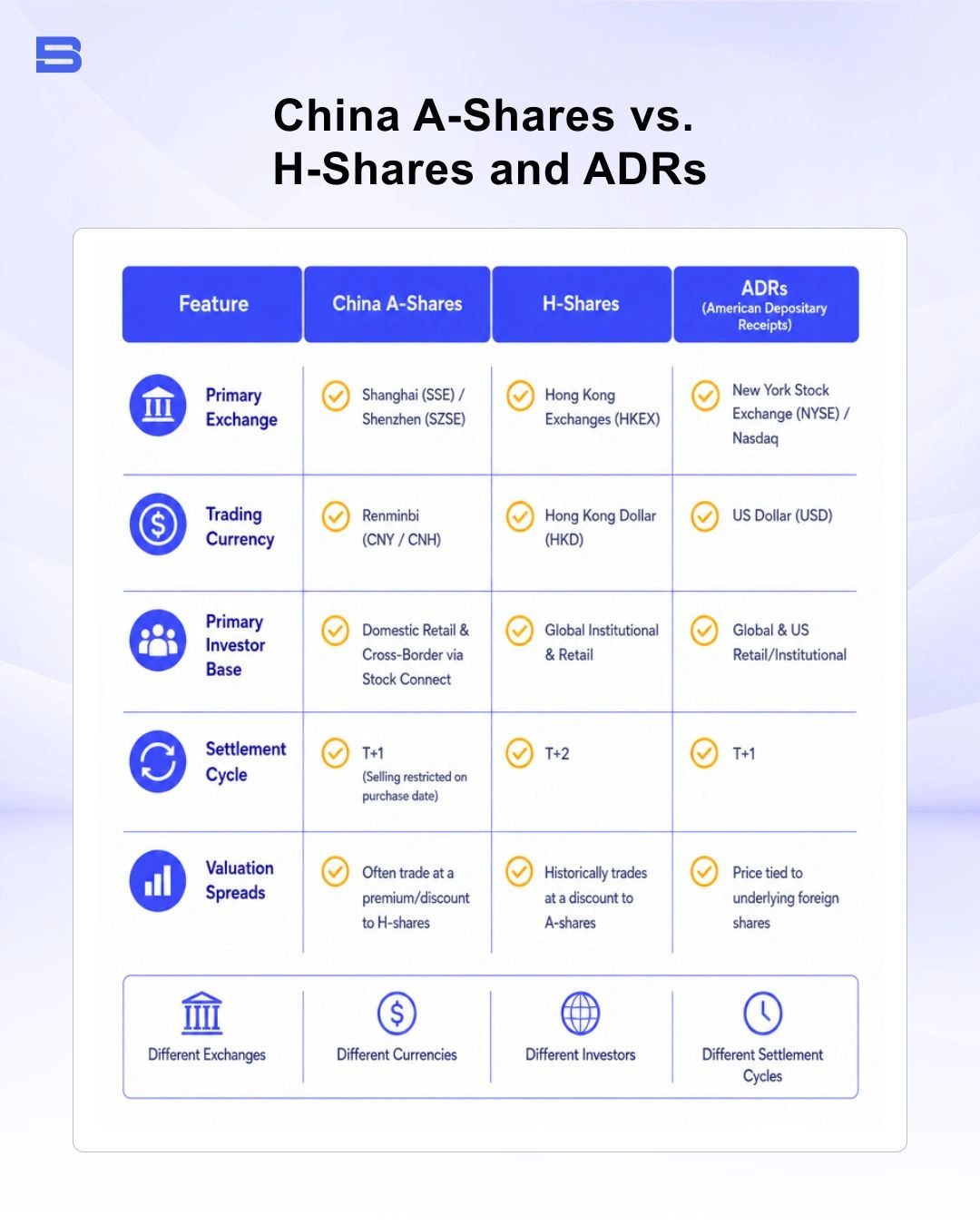
Understanding these distinctions helps clarify why a dual-listed company—such as a major mainland state-owned bank—might trade at different valuations in Shanghai compared to Hong Kong.
Growth Investing in Mainland Technology and Green Energy Sectors
For investors pursuing growth investing, mainland A-shares provide direct access to supply chains that are unavailable on secondary international exchanges. While overseas investors often recognize mega-cap tech conglomerates listed in Hong Kong or New York, the Shanghai and Shenzhen exchanges host the underlying ecosystem: advanced industrial automation, solar panel manufacturing, electric vehicle (EV) battery suppliers, and domestic semiconductor foundries.
Allocating to growth sectors in mainland China allows you to participate in domestic policy initiatives aimed at high-tech manufacturing independence and renewable energy deployment.
How to Trade China A-Shares in Malaysia via Stock Connect
The most accessible route for retail investors in Malaysia to buy direct China A-shares is through the Northbound Stock Connect market access program. Established between Hong Kong Exchanges and Clearing (HKEX), the Shanghai Stock Exchange, and the Shenzhen Stock Exchange, Stock Connect allows international investors to execute orders in mainland shares via eligible Hong Kong and Malaysian brokers without opening a mainland bank account.
Eligible Stock Connect Brokers in Malaysia
To trade A-shares, you do not need a specialized mainland brokerage. Instead, several local and regional brokers operating under Securities Commission Malaysia (SC) oversight provide direct market connectivity:
- Digital Brokerages: Platforms such as Moomoo Malaysia and FSMOne offer integrated access to Shanghai and Shenzhen markets via the Stock Connect route, featuring digital account opening and integrated offshore RMB currency conversion.
- Traditional Investment Banks: Local brokerages like Maybank Investment Bank, RHB Investment Bank, and CGS International provide overseas trading accounts equipped to route Northbound orders.
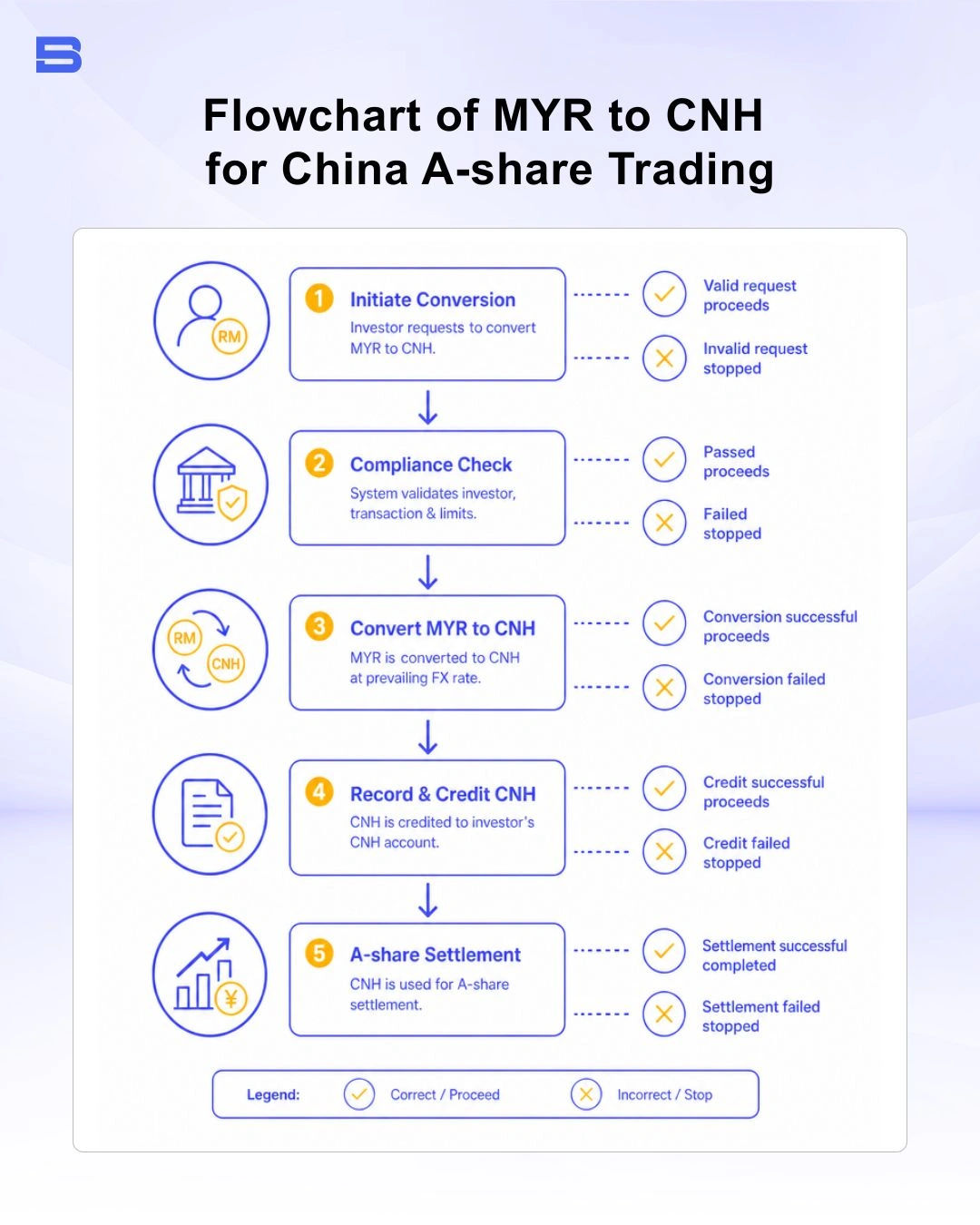
When choosing a broker, check whether their platform automatically converts Ringgit (MYR) to Offshore Renminbi (CNH) or whether you must perform currency conversion manually before placing an order.
Essential Stock Connect Trading Rules
Trading mainland equities via Northbound Stock Connect differs mechanically from placing trades on Bursa Malaysia or US exchanges:
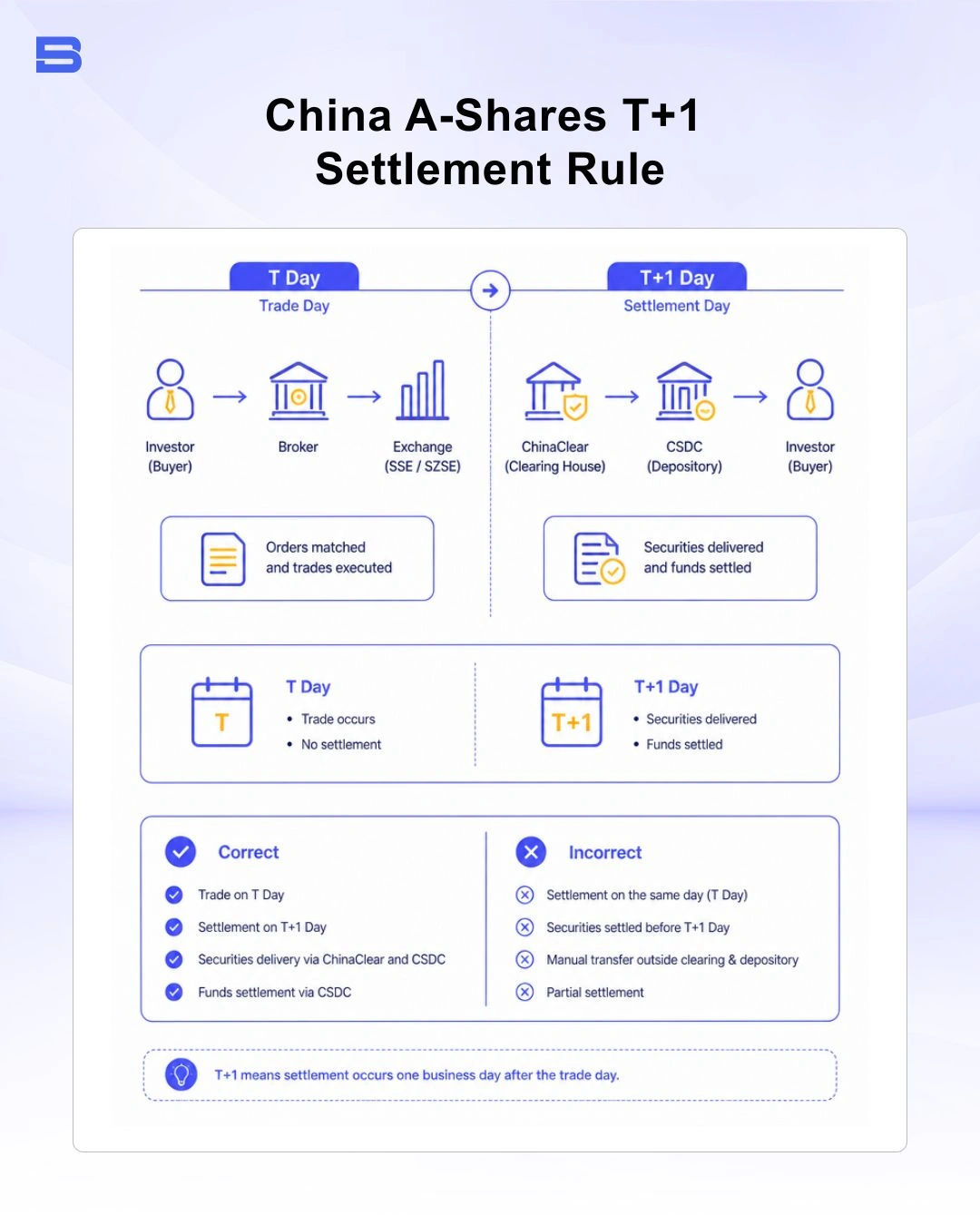
- T+1 Settlement Cycle: Shares purchased on day T cannot be sold until day T+1. Intra-day day trading (buying and selling the same stock on the same trading day) is strictly prohibited on mainland A-share markets.
- Limit Orders Only: Market orders are generally not permitted for Northbound trades; orders must be submitted as limit orders to prevent unexpected execution slippage.
- Board Lot Sizes: All buy orders must be placed in standard board lots of 100 shares. Odd lot execution is restricted exclusively to sell orders.
- Price Limits: Mainland Chinese exchanges generally impose daily price fluctuation limits on A-shares. On the Shanghai Stock Exchange, A-shares are normally subject to a ±10% daily price limit based on the previous closing price. On the Shenzhen Stock Exchange, Main Board stocks are generally subject to a ±10% limit, while ChiNext stocks are subject to a ±20% limit. Certain stocks, such as newly listed shares and risk-warning stocks, are subject to different rules.
- Trading Hours & Holidays: Northbound trading operates only on days when both the mainland markets (SSE/SZSE) and the Hong Kong market (HKEX) are open for business and clearing services are active.
Indirect Exposure: Investing in China A-Shares via ETFs
Directly stock-picking individual mainland equities requires ongoing monitoring of balance sheets, local regulatory announcements, and sector dynamics. If you prefer broad market coverage with lower operational complexity, Exchange-Traded Funds (ETFs) in Malaysia offer a practical alternative.
ETFs aggregate a basket of mainland equities into a single tradable security. By purchasing an A-share index ETF, you gain instant diversification across major mainland benchmark indices, such as the CSI 300 (tracking the top 300 stocks listed in Shanghai and Shenzhen) or the FTSE China A50.
Malaysian investors can access China A-share ETFs across three primary venues:
- Bursa Malaysia: Local ETFs tracking China indices allow you to invest directly in Ringgit (MYR) without incurring foreign exchange conversion fees, though trading volume may be lower than regional offerings.
- Hong Kong Exchanges (HKEX): Offers deep liquidity for physical and synthetic China A-share ETFs denominated in Hong Kong dollars (HKD), CNH, or US dollars (USD).
- US Exchanges (NYSE/Nasdaq): Broad-market China ETFs listed in the US provide access denominated in USD, though you should factor in local withholding tax treatment on underlying dividends.
Value Investing and Dividend Yield Strategies in Mainland Chinese Equities
Mainland Chinese markets are frequently characterized as growth-heavy and driven by retail sentiment, but substantial segments of the A-share universe appeal to conservative value investors.
Dividend Yield Strategies in A-Share Blue-Chips
For investors evaluating investment in dividend stocks, large-cap state-owned enterprises (SOEs) listed on the Shanghai exchange represent significant cash-flow generation. Sectors such as commercial banking, energy distribution, telecom infrastructure, and state-backed transport corridors frequently display high dividend yields.
Regulatory initiatives by mainland authorities have encouraged listed enterprises to improve corporate governance and maintain reliable dividend distribution payouts. Incorporating dividend-paying A-share blue chips alongside how to buy US stocks in Malaysia can provide defensive cash-flow yield while balancing portfolio volatility.
Value Investing Principles in Mainland Markets
Applying value investing in mainland markets requires looking beyond traditional price-to-earnings ratios. Because retail investors account for a significant portion of daily trading volume on mainland exchanges, market sentiment can cause stocks to swing widely away from their intrinsic valuation.
Value strategies in China focus on identifying cash-rich companies with strong moat protection, low debt levels, and stable domestic market share that may be temporarily out of favor due to macro sentiment.
Key Risks: RMB Currency Risk, Policy Volatility, and Settlement Rules
Allocating capital to mainland Chinese equities involves specific risk factors that must be managed alongside potential portfolio growth.
1. Offshore Renminbi (CNH) Currency Risk
Northbound Stock Connect transactions are quoted in onshore RMB (CNY) but settled in offshore RMB (CNH). Foreign exchange rate fluctuations between the Malaysian Ringgit (MYR) and CNH directly impact your investment returns. If the Renminbi depreciates against the Ringgit, your capital gains and dividend returns will yield less when converted back into MYR.
2. Policy and Regulatory Volatility
Mainland corporate earnings can be affected by shifting regulatory frameworks, state economic planning, and industry-specific interventions. Sudden policy updates targeting data security, private education, or real estate deleveraging have historically triggered rapid sector repricing.
3. Market Structure and Settlement Restrictions
Because direct A-share purchases follow T+1 settlement rules, you cannot immediately hedge or exit a newly opened position if unexpected market news breaks on the day of purchase. Furthermore, if the daily quota for Northbound Stock Connect is exhausted during periods of intense market activity, new buy orders may be rejected until quota space frees up.
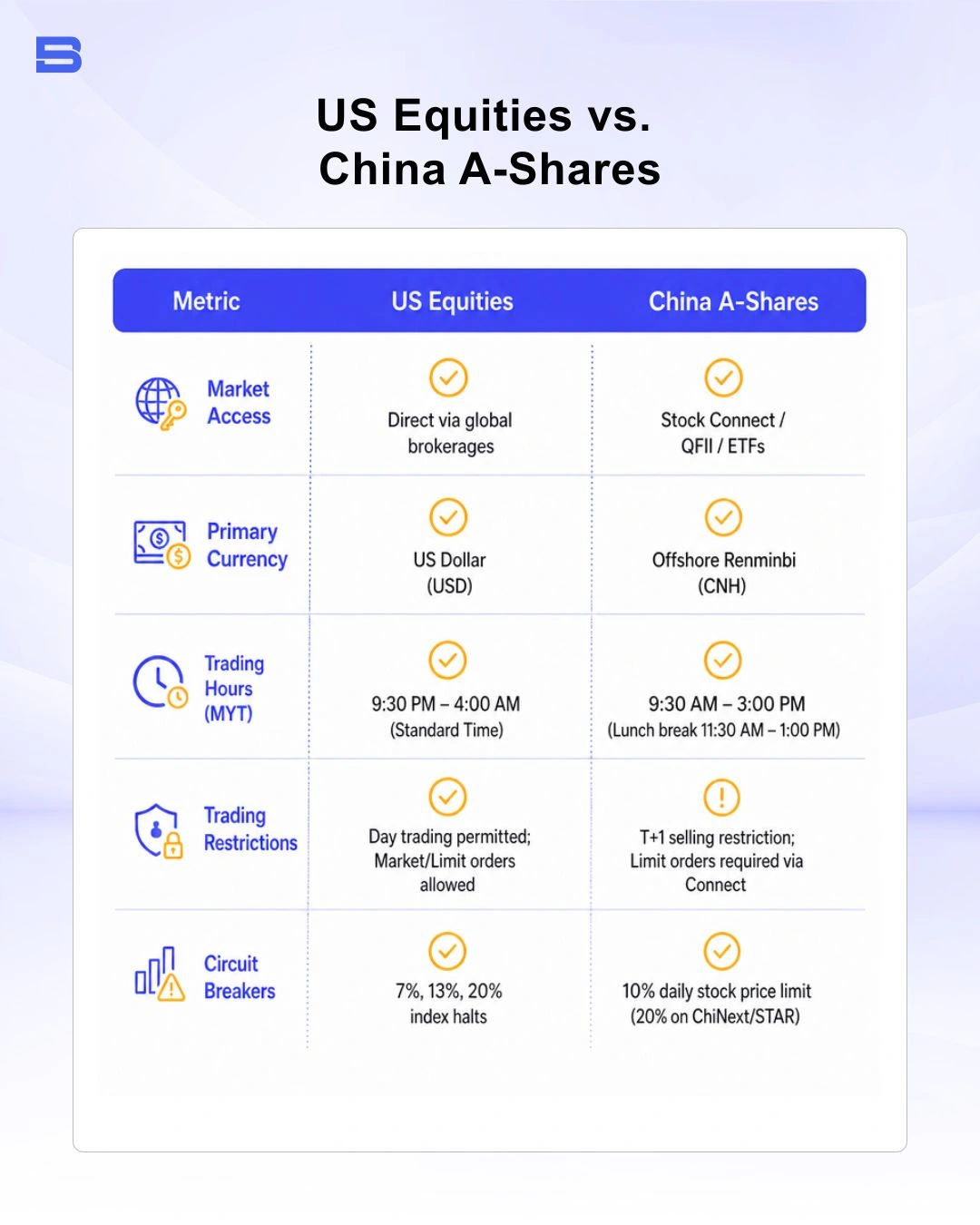
Accessing Foreign Markets: Comparing US Equities vs. China A-Shares
To understand how mainland Chinese stocks fit into a broader international portfolio, compare their structural characteristics against US equity markets:
The Bottom Line
Investing in China A-shares provides direct access to mainland China's domestic industrial base, technological supply chains, and consumer markets. While Northbound Stock Connect has significantly streamlined access for retail investors in Malaysia, trading mainland shares requires navigating unique rules such as T+1 settlement cycles, price fluctuation limits, and offshore CNH exchange rates.
By balancing direct stock exposure or ETF holdings against known regulatory and currency risks, you can effectively integrate mainland Chinese equities into a well-diversified global portfolio.
- What Can You Trade? A Guide to Forex, Stocks, and More
- CFD Trading for Beginners
- What is CFD Trading and How Does It Work?
- Forex vs. Stocks: Which Market Suits You Best?
- How to Diversify a Portfolio Across Asset Classes
- How Dividend Stocks Work: Yields, Risks, and Strategies
- Silver Trading Explained: A Guide for Retail Investors
- Precious Metals Trading: A Complete Guide for Beginners
- Natural Gas Trading: A Guide to the Market
- Structured Warrants Malaysia: How They Work and Risks
- What Is the KLCI Index and How to Trade It
- Gold Investment in Malaysia: A Complete Guide for Beginners
- What Is Kijang Emas and How to Invest in It
- Value Investing Explained: How to Find Undervalued Stocks
- How to Trade Bitcoin Safely: A Complete Market Guide
- Growth Investing Explained: Strategies, Metrics, and Risks
- What Is Digital Gold Malaysia and How to Invest
- Crypto Trading Strategies for Beginners
- Gold vs Bitcoin: Key Differences, Risks, and Strategies
- Sukuk: A Guide for Beginners to Islamic Bonds
- What Is FCPO (Crude Palm Oil Futures) and How to Trade It
- How to Identify and Invest in Shariah-Compliant Stocks
- Timber Investment: Is It Worth It?
- Gold ETF Malaysia: A Guide for Beginners
- What Are Malaysian Government Securities (MGS)?
- Corporate Bonds Malaysia: A Guide for Beginners
- China A-Shares Trading Guide for Malaysian Investors
- What Is a Silver ETF and How to Invest in It?
- How to Trade XRP: A Practical Guide for Retail Investors
- How to Trade Solana (SOL): A Guide for Beginners
- What Are Gold Futures and How Do They Work?
- Money Market Fund in Malaysia: A Guide for Beginners
- Property Investment Malaysia: Direct Real Estate or M-REITs?
- What Is Binance Coin and How Does It Work?
- Green Sukuk: A Guide for Beginners to Islamic ESG Investing
- What Is Shiba Inu (SHIB) and How to Trade It
- What Is USDT? A Complete Guide to Tether for Beginners
- What Is Dogecoin and How to Trade It Safely for Beginners
- Cardano: A Guide for Beginners to Trade This Cryptocurrency
- Polkadot: A Guide to Trading This Cryptocurrency
- Tron: A Guide for Beginners to Trading This Cryptocurrency
- What Is Litecoin (LTC)? A Guide to Trading Digital Silver
- What Is Chainlink (LINK) and How to Trade It
- How to Trade Pepe Coin: Spot, Leverage, and Risk Management
- Near Protocol: A Guide to Trading This Cryptocurrency
- Trading Polygon Crypto: A Practical Guide for Beginners
- Trade Toncoin: Understanding the TON Ecosystem and Risks
- Cosmos Crypto: Ecosystem Architecture, Tokenomics, and Risks
- Stellar Crypto: A Guide to Trading This Cryptocurrency
- Avalanche Crypto Explained: A Practical Guide for Traders
- What Is Worldcoin? How to Trade WLD and Manage Risk
- Aptos: A Guide for Beginners to Trading This Cryptocurrency
- Sui Crypto Explained: Tokenomics and Trading Guide
- Celestia: A Guide to Trading This Cryptocurrency
- Decentraland: A Guide to Trading This Cryptocurrency
- What Is Arbitrum? How to Trade the Leading Layer 2 Network
- Sei Crypto: A Guide to Trading This Cryptocurrency
- What Is Injective Protocol and How to Trade INJ Safely
Disclaimer: The content on this page is intended for educational and informational purposes only. It does not constitute financial, investment, tax, or legal advice, and should not be interpreted as a recommendation to buy, sell, or hold any financial instrument or asset. Trading and investing involve significant risk, including the possible loss of your entire capital. Products such as forex, CFDs, and cryptocurrencies carry additional risks due to leverage, high volatility, and limited regulatory protection in some jurisdictions. Past performance of any financial instrument does not guarantee future results. Any market views, forecasts, or opinions expressed are those of the author at the time of writing and may not reflect current market conditions. Platform features, fees, and regulatory status are subject to change — always verify information directly with the relevant provider or regulator before making any financial decision. BrokerSpecs may receive compensation from third parties featured on this site. Always conduct your own due diligence and consider seeking advice from a licensed financial professional before investing.