



Related Tags
Think of an investment plan as the “rule book” for your money. It’s a predefined set of guidelines that dictates your risk tolerance, goals, and the assets you buy or sell to reach a specific financial goal.
Without a proper strategy, you may end up investing based on emotion, like panic-selling when the market drops or hype-buying a stock because everyone did the same. Having an investment plan will keep those impulses in check and help you make an informed decision.
Whether you choose to manage your investment independently or partner with a financial advisor, your investment plan should not be treated as a “set and forget” endeavour. Since your life goals and economy are constantly evolving, it is vital to periodically review and adjust your strategy to ensure it remains aligned with your long-term objectives.
Benefits of Investment Planning
Strategizing your investments is a critical exercise in maximizing the utility of your capital. By moving beyond simple saving and into planning, you can effectively:
- Recurring Cash Flow
Transform idle cash into a source of recurring income streams. - Long-Term Tax Savings
Utilize strategic planning to minimize the tax liability on your portfolio growth. - Accelerate Financial Freedom
Create a path towards self-sufficiency, where work becomes a choice rather than a necessity. - Ensure Long-Term Financial Security
Establish a financial safety net that ensures the stability of your household.
Clearly Define Your Financial Goals
Before deciding where to invest, you need a clear reason, whether you’re eyeing a down payment on a house, funding a child’s tuition, or building a retirement nest egg. Your objectives dictate your strategy. To make your plan actionable, it’s important to categorize your goals into an expected timeline:
Short-term (0-3 years): Immediate needs requiring high liquidity and safety.
Medium-term (3-5 years): Intermediate goals allow for a balanced mix of growth and stability.
Long-term (5+ years): Distant milestones that allow you to prioritize higher growth and compounding.
By mapping out these targets, it becomes easier to set realistic investment goals that align with your objectives and effectively support each of your financial goals. Using the SMART goals framework can help you set specific, measurable, achievable, relevant, and time-bound goals as it helps keep your purposes realistic while holding you accountable for accomplishing them.
Assess Your Risk Tolerance
Risk tolerance is highly personal to every individual. Whether you’re willing to endure market swings for the sake of higher growth or you prefer the peace of mind that comes with steady, guaranteed returns, your comfort level dictates your strategy.
Identifying risk tolerance provides valuable insight, helping ensure your portfolio aligns with your personal comfort and investment temperament. For example, a conservative profile typically favours fixed-income stability, whereas an aggressive profile seeks out equity-based investments.
Steps to Assess Your Risk Tolerance
To assess your risk tolerance, you need to look at your financial ability to take risks and your emotional ability to handle risks.
Here are the essential steps to determine where you sit on the spectrum:
Assess Your Investment Timeline
Long-term goals (retiring in 20 years) generally favour higher-growth assets like stocks.
Short-term targets (home purchase in two years) require lower risk, such as cash or bonds.
Determine Your Financial Resilience (Risk Capacity)
Assess your ability to withstand potential losses without compromising your daily lifestyle, depleting your emergency fund, or derailing long-term security. If your essential expenses are covered and your debt is low, you have a higher capacity to take risks.
Test Your Emotional Fortitude (Risk Tolerance)
Beyond the numbers, consider how you react when the market dives. Being honest about your temperament helps you avoid an aggressive strategy that can lead to poor, impulsive decisions during volatile times.
Utilize Questionnaire
Take advantage of the structured risk-profile questionnaire offered by major financial institutions. These assessments use targeted behavioural questions to strip away bias, providing data-driven information about the spectrum from conservative to aggressive.
Identify Your Profile
Once you have analyzed your timeline and synthesized these factors into a clear investment profile. There are a few categorizations that serve as your strategic compass, ensuring every asset you choose aligns with your ultimate objectives.
- Conservative: Prioritize capital preservation and are willing to accept lower returns to reduce volatility.
- Moderate: Accept some market fluctuations in pursuit of greater long-term growth.
- Aggressive: Highly tolerant of volatility and focused on maximizing long-term growth.
By identifying your profile, you create a standard that holds you accountable, making it easier to filter out market noise and stick to your long-term plan. You can commit to an annual reassessment or a check-in following a significant milestone, such as a career shift, to ensure your investment still mirrors your current financial reality.
Keeping this alignment sharp prevents you from outgrowing your plan or taking on unnecessary exposure as your goals shift.
What Shapes Your Risk Tolerance
Risk tolerance refers to the level of uncertainty that you are willing to accept when facing potential declines in your portfolio. It is mainly influenced by factors such as age, financial capacity, investment time horizon, and personal comfort with market volatility.
Key Factors Affecting Risk Tolerance:
Age and Time Horizon
Younger investors typically have a higher risk tolerance because they have more time to recover from potential loss. A longer time horizon allows them to withstand and ride out periods of market volatility.
Financial Ability to Take Risk
Your net worth, income stability, and debt levels measure how much market turbulence you can withstand based on your actual balance sheet. Higher income and assets generally will lead to much greater risk-taking.
Emotional Tolerance for Risk
It reflects your emotional resilience when faced with market swings. Risk-averse individuals prefer stability and are willing to trade higher potential returns for the security of low volatility assets. Risk-seeking individuals are comfortable with navigating high-volatility assets like equities or venture capital.
Investment Goals
Categorize by short-term goals that include immediate needs like an emergency fund or down payment for a home. Long-term goals focus more on the retirement plan, as it typically involves high growth objectives and more risk-taking to preserve the capital.
Understanding and Experience Level
If you possess a deep understanding of financial mechanisms or have navigated previous market cycles, you tend to demonstrate a higher appetite for risk.
Family Responsibilities and Marital Status
Having greater financial responsibilities, particularly in the presence of dependants, can lower your willingness to take on financial risk.
By considering these factors, you can construct a portfolio that combines stability with the potential for meaningful long-term gains.
Ultimately, finding the right balance helps you avoid the common extremes of being overly cautious and losing purchasing power to inflation, or taking excessive risks that could lead to panic selling during market downturns.
Conservative and Aggressive Investment Approaches
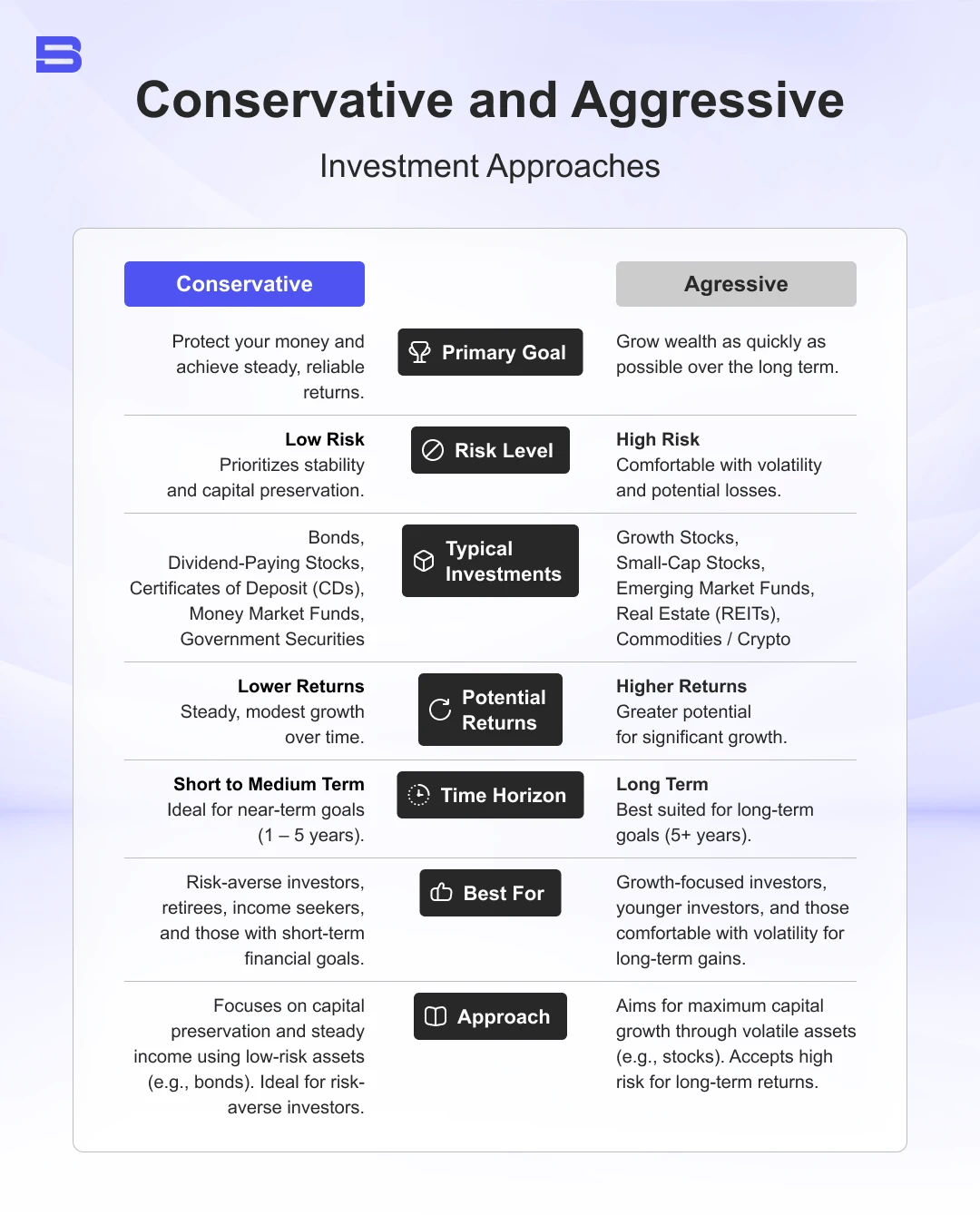
Conservative investing focuses on preserving capital and generating stable income by investing in lower-risk assets such as bonds. This approach is generally suitable for retirees or individuals who prefer minimal risk. In contrast, aggressive investing targets substantial capital growth by allocating funds to stocks and other volatile assets, accepting higher levels of risk in pursuit of greater long-term returns.
The appropriate strategy depends on an individual’s risk tolerance, investment time horizon, and financial objectives.
To get a clear picture of the comparison, refer to the infographic below:
Factors to Consider When Selecting an Investment Account
Navigating the landscape of investment accounts requires a synergy between your financial objectives, time horizon, and risk appetite. While the ideal account is highly subjective, most enthusiasts structure their portfolios using a combination of the following wrappers:
- Taxable Brokerage Accounts
Most versatile options if you’re looking for unrestricted capital access. - Individual Retirement Accounts (IRAs)
Specialized for long-term wealth accumulation through significant tax advantages. - 529 Education Savings Plans
If you’re looking to fund educational legacies, the 529 operates similarly to an IRA but is earmarked for qualified education expenses.
Summary of Account Attributes:
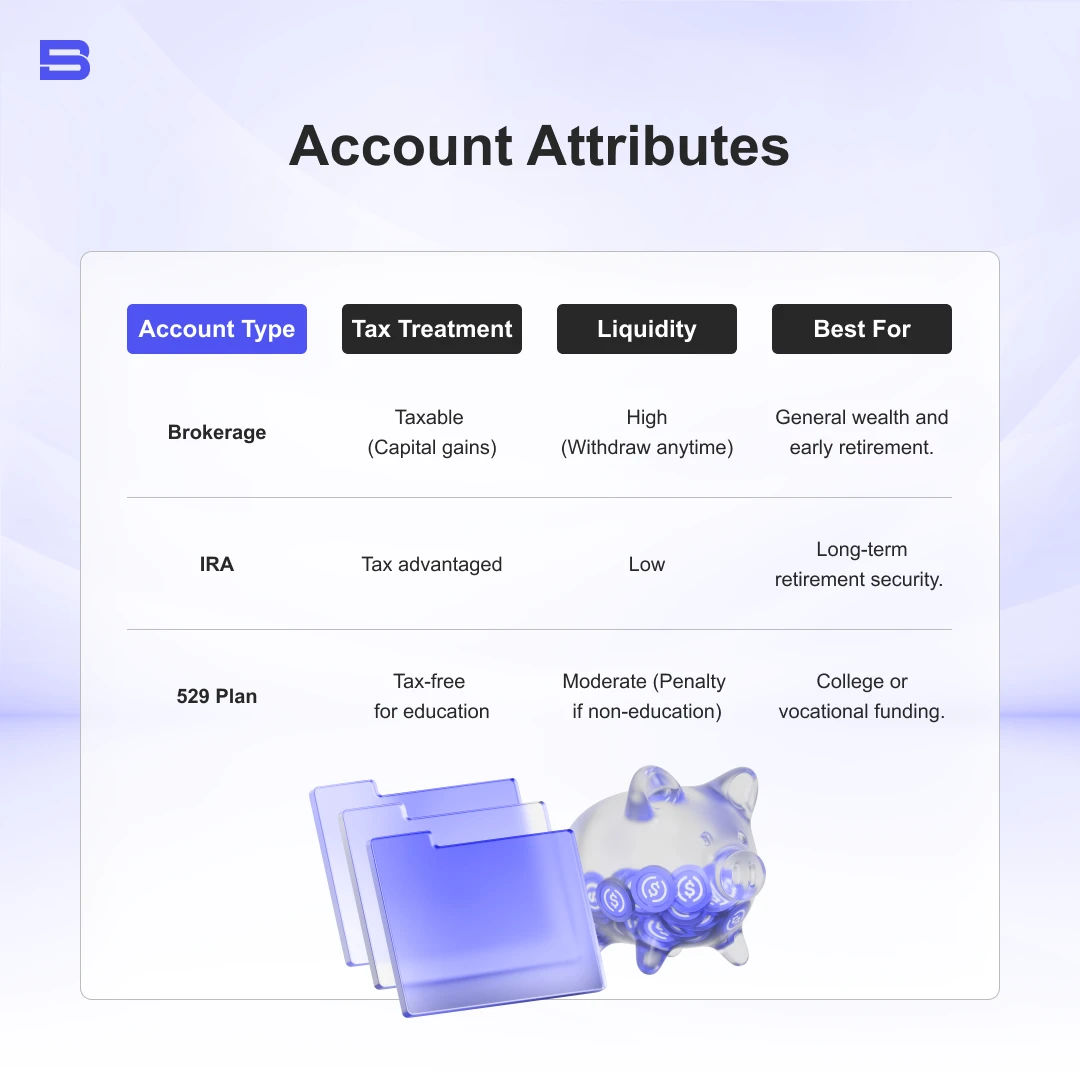
Optimizing your wealth starts with aligning your capital with the appropriate investment accounts. Your choice should be a direct reflection of your intended destination, your timeline, and your capacity for market fluctuations.
As you refine your plan, are you prioritizing a tax-deferred growth to lower your current bracket, or are you aiming for tax-free distributions in the future?
How To Build an Investment Portfolio?
Constructing a diversified portfolio requires a deep understanding of asset allocation and the mechanics of diversification. Spreading your investments across different types of assets can help manage risk.
The main asset classes include:
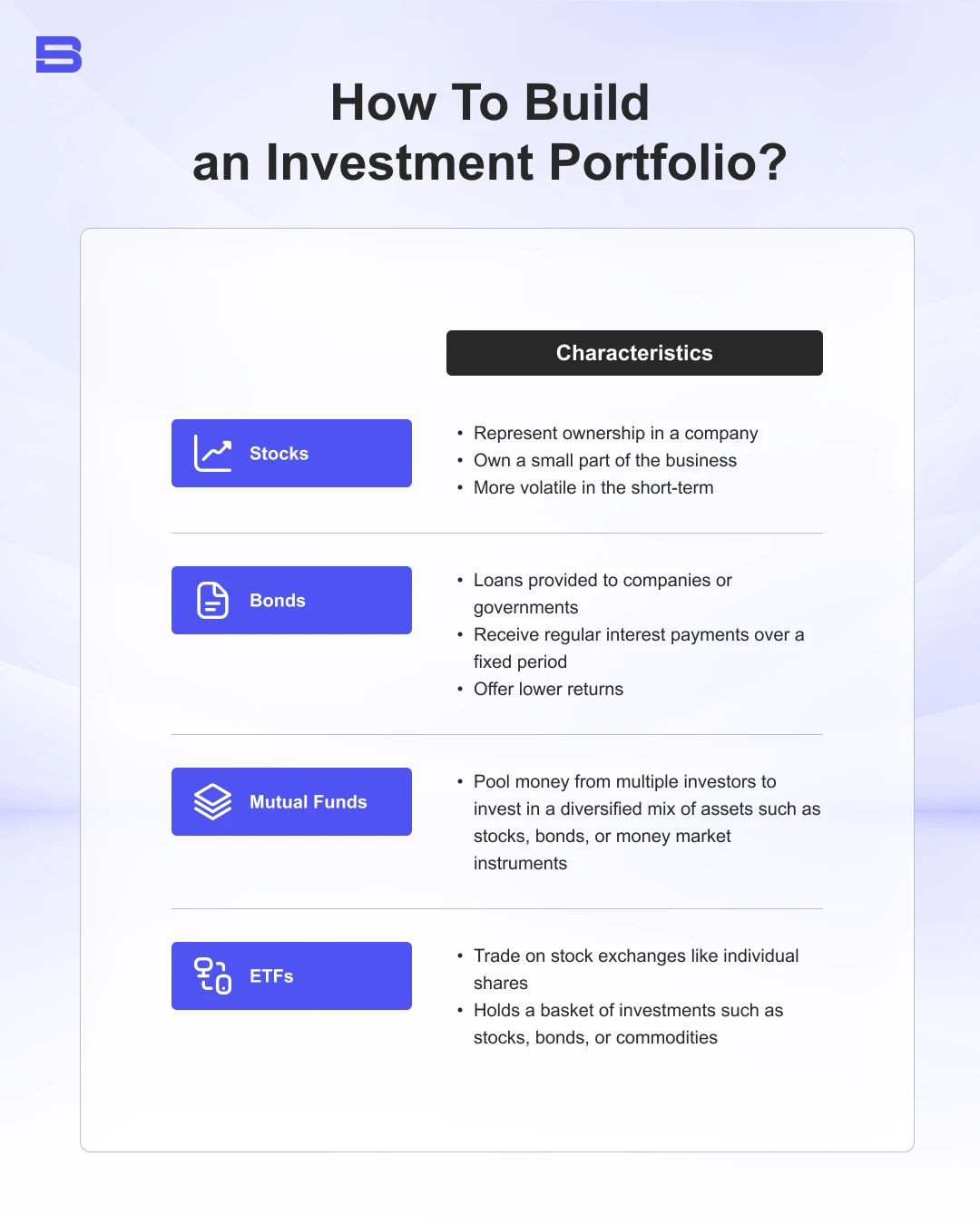
Diversifying your portfolio means combining different types of investments to help reduce overall risk and improve the likelihood of reaching your financial goals.
Here are some ways to diversify your portfolio:
- Invest across different asset classes, such as stocks, bonds, mutual funds, and ETFs, to reduce the impact of poor performance in any single category.
- Spread investment across various sectors by rotating exposure into healthcare, technology, financials, and real estate.
- Hedging against a domestic economic downturn by allocating a portion of your portfolio to different countries and regions.
While these options may seem complex, you can utilize systematic tools that can quantify your risk tolerance. It interprets your personal preferences into a strategic investment plan to ensure your portfolio remains aligned with your long-term objectives.
Ready to Start Your Investment Journey?
An investment plan serves as the operational framework for your financial life, ensuring that every capital allocation is a deliberate step toward your objectives rather than a reactive impulse.
A robust investment strategy is your primary defense against market noise. By remaining adaptable yet grounded in research, you secure a financial future that is built on intentionality rather than luck. Begin your investment journey today and grow your confidence along the way.
- How to Build an Investment Plan That Actually Works for You?
- What Is the MACD Indicator and How to Use It
- What Is a Wedge Pattern in Trading?
- What Is Ichimoku Cloud Strategy? A Complete Trading System
- Mastering Elliott Wave Theory: Rules and Trading Strategies
- News Trading: Strategies, Execution Risks, and Risk Control
- What Is an Iron Condor Options Strategy?
- Backtesting Explained: What It Is and Why It Really Matters
- Grid Trading: Mechanics, Parameters, and Risk Strategies
- What Is Breakout Trading and How Does It Work?
- Mean Reversion: Technical Strategies and Risk Frameworks
- Momentum Trading: Indicators, Strategies, and Risk Control
- Hammer Candlestick: Structure, Meaning, and Strategy
- Doji Candlestick: Types, Signals, and Trading Strategies
- What Is the Sharpe Ratio and How to Calculate It
- What Is VWAP and How Do Traders Use It?
- Trade the Ascending Triangle: A Step-by-Step Practical Guide
- What Is the Stochastic Oscillator and How to Use It
- How to Trade the Descending Triangle Pattern
- High Frequency Trading: Speed, Algorithms, and Market Impact
- What Is Volume Profile and How to Use It in Trading
- What Is a Morning Star Pattern Candlestick?
- Trade with Parabolic SAR: A Practical Analysis Guide
- Evening Star Pattern: Structure, Rules, and Risk Controls
- Kelly Criterion: Formula, Position Sizing, and Risk
- What Is the NYSE Minimum Trading Price? Rules Explained
Disclaimer: The content on this page is intended for educational and informational purposes only. It does not constitute financial, investment, tax, or legal advice, and should not be interpreted as a recommendation to buy, sell, or hold any financial instrument or asset. Trading and investing involve significant risk, including the possible loss of your entire capital. Products such as forex, CFDs, and cryptocurrencies carry additional risks due to leverage, high volatility, and limited regulatory protection in some jurisdictions. Past performance of any financial instrument does not guarantee future results. Any market views, forecasts, or opinions expressed are those of the author at the time of writing and may not reflect current market conditions. Platform features, fees, and regulatory status are subject to change — always verify information directly with the relevant provider or regulator before making any financial decision. BrokerSpecs may receive compensation from third parties featured on this site. Always conduct your own due diligence and consider seeking advice from a licensed financial professional before investing. Portions of this article were prepared with the assistance of AI tools and reviewed by our editorial team before publication.