


Related Tags
You click "Confirm Buy" on a decentralized exchange during a high-volatility market breakout, only to watch the transaction hang for five seconds while slippage eats 4% of your execution price. High-frequency decentralized trading often breaks down on legacy networks because traditional single-threaded blockchains force all smart contracts into one sequential queue.
What Is Sei (SEI) Crypto and How Does the Network Work?
Sei crypto is a specialized Layer-1 blockchain engineered specifically for trading applications, order matching, and high-throughput financial infrastructure. Unlike general-purpose blockchains designed to handle everything from social media apps to casual Non-Fungible Token (NFT) minting, Sei crypto optimizes every layer of its tech stack to deliver sub-second transaction finality and ultra-low latency execution for decentralized exchanges (DEXs).
At its core, the platform operates a native order-matching engine built directly into the Layer-1 protocol layer. This design allows decentralized applications (dApps) to leverage shared liquidity pools and offload order management tasks without writing custom order-book logic from scratch.
Parallelized EVM Architecture and Trading Speed
The Sei crypto's major technical leap came with its v2 upgrade, introducing a parallelized Ethereum Virtual Machine (EVM). Standard EVM environments like Ethereum process transactions sequentially: every smart contract call waits in a single line, creating network congestion and driving up gas fees when trading activity spikes.
Parallelized EVM architecture allows non-conflicting transactions to process simultaneously across multiple CPU cores. If Trader A swaps tokens on Pool X while Trader B buys an asset on Pool Y, the network processes both state changes in parallel.
This execution framework achieves theoretical throughput rates of thousands of transactions per second with sub-400 millisecond block finality times. To maintain accurate pricing across these fast execution threads, the network integrates decentralized oracle feeds like Chainlink to stream real-time price data into liquid trading pairs.
Furthermore, the protocol incorporates single-block order execution and frequent batch auctioning to combat maximal extractable value (MEV). Front-running bots routinely exploit standard mempools — the public waiting area where pending transactions sit before being confirmed — by placing high-gas orders ahead of pending retail swaps. By batching orders at the block level and executing them simultaneously at a unified clearing price, Sei crypto eliminates front-running incentives for arbitrage bots.
Sei Tokenomics, Market Cap, and Supply Dynamics
Evaluating a Sei crypto asset requires examining its underlying supply structure and release schedule alongside its technology stack. The native SEI token powers the network as gas payment for transaction fees, staking collateral for network security, and governance voting power.
- Maximum Supply Cap: Fixed at 10,000,000,000 SEI (10 billion tokens), although the full supply is released over time according to the token distribution and vesting schedule.
- Ecosystem & Reserve Allocation: 51% of SEI was initially allocated to community-focused initiatives, comprising a 48% Ecosystem Reserve for staking rewards, ecosystem initiatives, grants, and incentives, plus a 3% Launchpool allocation.
- Core Team & Private Investors: The US Securities and Exchange Commission (SEC) filing confirms the 20% + 20% + 9% allocation breakdown
The underlying tokenomics carry inherent supply risks that intermediate traders must monitor. Systematic vesting schedules release private sale and team allocations periodically into the circulating supply. When large token unlocks occur, circulating supply expands rapidly, creating inflationary pressure that can depress secondary market prices if market demand fails to absorb the incoming token volume.
Sei vs. Sui vs. Aptos: Comparing Next-Gen Layer-1 Blockchains
The race for high-performance Layer-1 dominant infrastructure centers around three prominent networks: Sei crypto, Sui, and Aptos. While all three focus on solving execution bottlenecks through parallel processing, their architectural choices and targeted markets differ significantly.
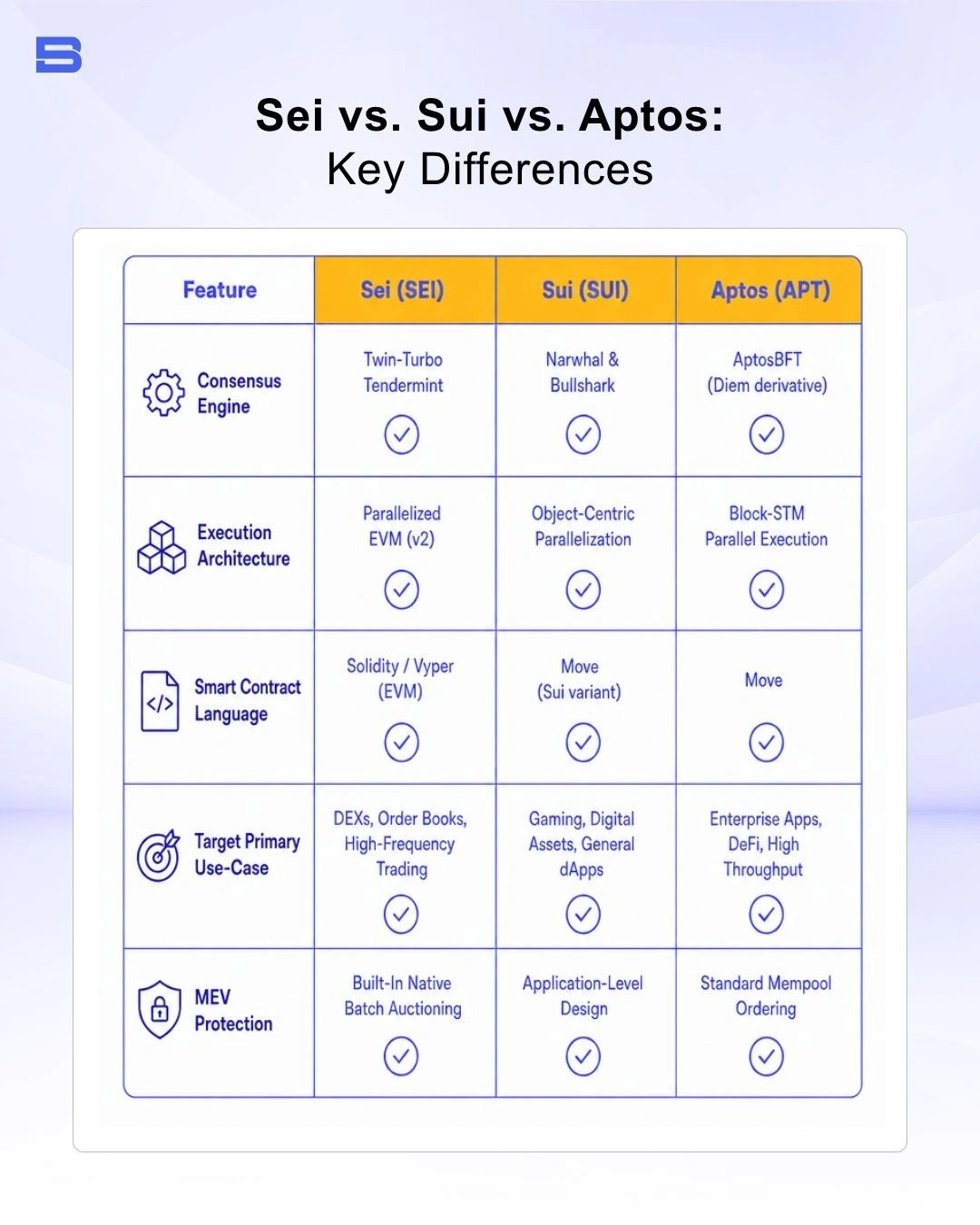
While Sui and Aptos utilize the Move programming language to achieve object-level security, they require developers to learn an entirely new coding framework. By adopting a parallelized EVM, the network allows Ethereum developers to deploy existing Solidity smart contracts directly onto a high-speed engine without rewriting their codebase.
How to Trade SEI Crypto: Spot, Futures, and Key Metrics
Trading the SEI token requires understanding the distinct execution mechanics across spot and perpetual futures derivative markets. Spot trading involves purchasing the physical token for settlement into a private wallet, whereas perpetual futures allow traders to speculate on price action using leverage without underlying asset delivery.
Leverage Risk in Derivative Markets
Margin trading amplifies both upside returns and downside equity destruction. When trading perpetual contracts with leverage, small percentage movements in the underlying asset lead to outsized impacts on your margin account.
Consider a practical comparison between a standard spot trade and a leveraged margin trade:
- Spot Trade Scenario: You allocate $1,000 to buy SEI tokens at $0.50 per token, securing 2,000 tokens. If the price moves up by 10% to $0.55, your position value increases to $1,100, yielding a clean +$100 profit (+10% ROI). If the price falls 10% to $0.45, your position value drops to $900 (-$100 loss / -10% ROI). You retain your 2,000 tokens regardless of price fluctuation and face zero liquidation risk.
- 5x Leveraged Futures Scenario: You allocate $1,000 as collateral (margin) to open a $5,000 position on SEI perpetual contracts using 5x leverage ($5,000 total exposure).
- 10% Upward Move ($0.50 to $0.55): The $5,000 position gains 10%, generating a $500 profit. Relative to your $1,000 margin, your return doubles to +50% ROI.
- 10% Downward Move ($0.50 to $0.45): The $5,000 position loses 10%, incurring a -$500 loss. Your account capital drops by -50% ROI.
- 20% Downward Move ($0.50 to $0.40): The total position loses $1,000. Because the loss equals your initial $1,000 margin collateral, your position triggers a margin call and liquidation, completely wiping out your equity if no stop-loss order was set.
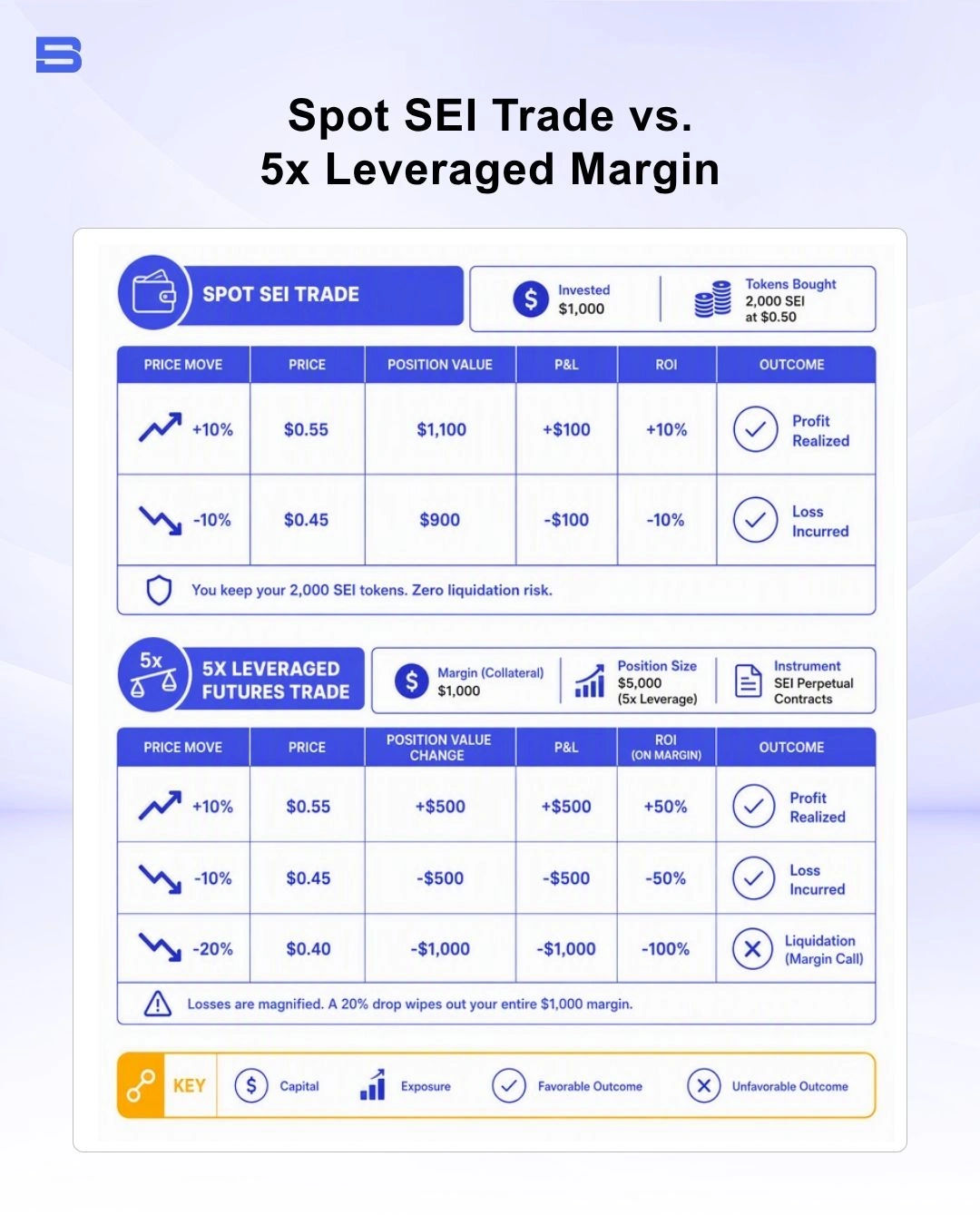
Leverage amplifies your returns when you're right, but it accelerates capital destruction just as quickly when the market moves against you — a 20% move against a 5x position wipes out 100% of your account margin. Regulatory bodies such as the US Securities and Exchange Commission (SEC) routinely issue investor alerts highlighting that derivative trading leverage poses severe capital risks for retail traders. Beginners should establish core risk parameters using stop-loss limits before opening margin positions.
Is SEI Crypto a Good Investment for Traders?
Deciding whether to incorporate SEI tokens into a trading portfolio requires balancing structural technological advantages against market risks.
Upside Potential
- Niche Specialization: High-throughput order-book integration makes the network an attractive host for specialized DeFi derivatives platforms.
- EVM Compatibility: Solidity support lowers entry barriers for Ethereum developer migration, which may help foster faster total value locked (TVL) expansion.
- MEV Defense: Native batch execution provides a fairer environment for algorithmic traders tired of front-running losses.
Downside Risks
- Token Unlocks: Large-scale vesting cliffs scheduled for early private sale participants introduce ongoing supply overhangs.
- Network Competition: Layer-1 alternatives like Sui crypto and Aptos command substantial venture backing and compete directly for trading volume.
- Extreme Market Volatility: Crypto assets experience sharp drawdown cycles compared to conventional financial assets. Allocating capital to volatile tokens represents a significantly higher risk profile than diversifying across conservative markets or comparing alternative store-of-value strategies like Gold vs. Bitcoin.
The Monetary Authority of Singapore (MAS) warns retail investors that digital payment token trading involves extreme market volatility, potential liquidity crunches, and speculative risk. You should conduct independent analysis, monitor unlock schedules, and never risk essential capital on speculative altcoins.
Conclusion
Sei crypto delivers a specialized execution layer designed to solve execution delays, network congestion, and MEV front-running on decentralized exchanges. Through its parallelized EVM upgrade and built-in order matching capabilities, it offers tangible infrastructure improvements for high-frequency DEX traders.
However, token unlock dilution, intense Layer-1 competition, and high market volatility mean you'll need to enforce strong risk management strategies and position sizing before trading this asset. If you’re weighing Sei crypto against other Layer-1 options, disciplined risk management remains essential.
- What Can You Trade? A Guide to Forex, Stocks, and More
- CFD Trading for Beginners
- What is CFD Trading and How Does It Work?
- Forex vs. Stocks: Which Market Suits You Best?
- How to Diversify a Portfolio Across Asset Classes
- How Dividend Stocks Work: Yields, Risks, and Strategies
- Silver Trading Explained: A Guide for Retail Investors
- Precious Metals Trading: A Complete Guide for Beginners
- Natural Gas Trading: A Guide to the Market
- Structured Warrants Malaysia: How They Work and Risks
- What Is the KLCI Index and How to Trade It
- Gold Investment in Malaysia: A Complete Guide for Beginners
- What Is Kijang Emas and How to Invest in It
- Value Investing Explained: How to Find Undervalued Stocks
- How to Trade Bitcoin Safely: A Complete Market Guide
- Growth Investing Explained: Strategies, Metrics, and Risks
- What Is Digital Gold Malaysia and How to Invest
- Crypto Trading Strategies for Beginners
- Gold vs Bitcoin: Key Differences, Risks, and Strategies
- Sukuk: A Guide for Beginners to Islamic Bonds
- What Is FCPO (Crude Palm Oil Futures) and How to Trade It
- How to Identify and Invest in Shariah-Compliant Stocks
- Timber Investment: Is It Worth It?
- Gold ETF Malaysia: A Guide for Beginners
- What Are Malaysian Government Securities (MGS)?
- Corporate Bonds Malaysia: A Guide for Beginners
- China A-Shares Trading Guide for Malaysian Investors
- What Is a Silver ETF and How to Invest in It?
- How to Trade XRP: A Practical Guide for Retail Investors
- How to Trade Solana (SOL): A Guide for Beginners
- What Are Gold Futures and How Do They Work?
- Money Market Fund in Malaysia: A Guide for Beginners
- Property Investment Malaysia: Direct Real Estate or M-REITs?
- What Is Binance Coin and How Does It Work?
- Green Sukuk: A Guide for Beginners to Islamic ESG Investing
- What Is Shiba Inu (SHIB) and How to Trade It
- What Is USDT? A Complete Guide to Tether for Beginners
- What Is Dogecoin and How to Trade It Safely for Beginners
- Cardano: A Guide for Beginners to Trade This Cryptocurrency
- Polkadot: A Guide to Trading This Cryptocurrency
- Tron: A Guide for Beginners to Trading This Cryptocurrency
- What Is Litecoin (LTC)? A Guide to Trading Digital Silver
- What Is Chainlink (LINK) and How to Trade It
- How to Trade Pepe Coin: Spot, Leverage, and Risk Management
- Near Protocol: A Guide to Trading This Cryptocurrency
- Trading Polygon Crypto: A Practical Guide for Beginners
- Trade Toncoin: Understanding the TON Ecosystem and Risks
- Cosmos Crypto: Ecosystem Architecture, Tokenomics, and Risks
- Stellar Crypto: A Guide to Trading This Cryptocurrency
- Avalanche Crypto Explained: A Practical Guide for Traders
- What Is Worldcoin? How to Trade WLD and Manage Risk
- Aptos: A Guide for Beginners to Trading This Cryptocurrency
- Sui Crypto Explained: Tokenomics and Trading Guide
- Celestia: A Guide to Trading This Cryptocurrency
- Decentraland: A Guide to Trading This Cryptocurrency
- What Is Arbitrum? How to Trade the Leading Layer 2 Network
- Sei Crypto: A Guide to Trading This Cryptocurrency
- What Is Injective Protocol and How to Trade INJ Safely
Disclaimer: The content on this page is intended for educational and informational purposes only. It does not constitute financial, investment, tax, or legal advice, and should not be interpreted as a recommendation to buy, sell, or hold any financial instrument or asset. Trading and investing involve significant risk, including the possible loss of your entire capital. Products such as forex, CFDs, and cryptocurrencies carry additional risks due to leverage, high volatility, and limited regulatory protection in some jurisdictions. Past performance of any financial instrument does not guarantee future results. Any market views, forecasts, or opinions expressed are those of the author at the time of writing and may not reflect current market conditions. Platform features, fees, and regulatory status are subject to change — always verify information directly with the relevant provider or regulator before making any financial decision. BrokerSpecs may receive compensation from third parties featured on this site. Always conduct your own due diligence and consider seeking advice from a licensed financial professional before investing.