



Related Tags
Contract for difference (CFD) is a versatile financial derivative that allows you to speculate on the price movements of global markets such as stocks, commodities, currencies (forex), and cryptocurrencies without owning the underlying asset. Unlike traditional investing, where you can own the assets, CFD trading focuses entirely on price action itself. CFDs are traded over-the-counter (OTC) and are not available in all countries.
The following section will explore the advantages and disadvantages of CFD trading and walk through real-world scenarios to illustrate how it works. We will also highlight the significant risks involved and provide a roadmap for how beginners can navigate CFD trading safely and strategically.
What are Contract for Differences (CFDs)?
CFD is an agreement between two parties: a broker and a trader to exchange the difference in the price of an asset between the time a contract is opened and closed. Traders use CFDs to bet on the price of the underlying asset, whether it will increase or decrease. The fundamental principle of CFD is that traders can profit from price fluctuations driven by the market’s natural volatility.
To capitalize on these fluctuations, you can execute one of two primary strategies: “go long” or "go short”. If you anticipate that the underlying asset’s value will rise, you open a “long” position (buy) with the expectation of selling it later at a higher price. Conversely, if you believe the price will decline, you open a “short” position (sell)with the intention to settle the trade at a lower value. In both scenarios, the final profit or loss is determined by the price difference between the opening and closing of the position.
CFDs Are Leveraged
In CFD trading, leverage acts as a multiplier for your capital that enables you to gain a large exposure to the market while committing a small amount of your own capital. In other words, you are borrowing the broker’s funds to amplify your trade size.
While this boosts your purchasing power, it also acts as a double-edged sword—a minor price fluctuation can lead to significant gains or rapid losses.
Why Do People Trade CFDs
People trade CFDs mainly because of the flexibility they provide: high leverage, the ability to profit from both rising and falling markets, and high liquidity, among others. This, of course, comes with its own risks.
The following breakdown organizes the core mechanics into a clear view of rewards and risks:
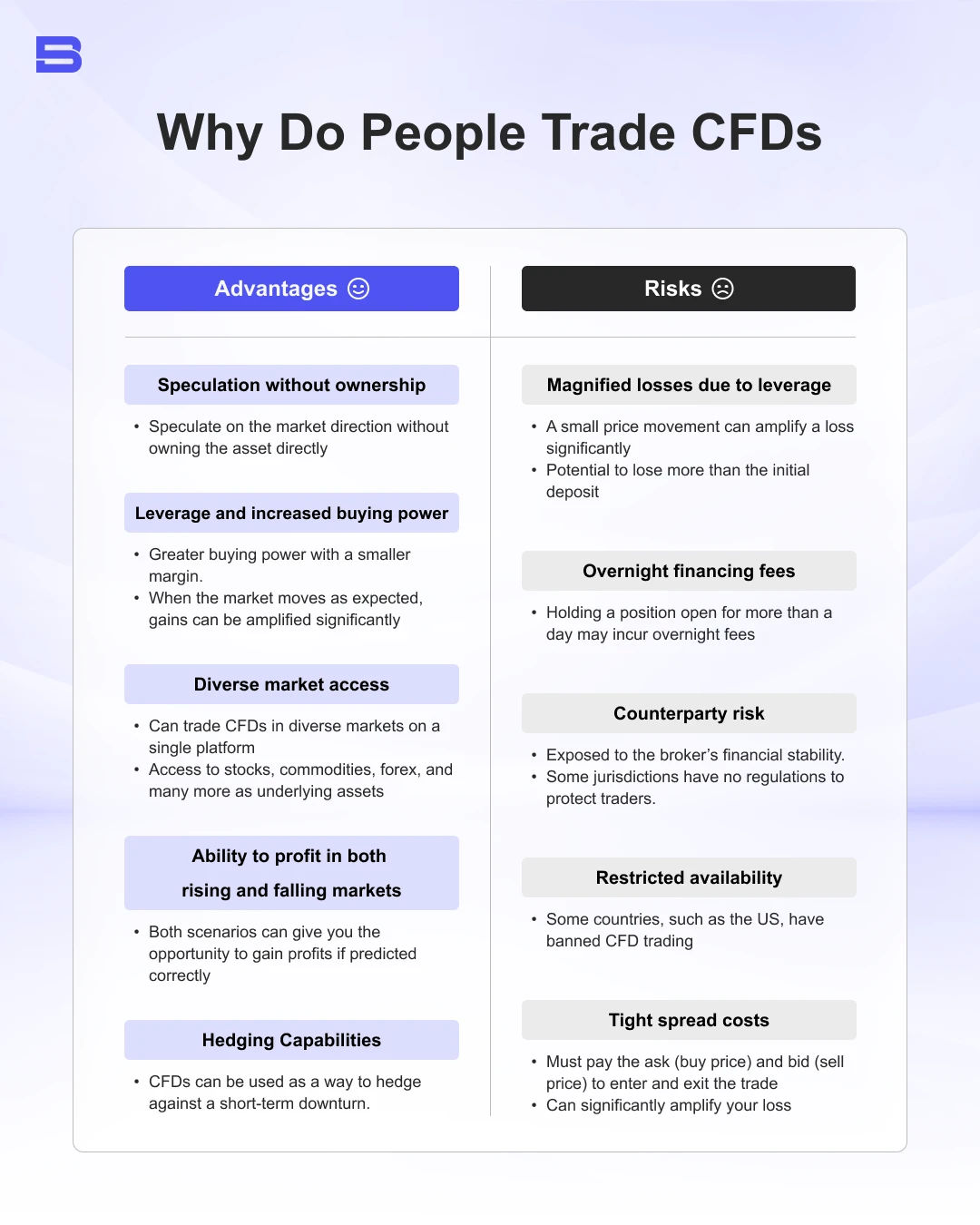
CFD offers unparalleled flexibility for speculation and hedging. However, the combination of leverage and financing fees makes it a very high-risk financial instrument unsuitable for long-term and passive trading. As a beginner trader, especially in CFD, you should approach CFD trading with caution and prepare proper risk management strategies before you start trading.
Example Scenarios
To understand how CFD trading works in practice, let’s take a look at the scenarios below:
Profitable Scenario with Leverage
You decide to trade the EUR/USD currency pair as you believe the Euro will strengthen against the Dollar. The leverage is 30:1.
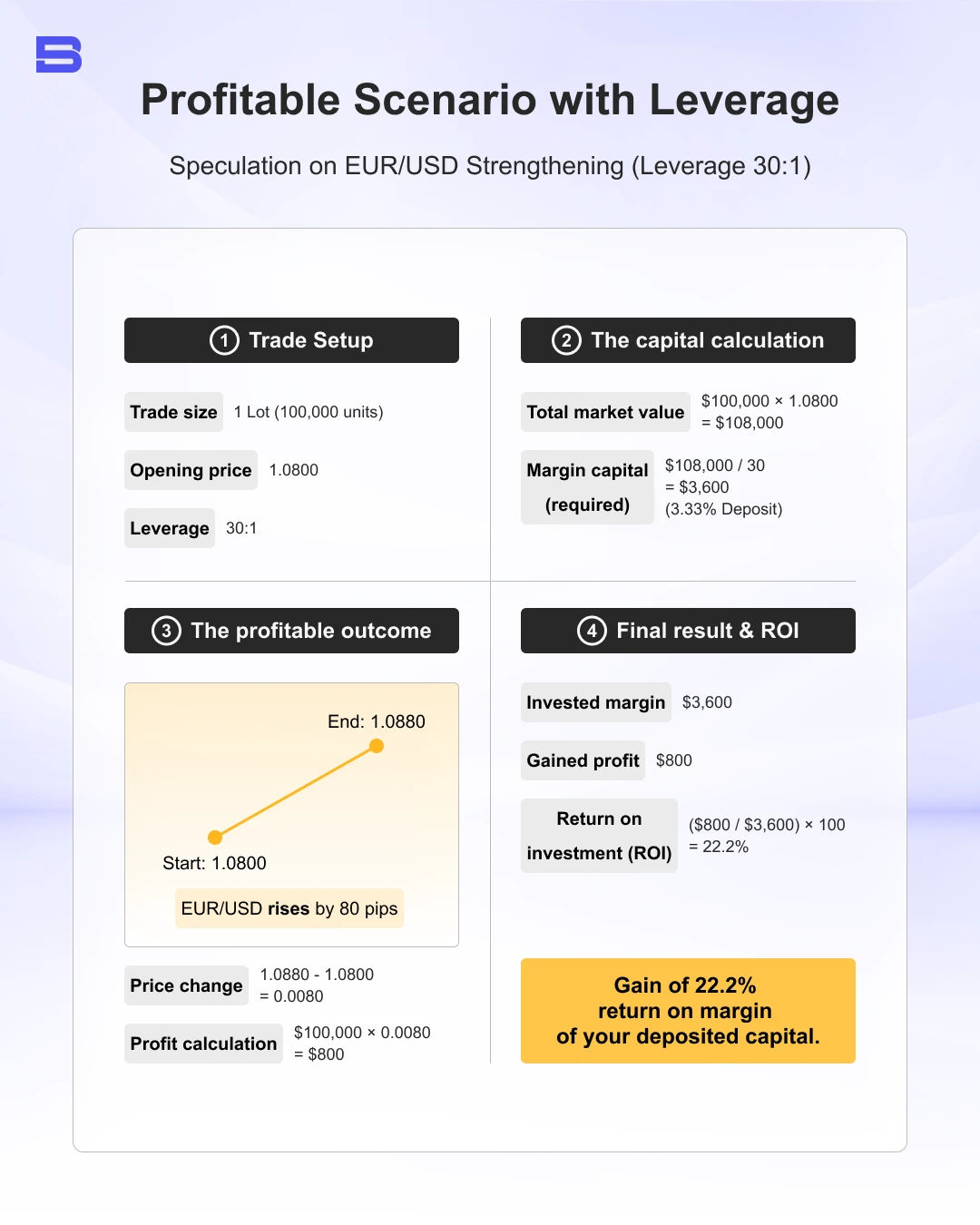
Result: You invested $3,600 in margin and gained $800 profit. This equals a gain of 22.2% return on the margin of your deposited capital.
Losing Trade with Leverage
You believe that the price of GBP/USD will rise. The currency price of GBP/USD is 1.2500, and you use the same leverage as 30:1. Here are the calculation details:
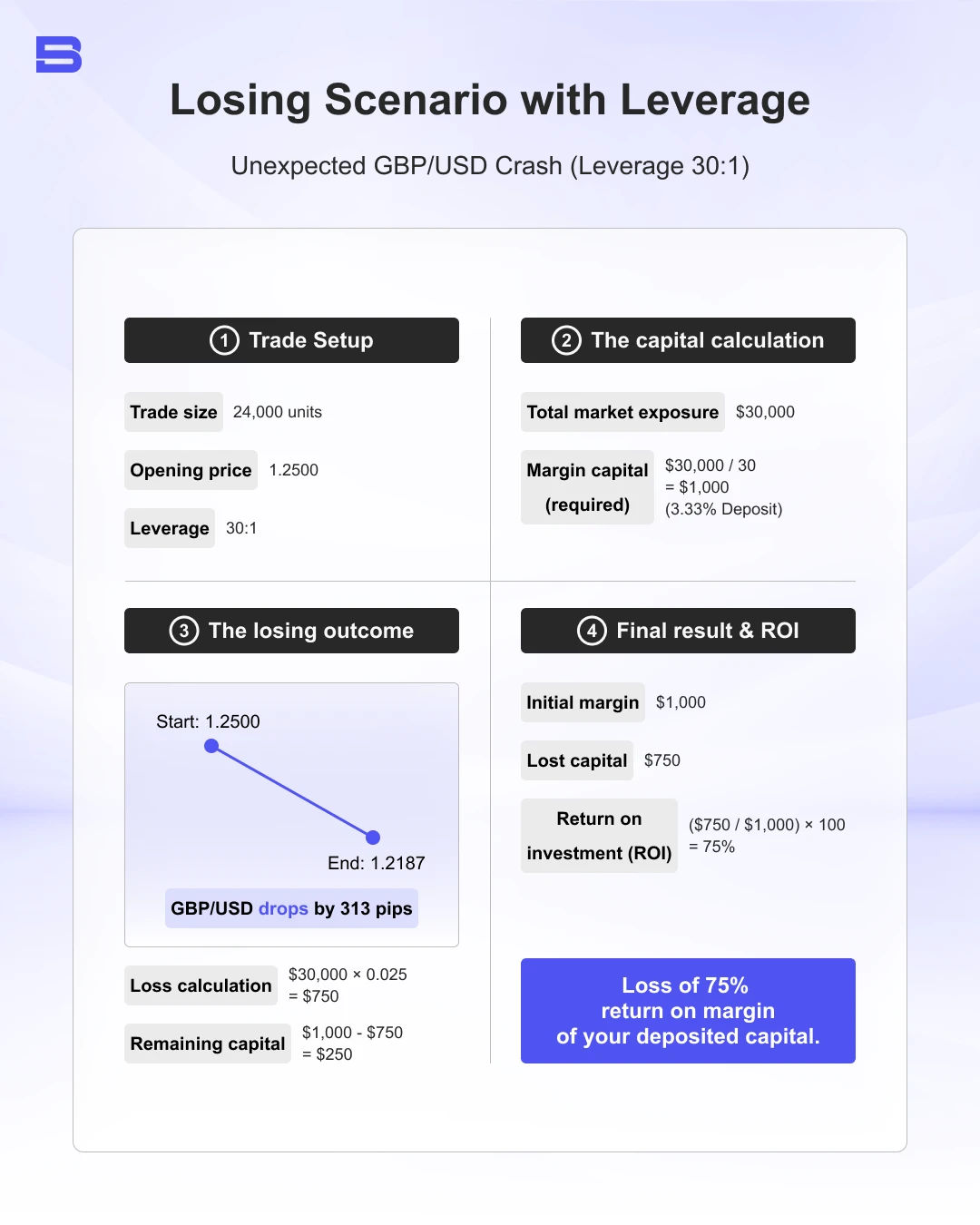
Result: 75% of your account has been wiped out, the small market percentage of 2.5%. You lose an amount of $750 GBP due to risk leverage in CFD trading. If the market keeps moving against your direction, you can lose a much greater amount of money.
In addition to these market-driven losses, you must also account for any applicable fees, such as spreads, commissions, overnight financing charges, or other brokerage costs, which can further increase the overall loss.
Managing Risks in CFD Trading
Despite offering significant profit, trading CFDs also comes with various risks. Having a clear understanding of managing risk is an essential part of maintaining a sustainable long-term success and minimizing losses. The following are some risk management strategies traders can implement when trading CFDs.
1. Stop-loss Order
A stop-loss order can help reduce potential losses when the market moves against your direction. It can ensure that your position closes automatically in the trading system when the predetermined stop price is reached, sparing you from constantly monitoring the price movements.
2. Take-profit Order
To lock in gains, you can use take-profit orders by setting them to ‘’automatically’’ close the position once a market price has reached a specific profit target. Combined with a stop-loss order, they can help you balance potential risk and profit efficiently.
3. Diversify Your Investment
Spreading your capital across various asset classes can help you hedge against market volatility. By maintaining exposure to different markets, you can potentially offset losses in CFD trading through gains in another asset.
4. Testing Your Strategy
Before going live, it’s advisable to deploy your risk management strategy using a demo account first. This allows you to get a clear picture of your possible trading conditions and assess your risk management plan.
Integrating these risk management strategies into your CFD framework will not only protect against the downside but helps maintain a sustainable long-term success.
How to Trade CFD Safely
Trading CFD for beginners—or even experienced traders—requires a disciplined mindset and approach that prioritizes education, regulatory compliance, and risk management.
To build a solid foundation, you need to grasp the mechanics of the market before you start trading. Here’s how to approach the initial learning phase:
1. Research and Preparation
Having a clear understanding of the fundamentals of CFD mechanics can help you plan your trading strategy more effectively. You can also use a demo account to practice with virtual funds, giving you a clearer picture of the trading platform. This helps you experience the real, live market, so you can strategize without worrying about losing your actual money.
2. Choose a Regulated Broker
Choose licensed and regulated brokers under well-known authorities, such as the Financial Conduct Authority (FCA) in the UK, Australian Securities and Investments Commission (ASIC), or Monetary Authority of Singapore (MAS). These regulators enforce strict rules regarding transparency, reporting, and ethical conduct. You also need to ensure that the broker provides structural protections, such as negative balance protection, and holds clients’ funds in segregated accounts.
3. Master Risk Management
Use stop-loss orders to automatically close the position when the price moves against you, to help limit the potential losses. As a beginner, avoid risking more than 1-2% of your total trading capital on a single trade. Limit yourself from using the maximum leverage; use lower ratios such as 10:1 or 20:1 to minimize the impact of large losses. You can also diversify your portfolio across different asset classes to avoid losing more than your initial investment.
4. Start Small and Stay Disciplined
You can start with minimal capital or small trade sizes to gain experience and gradually increase your investment as your confidence and skills improve. Avoid overleveraging, as it can lead to massive potential losses. You can also record your trading journey to analyze both wins and losses, refining your strategy over time.
5. Monitor and Analyze
Stay informed and keep up with the latest market news and economic data, as they can affect your trading. When trading CFDs, be aware of the overnight fees that are charged by the broker if you wish to leave a position open for an extended period. Last but not least, avoid revenge trading as it can lead to much greater losses.
Success in CFD trading is built on strategic risk management planning and a comprehensive understanding of how it works. By anchoring your approach in those principles, you have prioritized the safety of your capital above all. Despite not having control over the market’s direction, mastering these areas will enable you to maintain and control your longevity in the market.
The Bottom Line
CFD trading offers a versatile gateway to global markets by empowering you to capitalize on both rising and falling prices while maximizing your market leverage through exposure. For those just starting out, the reliable road to success involves mastering the mechanics of the market, constantly utilizing stop-loss orders to cap your losses and ensure your trade size never exceeds the capital that you can afford to lose.
Make use of the market’s versatility by taking advantage of its ability to go short and long, which allows you to find opportunities regardless of the market sentiment. The flexibility and leverage they offer are powerful tools in amplifying the profit, but they are only beneficial when anchored by a strict commitment to preserve capital.
- What Can You Trade? A Guide to Forex, Stocks, and More
- CFD Trading for Beginners
- What is CFD Trading and How Does It Work?
- Forex vs. Stocks: Which Market Suits You Best?
- How to Diversify a Portfolio Across Asset Classes
- How Dividend Stocks Work: Yields, Risks, and Strategies
- Silver Trading Explained: A Guide for Retail Investors
- Precious Metals Trading: A Complete Guide for Beginners
- Natural Gas Trading: A Guide to the Market
- Structured Warrants Malaysia: How They Work and Risks
- What Is the KLCI Index and How to Trade It
- Gold Investment in Malaysia: A Complete Guide for Beginners
- What Is Kijang Emas and How to Invest in It
- Value Investing Explained: How to Find Undervalued Stocks
- How to Trade Bitcoin Safely: A Complete Market Guide
- Growth Investing Explained: Strategies, Metrics, and Risks
- What Is Digital Gold Malaysia and How to Invest
- Crypto Trading Strategies for Beginners
- Gold vs Bitcoin: Key Differences, Risks, and Strategies
- Sukuk: A Guide for Beginners to Islamic Bonds
- What Is FCPO (Crude Palm Oil Futures) and How to Trade It
- How to Identify and Invest in Shariah-Compliant Stocks
- Timber Investment: Is It Worth It?
- Gold ETF Malaysia: A Guide for Beginners
- What Are Malaysian Government Securities (MGS)?
- Corporate Bonds Malaysia: A Guide for Beginners
- China A-Shares Trading Guide for Malaysian Investors
- What Is a Silver ETF and How to Invest in It?
- How to Trade XRP: A Practical Guide for Retail Investors
- How to Trade Solana (SOL): A Guide for Beginners
- What Are Gold Futures and How Do They Work?
- Money Market Fund in Malaysia: A Guide for Beginners
- Property Investment Malaysia: Direct Real Estate or M-REITs?
- What Is Binance Coin and How Does It Work?
- Green Sukuk: A Guide for Beginners to Islamic ESG Investing
- What Is Shiba Inu (SHIB) and How to Trade It
- What Is USDT? A Complete Guide to Tether for Beginners
- What Is Dogecoin and How to Trade It Safely for Beginners
- Cardano: A Guide for Beginners to Trade This Cryptocurrency
- Polkadot: A Guide to Trading This Cryptocurrency
- Tron: A Guide for Beginners to Trading This Cryptocurrency
- What Is Litecoin (LTC)? A Guide to Trading Digital Silver
- What Is Chainlink (LINK) and How to Trade It
- How to Trade Pepe Coin: Spot, Leverage, and Risk Management
- Near Protocol: A Guide to Trading This Cryptocurrency
- Trading Polygon Crypto: A Practical Guide for Beginners
- Trade Toncoin: Understanding the TON Ecosystem and Risks
- Cosmos Crypto: Ecosystem Architecture, Tokenomics, and Risks
- Stellar Crypto: A Guide to Trading This Cryptocurrency
- Avalanche Crypto Explained: A Practical Guide for Traders
- What Is Worldcoin? How to Trade WLD and Manage Risk
- Aptos: A Guide for Beginners to Trading This Cryptocurrency
- Sui Crypto Explained: Tokenomics and Trading Guide
- Celestia: A Guide to Trading This Cryptocurrency
- Decentraland: A Guide to Trading This Cryptocurrency
- What Is Arbitrum? How to Trade the Leading Layer 2 Network
- Sei Crypto: A Guide to Trading This Cryptocurrency
- What Is Injective Protocol and How to Trade INJ Safely
Disclaimer: The content on this page is intended for educational and informational purposes only. It does not constitute financial, investment, tax, or legal advice, and should not be interpreted as a recommendation to buy, sell, or hold any financial instrument or asset. Trading and investing involve significant risk, including the possible loss of your entire capital. Products such as forex, CFDs, and cryptocurrencies carry additional risks due to leverage, high volatility, and limited regulatory protection in some jurisdictions. Past performance of any financial instrument does not guarantee future results. Any market views, forecasts, or opinions expressed are those of the author at the time of writing and may not reflect current market conditions. Platform features, fees, and regulatory status are subject to change — always verify information directly with the relevant provider or regulator before making any financial decision. BrokerSpecs may receive compensation from third parties featured on this site. Always conduct your own due diligence and consider seeking advice from a licensed financial professional before investing.