


Related Tags
You are watching gas fees on Ethereum spike to painful levels during a sudden market swing, watching potential profit get swallowed by execution costs before your order even fills. High-speed alternative networks promise lower fees, but evaluating whether a token like NEAR belongs in your active strategy requires moving past marketing promises. Understanding how NEAR functions as a high-throughput asset—and how to navigate its volatile market structure—is essential before risking real capital.
What Is Near Protocol and How Does It Work?
Near Protocol is a Layer-1 decentralized application platform designed to achieve high transaction throughput and developer usability through modular network partitioning.
Launched on mainnet in 2020 by former Google engineer Illia Polosukhin and Alexander Skidanov, NEAR addresses the blockchain trilemma—balancing scalability, security, and decentralization—without forcing applications to rely entirely on Layer-2 scaling tools.
Understanding Nightshade Sharding Architecture
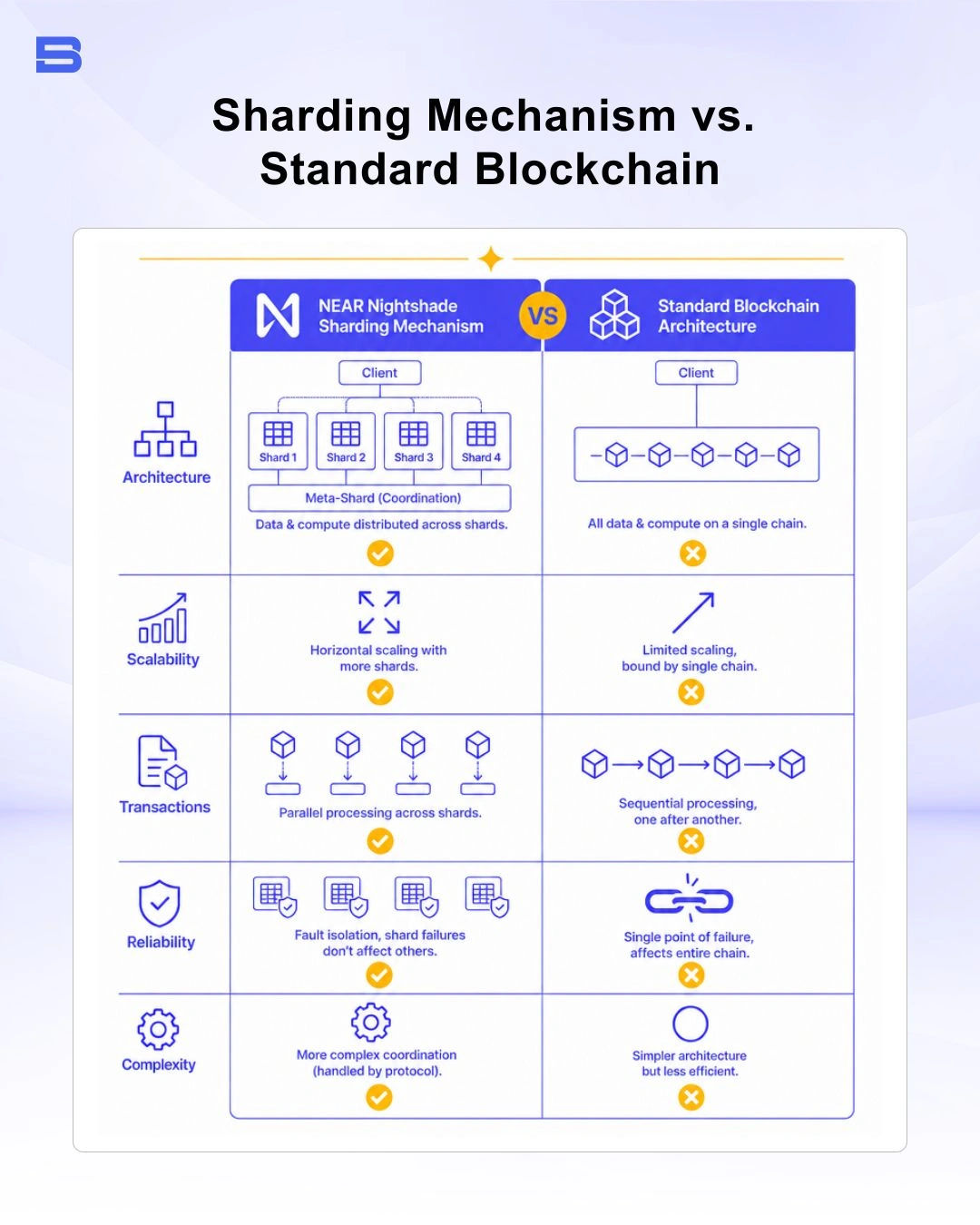
Unlike monolithic blockchains where every node must process every transaction sequentially, Near Protocol implements a proprietary consensus mechanism featuring Nightshade sharding. In standard sharded architectures, individual chains generate separate blocks, creating complex cross-chain verification requirements.
Under Nightshade, validators process distinct subsets of transactions in parallel across multiple shards. Each shard produces a portion—known as a "chunk"—of a single, unified block. This design enables the protocol to process thousands of transactions per second (TPS) while maintaining block finality in approximately one second.
Cross-Chain Interoperability via the Rainbow Bridge
For crypto traders, liquidity moving between ecosystems is a primary catalyst for price volatility. NEAR maintains cross-chain compatibility through the Rainbow Bridge Near Protocol system.
This trustless bridge allows users to transfer ERC-20 tokens and assets seamlessly between Ethereum and the Near Protocol ecosystem. By enabling developers and traders to move capital quickly into lower-fee environments, bridge activity often serves as a key indicator of network utility and shifting token demand.
NEAR Token Utility and Economics
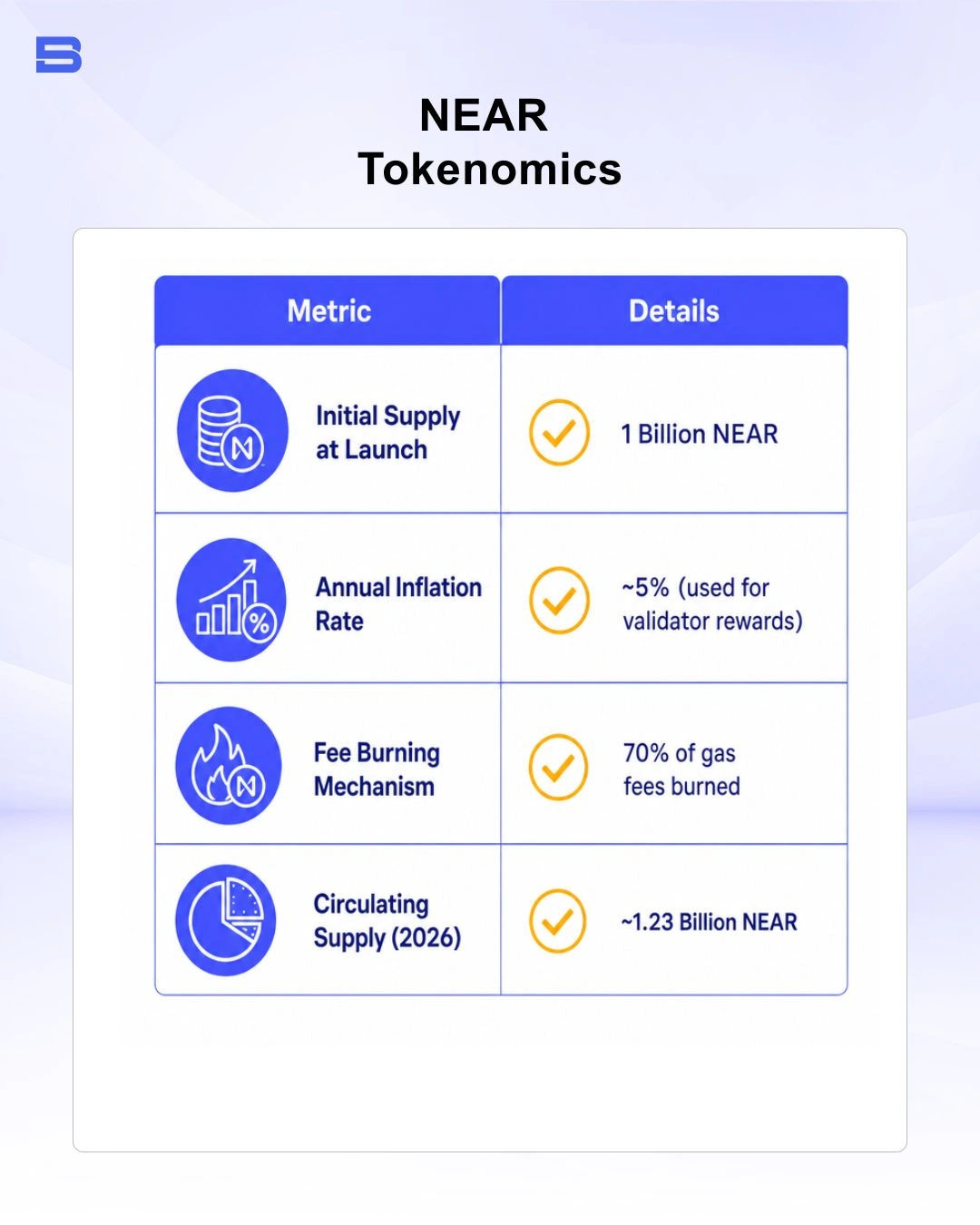
Evaluating an asset's price dynamics requires analyzing Near Protocol tokenomics, which dictate how the native asset (NEAR) flows through the ecosystem.
- Gas & Storage Fees: Transactions and smart-contract execution on NEAR require fees paid in NEAR. As of 2026, 70% of transaction fees are burned, while 30% goes to the contract developer, creating deflationary pressure as network activity increases.
- Staking & Consensus: NEAR utilizes a Proof-of-Stake (PoS) consensus variant called Thresholded Proof-of-Stake (TPoS). Validators and delegators stake NEAR tokens to secure the network, earning annualized yield generated from inflation.
- Governance: NEAR token holders can lock NEAR to receive veNEAR voting power, allowing them to participate directly in or delegate governance votes covering ecosystem grants, budgets, and protocol-related decisions.
How to Trade Near Protocol (NEAR)
Trading NEAR requires selecting an execution venue and understanding market access methods. Traders can gain exposure via spot exchanges or derivative products like Contracts for Difference (CFDs).
When executing spot trades, you purchase and hold the underlying token in a Web3 or exchange wallet. For active swing trading or short-term speculation, derivative products allow traders to take both long and short positions using leverage. However, crypto CFD leverage risk must be managed strictly. High volatility paired with leverage dramatically accelerates margin call triggers.
If you are already familiar with how to trade Bitcoin, managing position sizing on altcoins requires even stricter stop-loss placement due to lower liquidity depth and wider bid-ask spreads.
Worked Scenario: CFD Leverage and Liquidation Risk
Consider a trader holding an account balance of RM5,000 who opens a long CFD position on NEAR using 5:1 leverage when NEAR is priced at $2.00.
- Total Position Value: RM25,000 worth of NEAR (500% of capital exposure).
- Price Drop Impact: If NEAR's price drops by 10% (to $1.80), the total position loses RM2,500.
- Account Capital Loss: That 10% asset drop results in a 50% loss of the trader's actual RM5,000 margin balance.
If the market drops 20%, the position faces automatic liquidation, wiping out the entire balance. Margin positions must always carry tight stop-loss thresholds to prevent rapid capital loss.
When choosing a platform, ensure you verify trading venues against the regulatory standards established by authorities such as the Securities Commission Malaysia (SC).
Near Protocol vs. Polygon Crypto and Ethereum
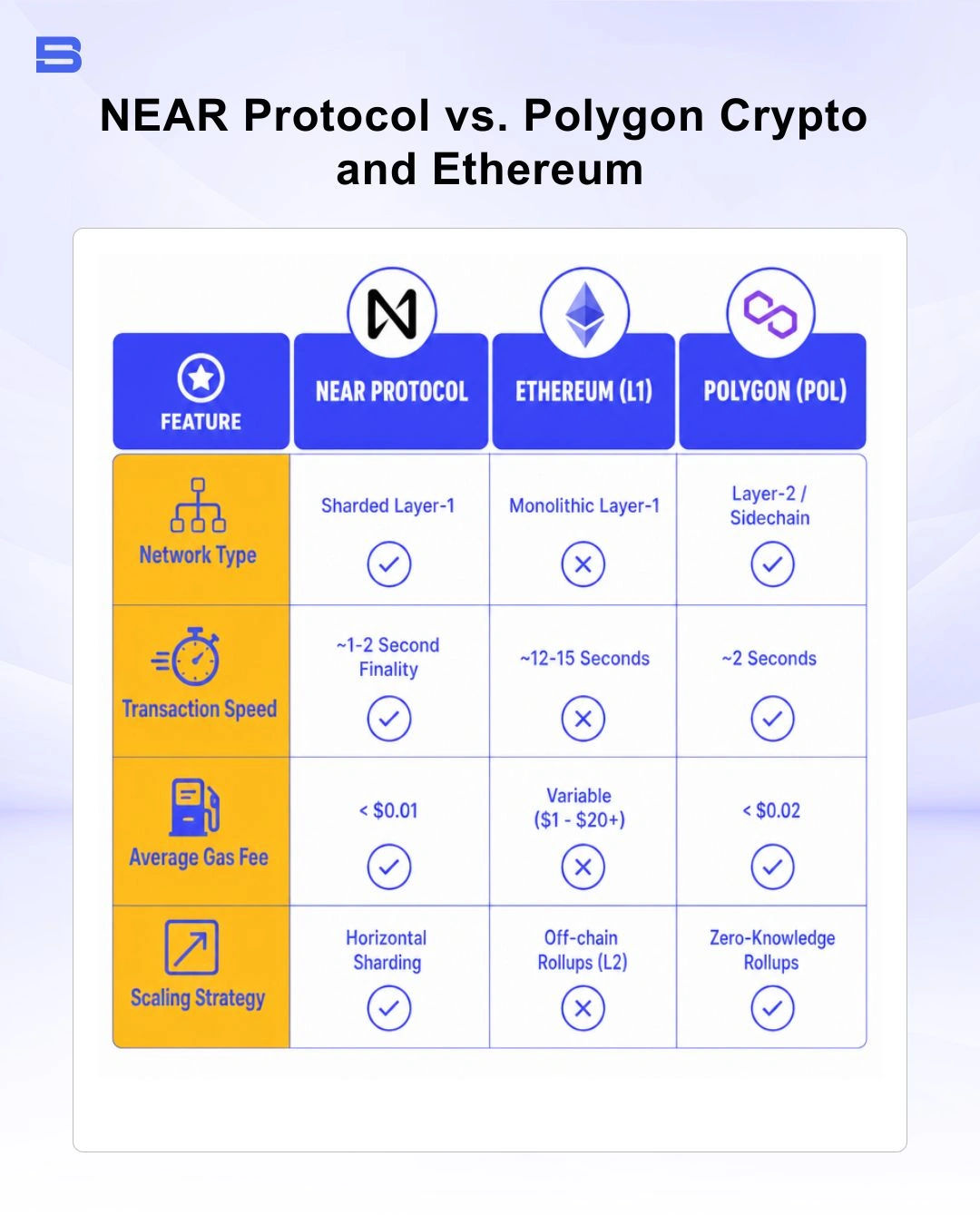
Traders comparing Layer-1 networks must evaluate how NEAR stacks up against major market benchmarks like Ethereum and established scaling solutions such as Polygon crypto.
Ethereum remains the liquidity baseline for decentralized finance, but its base layer suffers from high gas fees during volatility spikes. To bypass this, traders often turn to Layer-2 rollups like Arbitrum or sidechains like Polygon. Near Protocol takes a different technical approach: scaling natively at Layer-1 via Nightshade sharding while maintaining high-speed execution.
Traders applying strategies from how to trade Ethereum will find NEAR offers lower fee overhead, though overall decentralized market liquidity remains concentrated on Ethereum mainnet.
Comparing Layer-1 Competitors: Near vs. Avalanche Crypto
In the competitive Layer-1 landscape, NEAR competes directly with alternative high-performance blockchains like Avalanche Crypto, Cardano, and legacy networks such as Litecoin.
Avalanche uses a multi-chain subnet architecture to achieve rapid finality, appealing heavily to institutional private deployments. In contrast, Near Protocol focuses on chain abstraction—making Web3 dApps feel as seamless to navigate as traditional Web2 applications. Legacy altcoins like Litecoin offer pure transactional payment processing, but lack the smart contract capabilities required for decentralized finance ecosystems.
Evaluating Cardano alongside NEAR reveals contrasting execution philosophies: Cardano relies on academic peer review and slower formal verification rollouts, while Near Protocol prioritizes rapid developer onboarding using familiar programming languages like Rust and JavaScript.
Key Risks and Considerations Before Trading NEAR
When evaluating if Near Protocol is a good investment, traders must weigh both potential upside catalysts and significant market risks equally.
Upside Potential
- Scalable Tech Infrastructure: Nightshade 2.0 and state-based sharding allow the network to expand throughput as user adoption grows.
- Developer Usability: Native support for JavaScript and Rust lowers entry barriers for software developers moving into Web3.
- Ecosystem Interoperability: Assets move easily across chains using the Rainbow Bridge and Aurora (NEAR's EVM layer).
Downside Risks
- Extreme Volatility: Altcoins can experience aggressive price swings and severe drawdowns, with declines of 70% or more occurring during major crypto market downturns. Research published by MDPI analyzed 609 cryptocurrencies and used a 70% drawdown threshold to identify severe, sustained price distress.
- Competition for Liquidity: Competing Layer-1 and Layer-2 networks continuously battle for developer activity and total value locked (TVL).
- Inflation: As of 2026, NEAR historically used a 5% annual inflation rate, with transaction-fee burning partially offsetting new token issuance. When network activity and fee burning are low, the remaining issuance can dilute the proportional holdings of non-staked NEAR holders.
NEAR Protocol: Final Takeaways for Traders
Near Protocol presents a technically compelling Layer-1 platform designed to solve blockchain scaling without sacrificing user experience. However, trading NEAR requires managing the sharp volatility inherent to liquid altcoin markets. By utilizing disciplined risk management, enforcing stop-loss limits, and keeping leverage low, traders can participate in NEAR's price movements while safeguarding their capital.
- What Can You Trade? A Guide to Forex, Stocks, and More
- CFD Trading for Beginners
- What is CFD Trading and How Does It Work?
- Forex vs. Stocks: Which Market Suits You Best?
- How to Diversify a Portfolio Across Asset Classes
- How Dividend Stocks Work: Yields, Risks, and Strategies
- Silver Trading Explained: A Guide for Retail Investors
- Precious Metals Trading: A Complete Guide for Beginners
- Natural Gas Trading: A Guide to the Market
- Structured Warrants Malaysia: How They Work and Risks
- What Is the KLCI Index and How to Trade It
- Gold Investment in Malaysia: A Complete Guide for Beginners
- What Is Kijang Emas and How to Invest in It
- Value Investing Explained: How to Find Undervalued Stocks
- How to Trade Bitcoin Safely: A Complete Market Guide
- Growth Investing Explained: Strategies, Metrics, and Risks
- What Is Digital Gold Malaysia and How to Invest
- Crypto Trading Strategies for Beginners
- Gold vs Bitcoin: Key Differences, Risks, and Strategies
- Sukuk: A Guide for Beginners to Islamic Bonds
- What Is FCPO (Crude Palm Oil Futures) and How to Trade It
- How to Identify and Invest in Shariah-Compliant Stocks
- Timber Investment: Is It Worth It?
- Gold ETF Malaysia: A Guide for Beginners
- What Are Malaysian Government Securities (MGS)?
- Corporate Bonds Malaysia: A Guide for Beginners
- China A-Shares Trading Guide for Malaysian Investors
- What Is a Silver ETF and How to Invest in It?
- How to Trade XRP: A Practical Guide for Retail Investors
- How to Trade Solana (SOL): A Guide for Beginners
- What Are Gold Futures and How Do They Work?
- Money Market Fund in Malaysia: A Guide for Beginners
- Property Investment Malaysia: Direct Real Estate or M-REITs?
- What Is Binance Coin and How Does It Work?
- Green Sukuk: A Guide for Beginners to Islamic ESG Investing
- What Is Shiba Inu (SHIB) and How to Trade It
- What Is USDT? A Complete Guide to Tether for Beginners
- What Is Dogecoin and How to Trade It Safely for Beginners
- Cardano: A Guide for Beginners to Trade This Cryptocurrency
- Polkadot: A Guide to Trading This Cryptocurrency
- Tron: A Guide for Beginners to Trading This Cryptocurrency
- What Is Litecoin (LTC)? A Guide to Trading Digital Silver
- What Is Chainlink (LINK) and How to Trade It
- How to Trade Pepe Coin: Spot, Leverage, and Risk Management
- Near Protocol: A Guide to Trading This Cryptocurrency
- Trading Polygon Crypto: A Practical Guide for Beginners
- Trade Toncoin: Understanding the TON Ecosystem and Risks
- Cosmos Crypto: Ecosystem Architecture, Tokenomics, and Risks
- Stellar Crypto: A Guide to Trading This Cryptocurrency
- Avalanche Crypto Explained: A Practical Guide for Traders
- What Is Worldcoin? How to Trade WLD and Manage Risk
- Aptos: A Guide for Beginners to Trading This Cryptocurrency
- Sui Crypto Explained: Tokenomics and Trading Guide
- Celestia: A Guide to Trading This Cryptocurrency
- Decentraland: A Guide to Trading This Cryptocurrency
- What Is Arbitrum? How to Trade the Leading Layer 2 Network
- Sei Crypto: A Guide to Trading This Cryptocurrency
- What Is Injective Protocol and How to Trade INJ Safely
Disclaimer: The content on this page is intended for educational and informational purposes only. It does not constitute financial, investment, tax, or legal advice, and should not be interpreted as a recommendation to buy, sell, or hold any financial instrument or asset. Trading and investing involve significant risk, including the possible loss of your entire capital. Products such as forex, CFDs, and cryptocurrencies carry additional risks due to leverage, high volatility, and limited regulatory protection in some jurisdictions. Past performance of any financial instrument does not guarantee future results. Any market views, forecasts, or opinions expressed are those of the author at the time of writing and may not reflect current market conditions. Platform features, fees, and regulatory status are subject to change — always verify information directly with the relevant provider or regulator before making any financial decision. BrokerSpecs may receive compensation from third parties featured on this site. Always conduct your own due diligence and consider seeking advice from a licensed financial professional before investing.