


Related Tags
Navigating the Layer-1 blockchain landscape often requires choosing between rapid ecosystem growth and rigorous protocol security. While many crypto networks deploy updates rapidly and fix vulnerabilities iteratively in live production, Cardano takes a deliberate, peer-reviewed approach to development. For traders comparing public blockchains, understanding ADA—the native token powering Cardano—requires evaluating how its academic foundation, architectural mechanics, and staking dynamics influence its market liquidity and long-term utility.
What Is Cardano and How Does It Work?
Cardano is a third-generation public blockchain platform designed to provide a highly secure, scalable infrastructure for decentralized applications (dApps) and financial contracts. Founded in 2017 by Ethereum co-founder Charles Hoskinson and developed by Input Output Global (IOG), Cardano stands apart from competitors by grounding every major protocol upgrade in peer-reviewed academic research.
To achieve both high security and operational flexibility, Cardano uses a distinct dual-layer architecture:
- Cardano Settlement Layer (CSL): Acts as the balance ledger. The CSL handles standard peer-to-peer ADA token transfers, separating simple transactional accounting from smart contract computations.
- Cardano Computation Layer (CCL): Executes smart contract logic, decentralized applications, and complex financial operations independently of the balance ledger.
By separating transaction settlement from smart contract execution, network congestion on decentralized applications does not slow down standard token transfers. For market participants, this structural separation offers predictable transaction processing even during peak network demand.
The Ouroboros Consensus Engine
At the core of Cardano's security model is the Ouroboros proof-of-stake protocol, the first mathematically proven secure consensus mechanism in the crypto ecosystem. Unlike proof-of-work mining—which relies on high energy consumption and specialized hardware—Ouroboros secures the network through economic staking incentives.
You don't need a computer science degree to follow this: Ouroboros simply splits time into Epochs (five days) and Slots (one second), and your odds of leading a slot rise with however much ADA you've staked or delegated. During each slot, the network algorithmically selects a stake pool operator to lead the slot and mint a new block. Slot leader selection probability scales proportionally to the total ADA pledged or delegated to that pool. This structure allows Cardano to achieve security comparable to Bitcoin while consuming a tiny fraction of the electrical energy.
Smart Contracts and Plutus Platform
Cardano natively processes smart contracts using the Plutus development framework, built on the functional programming language Haskell. Unlike networks that use traditional account-based models, Cardano utilizes an Extended Unspent Transaction Output (EUTXO) model.
The EUTXO model offers deterministic execution. This means you can calculate exact transaction fees and smart contract execution outcomes locally before broadcasting the transaction to the network. As a result, Cardano trades eliminate "failed transaction gas fees," a common friction point on Ethereum where users pay network fees even if a trade fails.
ADA Utility and Tokenomics
The native token of the Cardano network is ADA, named after 19th-century mathematician Ada Lovelace. ADA serves three core functions across the network: transaction fee settlement, protocol governance voting, and staking to secure network consensus.
Cardano's tokenomics are defined by a strict supply cap:
- Max Supply: According to Cardano's official protocol documentation (IOG Docs), ADA's max supply is fixed at 45,000,000,000 ADA.
- Circulating Supply Allocation: Public sale, development treasury allocations, and ongoing block distribution reserves.
- Fee Structure: Calculated via a deterministic formula based on transaction size and computational steps (a+bsize), ensuring predictable, low-cost transfers.
Because the maximum supply is fixed at 45 billion ADA, the asset carries built-in scarcity. Inflation is controlled strictly through reserve emissions that gradually decrease over time, mirroring halving dynamics seen in older digital assets.
How Cardano Staking Works
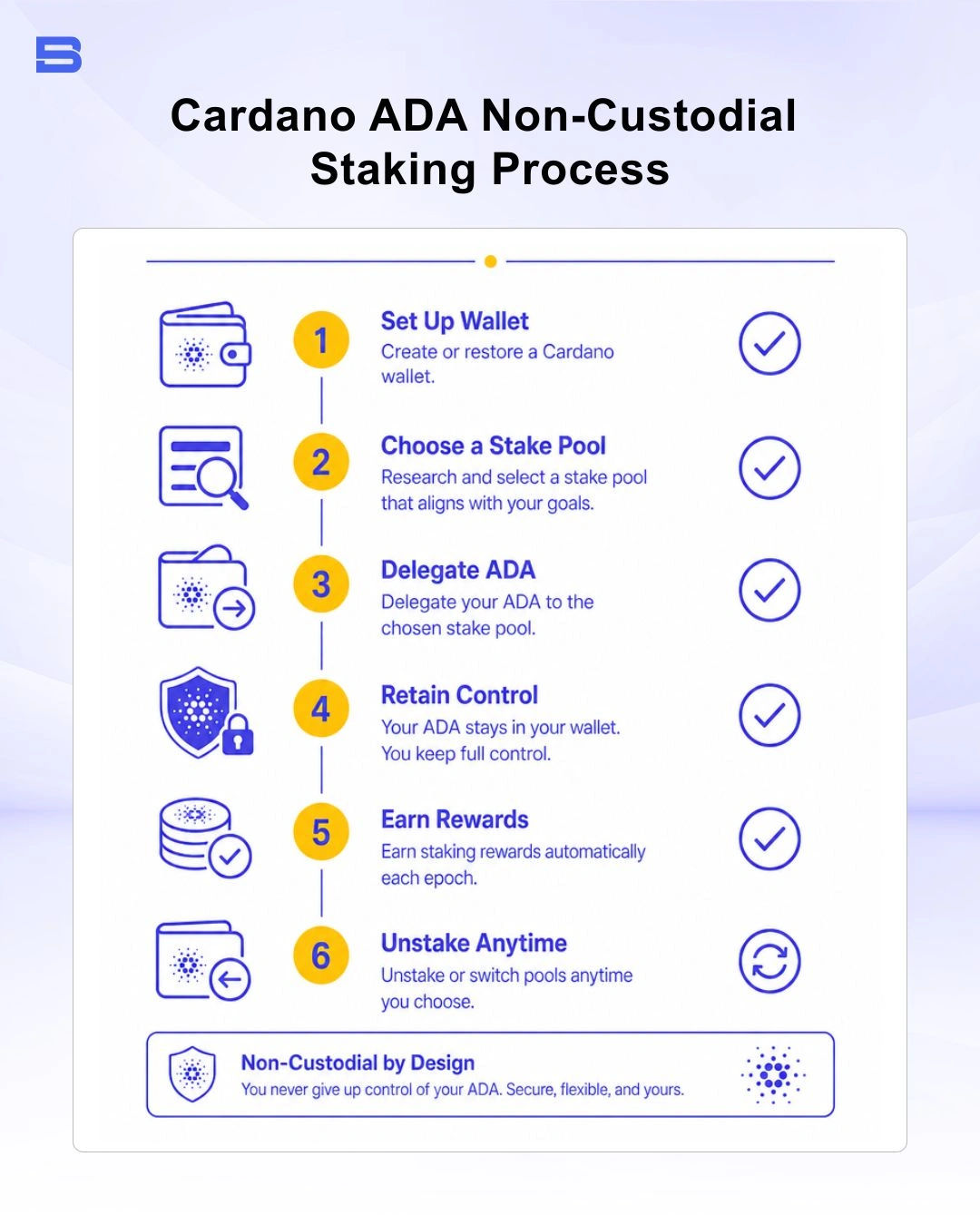
Cardano offers a flexible staking structure that allows ADA holders to earn passive yield while maintaining full control of their funds.
- Non-Custodial Delegation: Delegating ADA to a stake pool does not transfer ownership. Your ADA never leaves your personal digital wallet, eliminating counterparty lockup risks.
- No Unbonding Periods: ADA is never locked or frozen. You can transfer, trade, or spend your staked ADA at any time without paying slashing penalties or waiting through unbonding lockup windows.
- Automated Epoch Distribution: Staking rewards are automatically calculated and distributed at the end of every five-day epoch.
Cardano vs. Ethereum: Key Differences
While both Cardano and Ethereum serve as foundational platforms for decentralized finance, their underlying technical designs lead to distinct trading characteristics. Similar to how payments-focused networks like XRP target cross-border settlement, Cardano and Ethereum approach global smart contract execution from fundamental architectural differences.
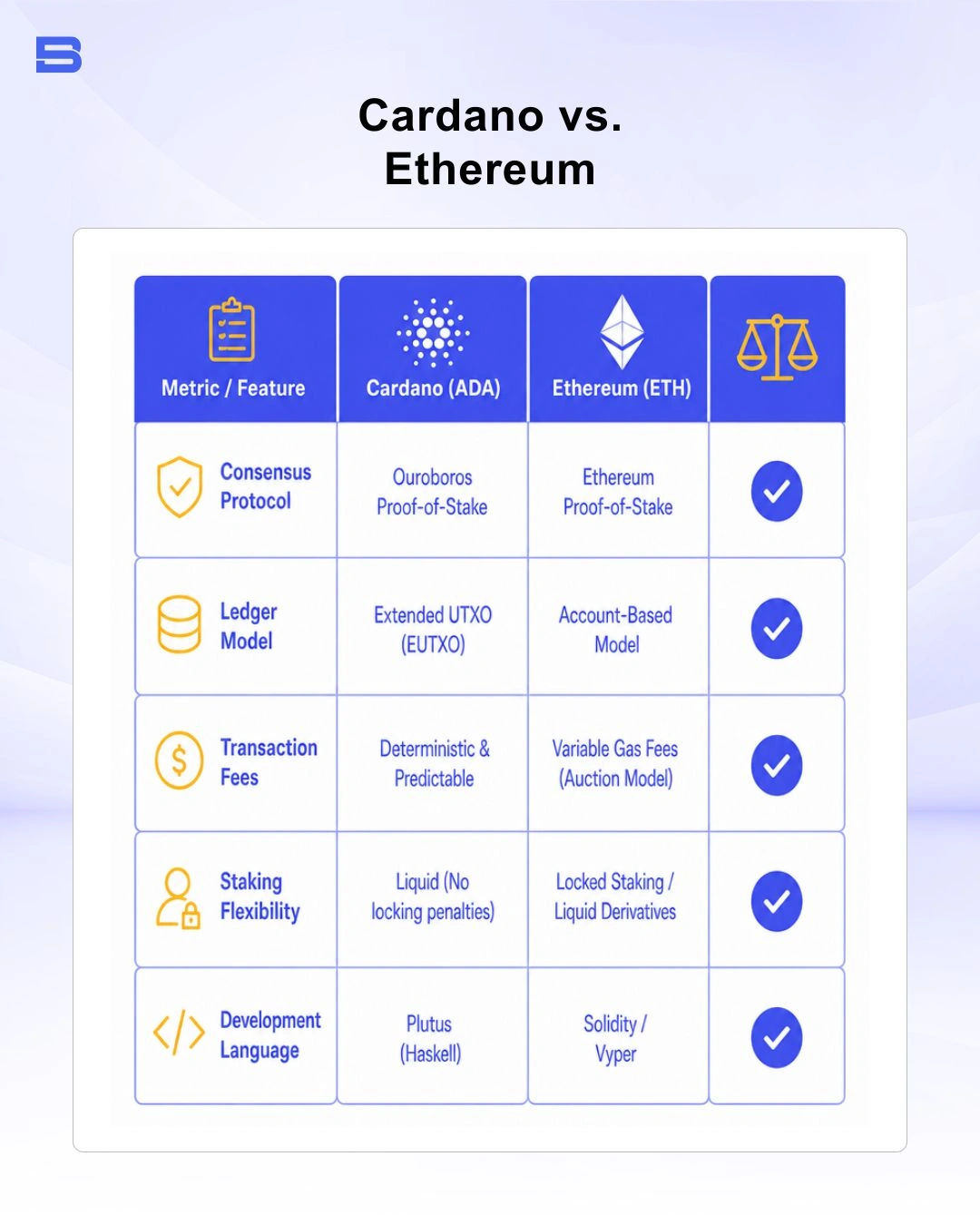
While Ethereum benefits from earlier deployment and deeper decentralized liquidity, Cardano’s deterministic EUTXO model gives traders absolute certainty regarding network costs before initiating trades.
Cardano vs. Polkadot and Solana: Comparing Layer-1 Networks
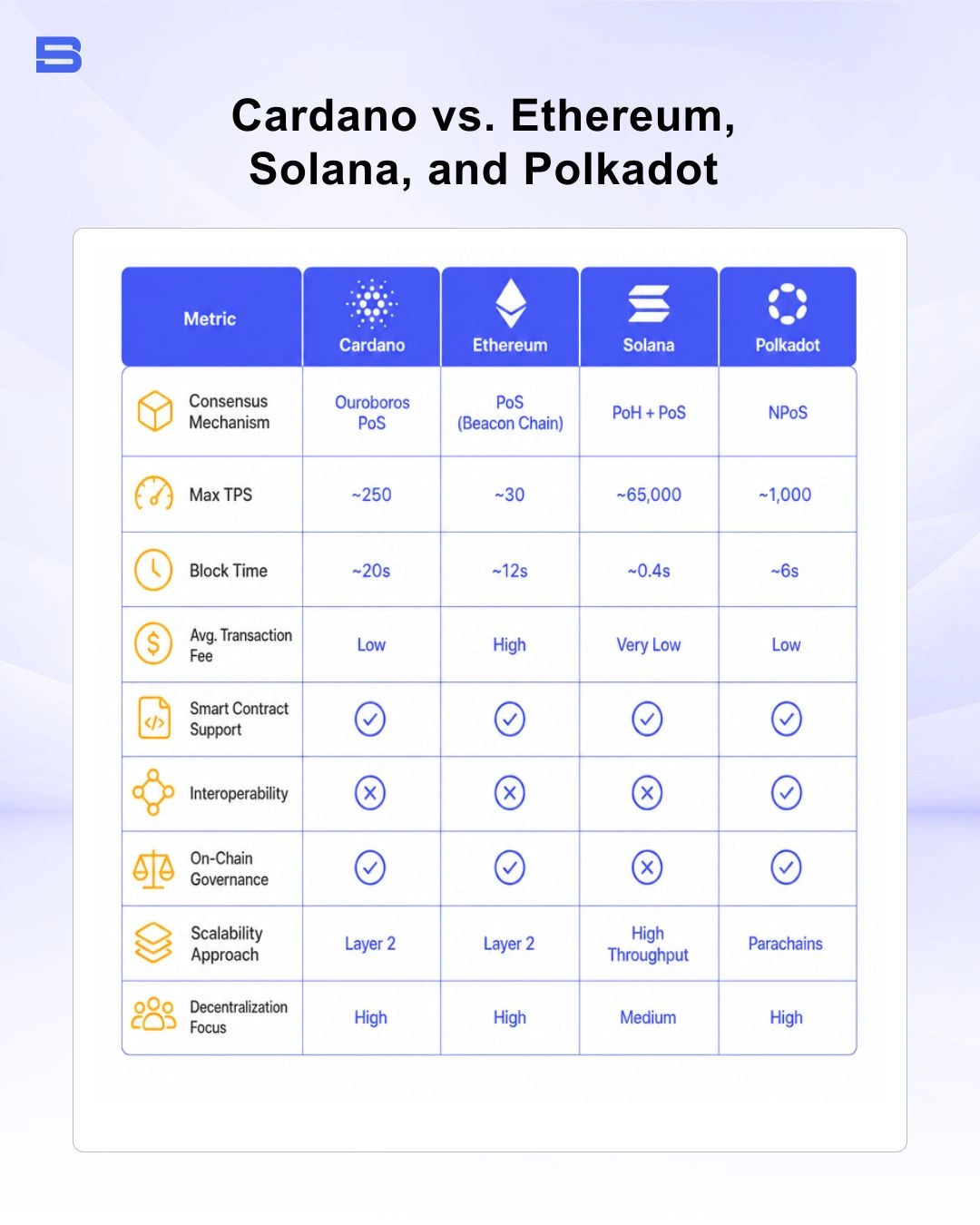
When assessing alternative smart contract networks, traders balance protocol throughput against decentralization and security guarantees. Comparing Cardano alongside Polkadot, Solana, and Layer-2 scaling solutions like Arbitrum highlights clear operational trade-offs:
- Cardano: Prioritizes peer-reviewed security, formal verification, and liquid staking. Ongoing scaling implementations such as Hydra, a Layer-2 sidechain solution designed to boost transaction throughput off the main chain, favor long-term stability over raw execution speed.
- Solana: Focuses on ultra-high throughput and sub-second block times using Proof-of-History, a timestamping method that lets the network order transactions without waiting for full consensus on every block. However, higher hardware requirements for node validators trade off some structural decentralization.
- Polkadot: Focuses on cross-chain interoperability via a shared Relay Chain and specialized Parachains.
For crypto traders, Cardano represents a conservative Layer-1 asset characterized by steady development cycles rather than rapid, experimental software releases.
Trading Cardano: Spot vs. Crypto CFDs
Intermediate traders can access ADA price movements through two main financial instruments: direct Spot Crypto Purchases or Contracts for Difference (CFDs). Choosing between spot ownership and derivative trading depends on your personal strategy, risk tolerance, and investment horizon.
Spot Cardano Trading
Purchasing spot ADA on regulated spot exchanges means acquiring actual underlying ownership of the digital asset.
- Pros: You hold actual ADA, allowing you to transfer funds to a private wallet, delegate tokens to earn staking yields, and participate in governance voting.
- Cons: Requires managing cryptographic private keys safely. Spot trading yields capital growth only when asset prices rise.
Cardano CFD Derivatives
Trading Cardano through CFDs allows you to speculate on ADA price movements without taking physical delivery or managing private wallet infrastructure.
- Pros: Access to two-way market positions (ability to go long or short) and flexible margin leverage.
- Cons: Leveraged CFD products introduce substantial financial risks.
Leverage amplifies your returns when the market moves in your favor, but it accelerates capital destruction just as quickly when positions move against you—holding a 5:1 leveraged position means a 20% adverse price swing results in a complete margin wipeout. Furthermore, derivative positions held open overnight incur financing charges (swaps), making CFDs better suited for short-term tactical trades rather than multi-year holdings.
When trading digital assets from Southeast Asia or global jurisdictions, verify that your selected trading platform operates under appropriate regulatory oversight. In Malaysia, spot crypto exchanges operating legally must be registered as Recognized Market Operators (RMOs) with the Securities Commission Malaysia (SC). Derivative brokers providing crypto CFDs globally are subject to strict leverage caps and investor protection disclosures set out by the International Organization of Securities Commissions (IOSCO).
The Bottom Line
Cardano provides a distinct alternative to high-velocity blockchain networks by grounding its development in peer-reviewed computer science and formal verification. Its non-custodial liquid staking and deterministic EUTXO fee model appeal to market participants seeking structural predictability. However, trading ADA requires balancing these technological strengths against general crypto market volatility, scaling adoption timelines, and the operational risks inherent to leveraged trading products.
- What Can You Trade? A Guide to Forex, Stocks, and More
- CFD Trading for Beginners
- What is CFD Trading and How Does It Work?
- Forex vs. Stocks: Which Market Suits You Best?
- How to Diversify a Portfolio Across Asset Classes
- How Dividend Stocks Work: Yields, Risks, and Strategies
- Silver Trading Explained: A Guide for Retail Investors
- Precious Metals Trading: A Complete Guide for Beginners
- Natural Gas Trading: A Guide to the Market
- Structured Warrants Malaysia: How They Work and Risks
- What Is the KLCI Index and How to Trade It
- Gold Investment in Malaysia: A Complete Guide for Beginners
- What Is Kijang Emas and How to Invest in It
- Value Investing Explained: How to Find Undervalued Stocks
- How to Trade Bitcoin Safely: A Complete Market Guide
- Growth Investing Explained: Strategies, Metrics, and Risks
- What Is Digital Gold Malaysia and How to Invest
- Crypto Trading Strategies for Beginners
- Gold vs Bitcoin: Key Differences, Risks, and Strategies
- Sukuk: A Guide for Beginners to Islamic Bonds
- What Is FCPO (Crude Palm Oil Futures) and How to Trade It
- How to Identify and Invest in Shariah-Compliant Stocks
- Timber Investment: Is It Worth It?
- Gold ETF Malaysia: A Guide for Beginners
- What Are Malaysian Government Securities (MGS)?
- Corporate Bonds Malaysia: A Guide for Beginners
- China A-Shares Trading Guide for Malaysian Investors
- What Is a Silver ETF and How to Invest in It?
- How to Trade XRP: A Practical Guide for Retail Investors
- How to Trade Solana (SOL): A Guide for Beginners
- What Are Gold Futures and How Do They Work?
- Money Market Fund in Malaysia: A Guide for Beginners
- Property Investment Malaysia: Direct Real Estate or M-REITs?
- What Is Binance Coin and How Does It Work?
- Green Sukuk: A Guide for Beginners to Islamic ESG Investing
- What Is Shiba Inu (SHIB) and How to Trade It
- What Is USDT? A Complete Guide to Tether for Beginners
- What Is Dogecoin and How to Trade It Safely for Beginners
- Cardano: A Guide for Beginners to Trade This Cryptocurrency
- Polkadot: A Guide to Trading This Cryptocurrency
- Tron: A Guide for Beginners to Trading This Cryptocurrency
- What Is Litecoin (LTC)? A Guide to Trading Digital Silver
- What Is Chainlink (LINK) and How to Trade It
- How to Trade Pepe Coin: Spot, Leverage, and Risk Management
- Near Protocol: A Guide to Trading This Cryptocurrency
- Trading Polygon Crypto: A Practical Guide for Beginners
- Trade Toncoin: Understanding the TON Ecosystem and Risks
- Cosmos Crypto: Ecosystem Architecture, Tokenomics, and Risks
- Stellar Crypto: A Guide to Trading This Cryptocurrency
- Avalanche Crypto Explained: A Practical Guide for Traders
- What Is Worldcoin? How to Trade WLD and Manage Risk
- Aptos: A Guide for Beginners to Trading This Cryptocurrency
- Sui Crypto Explained: Tokenomics and Trading Guide
- Celestia: A Guide to Trading This Cryptocurrency
- Decentraland: A Guide to Trading This Cryptocurrency
- What Is Arbitrum? How to Trade the Leading Layer 2 Network
- Sei Crypto: A Guide to Trading This Cryptocurrency
- What Is Injective Protocol and How to Trade INJ Safely
Disclaimer: The content on this page is intended for educational and informational purposes only. It does not constitute financial, investment, tax, or legal advice, and should not be interpreted as a recommendation to buy, sell, or hold any financial instrument or asset. Trading and investing involve significant risk, including the possible loss of your entire capital. Products such as forex, CFDs, and cryptocurrencies carry additional risks due to leverage, high volatility, and limited regulatory protection in some jurisdictions. Past performance of any financial instrument does not guarantee future results. Any market views, forecasts, or opinions expressed are those of the author at the time of writing and may not reflect current market conditions. Platform features, fees, and regulatory status are subject to change — always verify information directly with the relevant provider or regulator before making any financial decision. BrokerSpecs may receive compensation from third parties featured on this site. Always conduct your own due diligence and consider seeking advice from a licensed financial professional before investing.