


Related Tags
Entering a derivative market for the first time can feel intimidating, but gold futures offer deep liquidity, structural efficiency, and transparent exchange-based pricing for active traders seeking direct exposure to gold markets, holding without ever taking delivery of physical bullion.
What Are Gold Futures?
A gold futures contract is a standardized, legally binding agreement to buy or sell a specified quantity of gold at a predetermined price on a set future date. Unlike spot trading, where transactions settle almost immediately, futures allow market participants to lock in prices today for transactions occurring months down the line.
Trading gold futures involves two primary positions:
- Long Position (Buyer): Agrees to buy gold at the contract price upon expiration. Traders go long when they anticipate rising gold prices.
- Short Position (Seller): Agrees to deliver gold at the contract price upon expiration. Traders go short when they expect falling gold prices or wish to hedge existing physical inventories.
Gold Futures Contract Specifications
These contracts trade on regulated derivatives exchanges worldwide. Contract sizes and tick values are strictly standardized to ensure market liquidity and transparency.
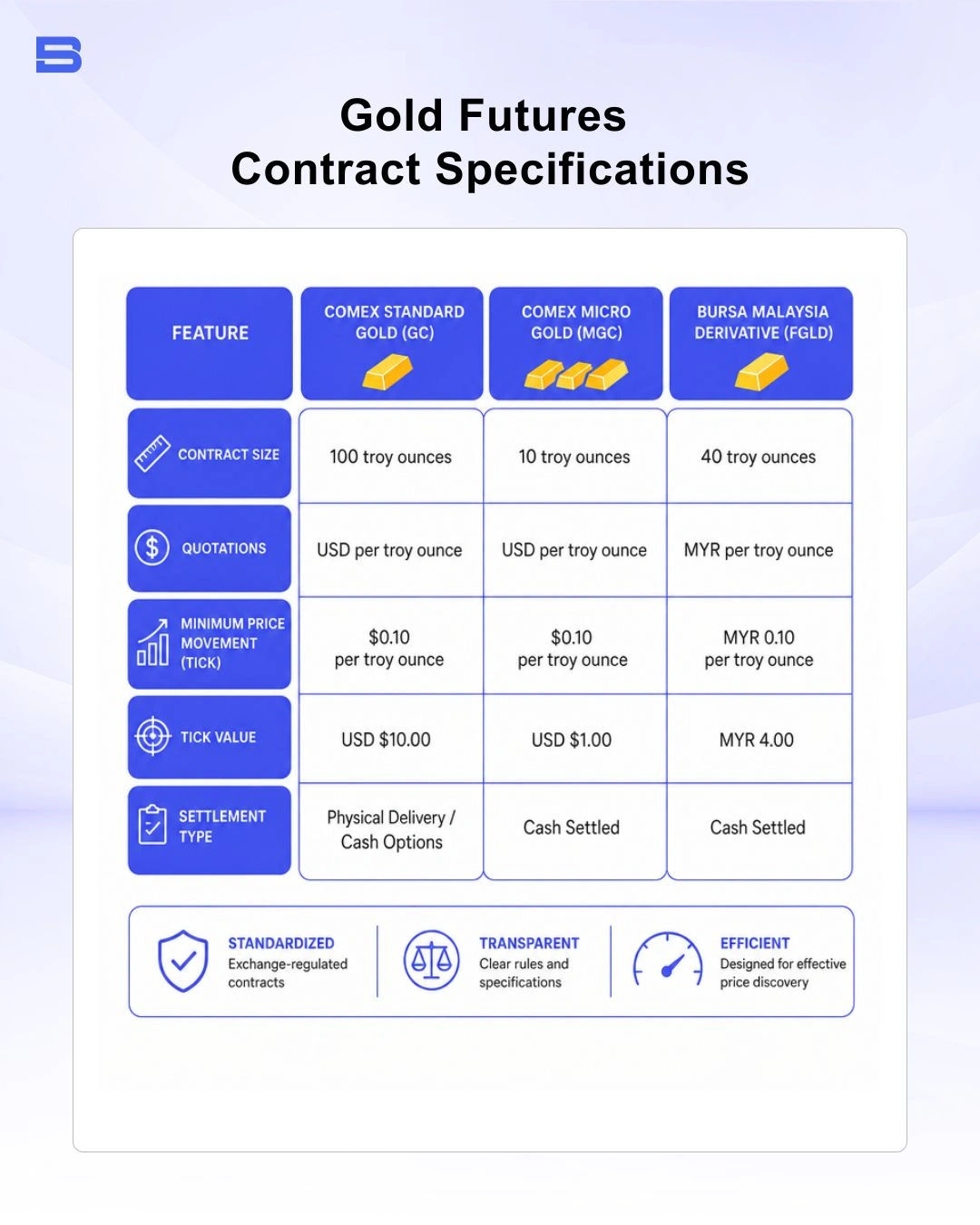
For updated margin parameters and official specifications, consult the CME Group and Bursa Malaysia Derivatives contract guides directly.
How Do Gold Futures Work?
When you buy or sell a gold futures contract on an exchange, you are not paying the full nominal value of the underlying gold. Instead, the transaction is facilitated through a centralized exchange clearinghouse that handles the transaction, standing in as the counterparty to every trade to eliminate default risk.
Every trading day, positions undergo a daily mark-to-market settlement. Profits and losses are calculated at the end of the trading session based on the daily settlement price, and funds are credited to or debited from your trading account in real time. Most retail traders close out their positions before contract expiration by executing an offsetting trade, avoiding physical delivery entirely.
The Mechanics of Leverage in Gold Futures
Leverage is the defining characteristic of futures trading. Rather than funding 100% of the contract value, exchanges require a performance bond known as the initial margin.
- Amplified Capital Efficiency: A standard COMEX (Commodity Exchange, Inc.) contract covering 100 troy ounces at US dollar (USD) 2,000 per ounce has a total nominal value of USD 200,000. If the initial margin requirement is USD 10,000, you are controlling USD 200,000 worth of gold with just 5% capital down (20:1 leverage).
- Symmetrical Profit and Loss: While a 2% increase in the price of gold yields a USD 4,000 gain on your USD 10,000 margin (a 40% return on equity), a 2% price decline results in an equivalent USD 4,000 loss.
Margin Requirements and Margin Calls
To maintain an open position, your account balance must stay above the maintenance margin threshold set by the exchange.
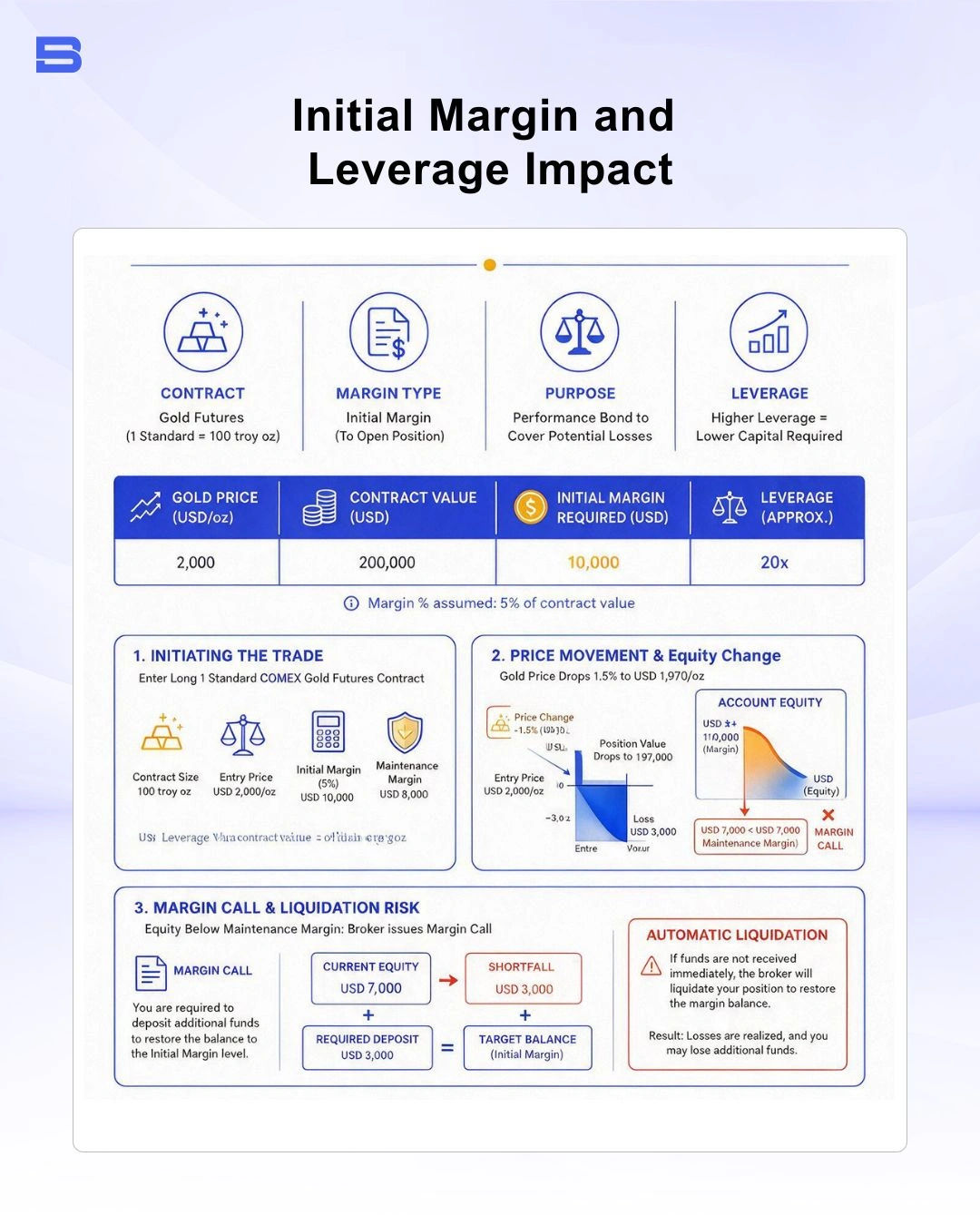
Worked Scenario: Suppose you purchase one standard COMEX Gold futures contract at USD 2,000/oz with an initial margin of USD 10,000 and a maintenance margin of USD 8,000. If the gold price drops by 1.5% (a USD 30 drop to USD 1,970/oz), your contract suffers a loss of USD 3,000 (30 x 100 oz).
Your account equity falls from USD 10,000 to USD 7,000. Because USD 7,000 is below the USD 8,000 maintenance threshold, your broker issues a margin call. You must immediately deposit USD 3,000 to restore your balance to the initial margin level or risk automated liquidation of your position.
How Do Gold Futures Compare to Other Gold Investments?
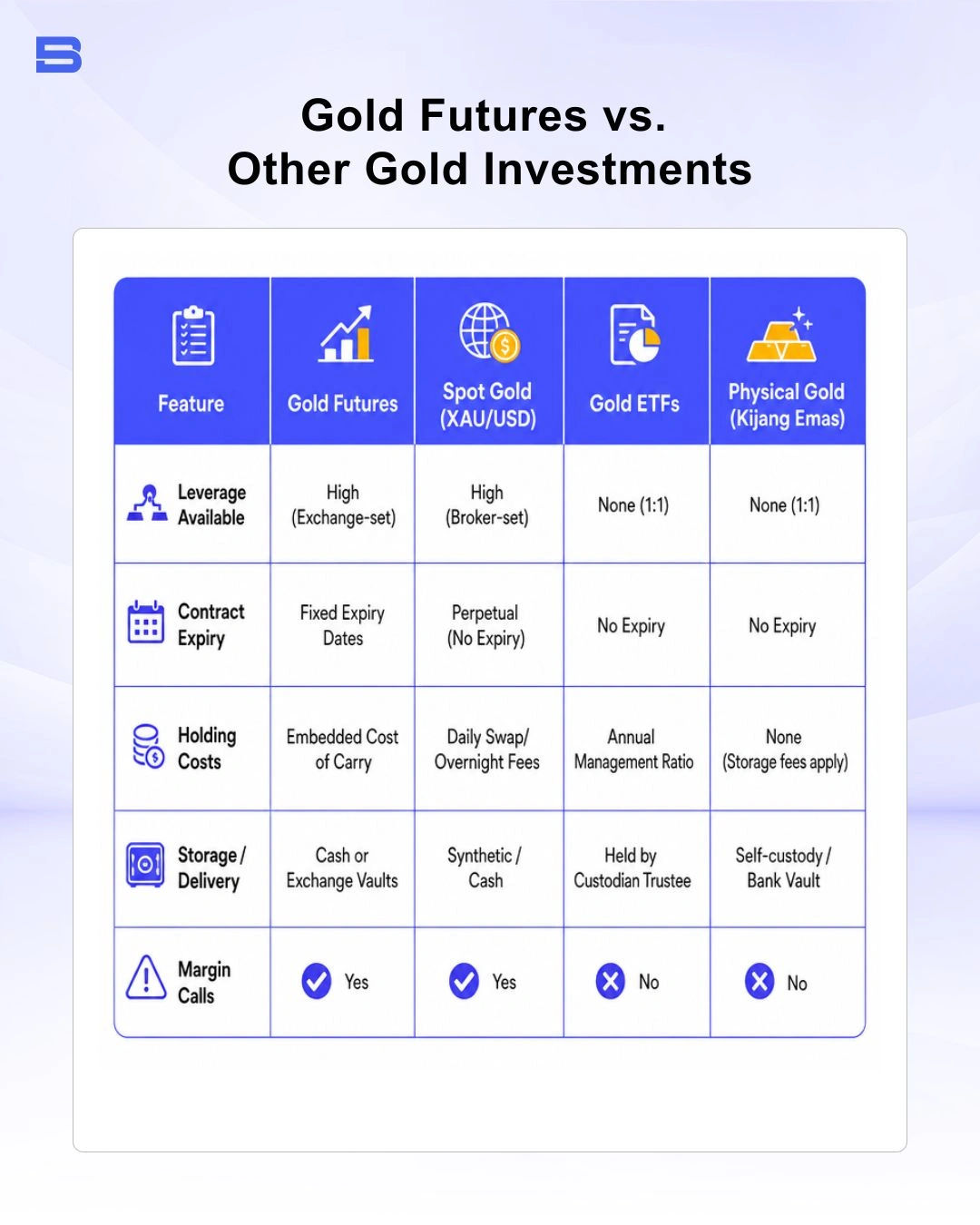
Investors looking for gold exposure—including those exploring gold investment Malaysia options—can choose from several instruments tailored to their investment horizon, leverage needs, and liquidity preferences.
Gold Futures vs. Spot Gold (XAU/USD)
Spot gold represents the current market price for immediate settlement, whereas futures prices reflect anticipated future supply and demand plus storage and financing costs (known as the cost of carry). Spot positions do not expire but incur daily swap or rollover fees if held overnight. Futures contracts have set expiration dates and roll over quarterly, but they do not charge daily overnight financing rates.
Gold Futures vs. Gold ETFs
Gold Exchange-Traded Funds (ETFs) offer non-leveraged equity exposure to gold bullion prices. ETFs are simple to hold in traditional stock brokerage accounts for long-term strategic allocation. In contrast, gold futures are short-to-medium-term instruments built for active traders using tactical leverage and hedging strategies.
Gold Futures vs. Physical Gold (Kijang Emas)
Physical bullion coins—such as Malaysia's official Kijang Emas minted by Bank Negara Malaysia—offer tangible security without counterparty risk. However, physical gold incurs wider buy-sell spreads, storage considerations, and zero operational leverage compared to standardized derivative contracts.
Accessing Gold Futures in Malaysia and Globally
Retail traders can participate in global gold futures markets by opening an account with licensed derivatives brokers.
In Malaysia, futures brokers are licensed and monitored by the Securities Commission Malaysia (SC) under the Capital Markets and Services Act. Global brokers clearing US contracts like COMEX operate under strict oversight from the US Commodity Futures Trading Commission (CFTC). Always verify that your chosen brokerage holds a valid capital markets services license before depositing funds.
Understanding the Risks of Trading Gold Futures
Trading derivative instruments carries explicit financial risks that require active management:
- Leverage Acceleration: Leverage amplifies both gains and losses equally; adverse price shocks can liquidate capital in minutes.
- Gap Risk: Overnight fundamental news or geopolitical events can cause prices to gap past pending stop-loss orders, resulting in execution slippage.
- Expiration Rollover: Holding positions across contract months requires manually rolling over contracts before the first notice or delivery date, incurring transaction spreads.
Disciplined traders manage these hazards by utilizing stop-loss orders, maintaining conservative position sizes relative to overall account capital, and avoiding over-leveraging.
Gold Futures as Part of a Broader Metals Strategy
Gold futures serve as a key component within comprehensive precious metals strategy allocation models. Institutions use gold derivative contracts to hedge against fiat currency devaluation and inflation pressures. Active traders frequently pair gold positions against other industrial or precious commodities, such as silver trading contracts, to execute relative-value spread strategies during periods of economic transition.
The Bottom Line
Gold futures provide unmatched liquidity, structural efficiency, and transparent pricing for active traders seeking direct exposure to gold markets. While leverage makes them powerful tools for capital management and short-term hedging, it demands strict risk discipline, clear stop-loss rules, and continuous monitoring of margin requirements.
- What Can You Trade? A Guide to Forex, Stocks, and More
- CFD Trading for Beginners
- What is CFD Trading and How Does It Work?
- Forex vs. Stocks: Which Market Suits You Best?
- How to Diversify a Portfolio Across Asset Classes
- How Dividend Stocks Work: Yields, Risks, and Strategies
- Silver Trading Explained: A Guide for Retail Investors
- Precious Metals Trading: A Complete Guide for Beginners
- Natural Gas Trading: A Guide to the Market
- Structured Warrants Malaysia: How They Work and Risks
- What Is the KLCI Index and How to Trade It
- Gold Investment in Malaysia: A Complete Guide for Beginners
- What Is Kijang Emas and How to Invest in It
- Value Investing Explained: How to Find Undervalued Stocks
- How to Trade Bitcoin Safely: A Complete Market Guide
- Growth Investing Explained: Strategies, Metrics, and Risks
- What Is Digital Gold Malaysia and How to Invest
- Crypto Trading Strategies for Beginners
- Gold vs Bitcoin: Key Differences, Risks, and Strategies
- Sukuk: A Guide for Beginners to Islamic Bonds
- What Is FCPO (Crude Palm Oil Futures) and How to Trade It
- How to Identify and Invest in Shariah-Compliant Stocks
- Timber Investment: Is It Worth It?
- Gold ETF Malaysia: A Guide for Beginners
- What Are Malaysian Government Securities (MGS)?
- Corporate Bonds Malaysia: A Guide for Beginners
- China A-Shares Trading Guide for Malaysian Investors
- What Is a Silver ETF and How to Invest in It?
- How to Trade XRP: A Practical Guide for Retail Investors
- How to Trade Solana (SOL): A Guide for Beginners
- What Are Gold Futures and How Do They Work?
- Money Market Fund in Malaysia: A Guide for Beginners
- Property Investment Malaysia: Direct Real Estate or M-REITs?
- What Is Binance Coin and How Does It Work?
- Green Sukuk: A Guide for Beginners to Islamic ESG Investing
- What Is Shiba Inu (SHIB) and How to Trade It
- What Is USDT? A Complete Guide to Tether for Beginners
- What Is Dogecoin and How to Trade It Safely for Beginners
- Cardano: A Guide for Beginners to Trade This Cryptocurrency
- Polkadot: A Guide to Trading This Cryptocurrency
- Tron: A Guide for Beginners to Trading This Cryptocurrency
- What Is Litecoin (LTC)? A Guide to Trading Digital Silver
- What Is Chainlink (LINK) and How to Trade It
- How to Trade Pepe Coin: Spot, Leverage, and Risk Management
- Near Protocol: A Guide to Trading This Cryptocurrency
- Trading Polygon Crypto: A Practical Guide for Beginners
- Trade Toncoin: Understanding the TON Ecosystem and Risks
- Cosmos Crypto: Ecosystem Architecture, Tokenomics, and Risks
- Stellar Crypto: A Guide to Trading This Cryptocurrency
- Avalanche Crypto Explained: A Practical Guide for Traders
- What Is Worldcoin? How to Trade WLD and Manage Risk
- Aptos: A Guide for Beginners to Trading This Cryptocurrency
- Sui Crypto Explained: Tokenomics and Trading Guide
- Celestia: A Guide to Trading This Cryptocurrency
- Decentraland: A Guide to Trading This Cryptocurrency
- What Is Arbitrum? How to Trade the Leading Layer 2 Network
- Sei Crypto: A Guide to Trading This Cryptocurrency
- What Is Injective Protocol and How to Trade INJ Safely
Disclaimer: The content on this page is intended for educational and informational purposes only. It does not constitute financial, investment, tax, or legal advice, and should not be interpreted as a recommendation to buy, sell, or hold any financial instrument or asset. Trading and investing involve significant risk, including the possible loss of your entire capital. Products such as forex, CFDs, and cryptocurrencies carry additional risks due to leverage, high volatility, and limited regulatory protection in some jurisdictions. Past performance of any financial instrument does not guarantee future results. Any market views, forecasts, or opinions expressed are those of the author at the time of writing and may not reflect current market conditions. Platform features, fees, and regulatory status are subject to change — always verify information directly with the relevant provider or regulator before making any financial decision. BrokerSpecs may receive compensation from third parties featured on this site. Always conduct your own due diligence and consider seeking advice from a licensed financial professional before investing.