


Related Tags
Entering a transaction on Ethereum during peak network activity often reveals a frustrating reality: high gas fees and delayed block confirmations can significantly erode your trading efficiency. This infrastructure bottleneck led to the emergence of Layer 2 scaling protocols, designed to process high-volume transactions off the main blockchain while maintaining the security guarantees of the base layer.
Polygon Crypto is among the longer-running and more widely adopted Ethereum Layer 2 scaling frameworks in the digital asset space. For traders evaluating utility-driven cryptocurrencies, understanding how Polygon Crypto functions, its recent tokenomics overhaul, and the specific mechanics of trading its native asset is essential for navigating market volatility effectively.
What Is Polygon Crypto and How Does It Work?
Polygon is a decentralized Ethereum Layer 2 (L2) scaling framework built to improve transaction speed and drastically lower gas fees. Rather than attempting to replace Ethereum, Polygon Crypto operates alongside it, taking transaction computation off the main chain, processing it rapidly, and settling the finalized data back onto Ethereum's Layer 1.
The protocol executes transactions using customized sidechains. A quick primer: a blockchain is a shared digital ledger that records transactions, and every transaction on it requires a small payment called a 'gas fee.' Ethereum is the original blockchain many crypto apps run on (its 'Layer 1'); Polygon is a 'Layer 2' network built to make transactions on top of Ethereum cheaper and faster.
By bundling thousands of transactions into a single batch, Polygon Crypto reduces network congestion on Ethereum and reduces execution costs from several dollars to a fraction of a cent per trade.
Security and Validator Staking
The network secures its execution layer using a Proof of Stake (PoS) consensus mechanism. Decentralized validators run node infrastructure to verify transactions, validate blocks, and commit checkpoints to Ethereum.
Validator nodes must stake the network's native token as collateral to maintain network integrity; fraudulent behavior results in financial penalties through token slashing. Token holders who do not operate full nodes can delegate their holdings to active validators to help secure the network in exchange for a share of transaction fees.
The AggLayer and Ethereum Scaling
A key component of Polygon’s architecture is the Aggregation Layer (AggLayer). The AggLayer acts as a decentralized middleware protocol — software that lets separate blockchains communicate — connecting disparate Layer 2 chains and aggregating zero-knowledge proofs (cryptographic verification techniques) across multiple networks to unify cross-chain liquidity.
For active traders, AggLayer interoperability aims to eliminate liquidity fragmentation across scaling solutions, enabling seamless cross-chain asset swaps without requiring complex, high-risk token bridges.
Understanding the POL Tokenomics (ex-MATIC)
In late 2024, the network initiated a major protocol upgrade, migrating its primary ecosystem token from MATIC to POL on a direct 1:1 basis. This transition expanded the token's technical role from a single-chain fee token to a hyperproductive token across the entire Polygon L2 ecosystem.
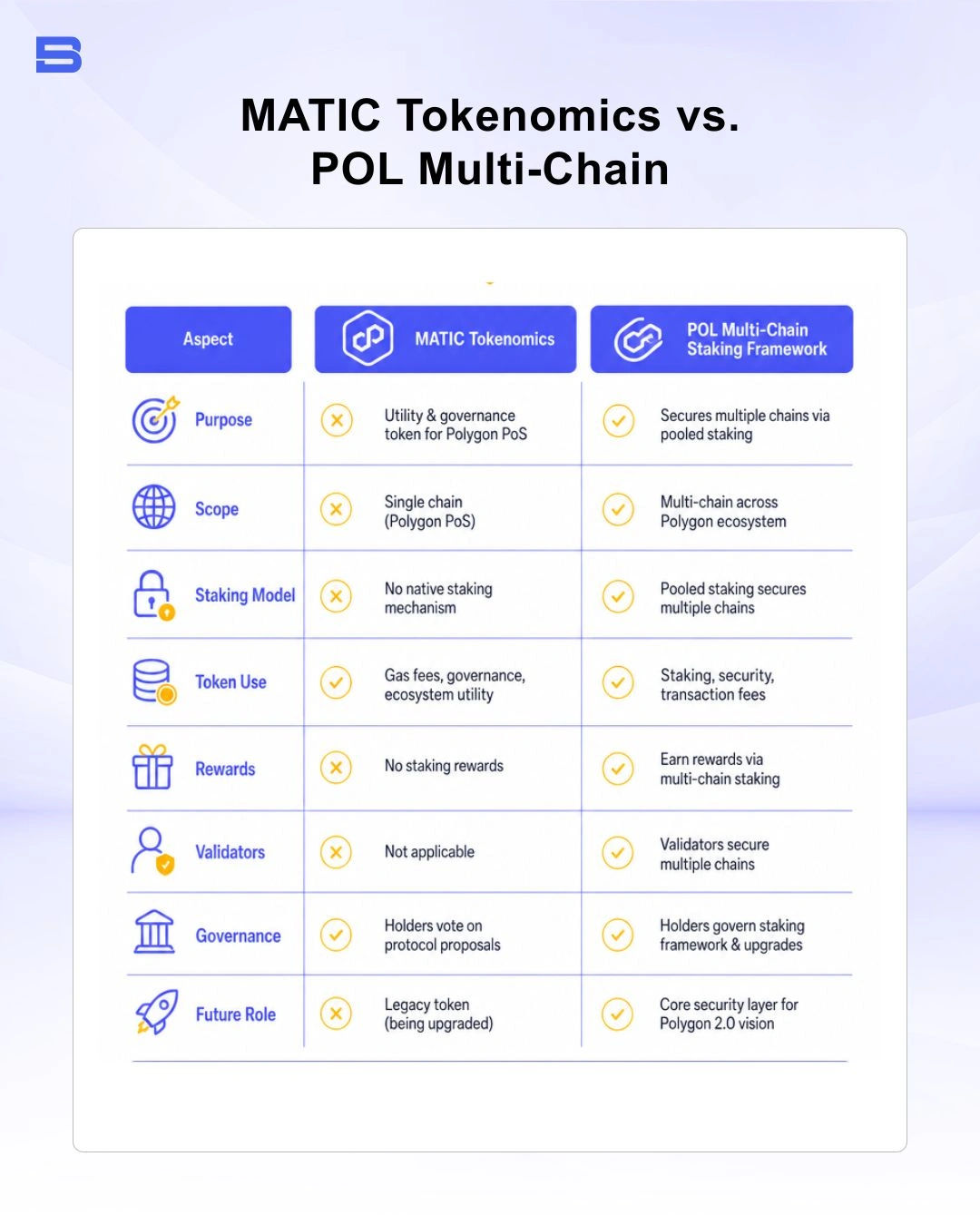
The Polygon ecosystem token POL fulfills three primary network functions:
- Gas Fee Execution: POL is required to pay transaction fees across Polygon's PoS sidechain and connected L2 networks.
- Validator Staking and Rewards: Node operators stake POL to secure the validator set, earning network rewards funded by a predictable, low-rate annual emission model.
- Ecosystem Governance: POL grants holders voting weight on protocol development proposals, treasury allocations, and network parameters.
The tokenomics structure incorporates a continuous fee-burning mechanism based on network activity, balancing emission rates against token supply contractions during periods of high network usage.
Polygon Crypto vs. Near Protocol: How Layer 2 and Layer 1 Solutions Compare
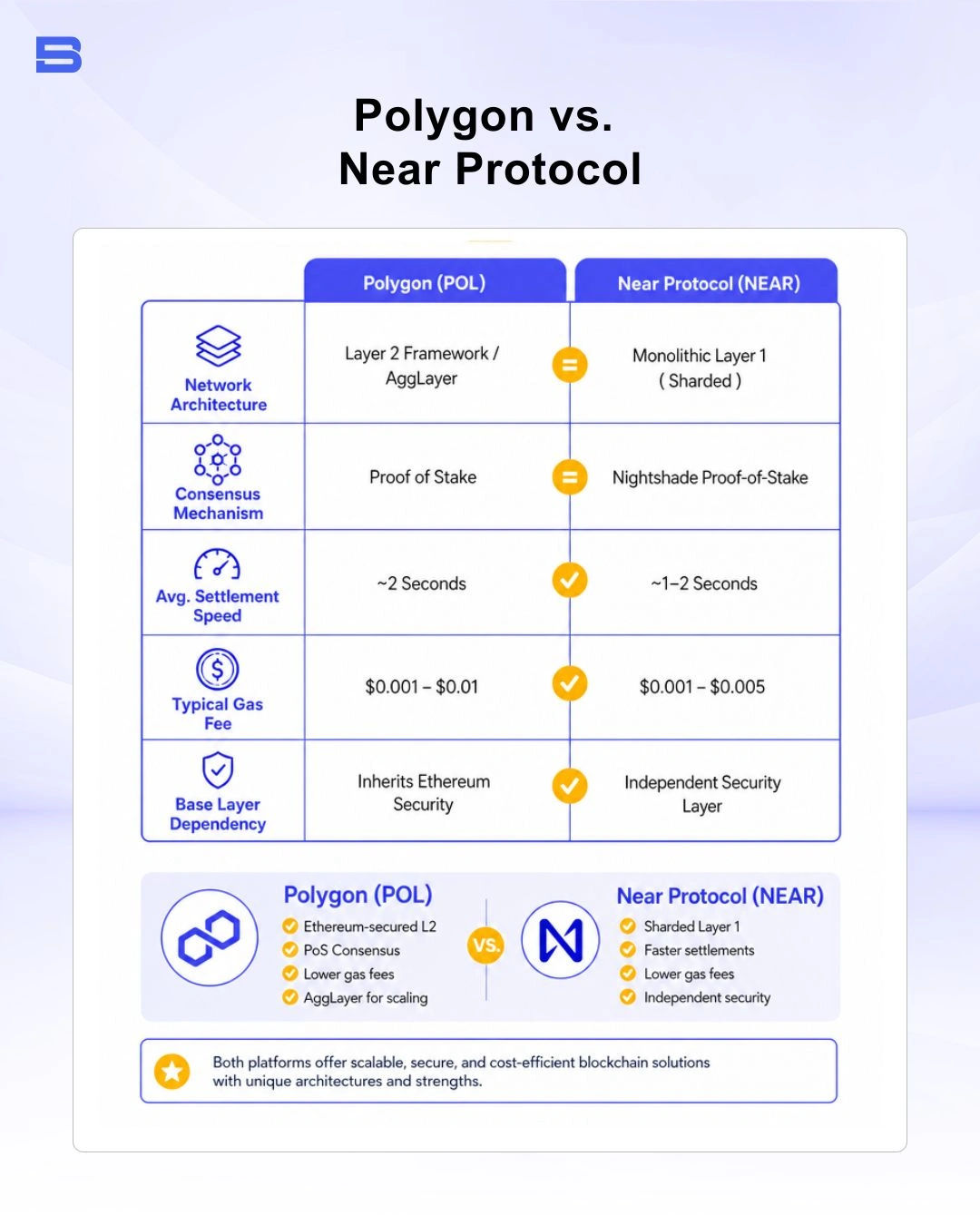
When evaluating layer 2 scaling infrastructure, traders frequently compare L2 solutions like Polygon Crypto against high-performance Layer 1 networks such as Near Protocol. While both aim to deliver rapid execution and sub-cent fees, their core architectural approaches differ fundamentally.
Polygon relies on Ethereum for ultimate settlement and base-layer security, functioning as a modular execution scaling layer. Near Protocol operates as an independent, monolithic Layer 1 blockchain using nightshade sharding to scale throughput internally.
Monolithic vs. Layer 2 Solutions
Alternative high-speed networks like Aptos and Sei crypto utilize parallel execution engines directly on Layer 1 to maximize processing speed. Conversely, Polygon’s L2 model prioritizes alignment with Ethereum’s established developer base and deep liquidity pools.
Monolithic chains offer streamlined single-chain environments, but L2 scaling frameworks benefit directly from the security, capital depth, and decentralization of the primary Ethereum mainnet.
How Polygon Interacts with Chainlink Oracles
Decentralized applications (dApps) operating on Polygon require real-time, tamper-proof off-chain market data to execute smart contracts safely. Polygon achieves high-fidelity data integration by embedding decentralized oracle networks provided by Chainlink.
For instance, decentralized money markets and options protocols on Polygon rely on Chainlink price feeds to determine collateral values, liquidation thresholds, and automated trade execution.
By retrieving verified market prices off-chain and delivering them on-chain with minimal latency, oracles prevent price manipulation and ensure execution reliability across Polygon's financial protocols.
How to Trade Polygon Crypto: Spot Ownership vs. Derivatives
Traders can access exposure to Polygon Crypto through direct spot token ownership or via derivative financial contracts. Each vehicle carries distinct capital requirements, operational structures, and risk profiles.
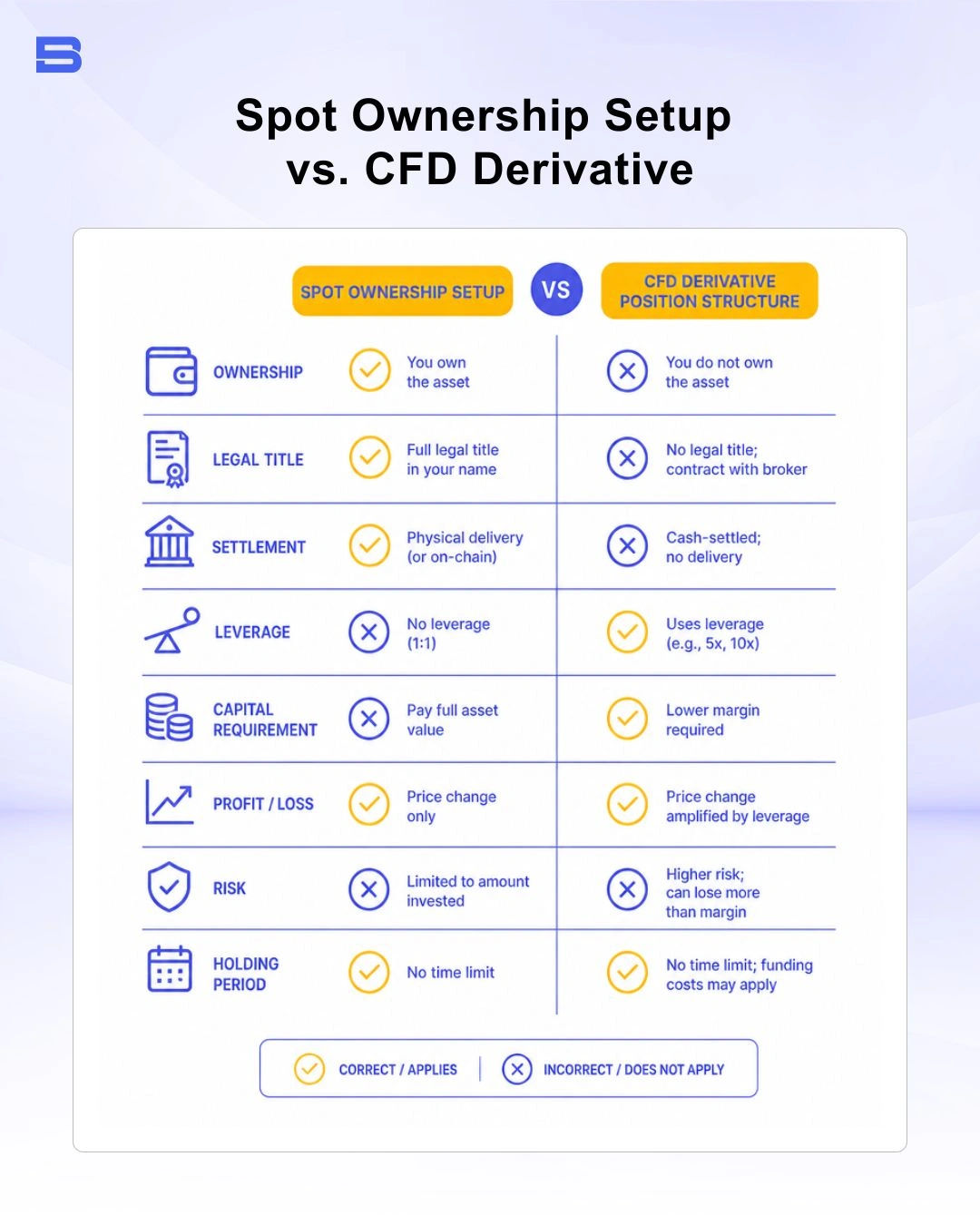
- Spot Ownership: Buying actual POL on a centralized or decentralized exchange gives you ownership of the underlying token. You can transfer POL to a compatible self-custody wallet, stake it with Polygon PoS validators, or use supported DeFi applications. Spot trading does not inherently involve leverage or margin calls, but you remain exposed to POL's market-price volatility.
- Derivatives — CFDs and Futures: Derivative instruments allow active traders to speculate on POL price movements in both long and short directions without taking delivery of underlying tokens. Cash CFDs have no expiry date and typically carry a daily (or triple, on rollover days) swap fee, while futures contracts have a fixed expiry and no swap fee but may involve a rollover adjustment when a position is rolled into a new contract. Regulated derivative brokers typically offer leverage on both instrument types, enabling position execution with a fraction of the total trade value committed as margin.
Worked Example: Position Sizing and Leverage Mechanics
Consider an investor evaluating a short-term trading setup on POL with a market price of $1.00 per token:
- Spot Trade Setup: Buying 1,000 POL tokens outright requires an upfront capital outlay of $1,000. If the token price rises by 5% to $1.05, the trade yields a $50 gain (excluding transaction fees). Conversely, a 5% drop to $0.95 results in an unrealized loss of $50.
- Leveraged Derivative Setup (2:1 Leverage): Using a CFD trading account with 2:1 leverage permitted under European Securities and Markets Authority (ESMA) product intervention rules for retail crypto-asset CFDs, opening a $1,000 position requires a margin deposit of $500. (Note: CFDs are generally not offered to retail investors in the United States under SEC and CFTC regulations.)
- If the price increases by 5% ($1.00 to $1.05), the trader realizes a $50 profit—yielding a 10% return on the $500 margin deposit.
- If the price declines by 5% ($1.00 to $0.95), the position incurs a $50 loss—representing a 10% capital drawdown on deposited margin.
Risk Allocation: Polygon vs. Store-of-Value Assets
When structuring a digital asset portfolio, utility tokens like Polygon must be categorized accurately based on risk profile. Compared to traditional store-of-value assets such as Gold or primary cryptocurrencies like Bitcoin, L2 tokens exhibit significantly higher price volatility and distinct market drivers.
Bitcoin functions primarily as a decentralized monetary network and digital safe-haven alternative. Gold operates as an established macro asset with centuries of institutional reserve history.
Polygon’s valuation, by contrast, is tied to protocol adoption, active developer activity, scaling demand, and competitive dynamics across alternative L2 solutions. While utility assets offer exposure to technological adoption, they carry higher downside volatility during broader risk-off market contractions.
Is Polygon Crypto Right for You?
Trading Polygon Crypto can offer opportunities for beginners interested in the POL token and Polygon ecosystem, but it also carries significant risks due to crypto-market volatility. Understanding how Polygon works, the role of POL, and the differences between spot trading and derivatives is essential before committing funds.
Beginners should start with a clear trading plan, use appropriate position sizing, set stop-loss levels, and avoid excessive leverage. Whether you choose spot POL trading or CFDs, risk management should remain a priority. Take time to research the market, understand trading costs, and practice with a demo account before trading with real money.
- What Can You Trade? A Guide to Forex, Stocks, and More
- CFD Trading for Beginners
- What is CFD Trading and How Does It Work?
- Forex vs. Stocks: Which Market Suits You Best?
- How to Diversify a Portfolio Across Asset Classes
- How Dividend Stocks Work: Yields, Risks, and Strategies
- Silver Trading Explained: A Guide for Retail Investors
- Precious Metals Trading: A Complete Guide for Beginners
- Natural Gas Trading: A Guide to the Market
- Structured Warrants Malaysia: How They Work and Risks
- What Is the KLCI Index and How to Trade It
- Gold Investment in Malaysia: A Complete Guide for Beginners
- What Is Kijang Emas and How to Invest in It
- Value Investing Explained: How to Find Undervalued Stocks
- How to Trade Bitcoin Safely: A Complete Market Guide
- Growth Investing Explained: Strategies, Metrics, and Risks
- What Is Digital Gold Malaysia and How to Invest
- Crypto Trading Strategies for Beginners
- Gold vs Bitcoin: Key Differences, Risks, and Strategies
- Sukuk: A Guide for Beginners to Islamic Bonds
- What Is FCPO (Crude Palm Oil Futures) and How to Trade It
- How to Identify and Invest in Shariah-Compliant Stocks
- Timber Investment: Is It Worth It?
- Gold ETF Malaysia: A Guide for Beginners
- What Are Malaysian Government Securities (MGS)?
- Corporate Bonds Malaysia: A Guide for Beginners
- China A-Shares Trading Guide for Malaysian Investors
- What Is a Silver ETF and How to Invest in It?
- How to Trade XRP: A Practical Guide for Retail Investors
- How to Trade Solana (SOL): A Guide for Beginners
- What Are Gold Futures and How Do They Work?
- Money Market Fund in Malaysia: A Guide for Beginners
- Property Investment Malaysia: Direct Real Estate or M-REITs?
- What Is Binance Coin and How Does It Work?
- Green Sukuk: A Guide for Beginners to Islamic ESG Investing
- What Is Shiba Inu (SHIB) and How to Trade It
- What Is USDT? A Complete Guide to Tether for Beginners
- What Is Dogecoin and How to Trade It Safely for Beginners
- Cardano: A Guide for Beginners to Trade This Cryptocurrency
- Polkadot: A Guide to Trading This Cryptocurrency
- Tron: A Guide for Beginners to Trading This Cryptocurrency
- What Is Litecoin (LTC)? A Guide to Trading Digital Silver
- What Is Chainlink (LINK) and How to Trade It
- How to Trade Pepe Coin: Spot, Leverage, and Risk Management
- Near Protocol: A Guide to Trading This Cryptocurrency
- Trading Polygon Crypto: A Practical Guide for Beginners
- Trade Toncoin: Understanding the TON Ecosystem and Risks
- Cosmos Crypto: Ecosystem Architecture, Tokenomics, and Risks
- Stellar Crypto: A Guide to Trading This Cryptocurrency
- Avalanche Crypto Explained: A Practical Guide for Traders
- What Is Worldcoin? How to Trade WLD and Manage Risk
- Aptos: A Guide for Beginners to Trading This Cryptocurrency
- Sui Crypto Explained: Tokenomics and Trading Guide
- Celestia: A Guide to Trading This Cryptocurrency
- Decentraland: A Guide to Trading This Cryptocurrency
- What Is Arbitrum? How to Trade the Leading Layer 2 Network
- Sei Crypto: A Guide to Trading This Cryptocurrency
- What Is Injective Protocol and How to Trade INJ Safely
Disclaimer: The content on this page is intended for educational and informational purposes only. It does not constitute financial, investment, tax, or legal advice, and should not be interpreted as a recommendation to buy, sell, or hold any financial instrument or asset. Trading and investing involve significant risk, including the possible loss of your entire capital. Products such as forex, CFDs, and cryptocurrencies carry additional risks due to leverage, high volatility, and limited regulatory protection in some jurisdictions. Past performance of any financial instrument does not guarantee future results. Any market views, forecasts, or opinions expressed are those of the author at the time of writing and may not reflect current market conditions. Platform features, fees, and regulatory status are subject to change — always verify information directly with the relevant provider or regulator before making any financial decision. BrokerSpecs may receive compensation from third parties featured on this site. Always conduct your own due diligence and consider seeking advice from a licensed financial professional before investing.