



Related Tags
Imagine stepping into a user-owned 3D virtual environment where every plot of real estate, digital outfit, and marketplace deal is permanently anchored on the blockchain. Decentraland represents one of the earliest full-scale virtual economies, operating as both an immersive digital realm and an active marketplace.
At the center of this economy is its native crypto asset, MANA. For traders, Decentraland presents a dual market structure: a volatile ERC-20 utility token traded on liquid exchanges, paired with a distinct market for non-fungible virtual real estate.
What Is Decentraland and How Does It Work?
The platform is an Ethereum-powered 3D virtual reality environment where users buy, build, and monetize virtual real estate, digital assets, and interactive experiences using its native cryptocurrency, MANA.
Unlike traditional online games hosted on centralized corporate servers, Decentraland runs on a decentralized network. The underlying world logic, land ownership records, and marketplace transactions are governed by smart contracts deployed on Ethereum.
Because Ethereum serves as the foundational infrastructure layer, interacting with Decentraland requires an Ethereum-compatible wallet to manage digital identities and execute transactions. If you are new to how base-layer smart contracts function, exploring how to trade Ethereum provides valuable context on transaction settlement and gas mechanics.
When a creator develops an interactive scene, building, or game inside Decentraland, the spatial coordinates and access permissions are tied directly to blockchain tokens. This framework ensures that individual participants maintain full ownership over their digital creations without relying on a single central server host.
Understanding MANA Tokenomics and Utility
MANA is an ERC-20 token that serves as the primary currency across the Decentraland ecosystem. Every commercial action—purchasing virtual clothing for avatars, paying for entry to virtual events, or acquiring digital collectibles—requires MANA.
From a tokenomics standpoint, according to Decentraland's official protocol documentation, MANA has a maximum supply of approximately 2.19 billion tokens. Historically, Decentraland used token-burn mechanisms, including burning MANA used in LAND sales and certain Marketplace fees. However, Marketplace fees are now directed to the Decentraland DAO treasury rather than burned.
Today, MANA functions as a liquid asset traded on centralized and decentralized exchanges worldwide, allowing traders to gain price exposure to the Decentraland ecosystem without ever logging into the 3D world itself.
Decentraland DAO and Community Governance
The platform operates under a Decentralized Autonomous Organization (DAO). The Decentraland DAO holds the core smart contracts that define the platform, including the LAND contract, Estates contract, Wearables, and the DAO treasury.
Holders of MANA and LAND possess voting power to direct the platform's policies, protocol upgrades, marketplace fee structures, and developer grants. In Decentraland's DAO, 1 MANA provides 1 unit of voting power, while each LAND parcel provides 2,000 units. This weighted governance system gives MANA, LAND, and NAME holders direct influence over platform decisions, including community funding and treasury allocations.
LAND NFTs vs. MANA Tokens: How Decentraland Valuation Works
To navigate Decentraland effectively, you must distinguish between its two primary digital assets: MANA and LAND. While both exist within the same ecosystem, their liquidity, valuation models, and trading mechanics differ significantly.
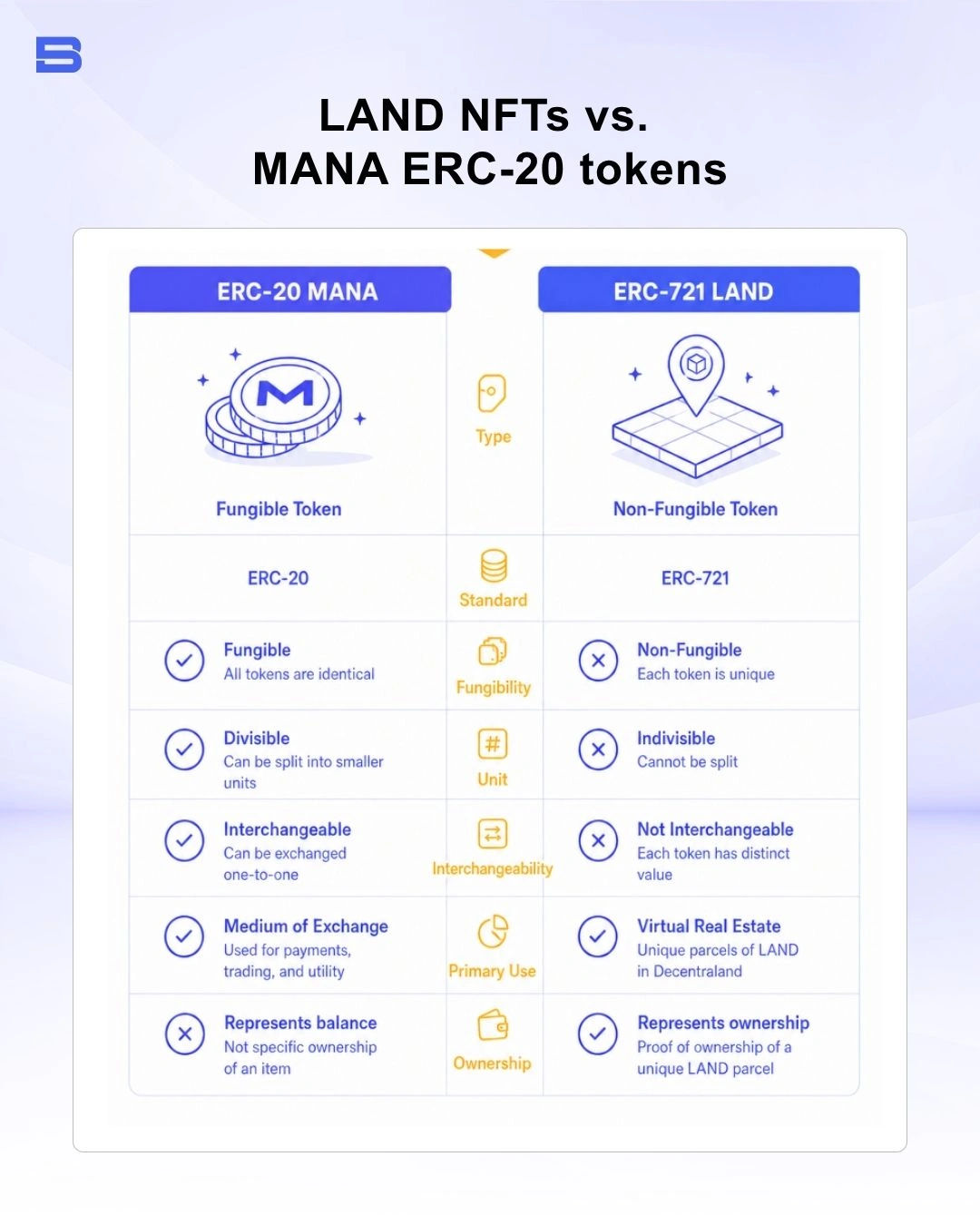
LAND represents non-fungible digital real estate divided into 90,601 discrete parcels, each identified by specific Cartesian coordinates (X, Y) on the virtual map, per Decentraland's official LAND contract documentation. Each LAND parcel is an ERC-721 token (NFT). Valuation for LAND depends on location, proximity to high-traffic virtual districts, and commercial development potential.
As a result, Non-Fungible Token (NFT) trading involves illiquid, highly specialized appraisals where individual transactions can take days or weeks to execute.
Conversely, MANA is a fungible asset with deep order book liquidity across major crypto exchanges. Traders speculating purely on price action typically trade MANA rather than purchasing individual LAND parcels.
Risks of Trading MANA: Volatility, Liquidity, and Drawdowns
Trading altcoins linked to metaverse projects carries extreme market risk. MANA is subject to severe market cycles influenced by broader cryptocurrency trends, shifts in user adoption, and macro liquidity conditions.
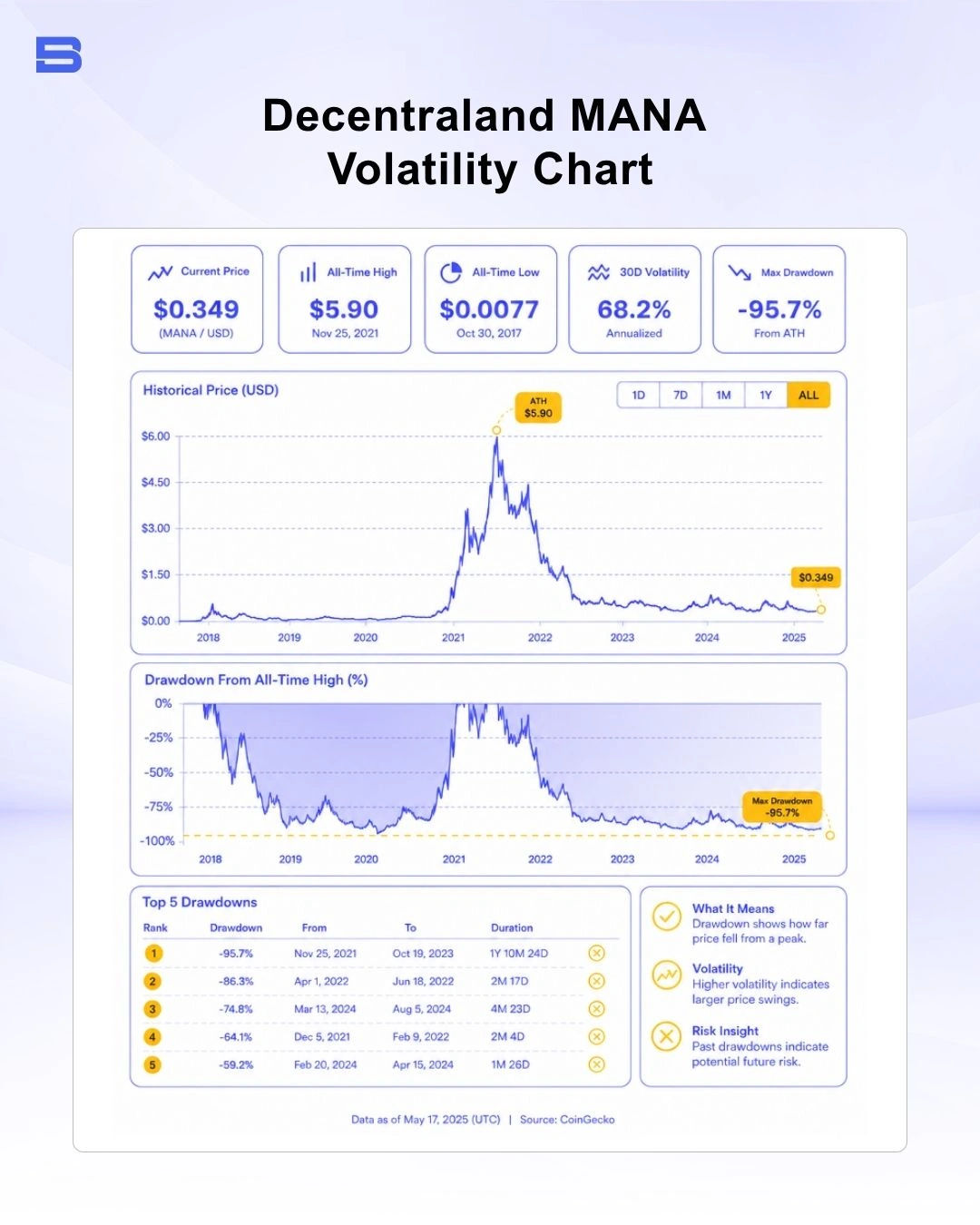
During the 2021 metaverse boom, MANA reached an all-time high of approximately $5.85. In subsequent market downturns, the token experienced a peak-to-trough decline exceeding 95%, falling below $0.30 and eventually much lower. This illustrates the substantial downside risk of holding unhedged altcoin positions through prolonged bear markets.
Market regulators, including the US Securities and Exchange Commission (SEC), frequently flag utility and governance tokens for regulatory scrutiny regarding classification and trading compliance.
Beyond general market volatility, key operational risks include:
- Active User Decay: Platform valuation heavily relies on daily active user engagement. If virtual world attendance declines, demand for in-game currency decreases accordingly.
- Smart Contract Vulnerabilities: Operating on Ethereum smart contracts exposes the platform to potential execution bugs or protocol exploits.
- Liquidity Compression: During broader market sell-offs, altcoin order books can experience rapid liquidity drops, increasing slippage on market orders.
Worked Scenario: Risk Management on a Volatile Shift
Consider a trader who opens a $1,000 spot position in MANA at $0.50 per token, receiving 2,000 MANA tokens.
If a sudden market-wide pullback drives the price down by 20% to $0.40:
Position Value = 2,000 x $0.40 = $800
Unrealized Loss = $1,000 - $800 = $200
Without a predetermined stop-loss order, an extended drawdown could further compress capital. Implementing strict position sizing—allocating no more than 2% to 5% of total portfolio equity to altcoins—helps shield capital from catastrophic losses during sharp altcoin downturns.
Decentraland vs. Alternative Crypto Tokens: Comparing Metaverse and Altcoin Assets
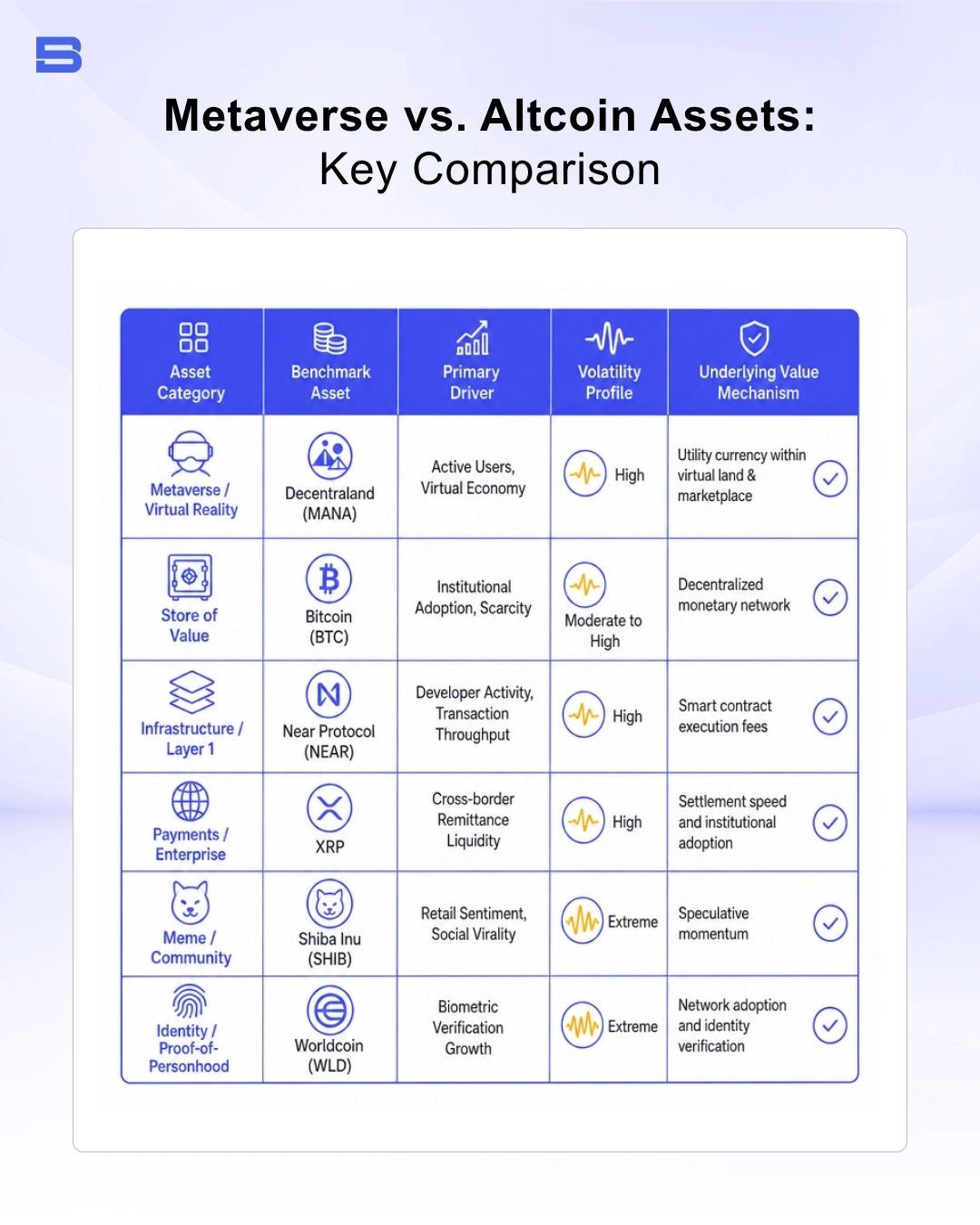
When structuring a digital asset portfolio, comparing MANA against other crypto asset classes helps clarify its risk profile and growth drivers. MANA behaves differently from store-of-value assets, smart contract platforms, memecoins, or digital identity tokens.
If your core strategy prioritizes monetary network stability, reviewing how to trade Bitcoin and reading our analysis on Gold vs. Bitcoin outlines how primary digital store-of-value assets operate compared to specialized utility tokens. Furthermore, comparing infrastructure networks like Near Protocol, layer-1 payment tokens like XRP, community memecoins like Shiba Inu, and proof-of-personhood networks like Worldcoin provides a complete picture of altcoin market segmentation.
How to Trade Decentraland (MANA) Safely
If you decide to trade MANA, executing transactions through regulated trading venues with robust security standards is essential for safeguarding your funds.
- Select a Compliant Exchange: Trade through established cryptocurrency exchanges or multi-asset contract for difference (CFD) platforms regulated by recognized authorities. Traders in Southeast Asia should ensure their chosen venue complies with local frameworks, such as those established by the Securities Commission Malaysia (SC).
- Fund Your Account and Set Risk Limits: Deposit capital using secure payment channels. Never commit funds required for immediate living expenses.
- Choose Your Instrument: Decide between buying spot MANA tokens (for actual asset ownership) or trading MANA via CFDs to speculate on short-term price movements in either direction.
- Deploy Risk Controls: Always attach a stop-loss order to every open trade to define your maximum acceptable loss before entering the market.
- Secure Your Holdings: If purchasing spot MANA for long-term holding, transfer your tokens from exchange custodial wallets to a private hardware cold storage wallet.
Conclusion
Decentraland offers traders exposure to the growing intersection of blockchain, virtual worlds, digital assets, and community governance. MANA serves as the ecosystem’s primary utility and governance token, while LAND and other digital assets contribute to the platform’s broader economy. The Decentraland DAO also allows MANA, LAND, and NAME holders to participate in governance and influence ecosystem decisions.
However, trading MANA requires careful risk management. Its history of substantial price volatility demonstrates that potential gains can come with significant downside risk. Traders should consider market conditions, liquidity, token supply dynamics, and their preferred trading timeframe before taking a position. As with other cryptocurrencies, disciplined position sizing, stop-loss strategies, and avoiding excessive leverage can help manage the risks associated with MANA trading.
- What Can You Trade? A Guide to Forex, Stocks, and More
- CFD Trading for Beginners
- What is CFD Trading and How Does It Work?
- Forex vs. Stocks: Which Market Suits You Best?
- How to Diversify a Portfolio Across Asset Classes
- How Dividend Stocks Work: Yields, Risks, and Strategies
- Silver Trading Explained: A Guide for Retail Investors
- Precious Metals Trading: A Complete Guide for Beginners
- Natural Gas Trading: A Guide to the Market
- Structured Warrants Malaysia: How They Work and Risks
- What Is the KLCI Index and How to Trade It
- Gold Investment in Malaysia: A Complete Guide for Beginners
- What Is Kijang Emas and How to Invest in It
- Value Investing Explained: How to Find Undervalued Stocks
- How to Trade Bitcoin Safely: A Complete Market Guide
- Growth Investing Explained: Strategies, Metrics, and Risks
- What Is Digital Gold Malaysia and How to Invest
- Crypto Trading Strategies for Beginners
- Gold vs Bitcoin: Key Differences, Risks, and Strategies
- Sukuk: A Guide for Beginners to Islamic Bonds
- What Is FCPO (Crude Palm Oil Futures) and How to Trade It
- How to Identify and Invest in Shariah-Compliant Stocks
- Timber Investment: Is It Worth It?
- Gold ETF Malaysia: A Guide for Beginners
- What Are Malaysian Government Securities (MGS)?
- Corporate Bonds Malaysia: A Guide for Beginners
- China A-Shares Trading Guide for Malaysian Investors
- What Is a Silver ETF and How to Invest in It?
- How to Trade XRP: A Practical Guide for Retail Investors
- How to Trade Solana (SOL): A Guide for Beginners
- What Are Gold Futures and How Do They Work?
- Money Market Fund in Malaysia: A Guide for Beginners
- Property Investment Malaysia: Direct Real Estate or M-REITs?
- What Is Binance Coin and How Does It Work?
- Green Sukuk: A Guide for Beginners to Islamic ESG Investing
- What Is Shiba Inu (SHIB) and How to Trade It
- What Is USDT? A Complete Guide to Tether for Beginners
- What Is Dogecoin and How to Trade It Safely for Beginners
- Cardano: A Guide for Beginners to Trade This Cryptocurrency
- Polkadot: A Guide to Trading This Cryptocurrency
- Tron: A Guide for Beginners to Trading This Cryptocurrency
- What Is Litecoin (LTC)? A Guide to Trading Digital Silver
- What Is Chainlink (LINK) and How to Trade It
- How to Trade Pepe Coin: Spot, Leverage, and Risk Management
- Near Protocol: A Guide to Trading This Cryptocurrency
- Trading Polygon Crypto: A Practical Guide for Beginners
- Trade Toncoin: Understanding the TON Ecosystem and Risks
- Cosmos Crypto: Ecosystem Architecture, Tokenomics, and Risks
- Stellar Crypto: A Guide to Trading This Cryptocurrency
- Avalanche Crypto Explained: A Practical Guide for Traders
- What Is Worldcoin? How to Trade WLD and Manage Risk
- Aptos: A Guide for Beginners to Trading This Cryptocurrency
- Sui Crypto Explained: Tokenomics and Trading Guide
- Celestia: A Guide to Trading This Cryptocurrency
- Decentraland: A Guide to Trading This Cryptocurrency
- What Is Arbitrum? How to Trade the Leading Layer 2 Network
- Sei Crypto: A Guide to Trading This Cryptocurrency
- What Is Injective Protocol and How to Trade INJ Safely
Disclaimer: The content on this page is intended for educational and informational purposes only. It does not constitute financial, investment, tax, or legal advice, and should not be interpreted as a recommendation to buy, sell, or hold any financial instrument or asset. Trading and investing involve significant risk, including the possible loss of your entire capital. Products such as forex, CFDs, and cryptocurrencies carry additional risks due to leverage, high volatility, and limited regulatory protection in some jurisdictions. Past performance of any financial instrument does not guarantee future results. Any market views, forecasts, or opinions expressed are those of the author at the time of writing and may not reflect current market conditions. Platform features, fees, and regulatory status are subject to change — always verify information directly with the relevant provider or regulator before making any financial decision. BrokerSpecs may receive compensation from third parties featured on this site. Always conduct your own due diligence and consider seeking advice from a licensed financial professional before investing.