


Related Tags
When you send money across international borders through traditional banking networks, the process often feels stuck in a previous era. Transfers can take several business days to settle, passing through multiple intermediary correspondent banks that each deduct processing fees along the way. If you are converting foreign exchange during the transfer, currency conversion markups can swallow a noticeable percentage of your principal.
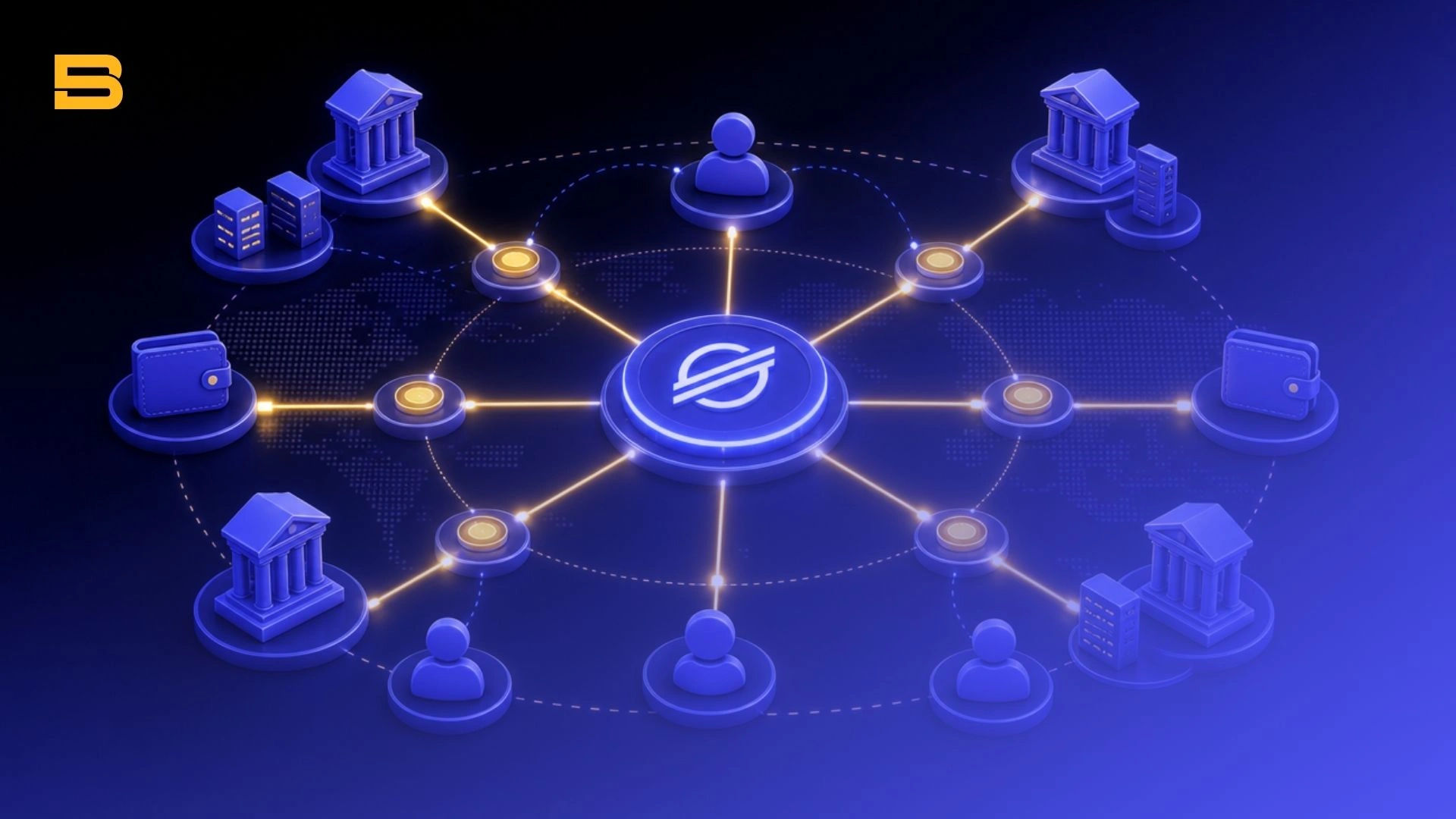
The Stellar network was built specifically to address this friction in global payment rails. By providing a decentralized, open-source blockchain infrastructure, Stellar crypto allows financial institutions, payment providers, and everyday users to move fiat currencies and digital tokens instantly across borders for fractions of a cent.
What Is Stellar Crypto and How Does It Work?
Stellar crypto is an open-source, decentralized blockchain network designed to facilitate fast, low-cost cross-border payments and asset transfers. Launched in 2014 by Jed McCaleb and Joyce Kim, the protocol acts as a global financial intermediary ledger. Rather than replacing traditional fiat currencies, Stellar bridges them by connecting banks, payment systems, and individuals on a single unified network.
At the heart of the network is its native digital asset, lumens (XLM). A standard Stellar account currently requires a minimum balance of 1 XLM, equal to two 0.5-XLM base reserves. Transactions have a network minimum fee of 0.00001 XLM per operation, although fees can increase during periods of high demand.
This design serves an anti-spam function: it prevents malicious actors from flooding the network with fake transactions or inflating the ledger size with empty accounts. To understand how Stellar crypto reduces friction, consider a real-world scenario. Imagine a business in Malaysia needing to send RM10,000 to a supplier in Europe.
- Traditional Bank Wire: The Malaysian Ringgit (MYR) is converted to US Dollar (USD), sent via the SWIFT network through two correspondent banks, converted to Euros (EUR), and credited to the supplier 3 to 5 days later. The total fees might equal 3% to 5% of the transfer value, plus an uncompetitive Foreign Exchange (FX) spread.
- Stellar Network Rail: The Malaysian business deposits MYR with a local regulated gateway ("anchor") on Stellar. The gateway issues a digital token representing MYR on the ledger. Stellar automatically converts the MYR token into an EUR token using either a direct order book or XLM as a bridge asset, settling the transaction in under 5 seconds for a fee under $0.00001. The European anchor then pays out physical EUR to the supplier's local bank account.
The Stellar Consensus Protocol (SCP) Explained
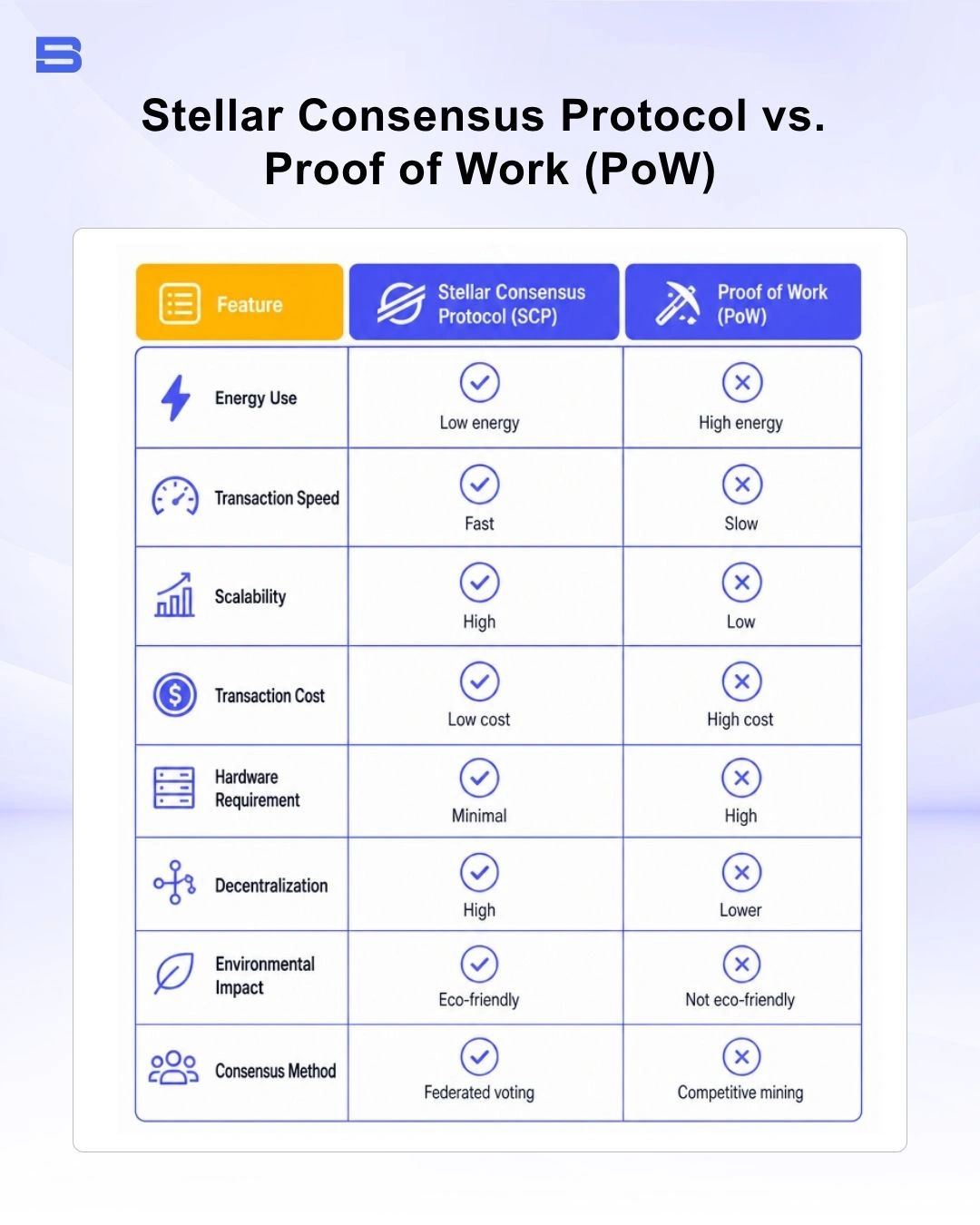
Unlike Bitcoin, which relies on energy-intensive Proof-of-Work (PoW) mining, or traditional Proof-of-Stake (PoS) networks, Stellar employs the Stellar Consensus Protocol (SCP). SCP is an implementation of a Federated Byzantine Agreement (FBA).
In SCP, network nodes do not compete to solve complex mathematical puzzles. Instead, each node selects a set of trusted peers—known as a "quorum slice" (the minimum set of trusted validators whose agreement a node needs to accept a decision).
The network reaches consensus when these overlapping trust groups agree on the validity of a transaction batch. This mechanism enables transaction finality within 3 to 5 seconds while keeping energy consumption negligible and throughput high.
How Path Payments Facilitate Cross-Border Transfers
One of Stellar's core features is native path payment processing. When you want to send a currency token (such as MYR) to someone who wants to receive a different currency token (such as EUR), the Stellar crypto ledger automatically searches for the most efficient conversion route across its built-in decentralized order books.
Path payments perform an "atomic swap"—meaning the multi-step transaction either executes completely or fails, ensuring no funds are lost mid-transit. The payment pathway might match your sell order directly against an MYR/EUR order, or route it through intermediate pairs (e.g., MYR to XLM, then XLM to EUR).
What Is XLM Used For?
While Stellar crypto can tokenize any currency or asset, its native token—lumens (XLM)—serves vital network functions:
- Transaction Fee Payment: Every transaction on the Stellar network consumes a small amount of XLM, which is burned or recycled to protect the ledger from spam attacks.
- Bridge Asset for Liquidity: When direct order books between two illiquid fiat currencies lack market depth, XLM acts as a neutral liquidity bridge to facilitate the exchange.
- Account Reservation: Holding XLM is required to open accounts, establish trustlines to custom tokens, and submit orders on the decentralized exchange (DEX).
- Real-World Asset (RWA) Tokenization: Financial institutions utilize Stellar crypto to tokenize real-world assets like treasury bonds, real estate, and fiat stablecoins (such as Circle's USDC and Franklin Templeton’s FOBXX fund).
Soroban Smart Contracts and Asset Tokenization
In 2024, Stellar underwent a major network upgrade known as Protocol 20, which introduced Soroban, a WebAssembly (Wasm)-based smart contract platform. Soroban contracts are primarily written in Rust and enable developers to build decentralized applications, including DeFi services, on Stellar crypto.
Through Soroban, developers can build complex decentralized applications (dApps), automated market makers (AMMs), and collateralized lending protocols. This smart contract engine enhances Stellar's capacity to host tokenized RWAs, positioning the network to compete with alternative blockchain ecosystems like Aptos.
Stellar vs. XRP: Key Differences for Traders
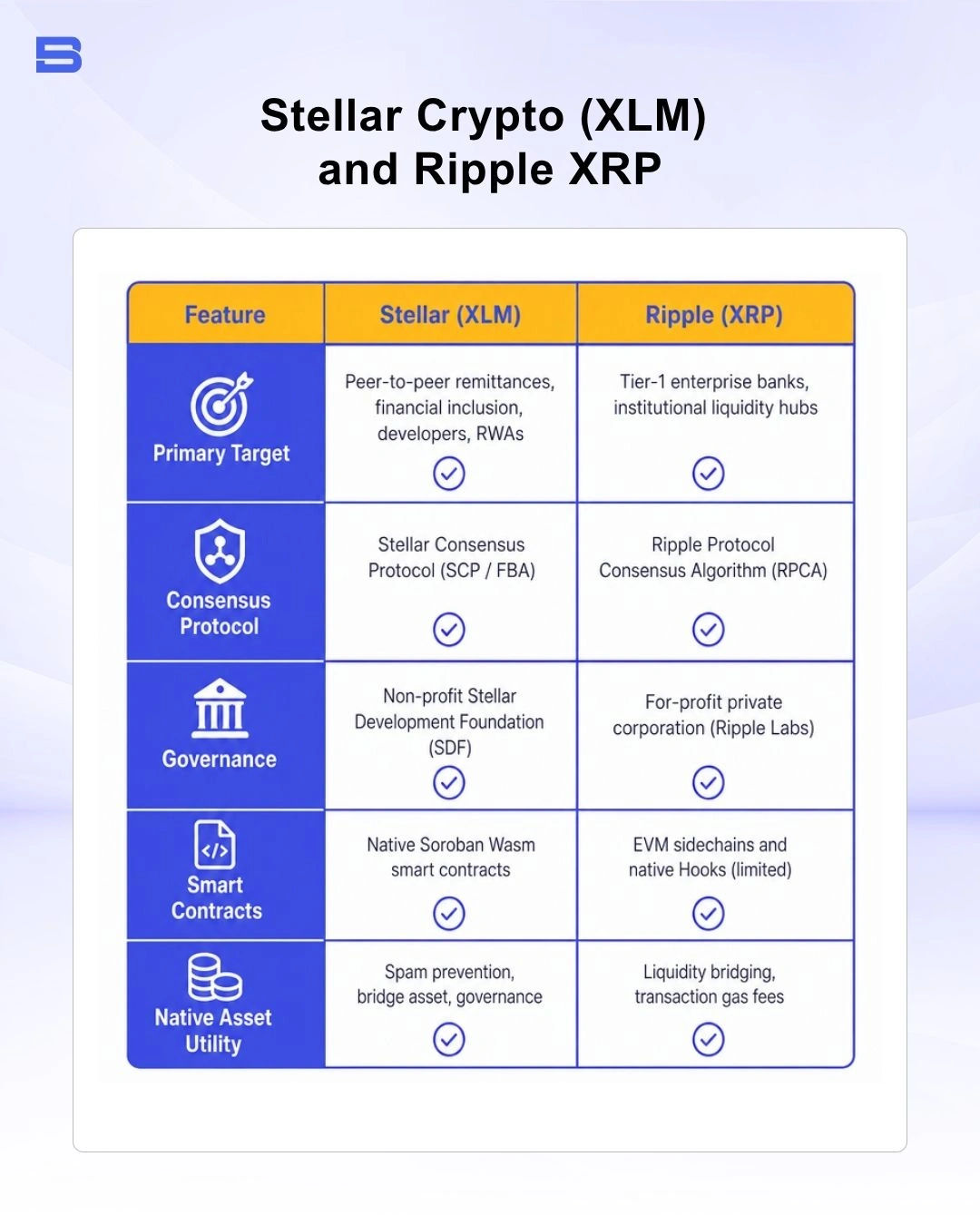
Because both networks were co-created by Jed McCaleb and share early architectural ideas, traders frequently compare Stellar (XLM) to Ripple (XRP). However, their operational focuses, target audiences, and governance models differ fundamentally.
While XRP focuses primarily on enterprise banking integration and liquidity corridors for large financial institutions, Stellar crypto emphasizes open-source accessibility, individual financial inclusion, and programmable smart contracts for digital asset issuers.
How Stellar Compares to Multi-Chain Networks Like Cosmos
When analyzing blockchain architecture, it is helpful to contrast payment-centric networks like Stellar crypto with multi-chain interoperability ecosystems such as Cosmos crypto.
Cosmos uses the Inter-Blockchain Communication (IBC) protocol to connect an array of independent, application-specific blockchains (Tendermint chains). In contrast, Stellar crypto operates as a unified, single-layer blockchain optimized strictly for financial asset issuance, token swaps, and cross-border settlement.
While Cosmos offers high flexibility for developers building custom blockchain infrastructure, Stellar crypto prioritizes transaction predictability, native asset issuance controls, and low technical overhead for financial institutions.
Other multi-chain frameworks like Toncoin and Avalanche crypto offer high throughput for general consumer dApps, but Stellar's built-in ledger features (such as native order books and asset clawback compliance flags) give it an edge for regulated financial issuers.
Smart Contract Ecosystems: Stellar vs. Ethereum
When comparing smart contract environments, Stellar’s Soroban framework differs significantly from Ethereum's Ethereum Virtual Machine (EVM) ecosystem.
- Throughput and Gas Predictability: Ethereum gas fees can rise significantly during network congestion, potentially making small transactions less economical. Stellar crypto has a low network minimum fee of 0.00001 XLM per operation, although surge pricing and additional Soroban resource fees can increase costs during periods of high demand.
- Developer Tooling: Ethereum relies primarily on Solidity, whereas Soroban uses Rust—a language widely adopted in systems programming and recognized for memory safety.
- Specialization: Ethereum functions as a general-purpose world computer hosting gaming, NFTs, and complex dApps. Stellar's smart contracts are tailored specifically toward financial applications, payment rails, and asset compliance.
Traders looking at regional crypto availability, such as trading Ethereum Malaysia, should note that while Ethereum holds greater liquidity, Stellar crypto provides superior cost efficiency for small cross-border payments.
How Trading Stellar Differs From Trading Bitcoin
Trading XLM requires a different approach than trading market leaders like Bitcoin. Understanding these structural differences helps you evaluate market behavior and risk profiles effectively.
- Value Proposition: Bitcoin is often viewed as a decentralized store of value or “digital gold,” with a maximum supply of 21 million coins. XLM is the native currency of the Stellar network, supporting transaction fees, account reserves, payments, and asset-related activity. Consequently, XLM’s potential value proposition depends more on network utility, adoption, and demand for Stellar-based financial services than on digital scarcity alone.
- Supply Structure: XLM has a total supply of roughly 50 billion tokens, following the reduction of its original 100 billion supply through token burns. A significant portion remains under the Stellar Development Foundation's (SDF) mandate and is used to support ecosystem development, grants, investments, and network adoption.
- Volatility Characteristics: XLM often exhibits higher beta relative to Bitcoin during market cycles. During broader altcoin rallies, XLM can experience sharp upward movements, but it can also undergo deeper retracements during market pullbacks.
If you are evaluating how to trade Bitcoin, you are generally trading macro monetary policy sentiment, spot exchange-traded fund (ETF) flows, and store-of-value narratives. When trading Stellar, technical analysis, network partnership announcements, and real-world tokenization growth play a larger role.
Safe-Haven Assets vs. Payment Networks
During periods of global market stress or high inflation, capital flows into safe-haven assets. When analyzing gold vs. Bitcoin, investors focus on capital preservation and purchasing power protection.
Payment networks like Stellar do not act as traditional safe-haven assets. XLM is a transactional liquidity token; its market price fluctuates with overall crypto market risk sentiment. While stablecoins issued on Stellar (like USDC) provide a haven from local currency depreciation, the XLM token itself remains a high-volatility digital asset.
Risks and Market Volatility in Stellar Trading
Trading or holding XLM involves significant risks that you should carefully evaluate before entering a position:
- Market Volatility: Like most altcoins, XLM experiences substantial price swings driven by general crypto sentiment, Bitcoin price movements, and macroeconomic factors.
- Validator Centralization Concerns: Although the Stellar Consensus Protocol is open and decentralized, a significant portion of core validator nodes are operated by well-known institutions and the SDF, leading to periodic debates around node distribution.
- Regulatory Environment: Global regulators, including the US Securities and Exchange Commission (SEC), continue to refine frameworks for digital assets and tokenized securities. Changes in cross-border payment regulations or stablecoin legislation can directly impact Stellar’s growth.
- Smart Contract Vulnerabilities: While Soroban has undergone security audits, new smart contract platforms carry inherent execution risks, protocol bugs, or potential exploit vectors in dApps built on top of the network.
Leverage magnifies your returns when you are right, but it accelerates capital destruction just as quickly when the market moves against you—a 2.5% move against a 30:1 leveraged position can wipe out a large share of your account margin.
Conclusion
Stellar crypto has established itself as a fast, reliable, and low-cost payment protocol designed to bridge traditional finance with blockchain technology. Through its unique consensus protocol, native path payments, and recent Soroban smart contract upgrade, Stellar crypto offers a practical solution for real-world asset tokenization and global remittances.
However, as with any digital asset, trading XLM requires a disciplined approach to risk management, position sizing, and market analysis.
- What Can You Trade? A Guide to Forex, Stocks, and More
- CFD Trading for Beginners
- What is CFD Trading and How Does It Work?
- Forex vs. Stocks: Which Market Suits You Best?
- How to Diversify a Portfolio Across Asset Classes
- How Dividend Stocks Work: Yields, Risks, and Strategies
- Silver Trading Explained: A Guide for Retail Investors
- Precious Metals Trading: A Complete Guide for Beginners
- Natural Gas Trading: A Guide to the Market
- Structured Warrants Malaysia: How They Work and Risks
- What Is the KLCI Index and How to Trade It
- Gold Investment in Malaysia: A Complete Guide for Beginners
- What Is Kijang Emas and How to Invest in It
- Value Investing Explained: How to Find Undervalued Stocks
- How to Trade Bitcoin Safely: A Complete Market Guide
- Growth Investing Explained: Strategies, Metrics, and Risks
- What Is Digital Gold Malaysia and How to Invest
- Crypto Trading Strategies for Beginners
- Gold vs Bitcoin: Key Differences, Risks, and Strategies
- Sukuk: A Guide for Beginners to Islamic Bonds
- What Is FCPO (Crude Palm Oil Futures) and How to Trade It
- How to Identify and Invest in Shariah-Compliant Stocks
- Timber Investment: Is It Worth It?
- Gold ETF Malaysia: A Guide for Beginners
- What Are Malaysian Government Securities (MGS)?
- Corporate Bonds Malaysia: A Guide for Beginners
- China A-Shares Trading Guide for Malaysian Investors
- What Is a Silver ETF and How to Invest in It?
- How to Trade XRP: A Practical Guide for Retail Investors
- How to Trade Solana (SOL): A Guide for Beginners
- What Are Gold Futures and How Do They Work?
- Money Market Fund in Malaysia: A Guide for Beginners
- Property Investment Malaysia: Direct Real Estate or M-REITs?
- What Is Binance Coin and How Does It Work?
- Green Sukuk: A Guide for Beginners to Islamic ESG Investing
- What Is Shiba Inu (SHIB) and How to Trade It
- What Is USDT? A Complete Guide to Tether for Beginners
- What Is Dogecoin and How to Trade It Safely for Beginners
- Cardano: A Guide for Beginners to Trade This Cryptocurrency
- Polkadot: A Guide to Trading This Cryptocurrency
- Tron: A Guide for Beginners to Trading This Cryptocurrency
- What Is Litecoin (LTC)? A Guide to Trading Digital Silver
- What Is Chainlink (LINK) and How to Trade It
- How to Trade Pepe Coin: Spot, Leverage, and Risk Management
- Near Protocol: A Guide to Trading This Cryptocurrency
- Trading Polygon Crypto: A Practical Guide for Beginners
- Trade Toncoin: Understanding the TON Ecosystem and Risks
- Cosmos Crypto: Ecosystem Architecture, Tokenomics, and Risks
- Stellar Crypto: A Guide to Trading This Cryptocurrency
- Avalanche Crypto Explained: A Practical Guide for Traders
- What Is Worldcoin? How to Trade WLD and Manage Risk
- Aptos: A Guide for Beginners to Trading This Cryptocurrency
- Sui Crypto Explained: Tokenomics and Trading Guide
- Celestia: A Guide to Trading This Cryptocurrency
- Decentraland: A Guide to Trading This Cryptocurrency
- What Is Arbitrum? How to Trade the Leading Layer 2 Network
- Sei Crypto: A Guide to Trading This Cryptocurrency
- What Is Injective Protocol and How to Trade INJ Safely
Disclaimer: The content on this page is intended for educational and informational purposes only. It does not constitute financial, investment, tax, or legal advice, and should not be interpreted as a recommendation to buy, sell, or hold any financial instrument or asset. Trading and investing involve significant risk, including the possible loss of your entire capital. Products such as forex, CFDs, and cryptocurrencies carry additional risks due to leverage, high volatility, and limited regulatory protection in some jurisdictions. Past performance of any financial instrument does not guarantee future results. Any market views, forecasts, or opinions expressed are those of the author at the time of writing and may not reflect current market conditions. Platform features, fees, and regulatory status are subject to change — always verify information directly with the relevant provider or regulator before making any financial decision. BrokerSpecs may receive compensation from third parties featured on this site. Always conduct your own due diligence and consider seeking advice from a licensed financial professional before investing.