



Related Tags
Fixed deposit rates may struggle to keep pace with inflation over the long term, potentially reducing the purchasing power of your savings. At the other end of the spectrum, equities offer greater growth potential but can experience significant price volatility, which may not suit investors seeking more predictable income.
Corporate bonds Malaysia can provide a middle ground for investors looking for potentially higher income than traditional bank deposits while avoiding the direct equity-market exposure of stocks. This guide explains how corporate bonds Malaysia work, compares conventional corporate bonds with Sukuk, explores key credit and investment risks, and highlights the options available to Malaysian retail investors.
What Are Corporate Bonds in Malaysia and How Do They Work?
A corporate bond is a fixed-income instrument issued by a public or private company to raise long-term capital for corporate expansion, debt refinancing, or major infrastructure developments. When you buy a corporate bond, you are essentially acting as a lender to the issuing corporation. In return, the issuer promises to pay you regular interest payments over a fixed duration and return your principal balance when the bond reaches maturity.
Understanding the mechanics of corporate debt requires familiarity with four fundamental terms:
- Face Value (Par Value): The nominal principal amount assigned to a bond, which is used to calculate coupon payments and is generally repaid by the issuer at maturity, subject to the terms of the issue. The face value or denomination can vary depending on the specific bond. For example, exchange-traded bonds and Sukuk (ETBS) on Bursa Malaysia have a principal price of RM100 per unit, with a minimum board lot of 10 units, equivalent to RM1,000.
- Coupon Rate: The annual fixed interest rate paid on the face value, usually distributed to bondholders on a semi-annual basis in Malaysia.
- Yield to Maturity (YTM): The total estimated annual rate of return you would earn if you bought the bond at its current market price and held it until its end date.
- Maturity Date: The predefined future date on which the corporate issuer must fully return your original principal.
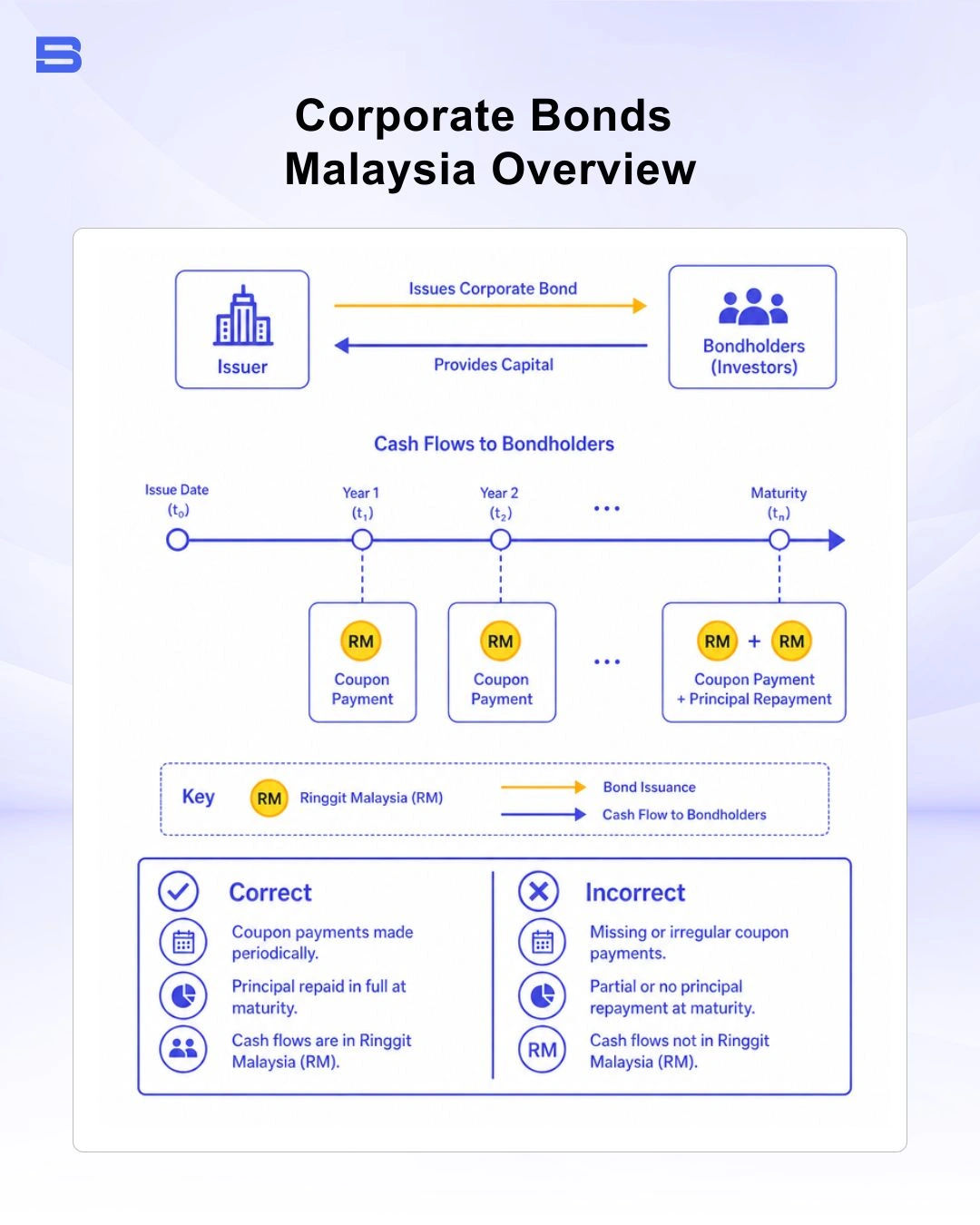
Worked Scenario: Calculating Corporate Bond Income
Consider an investor who purchases MYR 10,000 worth of a 5-year corporate bond issued by a local telecommunications firm offering a 5% p.a. coupon rate distributed semi-annually.
- Annual Interest: MYR 10,000 x 5% = MYR 500 per year
- Semi-Annual Payment: MYR 500 / 2 = MYR 250 every six months
- Total Returns over 5 Years: MYR 250 x 10 payments = MYR 2,500 in interest
When the 5-year tenure ends, the company pays back the initial MYR 10,000 principal, provided the corporate issuer remains solvent throughout the investment period.
Conventional Corporate Bonds vs Sukuk in Malaysia
Malaysia is a major global hub for Islamic capital markets, giving the country a distinctive position in the international fixed-income landscape. As a result, the corporate bonds Malaysia market consists of both conventional corporate bonds and Islamic debt securities known as Sukuk, offering investors different structures for generating fixed-income exposure.
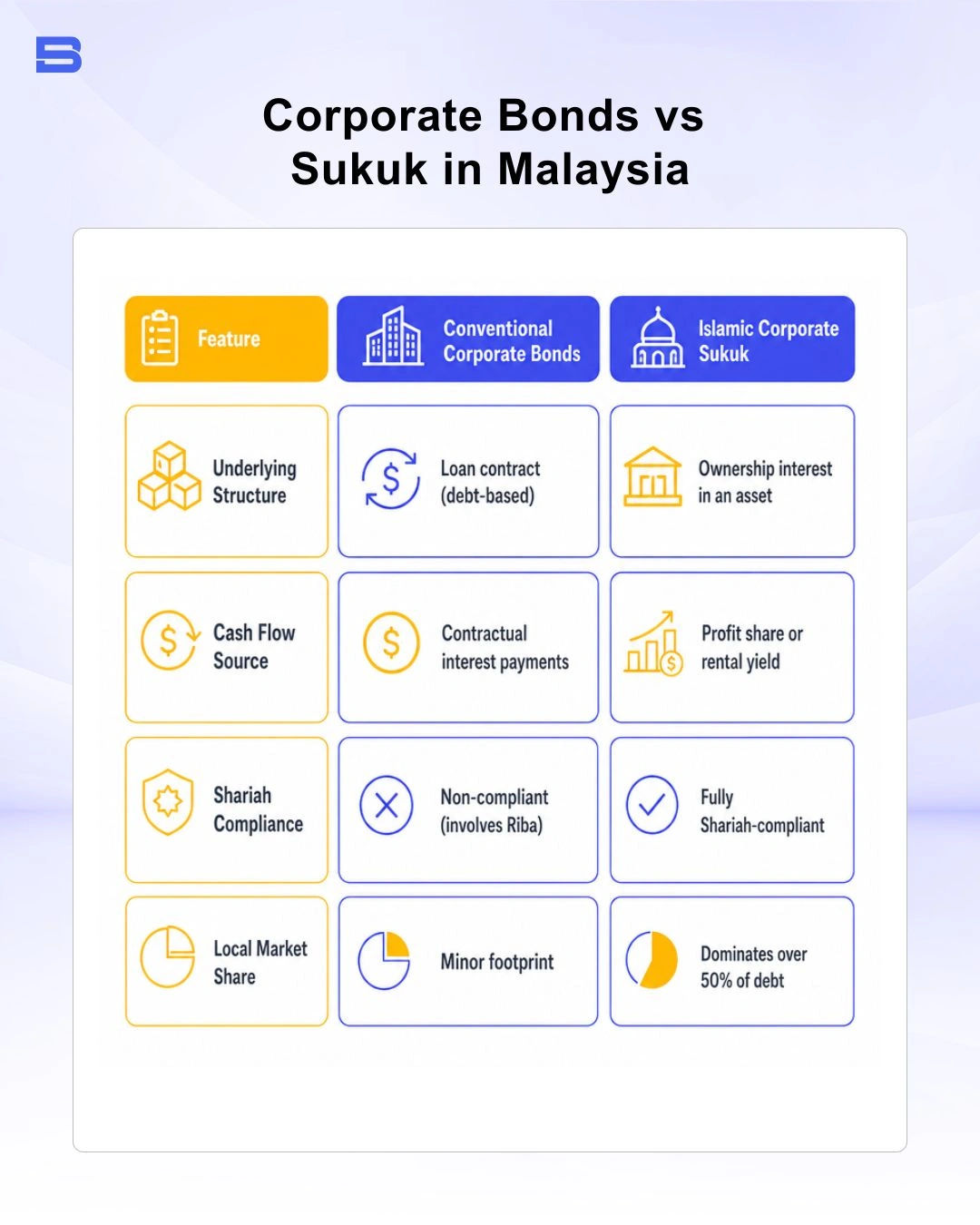
Conventional bonds represent a simple lender-borrower loan contract where interest is charged on the borrowed principal. Sukuk, by contrast, are structured to avoid Riba (interest). Instead of issuing debt, a Sukuk grants investors undivided fractional ownership in tangible underlying assets, project ventures, or leasing activities (Ijarah). Yield distributions to Sukuk holders represent earned profit shares or rental yields rather than contractual interest.
For retail investors in Malaysia, both instruments function similarly regarding payout frequency and credit evaluation. According to data published by the Securities Commission Malaysia (SC) and Bank Negara Malaysia, Sukuk represents more than half of Malaysia’s outstanding corporate debt securities, highlighting the country’s strong position as a global Islamic fixed-income market.
Malaysian Government Securities (MGS) vs Corporate Bonds
Investors exploring the corporate bonds Malaysia market often compare corporate debt with government-issued securities. The Malaysian federal government issues Malaysian Government Securities (MGS) and Shariah-compliant Government Investment Issues (GII) to help finance public spending and government development initiatives.
These government securities provide a useful reference point when assessing the potential returns and risks of corporate bonds Malaysia.
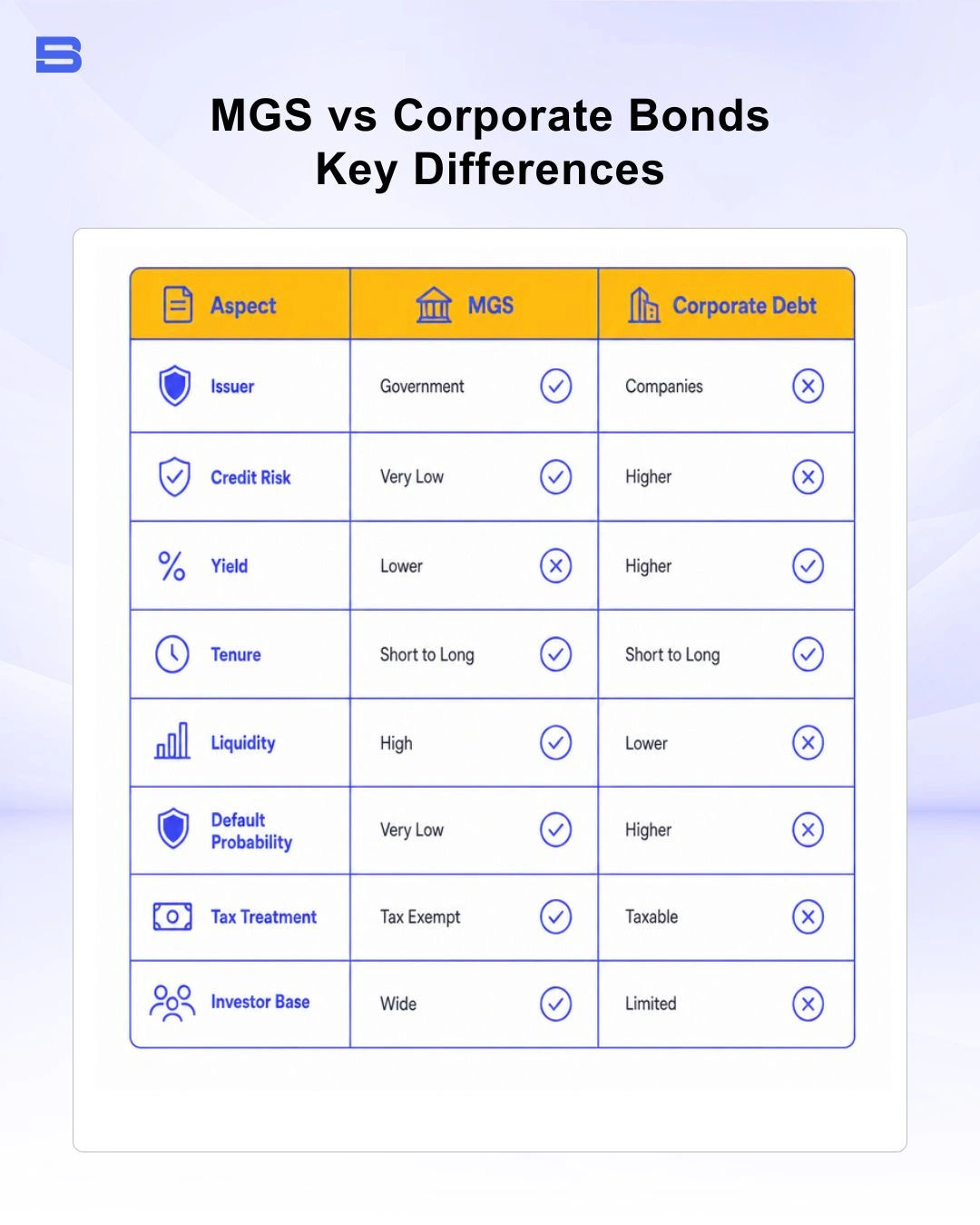
Because Malaysian Government Securities are backed by the full faith and credit of the Malaysian government, default risk is virtually non-existent. Corporate bonds, however, carry corporate default risk. To compensate investors for taking on this additional credit exposure, corporate debt yields are priced at a yield premium (credit spread) above baseline government bonds of equivalent maturity.
Are Corporate Bonds Safe in Malaysia? Risks and Ratings
While corporate debt offers higher yields than fixed deposits, it is not a zero-risk investment. Assessing bond stability requires evaluating three core risk factors:
- Credit (Default) Risk: The probability that a borrowing company experiences cash flow distress and defaults on its scheduled coupon payments or principal redemption.
- Interest Rate Risk: Bond prices in the secondary market move inversely to prevailing interest rates. If Bank Negara Malaysia (BNM) increases the Overnight Policy Rate (OPR), existing fixed-coupon bond prices fall in value if sold before maturity.
- Liquidity Risk: Unlike high-volume equities on Bursa Malaysia, many corporate bond issues trade over-the-counter (OTC), making quick liquidation at fair prices difficult during market downturns.
Understanding Credit Ratings: RAM vs MARC
To help investors gauge creditworthiness, mandatory credit ratings are assigned to corporate issues by Malaysia's two domestic rating agencies: RAM Rating Services Berhad (RAM Ratings) and Malaysian Rating Corporation Berhad (MARC Ratings).
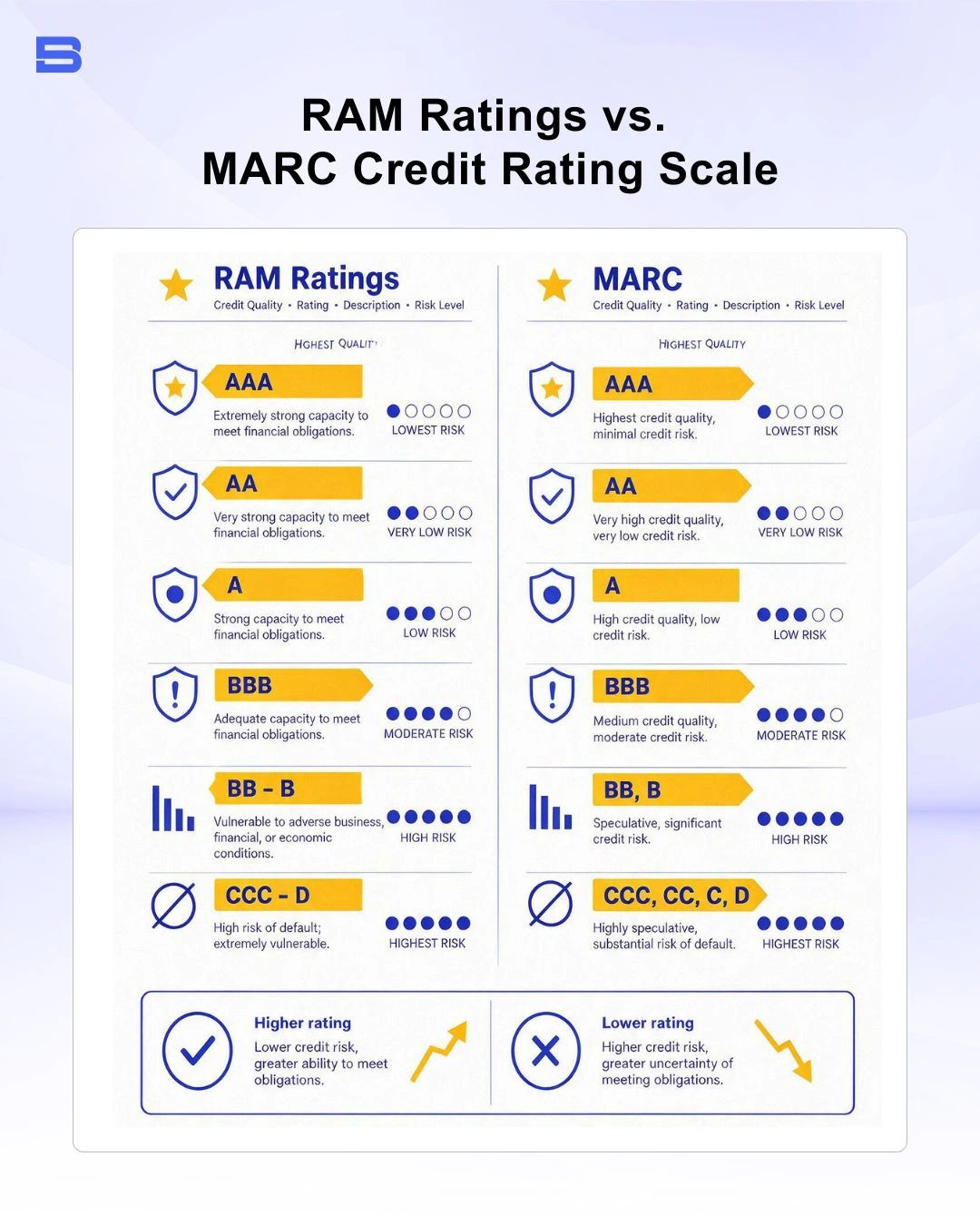
Investment-grade issues range from AAA (exceptionally strong safety margin) down to BBB (adequate credit protection but sensitive to economic downturns). Any corporate debt rated BB or lower is categorized as non-investment grade or high-yield debt, carrying elevated risk of default in exchange for higher prospective yields.
Expected Yields and Coupon Payments
Corporate bond yields in Malaysia depend heavily on the issuer's credit rating, macroeconomic conditions, and prevailing policy rates set by Bank Negara Malaysia (BNM).
Based on Bank Negara Malaysia's indicative yield-to-maturity data, highly rated corporate bonds such as AAA and AA-category issues generally offer yields that vary according to maturity, credit quality, liquidity, and prevailing market conditions. Investors should compare current corporate bond yields with available fixed-deposit rates when assessing potential income and risk.
Coupon payments are deposited directly into your designated cash or brokerage settlement account on predetermined schedule dates. Most local corporate issues distribute coupons semi-annually, providing a steady and predictable passive cash flow cycle throughout the bond's tenure.
How to Invest in Corporate Bonds in Malaysia
Historically, corporate fixed income was restricted to institutional entities due to high entry barriers. Today, retail investors can access corporate bonds and Sukuk through several distinct channels based on their capital sizes:
1. Exchange Traded Bonds and Sukuk (ETBS)
Retail investors can buy and sell eligible corporate bonds and Sukuk listed on Bursa Malaysia through a stockbroking account and Central Depository System (CDS) account. For exchange-traded retail bonds and Sukuk, SC Malaysia specifies a minimum board size of RM1,000, equivalent to 10 units at RM100 each, making eligible issues accessible to individual investors.
2. Bond Unit Trusts and Mutual Funds
If you want broad diversification across multiple corporate and fixed-income issuers without selecting individual debt issues, managed funds can provide an accessible alternative. Malaysian retail investors can invest in fixed-income unit trusts with minimum initial investments that vary by fund.
For example, funds such as the Principal Sustainable Conservative Bond Fund (Class MYR) — one of several bond unit trusts available to Malaysian retail investors — have minimum initial investments as low as MYR100. Minimums vary by provider, and Brokerspecs has no commercial relationship with the funds mentioned here.
3. Institutional Over-the-Counter (OTC) Trading
High-net-worth and other sophisticated investors seeking direct exposure to corporate bond issues may access the OTC market through banks or investment banks. According to SC Malaysia, RM250,000 per transaction is a threshold used in determining certain sophisticated-investor exemptions, but it should not be treated as a universal minimum investment size for OTC corporate bonds.
Actual minimum investment amounts depend on the specific bond, offering structure, intermediary, and applicable investor eligibility requirements.
Final Takeaways on Corporate Bonds Malaysia
Corporate bonds in Malaysia offer a valuable balance between low-yielding deposit accounts and volatile equity investments. By granting exposure to regular coupon payouts and predictable maturities, fixed-income assets allow you to preserve wealth while generating consistent passive income.
Before committing capital, remember to review issuer credit ratings from RAM or MARC, assess whether direct ETBS holdings or managed unit trusts suit your budget, and ensure chosen maturities align with your broader liquidity requirements.
- What Can You Trade? A Guide to Forex, Stocks, and More
- CFD Trading for Beginners
- What is CFD Trading and How Does It Work?
- Forex vs. Stocks: Which Market Suits You Best?
- How to Diversify a Portfolio Across Asset Classes
- How Dividend Stocks Work: Yields, Risks, and Strategies
- Silver Trading Explained: A Guide for Retail Investors
- Precious Metals Trading: A Complete Guide for Beginners
- Natural Gas Trading: A Guide to the Market
- Structured Warrants Malaysia: How They Work and Risks
- What Is the KLCI Index and How to Trade It
- Gold Investment in Malaysia: A Complete Guide for Beginners
- What Is Kijang Emas and How to Invest in It
- Value Investing Explained: How to Find Undervalued Stocks
- How to Trade Bitcoin Safely: A Complete Market Guide
- Growth Investing Explained: Strategies, Metrics, and Risks
- What Is Digital Gold Malaysia and How to Invest
- Crypto Trading Strategies for Beginners
- Gold vs Bitcoin: Key Differences, Risks, and Strategies
- Sukuk: A Guide for Beginners to Islamic Bonds
- What Is FCPO (Crude Palm Oil Futures) and How to Trade It
- How to Identify and Invest in Shariah-Compliant Stocks
- Timber Investment: Is It Worth It?
- Gold ETF Malaysia: A Guide for Beginners
- What Are Malaysian Government Securities (MGS)?
- Corporate Bonds Malaysia: A Guide for Beginners
- China A-Shares Trading Guide for Malaysian Investors
- What Is a Silver ETF and How to Invest in It?
- How to Trade XRP: A Practical Guide for Retail Investors
- How to Trade Solana (SOL): A Guide for Beginners
- What Are Gold Futures and How Do They Work?
- Money Market Fund in Malaysia: A Guide for Beginners
- Property Investment Malaysia: Direct Real Estate or M-REITs?
- What Is Binance Coin and How Does It Work?
- Green Sukuk: A Guide for Beginners to Islamic ESG Investing
- What Is Shiba Inu (SHIB) and How to Trade It
- What Is USDT? A Complete Guide to Tether for Beginners
- What Is Dogecoin and How to Trade It Safely for Beginners
- Cardano: A Guide for Beginners to Trade This Cryptocurrency
- Polkadot: A Guide to Trading This Cryptocurrency
- Tron: A Guide for Beginners to Trading This Cryptocurrency
- What Is Litecoin (LTC)? A Guide to Trading Digital Silver
- What Is Chainlink (LINK) and How to Trade It
- How to Trade Pepe Coin: Spot, Leverage, and Risk Management
- Near Protocol: A Guide to Trading This Cryptocurrency
- Trading Polygon Crypto: A Practical Guide for Beginners
- Trade Toncoin: Understanding the TON Ecosystem and Risks
- Cosmos Crypto: Ecosystem Architecture, Tokenomics, and Risks
- Stellar Crypto: A Guide to Trading This Cryptocurrency
- Avalanche Crypto Explained: A Practical Guide for Traders
- What Is Worldcoin? How to Trade WLD and Manage Risk
- Aptos: A Guide for Beginners to Trading This Cryptocurrency
- Sui Crypto Explained: Tokenomics and Trading Guide
- Celestia: A Guide to Trading This Cryptocurrency
- Decentraland: A Guide to Trading This Cryptocurrency
- What Is Arbitrum? How to Trade the Leading Layer 2 Network
- Sei Crypto: A Guide to Trading This Cryptocurrency
- What Is Injective Protocol and How to Trade INJ Safely
Disclaimer: The content on this page is intended for educational and informational purposes only. It does not constitute financial, investment, tax, or legal advice, and should not be interpreted as a recommendation to buy, sell, or hold any financial instrument or asset. Trading and investing involve significant risk, including the possible loss of your entire capital. Products such as forex, CFDs, and cryptocurrencies carry additional risks due to leverage, high volatility, and limited regulatory protection in some jurisdictions. Past performance of any financial instrument does not guarantee future results. Any market views, forecasts, or opinions expressed are those of the author at the time of writing and may not reflect current market conditions. Platform features, fees, and regulatory status are subject to change — always verify information directly with the relevant provider or regulator before making any financial decision. BrokerSpecs may receive compensation from third parties featured on this site. Always conduct your own due diligence and consider seeking advice from a licensed financial professional before investing.