


Related Tags
Entering the precious metals market often starts with gold, but silver rapidly draws attention due to its dramatic price swings and unique market drivers. If you're a retail trader, silver offers a compelling dynamic: it operates simultaneously as an industrial commodity and a monetary store of value. However, navigating its heightened volatility without risking significant capital erosion requires a firm grasp of execution instruments, margin mechanics, and structural supply-demand fundamentals.
What Is Silver Trading and How Does the Market Work?
Silver trading involves speculating on or hedging against the price movements of silver against fiat currencies (most commonly the US dollar, quoted as XAG/USD) or through derivative contracts. Unlike standard equities, silver does not produce cash flows or yield dividends; its value is determined by global supply, industrial consumption, investor demand, and macroeconomic trends.
The silver market is defined by its hybrid identity:
- Industrial Utility: According to The Silver Institute's World Silver Survey, over 50% of annual global silver demand stems from industrial applications, including photovoltaics (solar panels), automotive electronics, and medical equipment.
- Monetary Haven: Like gold, silver historically functions as a hedge against currency debasement and geopolitical uncertainty.
Because of this dual nature, silver often exhibits higher price elasticity than gold — meaning its demand changes more sharply when the price shifts. During economic expansions, industrial demand supports prices; during macroeconomic stress or inflationary cycles, monetary demand takes over.
Silver Spot Pricing and Global Trading Hours
The benchmark price for physical silver trading is determined via the London Over-the-Counter (OTC) spot market and exchange-traded futures such as the COMEX (part of the CME Group). Spot silver reflects the price for immediate settlement, typically quoted in U.S. dollars per troy ounce (1 troy ounce approx 31.1035 grams).
Global liquidity flows continuously across major trading centers:
- Asian Session (Tokyo/Singapore): Sets early liquidity, driven by regional demand and industrial supply data.
- European Session (London): High liquidity as the London Bullion Market Association (LBMA) market makers quote spot prices.
- American Session (New York): Peak liquidity and maximum volatility occur when the London and New York sessions overlap, coinciding with US economic data releases and COMEX floor/electronic trading.
Key Factors Driving the Price of Silver
Understanding market drivers is essential before placing capital at risk. Silver trading market dynamics depend on a combination of macroeconomic data, such as global monetary policy trends tracked by bodies like the International Monetary Fund (IMF), and microeconomic supply constraints from the mining sector:
- Industrial Demand Acceleration: The global transition toward green energy has significantly increased silver demand in solar cell manufacturing and electric vehicle (EV) production. Shifts in global manufacturing Purchasing Managers’ Index (PMI) numbers can influence investor confidence and market prices.
- US Dollar (USD) and Interest Rates: Silver is traditionally priced in USD and yields no interest. Consequently, a strengthening US dollar or rising real interest rates (nominal rates minus inflation) increases the opportunity cost. This is the potential return you give up by keeping money in metals instead of investing it elsewhere. Conversely, a weakening dollar or falling yields typically provide a tailwind.
- Mine Supply Constraints: Silver is primarily extracted as a byproduct of mining other metals, such as copper, lead, and zinc. Consequently, primary silver mine output is relatively inelastic—higher silver prices do not immediately lead to increased mine production.
- Inflation Expectations: Historically, silver acts as a store of value during persistent inflationary cycles, though its correlation can vary depending on prevailing real interest rate trends.
Popular Instruments for Silver Trading
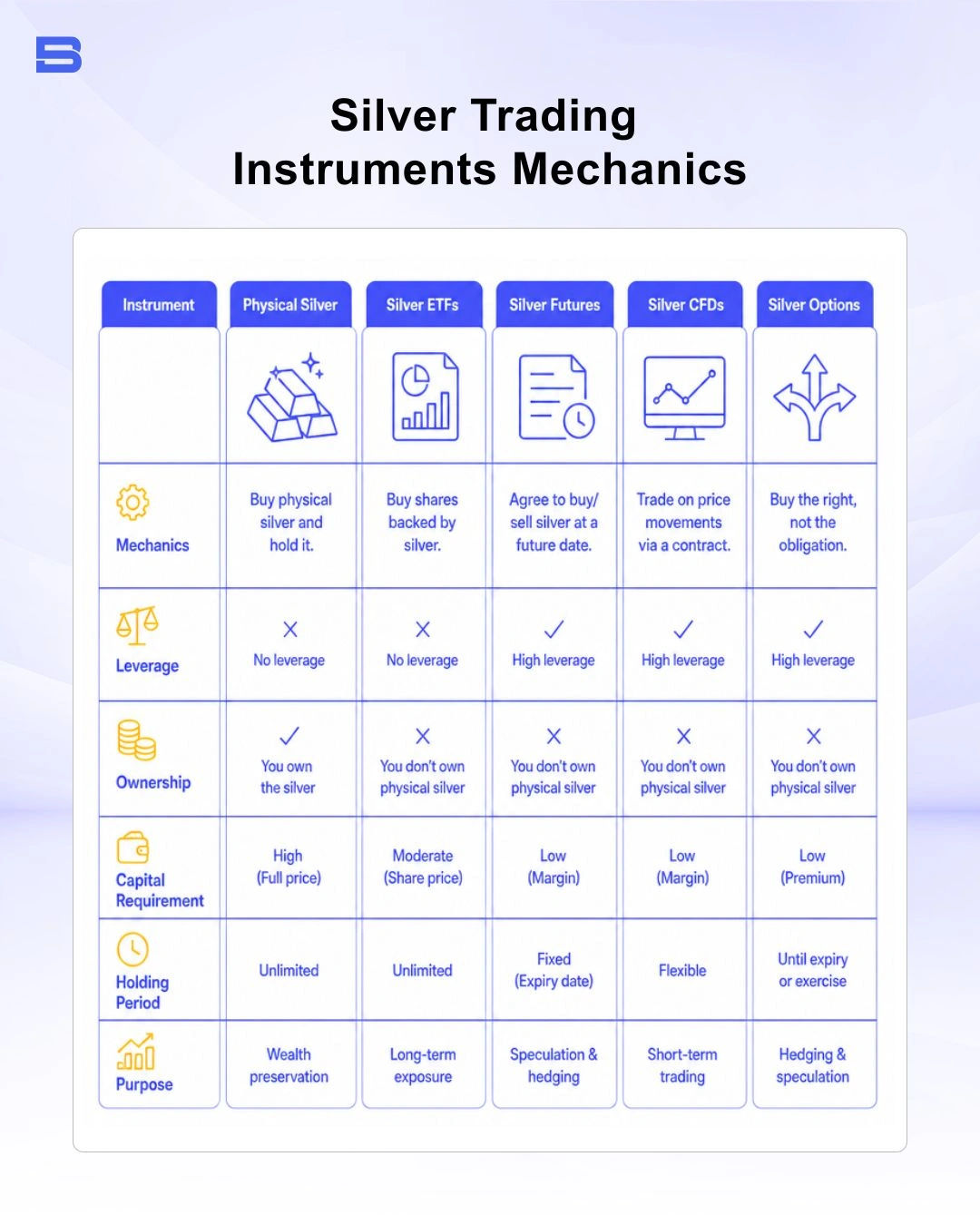
You can access the silver market through several distinct instruments, each offering varying levels of capital efficiency, risk exposure, and operational complexity.
Silver CFDs
Contracts for Difference (CFDs) allow traders to speculate on silver price movements without taking physical delivery of the metal. CFDs are derivative products where you exchange the difference in price between the position's opening and closing points.
- Leverage Mechanics: Brokers typically offer leverage on silver CFDs (e.g., 10:1 or 20:1 depending on regulatory jurisdiction).
- Example Calculation: At 10:1 leverage, opening a position worth $10,000 in silver requires an initial margin deposit of $1,000. If silver moves up by 2%, the position gains $200 (a 20% return on allocated margin). Conversely, if silver declines by 2%, the position loses $200 (a 20% loss of allocated margin).
- Holding Costs: Holding CFD positions overnight incurs financing fees known as swaps or rollover rates.
Silver Futures and Options
Futures contracts traded on regulated exchanges like the COMEX are standardized agreements to buy or sell a specified quantity of silver at a predetermined price on a future date. A standard contract represents 5,000 troy ounces, while an E-mini contract represents 1,000 troy ounces.
Regulated exchange execution is overseen by statutory bodies such as the US Commodity Futures Trading Commission (CFTC), ensuring central clearing and price transparency. Futures require maintaining initial and maintenance margins set by the exchange. Options on futures give traders the right, but not the obligation, to buy (call) or sell (put) silver contracts at a fixed strike price, offering defined-risk entry strategies.
Physical Silver vs. ETFs
If you’re a market participant with longer time horizons, derivative leverage may present unnecessary risk:
- Physical Bullion: Purchasing silver coins or bullion bars eliminates counterparty and leverage risk. However, physical ownership incurs dealer premiums above spot price, buy-sell spreads, transport costs, and ongoing insurance or secure vault storage fees.
- Silver Exchange-Traded Funds (ETFs): ETFs allow equity-based exposure to silver without direct ownership. Physical silver ETFs hold vaulted bullion backing their shares, tracking the spot price closely while charging a modest annual management expense ratio (MER) without the need for private storage arrangements.
Tactical Strategies: Trading the Gold-to-Silver Ratio (GSR)
A classic technical and quantitative approach used by precious metals traders involves tracking the Gold-to-Silver Ratio (GSR).
Gold-to-Silver Ratio = Spot Price of Gold per Ounce / Spot Price of Silver per Ounce
The Gold-Silver Ratio (GSR) shows how much silver is worth compared with one ounce of gold, helping investors compare the two precious metals. Because both assets share safe-haven properties but possess different industrial demands, the ratio tends to display mean-reverting behavior over long macroeconomic cycles.
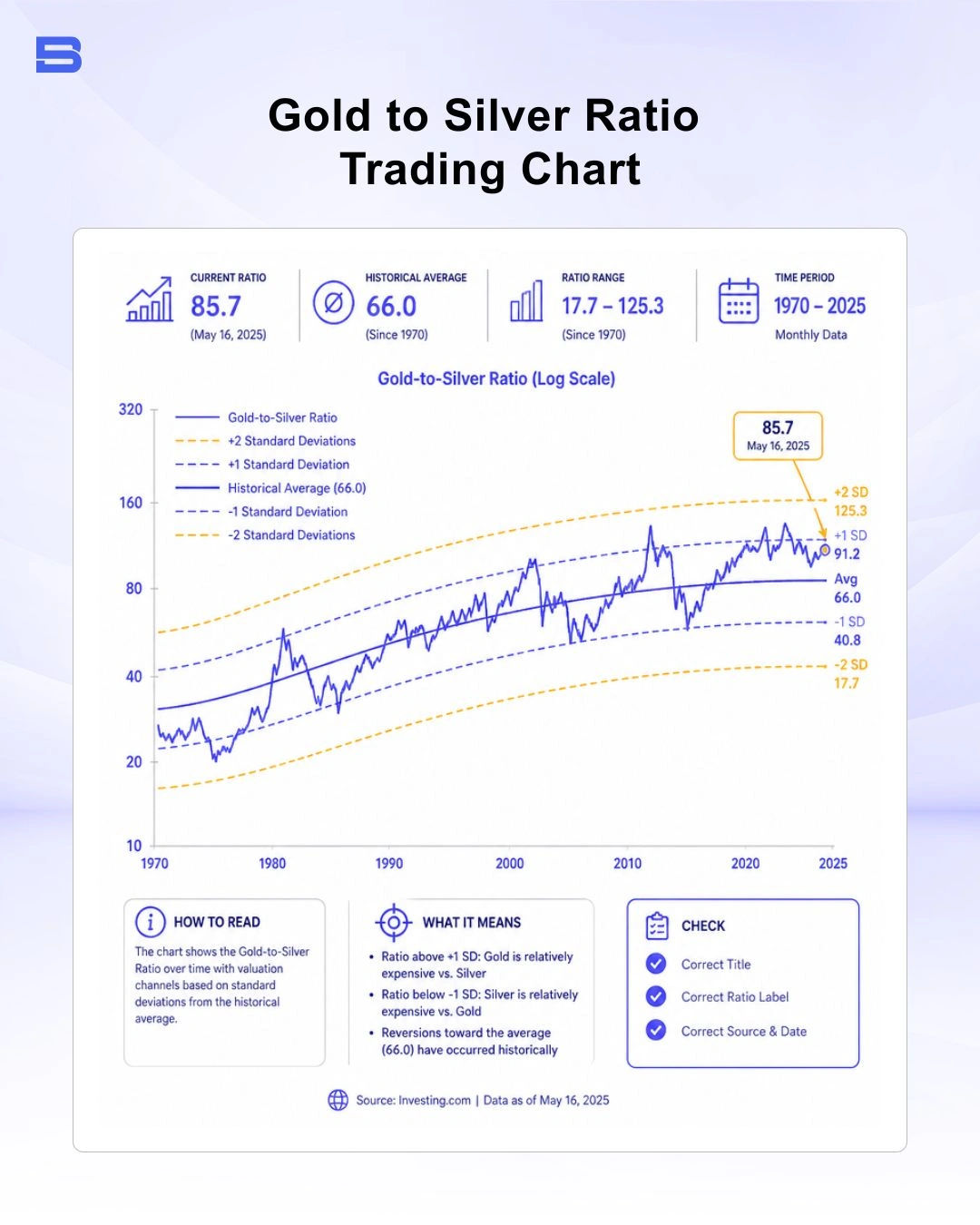
- High GSR (e.g., above 80:1 to 90:1): Historically suggests that silver is undervalued relative to gold. Traders looking for mean reversion may favor buying silver against gold (or going long silver CFDs while shorting gold CFDs in equal dollar amounts).
- Low GSR (e.g., below 50:1 to 60:1): Historically suggests silver is overvalued relative to gold, prompting traders to rotationally reallocate capital back into gold.
You can combine GSR mean-reversion signals with momentum indicators such as the Relative Strength Index (RSI) or simple trendlines to validate cyclical turns.
Commodity Market Dynamics: Silver vs. Oil Trading
When building a diversified commodity portfolio, you can compare precious metals with energy commodities like crude oil.
Oil trading focuses heavily on short-term inventory reports, such as US Energy Information Administration (EIA) data and Organization of the Petroleum Exporting Countries (OPEC) production decisions. Silver, by contrast, is sensitive to both monetary policy decisions and broader manufacturing cycles. Traders interested in broader raw materials exposure often monitor adjacent markets such as natural gas trading, rubber trading, or agricultural contracts.
How Silver Compares to Other Precious Metals
Within precious metals trading, silver sits between pure monetary assets and purely industrial metals:
- Gold vs. Silver: Gold is primarily a central bank reserve and monetary asset with limited industrial consumption. Silver’s price is significantly lower per ounce, but its smaller market capitalization results in wider percentage swings and lower liquidity depth during off-peak hours.
- Platinum and Palladium: Highly dependent on auto-catalyst production in traditional internal combustion engines. Silver benefits from broader electrification and renewable energy trends.
- Regional Investment Equivalents: International markets favor XAG/USD, but regional markets offer alternative gold and silver vehicles. These range from physical coins, such as Bank Negara Malaysia's official Kijang Emas bullion, to localized pool accounts like digital gold Malaysia.
Key Risks to Manage in Silver Trading
Navigating the silver market effectively requires strict capital protection protocols:
- Elevated Intra-Day Volatility: Silver daily percentage ranges frequently exceed gold's by 2x to 3x. Position sizes must be adjusted smaller relative to account size to accommodate wider stop-loss distances.
- Gapping and Slippage: During major macroeconomic events (such as US Non-Farm Payrolls or Federal Reserve rate announcements), liquidity can temporarily thin out, causing market prices to gap beyond order placement levels.
- Spread Expansion: The bid-ask spread on silver tends to widen outside of overlapping London/New York session hours. Trading during low-volume periods increases execution costs.
- Margin Call Escalation: Leveraged short-term positions face rapid liquidation risk if market corrections occur. Maintaining adequate free margin prevents premature automated stop-outs.
Conclusion
Silver trading offers retail investors a unique dynamic at the intersection of industrial growth and monetary hedging. While its heightened volatility provides trading opportunities across intraday and swing horizons, leverage can amplify downside losses just as rapidly as gains. Succeeding in the silver market requires selecting the right instrument for your holding period, monitoring real interest rates and industrial demand metrics, and maintaining strict position sizing on every execution.
- What Can You Trade? A Guide to Forex, Stocks, and More
- CFD Trading for Beginners
- What is CFD Trading and How Does It Work?
- Forex vs. Stocks: Which Market Suits You Best?
- How to Diversify a Portfolio Across Asset Classes
- How Dividend Stocks Work: Yields, Risks, and Strategies
- Silver Trading Explained: A Guide for Retail Investors
- Precious Metals Trading: A Complete Guide for Beginners
- Natural Gas Trading: A Guide to the Market
- Structured Warrants Malaysia: How They Work and Risks
- What Is the KLCI Index and How to Trade It
- Gold Investment in Malaysia: A Complete Guide for Beginners
- What Is Kijang Emas and How to Invest in It
- Value Investing Explained: How to Find Undervalued Stocks
- How to Trade Bitcoin Safely: A Complete Market Guide
- Growth Investing Explained: Strategies, Metrics, and Risks
- What Is Digital Gold Malaysia and How to Invest
- Crypto Trading Strategies for Beginners
- Gold vs Bitcoin: Key Differences, Risks, and Strategies
- Sukuk: A Guide for Beginners to Islamic Bonds
- What Is FCPO (Crude Palm Oil Futures) and How to Trade It
- How to Identify and Invest in Shariah-Compliant Stocks
- Timber Investment: Is It Worth It?
- Gold ETF Malaysia: A Guide for Beginners
- What Are Malaysian Government Securities (MGS)?
- Corporate Bonds Malaysia: A Guide for Beginners
- China A-Shares Trading Guide for Malaysian Investors
- What Is a Silver ETF and How to Invest in It?
- How to Trade XRP: A Practical Guide for Retail Investors
- How to Trade Solana (SOL): A Guide for Beginners
- What Are Gold Futures and How Do They Work?
- Money Market Fund in Malaysia: A Guide for Beginners
- Property Investment Malaysia: Direct Real Estate or M-REITs?
- What Is Binance Coin and How Does It Work?
- Green Sukuk: A Guide for Beginners to Islamic ESG Investing
- What Is Shiba Inu (SHIB) and How to Trade It
- What Is USDT? A Complete Guide to Tether for Beginners
- What Is Dogecoin and How to Trade It Safely for Beginners
- Cardano: A Guide for Beginners to Trade This Cryptocurrency
- Polkadot: A Guide to Trading This Cryptocurrency
- Tron: A Guide for Beginners to Trading This Cryptocurrency
- What Is Litecoin (LTC)? A Guide to Trading Digital Silver
- What Is Chainlink (LINK) and How to Trade It
- How to Trade Pepe Coin: Spot, Leverage, and Risk Management
- Near Protocol: A Guide to Trading This Cryptocurrency
- Trading Polygon Crypto: A Practical Guide for Beginners
- Trade Toncoin: Understanding the TON Ecosystem and Risks
- Cosmos Crypto: Ecosystem Architecture, Tokenomics, and Risks
- Stellar Crypto: A Guide to Trading This Cryptocurrency
- Avalanche Crypto Explained: A Practical Guide for Traders
- What Is Worldcoin? How to Trade WLD and Manage Risk
- Aptos: A Guide for Beginners to Trading This Cryptocurrency
- Sui Crypto Explained: Tokenomics and Trading Guide
- Celestia: A Guide to Trading This Cryptocurrency
- Decentraland: A Guide to Trading This Cryptocurrency
- What Is Arbitrum? How to Trade the Leading Layer 2 Network
- Sei Crypto: A Guide to Trading This Cryptocurrency
- What Is Injective Protocol and How to Trade INJ Safely
Disclaimer: The content on this page is intended for educational and informational purposes only. It does not constitute financial, investment, tax, or legal advice, and should not be interpreted as a recommendation to buy, sell, or hold any financial instrument or asset. Trading and investing involve significant risk, including the possible loss of your entire capital. Products such as forex, CFDs, and cryptocurrencies carry additional risks due to leverage, high volatility, and limited regulatory protection in some jurisdictions. Past performance of any financial instrument does not guarantee future results. Any market views, forecasts, or opinions expressed are those of the author at the time of writing and may not reflect current market conditions. Platform features, fees, and regulatory status are subject to change — always verify information directly with the relevant provider or regulator before making any financial decision. BrokerSpecs may receive compensation from third parties featured on this site. Always conduct your own due diligence and consider seeking advice from a licensed financial professional before investing.