


Related Tags
Entering the cryptocurrency market for the first time can feel like walking into a crowded financial exchange with a dozen competing auctioneers. You see thousands of digital assets fluctuating in value every second, but a few names consistently remain near the top of the market capitalization rankings. Among these dominant assets sits Binance Coin (BNB)—a token that originated as a simple discount mechanism for a centralized trading platform and transformed into the fuel for a broad, multi-chain decentralized ecosystem.
Understanding how Binance Coin works requires looking at both sides of its dual nature. It functions simultaneously as an internal utility asset for one of the largest cryptocurrency exchanges by trading volume and as the underlying gas token powering smart contracts across decentralized finance (DeFi).
What Is Binance Coin (BNB)?
Binance Coin (BNB) is the native utility token of the BNB Chain ecosystem. It is used to pay transaction fees, support staking and governance, and interact with decentralized applications (dApps) across the network. BNB also remains useful within the Binance exchange ecosystem, where users can use it to pay trading fees and receive applicable discounts.
Launched through an Initial Coin Offering (ICO) in July 2017, BNB was initially issued as an ERC-20 token on the Ethereum blockchain. Its early utility was closely linked to the Binance exchange, particularly as a means of paying trading fees at a discount.
In April 2019, BNB migrated from Ethereum to Binance Chain, becoming the native asset of Binance's first blockchain network. Binance Smart Chain (later renamed BNB Smart Chain, still abbreviated BSC) was subsequently launched in 2020 as a parallel, EVM-compatible blockchain designed to support smart contracts and decentralized applications. Both networks later became part of the broader BNB Chain ecosystem.
Today, BNB is used across the BNB Chain ecosystem for transaction fees, staking, governance, and interaction with dApps. Following the BNB Chain Fusion in 2024, the former BNB Beacon Chain was retired, with its functions migrated to BNB Smart Chain. BNB Chain now operates as a decentralized, community-driven ecosystem rather than a blockchain directly controlled by Binance.
To understand how BNB functions in practice, consider how transaction fees (often called "gas") operate on a blockchain network. Every time you execute an action on the network—such as swapping one digital token for another or interacting with a decentralized lending protocol—the underlying computers (validators) must process your transaction.
On the BNB Chain, these operational costs are paid directly in BNB. If a decentralized transaction costs 0.0005 BNB, that micro-amount is deducted from your wallet to compensate the network validators for processing your data. Without holding BNB in your crypto wallet, you cannot process smart contract transactions on its native network, regardless of how many other digital assets you hold.
What Is Binance Coin Used For?
The real-world value of any utility token depends heavily on its actual adoption and use cases. Binance Coin has developed one of the broadest utility frameworks in the digital asset sector, spanning both centralized exchange features and decentralized network functions.
Centralized Exchange Utility
- Trading Fee Discounts: When trading spot or derivative contracts on the Binance exchange, you can opt to pay transaction fees in BNB rather than the base trading currency, unlocking immediate fee reductions.
- Token Launchpad Access: BNB holders gain exclusive allocation rights to participate in new crypto token sales launched via Binance Launchpad and Launchpool platforms.
- Payment Settlement: Merchants and payment processors accepting BNB allow users to settle real-world goods and services directly using the token.
BNB Smart Chain (BSC) and EVM Compatibility
The secondary layer of BNB's utility operates on-chain. The BNB Smart Chain (BSC) is a high-throughput blockchain network that operates parallel to the original structural layer. Crucially, BSC was engineered with Ethereum Virtual Machine (EVM) compatibility.
EVM compatibility means that software developers who build applications for Ethereum can deploy their code directly onto BNB Smart Chain with minimal modifications. This structural setup allows users to experience significantly lower transaction fees and faster block execution times compared to traditional layer-1 networks, making BSC a popular venue for decentralized trading, gaming, and yield applications.
Tokenomics and the Quarterly Auto-Burn
Unlike fiat currencies, which do not have a fixed protocol-level maximum supply, BNB launched with an initial total supply of 200,000,000 BNB. BNB Chain committed to permanently removing 100 million BNB from circulation through token burns to eventually reduce the supply to 100,000,000 BNB.
To achieve this, BNB uses an Auto-Burn mechanism that periodically removes BNB from circulation. The amount burned is calculated using factors including BNB's market price and the number of blocks produced on BNB Smart Chain, making the process more predictable and independently auditable.
BNB also incorporates a Real-Time Burn mechanism, introduced through BEP-95, which permanently burns a portion of the gas fees generated on BNB Smart Chain. This mechanism reduces BNB's supply based on network activity and can continue operating even after the scheduled Auto-Burn process reaches its 100 million BNB target.
This supply reduction occurs through two primary systems:
- BEP-95 Real-Time Burn: A fixed percentage of the gas fees collected by validators on the BNB Smart Chain is burned continuously in real time on-chain.
- Quarterly Auto-Burn: An automated, formulaic quarterly burn that calculates the exact number of tokens to destroy based on BNB’s average market price and the total number of blocks produced during that quarter.
Because the Auto-Burn formula relies on verifiable on-chain metrics rather than discretionary exchange profits, the supply destruction process remains transparent and predictable for market participants.
How BNB Chain Consensus Works (PoSA)
The BNB Smart Chain secures its transaction ledger using a consensus model called Proof-of-Staked-Authority (PoSA). PoSA combines elements of Proof-of-Stake (PoS) and Proof-of-Authority (PoA).
Instead of requiring thousands of energy-intensive mining rigs (like Bitcoin's Proof-of-Work model), PoSA relies on a core set of elected validators who stake large amounts of BNB to validate transactions. This architectural design enables fast, 3-second block generation times and negligible gas fees.
However, BNB Smart Chain uses a relatively limited validator set compared with highly decentralized networks such as Ethereum. According to BNB Chain's official validator documentation, its Proof of Staked Authority (PoSA) consensus currently has 45 active validators, comprising 21 Cabinet validators and 24 Candidate validators, with 21 validators selected for each consensus epoch.
This architecture prioritizes fast block production, high throughput, and relatively low transaction fees, although it involves a greater degree of validator concentration and therefore a trade-off in decentralization.
Understanding BEP-20 Tokens
When assets are created or transferred on the BNB Smart Chain, they adhere to a technical blueprint known as the BEP-20 standard. Similar to Ethereum's ERC-20 standard, BEP-20 dictates the basic operating parameters for digital assets on the network—such as how transfers are executed, how balances are tracked, and how smart contracts interact with the tokens.
Every custom token created on BSC—whether a decentralized exchange governance asset or a stablecoin like Tether (USD₮)—operates using this BEP-20 blueprint, with BNB powering every state change on the network.
Comparing BNB with Other Major Altcoins (XRP, Solana)
To evaluate BNB's position within the wider cryptocurrency market, it helps to compare its core operational metrics against other top-ranking alternative assets like XRP and Solana. While all three networks aim for fast execution and low costs, their underlying market drivers and risk structures differ significantly.
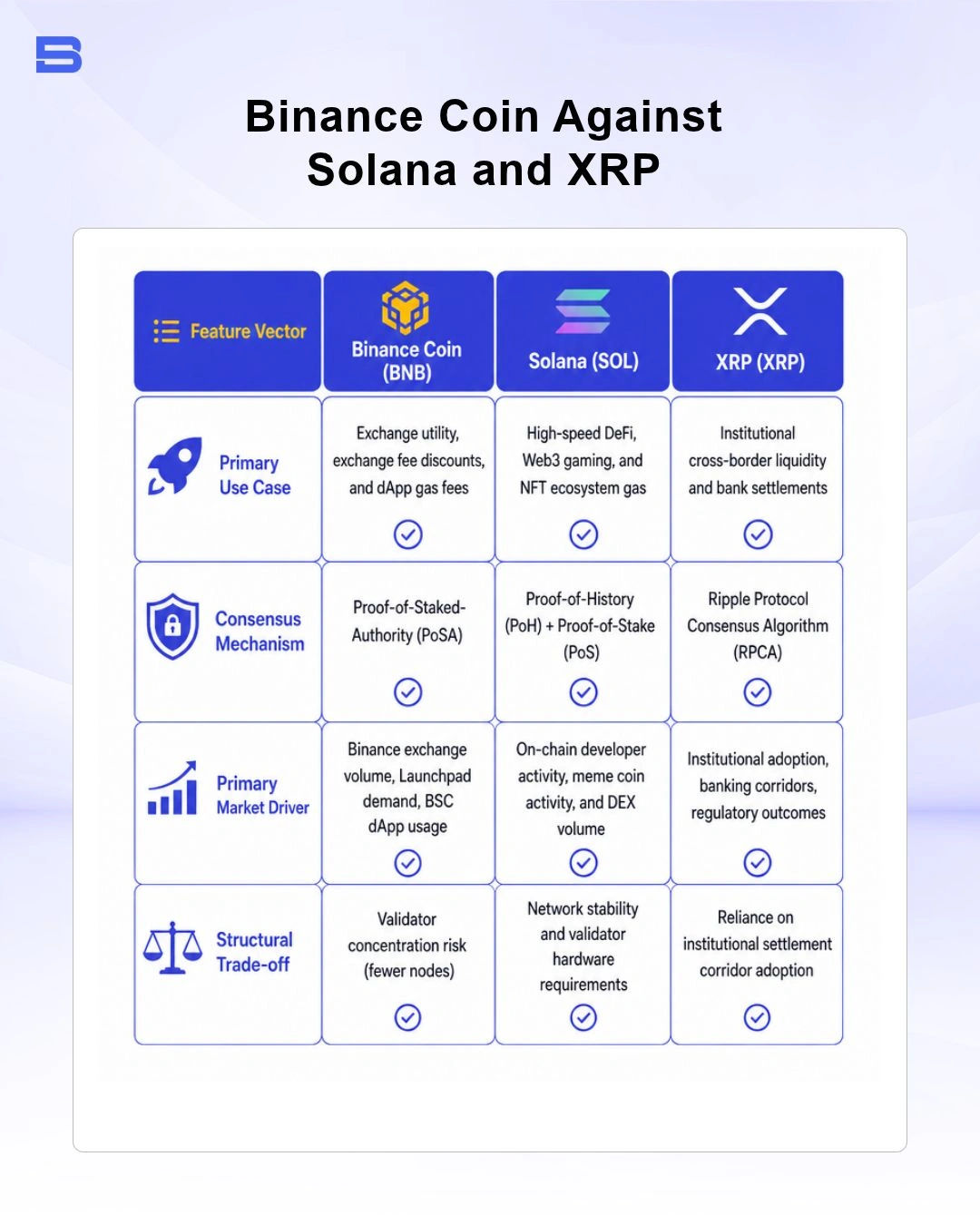
While Solana focuses heavily on maximizing pure throughput for retail DeFi applications and XRP targets traditional banking rails, BNB sits uniquely at the intersection of a large centralized commercial business and an EVM-compatible public blockchain network.
Trading Strategies and Risk Management for BNB
Trading digital assets like Binance Coin requires a structured approach that balances profit targets against potential loss scenarios. Because BNB's price movements are heavily tied to exchange infrastructure, market sentiment, and overall crypto market trends set by benchmark assets like Bitcoin, traders must manage several distinct risk vectors.
Key Risk Considerations
- Ecosystem Concentration Risk: Unlike neutral open-source blockchains, BNB's valuation retains a strong historical correlation with the corporate health, trading volume, and public reputation of the Binance exchange. Issues affecting the parent exchange can directly impact BNB's market liquidity and price.
- Regulatory Oversight: Crypto asset frameworks are evolving rapidly worldwide. International regulatory authorities—such as the Securities Commission Malaysia (SC) and the Monetary Authority of Singapore (MAS)—continuously update oversight guidelines regarding exchange operations and digital asset offerings. Traders must remain aware of how regulatory developments impact asset accessibility in their home jurisdictions.
- Volatility and Derivatives Risk: Digital assets experience high price swings. When engaging in spot trading or using leverage derivatives tied to BNB, sudden price movements can quickly trigger margin calls or liquidations.
Practical Risk Rules for Retail Traders
Before opening a position in BNB using stablecoins like USDT or base fiat pairs, establishing risk controls is essential:
- The 1% Risk Rule: Never risk more than 1% to 2% of your total trading capital on a single BNB trade. If your total account balance is $5,000, your maximum dollar loss on a position (where your stop-loss triggers) should not exceed $50 to $100.
- Correlated Market Analysis: Before executing a BNB setup, review the broader market trend established by top assets. To learn more about reading broader market structures, review our complete guides on how to trade Bitcoin and how to trade Ethereum.
- Avoid Over-Leveraging: High leverage amplifies your gains when you are right, but it accelerates capital destruction just as quickly when the market moves against you. For example, a 2.5% move against a 30:1 leveraged position can wipe out a large share of your allocated margin.
The Bottom Line
Binance Coin stands out in the digital asset market due to its dual operational role—acting as a commercial exchange asset and a decentralized gas token. While its strong utility and transparent deflationary auto-burn mechanics offer clear functional value, its structural ties to exchange infrastructure require traders to practice disciplined risk management. Balance your exposure carefully, maintain strict position sizing, and evaluate market conditions before taking a position.
- What Can You Trade? A Guide to Forex, Stocks, and More
- CFD Trading for Beginners
- What is CFD Trading and How Does It Work?
- Forex vs. Stocks: Which Market Suits You Best?
- How to Diversify a Portfolio Across Asset Classes
- How Dividend Stocks Work: Yields, Risks, and Strategies
- Silver Trading Explained: A Guide for Retail Investors
- Precious Metals Trading: A Complete Guide for Beginners
- Natural Gas Trading: A Guide to the Market
- Structured Warrants Malaysia: How They Work and Risks
- What Is the KLCI Index and How to Trade It
- Gold Investment in Malaysia: A Complete Guide for Beginners
- What Is Kijang Emas and How to Invest in It
- Value Investing Explained: How to Find Undervalued Stocks
- How to Trade Bitcoin Safely: A Complete Market Guide
- Growth Investing Explained: Strategies, Metrics, and Risks
- What Is Digital Gold Malaysia and How to Invest
- Crypto Trading Strategies for Beginners
- Gold vs Bitcoin: Key Differences, Risks, and Strategies
- Sukuk: A Guide for Beginners to Islamic Bonds
- What Is FCPO (Crude Palm Oil Futures) and How to Trade It
- How to Identify and Invest in Shariah-Compliant Stocks
- Timber Investment: Is It Worth It?
- Gold ETF Malaysia: A Guide for Beginners
- What Are Malaysian Government Securities (MGS)?
- Corporate Bonds Malaysia: A Guide for Beginners
- China A-Shares Trading Guide for Malaysian Investors
- What Is a Silver ETF and How to Invest in It?
- How to Trade XRP: A Practical Guide for Retail Investors
- How to Trade Solana (SOL): A Guide for Beginners
- What Are Gold Futures and How Do They Work?
- Money Market Fund in Malaysia: A Guide for Beginners
- Property Investment Malaysia: Direct Real Estate or M-REITs?
- What Is Binance Coin and How Does It Work?
- Green Sukuk: A Guide for Beginners to Islamic ESG Investing
- What Is Shiba Inu (SHIB) and How to Trade It
- What Is USDT? A Complete Guide to Tether for Beginners
- What Is Dogecoin and How to Trade It Safely for Beginners
- Cardano: A Guide for Beginners to Trade This Cryptocurrency
- Polkadot: A Guide to Trading This Cryptocurrency
- Tron: A Guide for Beginners to Trading This Cryptocurrency
- What Is Litecoin (LTC)? A Guide to Trading Digital Silver
- What Is Chainlink (LINK) and How to Trade It
- How to Trade Pepe Coin: Spot, Leverage, and Risk Management
- Near Protocol: A Guide to Trading This Cryptocurrency
- Trading Polygon Crypto: A Practical Guide for Beginners
- Trade Toncoin: Understanding the TON Ecosystem and Risks
- Cosmos Crypto: Ecosystem Architecture, Tokenomics, and Risks
- Stellar Crypto: A Guide to Trading This Cryptocurrency
- Avalanche Crypto Explained: A Practical Guide for Traders
- What Is Worldcoin? How to Trade WLD and Manage Risk
- Aptos: A Guide for Beginners to Trading This Cryptocurrency
- Sui Crypto Explained: Tokenomics and Trading Guide
- Celestia: A Guide to Trading This Cryptocurrency
- Decentraland: A Guide to Trading This Cryptocurrency
- What Is Arbitrum? How to Trade the Leading Layer 2 Network
- Sei Crypto: A Guide to Trading This Cryptocurrency
- What Is Injective Protocol and How to Trade INJ Safely
Disclaimer: The content on this page is intended for educational and informational purposes only. It does not constitute financial, investment, tax, or legal advice, and should not be interpreted as a recommendation to buy, sell, or hold any financial instrument or asset. Trading and investing involve significant risk, including the possible loss of your entire capital. Products such as forex, CFDs, and cryptocurrencies carry additional risks due to leverage, high volatility, and limited regulatory protection in some jurisdictions. Past performance of any financial instrument does not guarantee future results. Any market views, forecasts, or opinions expressed are those of the author at the time of writing and may not reflect current market conditions. Platform features, fees, and regulatory status are subject to change — always verify information directly with the relevant provider or regulator before making any financial decision. BrokerSpecs may receive compensation from third parties featured on this site. Always conduct your own due diligence and consider seeking advice from a licensed financial professional before investing.