



Related Tags
Picture a crowded market during a sudden downpour. Shoppers scatter, merchants panic, and high-quality goods are left abandoned on the tables, marked down at steep discounts just to clear space. In the financial markets, emotional reactions—driven by fear, short-term earnings misses, or broader economic anxiety—frequently cause the shares of solid, profitable companies to trade well below their true fundamental worth.
For patient investors, these market overreactions create unique opportunities. But how do you systematically separate short-term noise from a business's long-term intrinsic value? That is the core objective of value investing.
What Is Value Investing and How Does It Work?
Value investing is an investment strategy that involves buying assets—typically equities—trading for less than their intrinsic or fundamental worth. Pioneered by Benjamin Graham and David Dodd in the 1930s and later popularized by Warren Buffett, this approach views a stock not as a speculative ticker symbol, but as a fractional ownership stake in a real business.
The underlying mechanics rest on market inefficiency. Short-term stock prices are driven by sentiment, news cycles, and investor emotion. However, over the long term, a stock's price historically trends back toward the fundamental earnings power and asset valuation of the underlying business.
The Core Premise: Market Price vs. Intrinsic Value
The central principle of value investing rests on distinguishing between price and value. As Warren Buffett famously noted: "Price is what you pay; value is what you get."
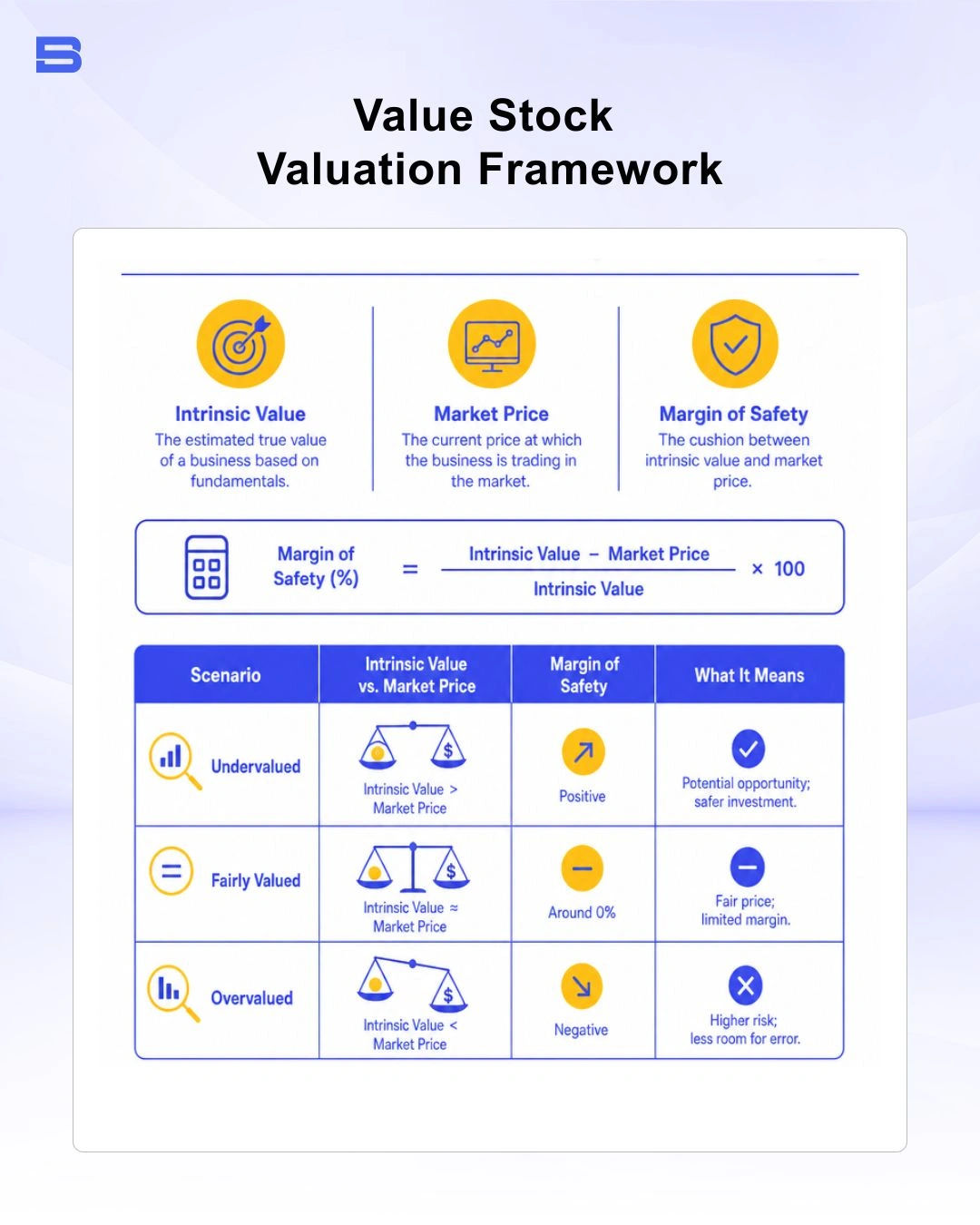
- Market Price: The current quote at which a stock trades on a public exchange, determined strictly by immediate supply and demand dynamics.
- Intrinsic Value: An estimated calculation of a company's true worth based on fundamental metrics, including cash flows, balance sheet assets, revenue growth, and competitive advantages.
When public panic or short-term headwinds drive the market price significantly below the calculated intrinsic value, a valuation gap opens up—creating a prospective entry point for fundamental investors.
The Margin of Safety: Protecting Capital Against Errors
Because calculating intrinsic value relies on financial estimates and future assumptions, valuation is never an exact science. To protect against analytical errors, unexpected economic downturns, or operational setbacks, value investors apply a Margin of Safety.
Margin of Safety Principle: The buffer created when you buy an asset at a discount to its estimated intrinsic value.
If your valuation model estimates a company's intrinsic worth at RM50 per share, purchasing it at RM35 establishes a 30% Margin of Safety. If your estimates turn out to be overly optimistic, or if market headwinds persist longer than anticipated, that discount helps absorb the downside while preserving capital.
Key Ratios Used to Evaluate Value Candidates
To identify potential candidates, fundamental investors rely on financial metrics sourced from regulatory disclosures, such as earnings filings submitted to the US Securities and Exchange Commission (SEC) or quarterly balance sheet releases on local exchanges.
Fundamental Valuation Ratios Every Investor Needs
- Price-to-Earnings (P/E) Ratio: Measures a company's current share price relative to its per-share earnings. A P/E ratio below the broader market average or industry peers can indicate that a stock is underpriced relative to its generating capacity.
- Price-to-Book (P/B) Ratio: Compares a company's market capitalization to its book value (total assets minus total liabilities). A P/B ratio under 1.0 suggests that the stock trades for less than the net accounting value of its physical and financial assets.
- Free Cash Flow Yield: Measures the cash generated by operational activities (after capital expenditures) relative to enterprise value, showing how efficiently a company produces liquid capital.
- Debt-to-Equity Ratio: Assesses financial leverage. True value candidates maintain manageable debt loads to ensure they can survive prolonged industry downturns without solvency risks.
Worked Scenario: Assessing Stock A
Consider a hypothetical valuation scenario for "Company A":
- Balance Sheet & Income Analysis: Company A holds total assets minus liabilities, yielding an equity book value of RM30 per share and generates stable earnings of RM4 per share.
- Intrinsic Value Calculation: Discounted cash flow (DCF) modeling estimates Company A's intrinsic value at RM50 per share.
- Market Price Assessment: Due to temporary supply chain disruptions, panic selling pushes the current market price down to RM35 per share.
- Metric Evaluation: At RM35, Company A trades at a P/E of 8.75x and offers a 30% Margin of Safety (RM50 - RM35) / RM50).
Value Investing vs. Growth Investing: Understanding the Core Differences
Investors often debate the relative advantages of value investing versus growth investing. While both seek long-term capital expansion, their selection criteria, timelines, and risk profiles differ significantly.
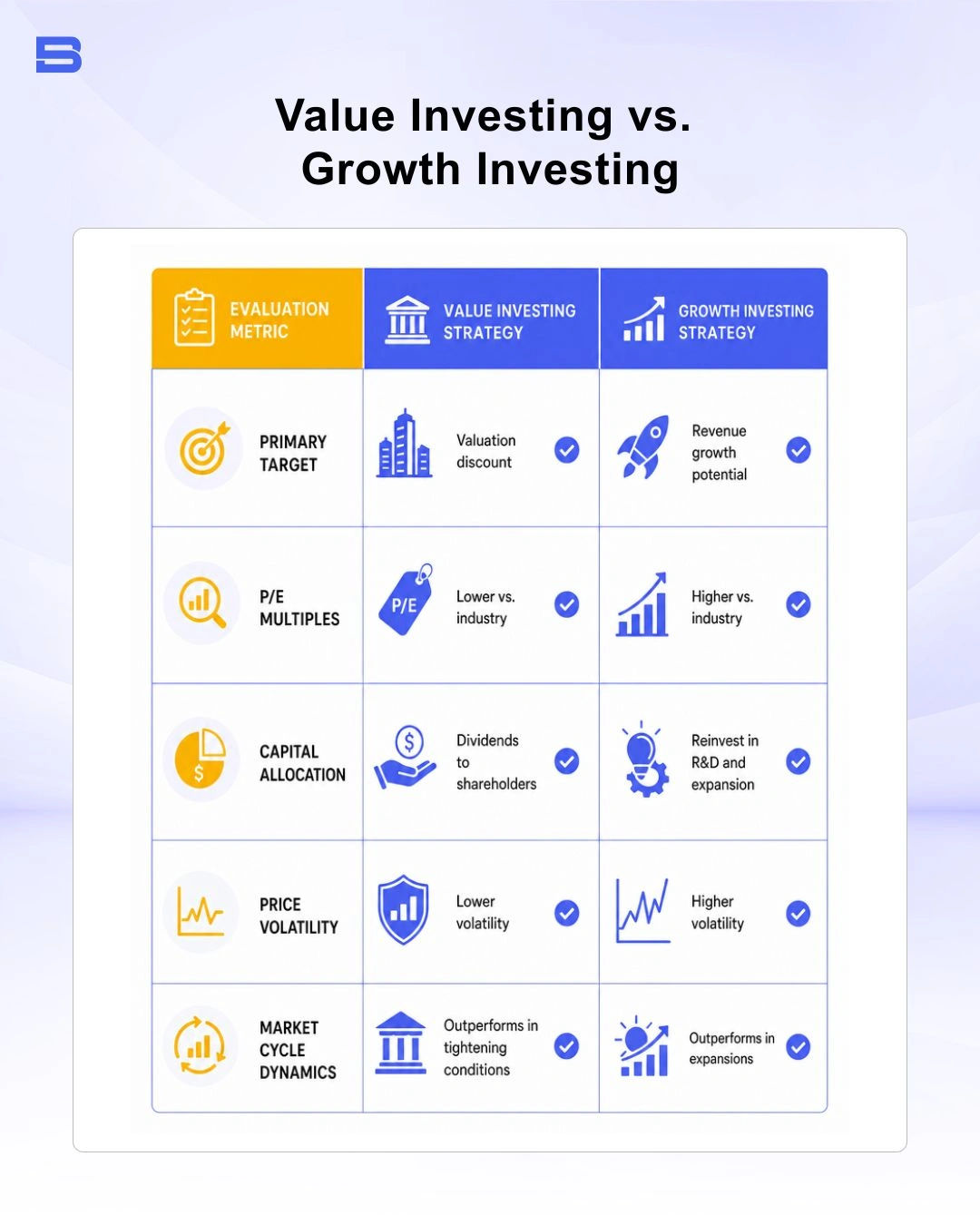
Leveraging a disciplined allocation strategy often involves balancing elements of both approaches depending on your overall financial objectives and horizon.
How Value Stocks and Dividend Stocks Intersect
A major overlap in fundamental analysis occurs between undervalued shares and stable income vehicles. Companies that trade at depressed valuations often maintain mature, cash-generative operations that allow them to distribute recurring payments.
When evaluating dividend stocks within a fundamental value model, it is crucial to analyze the Dividend Payout Ratio alongside cash reserves. A low valuation paired with an excessively high dividend yield (e.g., above 9–10%) can signal financial distress rather than an income opportunity. Value discipline emphasizes sustainable distributions backed by genuine free cash flow rather than high yields funded by debt.
Identifying Value Traps: How to Avoid Misleadingly Cheap Stocks
Not every stock trading at a low valuation ratio is a bargain. In many cases, a stock is cheap for a valid structural reason.
Value Trap Definition: A stock that appears undervalued based on low P/E or P/B ratios, but is actually declining due to permanent business model impairment, technological disruption, or poor management execution.
To protect your portfolio from value traps, evaluate these three structural red flags:
- Persistent Revenue Decay: A continuous multi-year decline in top-line revenue indicates that the company is losing market share to competitors or facing industry obsolescence.
- Escalating Debt Obligations: Low share prices combined with rising debt loads severely restrict operational flexibility and increase bankruptcy risk during economic slowdowns.
- Destructive Capital Reinvestment: Management teams that throw cash into failing legacy business units rather than adapting to shifting consumer demands drain shareholder capital over time.
Implementing Value Strategies in Regional Markets
Investors looking to execute a value strategy can access opportunities across both international and regional exchanges through various structural vehicles.
Direct Stock Execution
For direct equity exposure, global brokerage platforms allow retail investors to evaluate public filings on international exchanges, including learning how to buy US stocks in Malaysia or analyzing international valuation metrics directly. Advanced international allocations may also explore market opportunities directly, such as understanding how to invest in China A-shares from Malaysia.
Managed Funds and Local Vehicles
For investors seeking diversified exposure managed by institutional investment teams, collective investment schemes offer structured access. Local frameworks like unit trust Malaysia options or public equity programs such as ASNB investment structures portfolio around diversified value holdings, dividend-paying equities, and fixed-income assets.
When executing trades locally or internationally through regional brokers registered with regulatory bodies like Bursa Malaysia, ensure your platform aligns with structural execution security and competitive fee schedules.
Conclusion
Value investing provides a disciplined, time-tested framework for building wealth by purchasing businesses at a discount to their fundamental value. By anchoring your portfolio around a strict Margin of Safety, rigorously analyzing financial statements, and avoiding value traps, you can navigate market volatility with clarity and poise. Success in value investing does not depend on timing daily price swings, but on having the patience to let market prices reflect intrinsic business value over time.
- What Can You Trade? A Guide to Forex, Stocks, and More
- CFD Trading for Beginners
- What is CFD Trading and How Does It Work?
- Forex vs. Stocks: Which Market Suits You Best?
- How to Diversify a Portfolio Across Asset Classes
- How Dividend Stocks Work: Yields, Risks, and Strategies
- Silver Trading Explained: A Guide for Retail Investors
- Precious Metals Trading: A Complete Guide for Beginners
- Natural Gas Trading: A Guide to the Market
- Structured Warrants Malaysia: How They Work and Risks
- What Is the KLCI Index and How to Trade It
- Gold Investment in Malaysia: A Complete Guide for Beginners
- What Is Kijang Emas and How to Invest in It
- Value Investing Explained: How to Find Undervalued Stocks
- How to Trade Bitcoin Safely: A Complete Market Guide
- Growth Investing Explained: Strategies, Metrics, and Risks
- What Is Digital Gold Malaysia and How to Invest
- Crypto Trading Strategies for Beginners
- Gold vs Bitcoin: Key Differences, Risks, and Strategies
- Sukuk: A Guide for Beginners to Islamic Bonds
- What Is FCPO (Crude Palm Oil Futures) and How to Trade It
- How to Identify and Invest in Shariah-Compliant Stocks
- Timber Investment: Is It Worth It?
- Gold ETF Malaysia: A Guide for Beginners
- What Are Malaysian Government Securities (MGS)?
- Corporate Bonds Malaysia: A Guide for Beginners
- China A-Shares Trading Guide for Malaysian Investors
- What Is a Silver ETF and How to Invest in It?
- How to Trade XRP: A Practical Guide for Retail Investors
- How to Trade Solana (SOL): A Guide for Beginners
- What Are Gold Futures and How Do They Work?
- Money Market Fund in Malaysia: A Guide for Beginners
- Property Investment Malaysia: Direct Real Estate or M-REITs?
- What Is Binance Coin and How Does It Work?
- Green Sukuk: A Guide for Beginners to Islamic ESG Investing
- What Is Shiba Inu (SHIB) and How to Trade It
- What Is USDT? A Complete Guide to Tether for Beginners
- What Is Dogecoin and How to Trade It Safely for Beginners
- Cardano: A Guide for Beginners to Trade This Cryptocurrency
- Polkadot: A Guide to Trading This Cryptocurrency
- Tron: A Guide for Beginners to Trading This Cryptocurrency
- What Is Litecoin (LTC)? A Guide to Trading Digital Silver
- What Is Chainlink (LINK) and How to Trade It
- How to Trade Pepe Coin: Spot, Leverage, and Risk Management
- Near Protocol: A Guide to Trading This Cryptocurrency
- Trading Polygon Crypto: A Practical Guide for Beginners
- Trade Toncoin: Understanding the TON Ecosystem and Risks
- Cosmos Crypto: Ecosystem Architecture, Tokenomics, and Risks
- Stellar Crypto: A Guide to Trading This Cryptocurrency
- Avalanche Crypto Explained: A Practical Guide for Traders
- What Is Worldcoin? How to Trade WLD and Manage Risk
- Aptos: A Guide for Beginners to Trading This Cryptocurrency
- Sui Crypto Explained: Tokenomics and Trading Guide
- Celestia: A Guide to Trading This Cryptocurrency
- Decentraland: A Guide to Trading This Cryptocurrency
- What Is Arbitrum? How to Trade the Leading Layer 2 Network
- Sei Crypto: A Guide to Trading This Cryptocurrency
- What Is Injective Protocol and How to Trade INJ Safely
Disclaimer: The content on this page is intended for educational and informational purposes only. It does not constitute financial, investment, tax, or legal advice, and should not be interpreted as a recommendation to buy, sell, or hold any financial instrument or asset. Trading and investing involve significant risk, including the possible loss of your entire capital. Products such as forex, CFDs, and cryptocurrencies carry additional risks due to leverage, high volatility, and limited regulatory protection in some jurisdictions. Past performance of any financial instrument does not guarantee future results. Any market views, forecasts, or opinions expressed are those of the author at the time of writing and may not reflect current market conditions. Platform features, fees, and regulatory status are subject to change — always verify information directly with the relevant provider or regulator before making any financial decision. BrokerSpecs may receive compensation from third parties featured on this site. Always conduct your own due diligence and consider seeking advice from a licensed financial professional before investing.