



Related Tags
Imagine sitting across from two potential business partners. The first runs a mature utility company that pays out predictable annual dividends but reinvests almost nothing into expanding its footprint. The second leads an emerging enterprise software firm that pours every dollar of revenue straight back into software engineering, customer acquisition, and market conquest. Choosing the second business model forms the bedrock of growth investing.
What Is Growth Investing?
When you take a growth investing approach, you're buying shares in companies expected to grow sales and earnings significantly faster than the broader market. Rather than looking for bargains or quick dividend income, growth investors are willing to pay higher prices for strong business momentum and long-term market trends.
The underlying mechanism relies heavily on the reinvestment of earnings. When a high-growth firm generates operational cash flow, management opts not to issue dividends to shareholders. Instead, profits fund continuous research and development, physical capital infrastructure, strategic acquisitions, and hiring key technical personnel. Over multi-year investment horizons, this disciplined reinvestment accelerates top-line revenue, expands competitive moats, and drives sustained capital appreciation.
Case Example: How a Growth Company Operates
Consider a cloud-native software business expanding its annualized recurring revenue (ARR) at 35% year-over-year in a fast-growing market segment. In its early years, the firm may show net accounting losses on paper because sales and marketing expenses are fully front-loaded to win enterprise clients.
However, because these enterprise customers sign long-term multi-year contracts, the lifetime value of each client far exceeds the initial acquisition cost. By continuously reinvesting operational cash flow back into product scalability rather than paying cash dividends, the enterprise compound value increases exponentially over time.
Key Financial Metrics for Evaluating Growth Stocks
Evaluating potential growth investments requires quantitative tools distinct from classic asset-based screening. Because fast-expanding companies prioritize market share over immediate profit margins, traditional price-to-earnings (P/E) ratios can appear deceptively elevated or even non-existent for unprofitable firms. Accurate evaluation relies on a broader set of operating and valuation metrics disclosed in standard public reporting, such as Securities and Exchange Commission (SEC) filings.
- Year-over-Year (YoY) Revenue Growth Rate: Measures the speed of top-line expansion. Sustainable growth candidates typically demonstrate consistent revenue gains above 20% annually.
- Gross Profit Margins: High gross margins (often exceeding 60% to 70% in technology or healthcare) indicate strong pricing power and product differentiation.
- Price-to-Sales (P/S) Ratio: Evaluates valuation relative to gross sales, serving as an essential multiple when analyzing early-stage or non-profitable enterprises.
- Total Addressable Market (TAM): Quantifies the maximum overall revenue opportunity available to a product or service if 100% market share is achieved.
PEG Ratio: Evaluating Growth at a Reasonable Price (GARP)
The Price/Earnings-to-Growth (PEG) ratio adjusts the basic price-to-earnings ratio by explicitly incorporating the company's expected earnings growth rate, helping investors spot growth at a reasonable price (GARP).
PEG Ratio = Price-to-Earnings (P/E) Ratio Annual / Earnings Per Share (EPS) Growth Rate (%)
Assume Company A trades at a high P/E ratio of 30, while its earnings per share are projected to grow at 20% annually:
PEG Ratio = (30) / (20) = 1.5
Generally, a PEG ratio around 1.0 indicates fair value for a growth stock, while multiples above 2.0 suggest the market has priced in aggressive expectations.
The Rule of 40 for High-Growth Tech Companies
For software-as-a-service (SaaS) and platform technology businesses, analysts frequently employ the Rule of 40 to measure balanced operating performance:
Rule of 40 Benchmark = Revenue Growth Rate (%) + Profit Margin (%) > 40%
If a cloud business grows sales at 35% YoY while maintaining a net margin of 10%, its score is 45% (35% + 10%), successfully beating the 40% efficiency threshold. Conversely, a company growing revenue at 50% while bleeding money at a -20% profit margin scores 30% (50% - 20%), signaling inefficient growth that may strain capital reserves over time.
Growth Investing vs. Value Investing: Key Differences
Growth and value strategies reflect contrasting approaches to public equity markets. While growth investors focus on future business expansion and momentum, value investing prioritizes purchasing underpriced securities trading below their calculated intrinsic asset value.
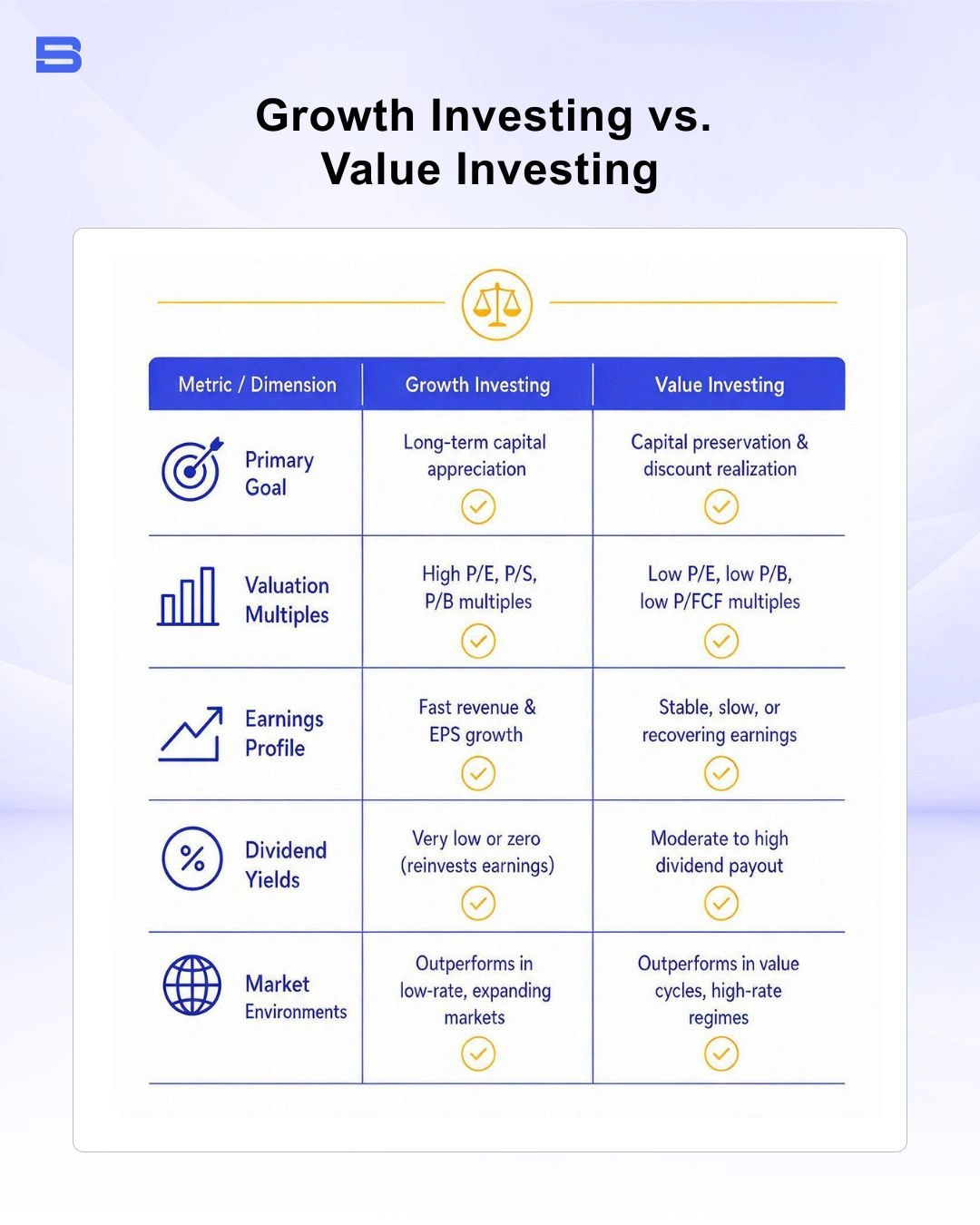
Understanding these differences enables portfolio managers to balance exposure across differing macroeconomic environments.
Growth Stocks vs. Dividend Stocks: Capital Appreciation vs. Income
Choosing between high-growth enterprises and dividend-paying assets comes down to balancing wealth accumulation against liquid income stream generation.
Growth stocks direct their resources toward market leadership, hiring, and capital expenditure. Holding fast-growing assets can accelerate the compound growth of the total return profile over decades. However, holders receive no current yield during the accumulation phase.
In contrast, mature dividend stocks distribute a fixed portion of profits back to equity holders every quarter. While these steady distributions provide downside cushioning during broader market drawdowns, mature firms often exhibit slower top-line growth rates.
Combining capital appreciation components alongside dividend allocations is a common approach to build portfolio cash flow without sacrificing structural growth opportunities.
The Risks of Growth Investing: High Volatility and Valuation Multiples
While high-growth strategies offer compelling upside potential, capital allocation to high-multiple equities carries significant investment risks. Growth equities systematically trade at premium earnings multiples based on optimistic future expectations. If a company fails to deliver expected quarterly metrics, price adjustments can be sudden and severe.
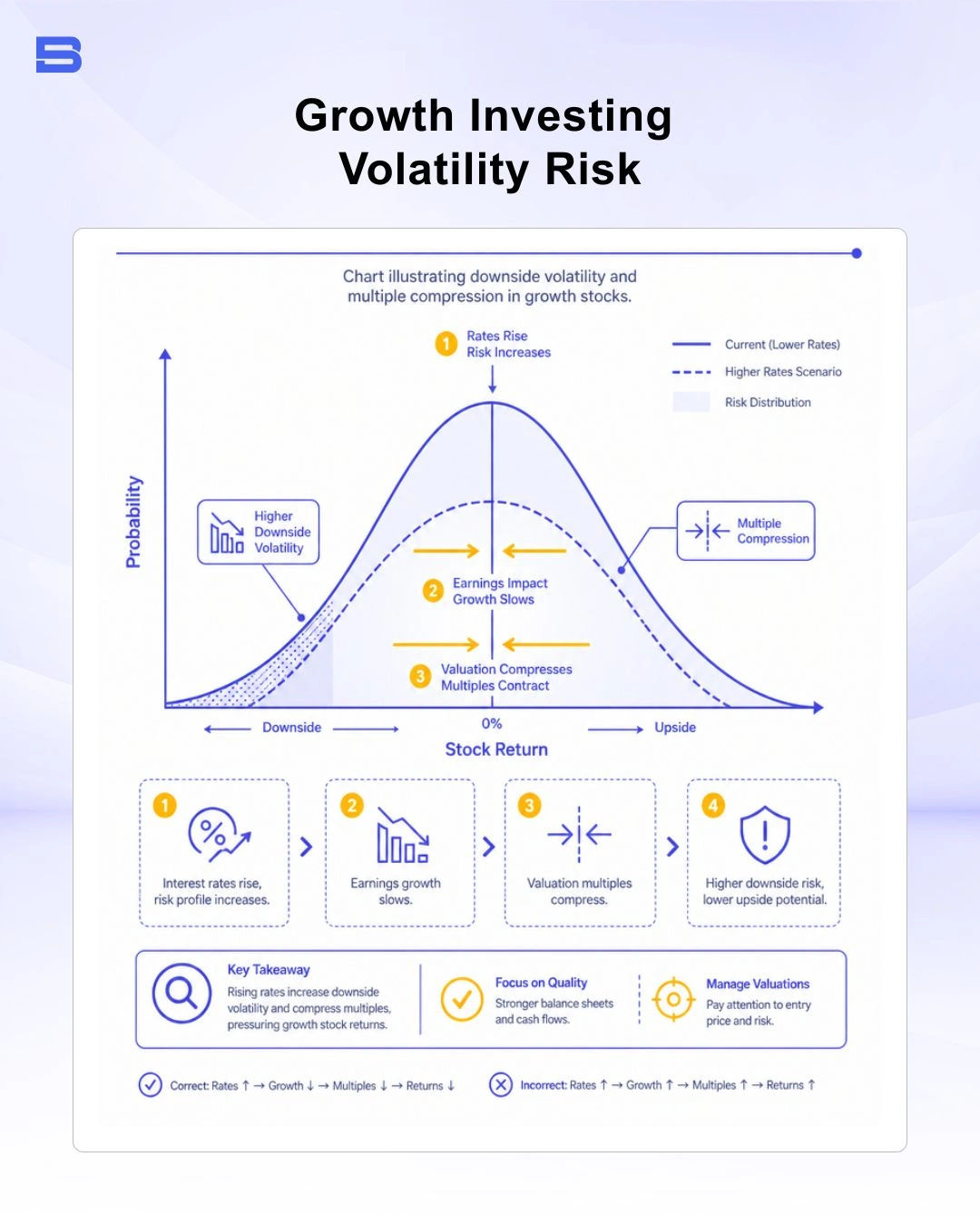
- Multiple Compression Risk: When central banks increase benchmark interest rates, discounting future corporate cash flows at higher discount rates lowers the present market valuation of high-multiple growth equities.
- Execution Misses: Missing revenue guidance by even a small percentage can spark sharp drawdowns, as over-leveraged sentiment resets rapidly.
- Capital Destruction During Bear Markets: Unprofitable growth companies reliant on external capital markets face significant liquidity risks if capital availability dries up during extended downturns.
To navigate high growth successfully, you'll want strict position sizing and stop-loss protocols so a single stock's pullback doesn't damage your overall portfolio.
How Southeast Asian Investors Access Global Growth Markets
For investors based in Southeast Asia and Malaysia, executing growth-oriented investment plans involves looking across both international indices and regional technology hubs.
Accessing International High-Growth Assets
If you're investing from Malaysia or the wider region, you can access foreign growth companies through locally regulated equities brokers.
- Global Equity Markets: Investors looking to allocate capital into major technology leaders can learn how to buy US stocks in Malaysia through platforms licensed under oversight frameworks from the Securities Commission Malaysia (SC).
- Global Exposure: Regional portfolios can also diversify geographically by exploring how to invest in China A-Shares from Malaysia via approved stock-connect broker channels.
- Implementation Vehicles: Investors choosing between active trading and structured funds can evaluate a unit trust vs trading account approach to decide whether managed mutual structures or direct stock execution better matches their personal risk tolerance.
Investors allocating across international jurisdictions must also actively account for foreign currency exchange volatility, such as US Dollar and Ringgit Malaysia (USD/MYR) exchange rate fluctuations, as currency movements can directly impact net equity returns.
Conclusion
Growth investing offers a practical path toward long-term wealth accumulation by prioritizing dynamic corporate expansion and market leadership over short-term dividend income. However, high expected compounding rates require managing downside risks, valuation multiple fluctuations, and broader economic shifts. By utilizing metric frameworks like the PEG ratio and maintaining disciplined position sizing, investors can target capital expansion while keeping portfolio exposure balanced.
- What Can You Trade? A Guide to Forex, Stocks, and More
- CFD Trading for Beginners
- What is CFD Trading and How Does It Work?
- Forex vs. Stocks: Which Market Suits You Best?
- How to Diversify a Portfolio Across Asset Classes
- How Dividend Stocks Work: Yields, Risks, and Strategies
- Silver Trading Explained: A Guide for Retail Investors
- Precious Metals Trading: A Complete Guide for Beginners
- Natural Gas Trading: A Guide to the Market
- Structured Warrants Malaysia: How They Work and Risks
- What Is the KLCI Index and How to Trade It
- Gold Investment in Malaysia: A Complete Guide for Beginners
- What Is Kijang Emas and How to Invest in It
- Value Investing Explained: How to Find Undervalued Stocks
- How to Trade Bitcoin Safely: A Complete Market Guide
- Growth Investing Explained: Strategies, Metrics, and Risks
- What Is Digital Gold Malaysia and How to Invest
- Crypto Trading Strategies for Beginners
- Gold vs Bitcoin: Key Differences, Risks, and Strategies
- Sukuk: A Guide for Beginners to Islamic Bonds
- What Is FCPO (Crude Palm Oil Futures) and How to Trade It
- How to Identify and Invest in Shariah-Compliant Stocks
- Timber Investment: Is It Worth It?
- Gold ETF Malaysia: A Guide for Beginners
- What Are Malaysian Government Securities (MGS)?
- Corporate Bonds Malaysia: A Guide for Beginners
- China A-Shares Trading Guide for Malaysian Investors
- What Is a Silver ETF and How to Invest in It?
- How to Trade XRP: A Practical Guide for Retail Investors
- How to Trade Solana (SOL): A Guide for Beginners
- What Are Gold Futures and How Do They Work?
- Money Market Fund in Malaysia: A Guide for Beginners
- Property Investment Malaysia: Direct Real Estate or M-REITs?
- What Is Binance Coin and How Does It Work?
- Green Sukuk: A Guide for Beginners to Islamic ESG Investing
- What Is Shiba Inu (SHIB) and How to Trade It
- What Is USDT? A Complete Guide to Tether for Beginners
- What Is Dogecoin and How to Trade It Safely for Beginners
- Cardano: A Guide for Beginners to Trade This Cryptocurrency
- Polkadot: A Guide to Trading This Cryptocurrency
- Tron: A Guide for Beginners to Trading This Cryptocurrency
- What Is Litecoin (LTC)? A Guide to Trading Digital Silver
- What Is Chainlink (LINK) and How to Trade It
- How to Trade Pepe Coin: Spot, Leverage, and Risk Management
- Near Protocol: A Guide to Trading This Cryptocurrency
- Trading Polygon Crypto: A Practical Guide for Beginners
- Trade Toncoin: Understanding the TON Ecosystem and Risks
- Cosmos Crypto: Ecosystem Architecture, Tokenomics, and Risks
- Stellar Crypto: A Guide to Trading This Cryptocurrency
- Avalanche Crypto Explained: A Practical Guide for Traders
- What Is Worldcoin? How to Trade WLD and Manage Risk
- Aptos: A Guide for Beginners to Trading This Cryptocurrency
- Sui Crypto Explained: Tokenomics and Trading Guide
- Celestia: A Guide to Trading This Cryptocurrency
- Decentraland: A Guide to Trading This Cryptocurrency
- What Is Arbitrum? How to Trade the Leading Layer 2 Network
- Sei Crypto: A Guide to Trading This Cryptocurrency
- What Is Injective Protocol and How to Trade INJ Safely
Disclaimer: The content on this page is intended for educational and informational purposes only. It does not constitute financial, investment, tax, or legal advice, and should not be interpreted as a recommendation to buy, sell, or hold any financial instrument or asset. Trading and investing involve significant risk, including the possible loss of your entire capital. Products such as forex, CFDs, and cryptocurrencies carry additional risks due to leverage, high volatility, and limited regulatory protection in some jurisdictions. Past performance of any financial instrument does not guarantee future results. Any market views, forecasts, or opinions expressed are those of the author at the time of writing and may not reflect current market conditions. Platform features, fees, and regulatory status are subject to change — always verify information directly with the relevant provider or regulator before making any financial decision. BrokerSpecs may receive compensation from third parties featured on this site. Always conduct your own due diligence and consider seeking advice from a licensed financial professional before investing.