



Related Tags
Imagine leaving RM10,000 sitting in a standard bank savings account. Depending on the bank and account type, it may only earn a relatively low annual interest rate. Bank Negara Malaysia tracks average savings deposit rates across Malaysian commercial and Islamic banks, providing a useful benchmark for comparing savings returns.
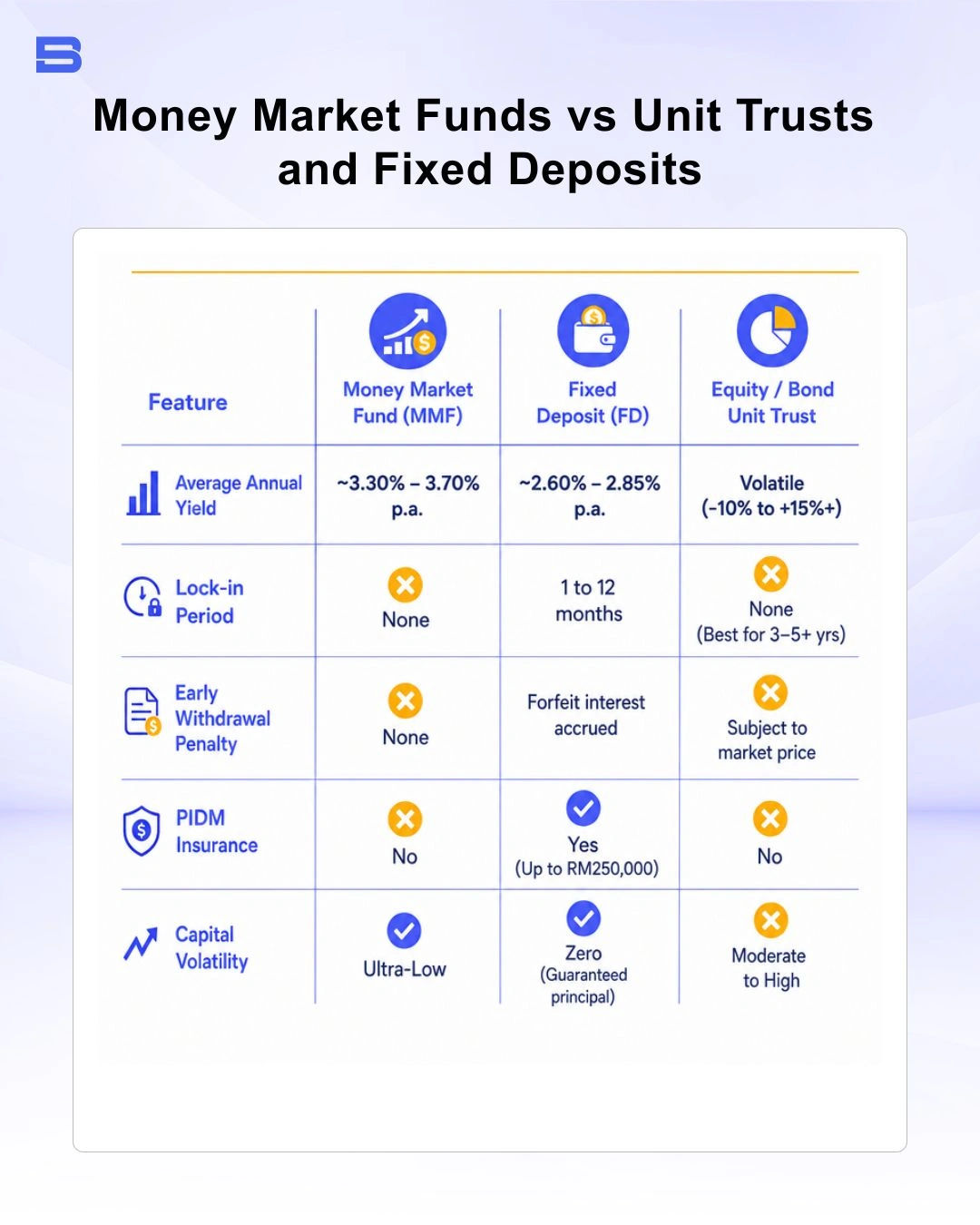
Over a full year, that emergency fund yields a mere RM25—a rate easily swallowed up by everyday inflation. On the flip side, locking that money into a 12-month fixed deposit might net you around 2.60% to 2.85% (rates as of early 2026), based on average board rates published in Bank Negara Malaysia's interest rate statistics, but the moment an unexpected car repair or medical bill pops up, breaking that deposit early means forfeiting your accrued interest.
This liquidity dilemma is precisely why a money market fund in Malaysia has gained massive traction among everyday retail investors. Offering competitive annual yields without locking up your hard-earned cash for months, they bridge the gap between bank deposits and long-term investments.
What Is a Money Market Fund in Malaysia?
A money market fund in Malaysia is a low-risk unit trust fund that pools money from individual and institutional investors to buy highly liquid, short-term debt instruments. Instead of investing in volatile company shares or long-term corporate bonds, the fund manager allocates capital into short-term bank deposits, commercial papers, and government-backed Treasury bills.
Because these underlying assets mature quickly—typically within a few weeks to under a year—money market funds maintain low price volatility while passing daily interest gains back to you. In Malaysia, retail money market funds historically delivered net annual yields hovering around 3.30% to 3.70% p.a. as of early 2026, based on recent fund fact sheets published by licensed Malaysian asset managers such as Public Mutual and Principal, closely tracking the overnight policy rate set by Bank Negara Malaysia.
As with any market-linked yield, this rate is not guaranteed and will move up or down with prevailing interest rates.
Is a Money Market Fund Safe in Malaysia?
For capital preservation, money market funds are considered a lower-risk financial instrument, given their reliance on high-grade issuers and licensed financial institutions, though they are not risk-free. Because the assets are spread across high-grade commercial issuers and major licensed banks, the probability of an issuer defaulting is minimal under normal economic conditions.
However, "low risk" does not mean "zero risk". If systemic interbank liquidity tightens or overall economic interest rates drop significantly, the daily yield generated by the fund will naturally adjust downward.
SC Regulation vs PIDM Capital Protection
A crucial distinction every investor must understand is regulatory oversight versus deposit guarantee:
- Securities Commission Malaysia (SC): Money market funds are strictly regulated under the SC's Capital Markets and Services Act. Fund managers must store investor capital with independent financial trustees (such as HSBC Trustee or Deutsche Trustee), ensuring the fund house cannot touch your underlying capital if the management company itself faces financial distress.
- PIDM Capital Protection: Money market funds are not insured by Perbadanan Insurans Deposit Malaysia (PIDM). Unlike traditional bank fixed deposits—which are guaranteed up to RM250,000 per depositor per bank under protection administered by Perbadanan Insurans Deposit Malaysia (PIDM)—money market funds carry market risk, meaning the Malaysian government does not guarantee your principal.
Tax Treatment for Malaysian Retail Investors
Under existing Malaysian Inland Revenue Board (LHDN) regulations, individual investors don't pay tax on dividend income distributed by Malaysian-domiciled unit trust funds. You do not need to declare these daily or monthly dividend distributions on your annual income tax return, allowing your yield to compound fully tax-free.
Money Market Funds vs Unit Trusts and Fixed Deposits
Choosing where to park cash depends on three main variables: liquidity, return potential, and capital safety. While equity or bond unit trust Malaysia investments focus on long-term capital growth with higher volatility, money market funds focus entirely on cash preservation and immediate access.
When weighing a fixed deposit vs unit trust alternative, fixed deposits offer fixed guaranteed interest but rigid lock-in periods. Money market funds offer flexible yield without lock-in penalties.
For Bumiputera investors, fixed-price government-supported initiatives like an Amanah Saham Bumiputera (ASB) account or broader Amanah Saham Nasional Berhad (ASNB) investment options remain powerful baseline holdings. However, money market funds serve a distinct role for quick-turnaround liquidity across all Malaysian demographics.
Types of Money Market Funds in Malaysia
Malaysian investors can choose between conventional and Islamic fund structures:
- Conventional Money Market Funds: Invest in conventional interbank deposits, short-term commercial papers, and corporate debt instruments issued by licensed financial institutions.
- Shariah-compliant Money Market Fund: Invest strictly in Islamic money market paper, Murabahah commercial papers (a Shariah-compliant cost-plus financing structure), and short-term government Sukuk (Islamic bonds structured to comply with Shariah law).
Liquidity Mechanics and Withdrawal Speed
Understanding how cash moves out of a fund prevents surprises during emergencies:
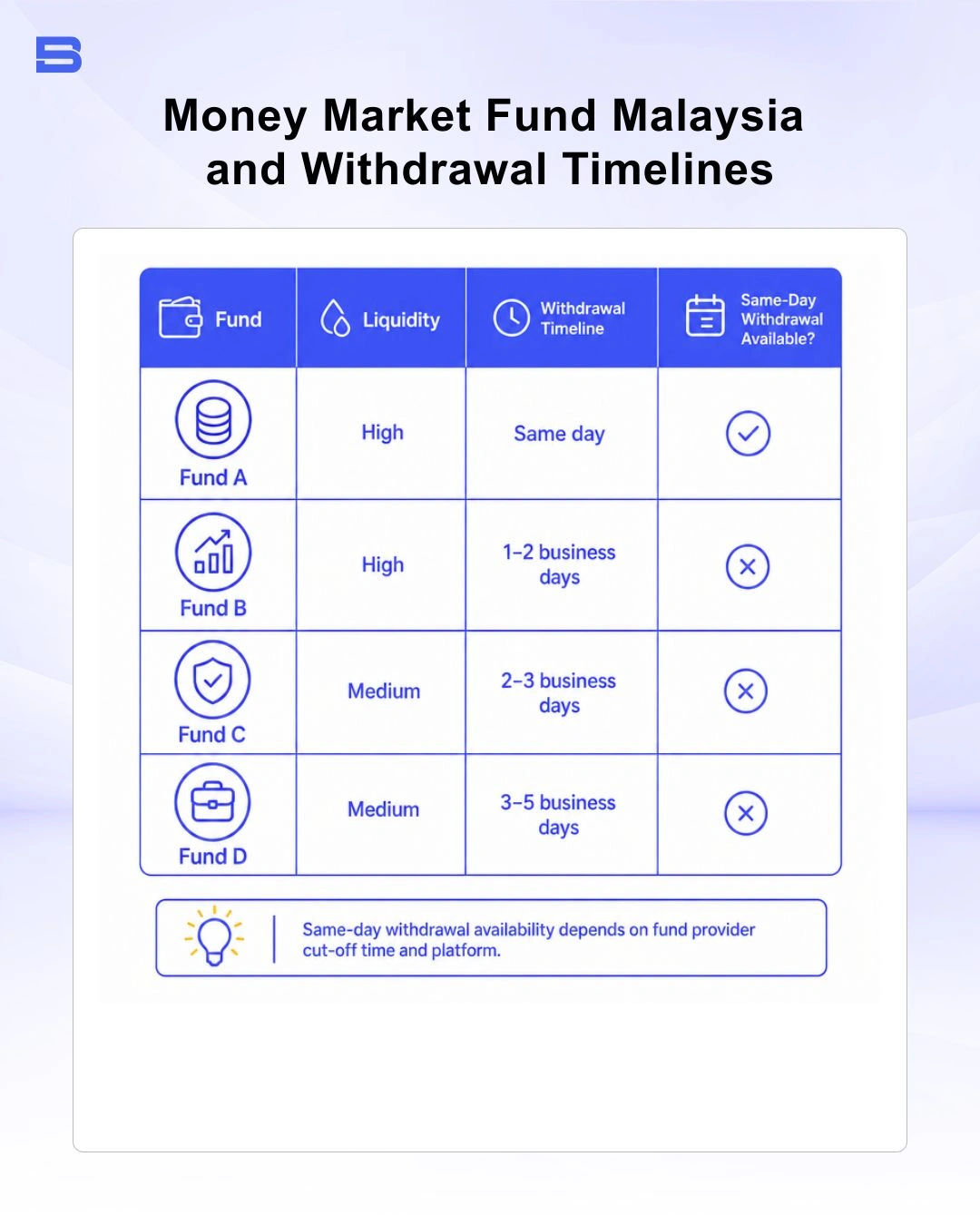
- Standard T+1 / T+2 Withdrawals: Most bank-distributed unit trust money market funds process redemptions within 1 to 2 business days. Requesting a cash-out on Monday morning typically lands the funds in your bank account by Tuesday afternoon.
- Instant Cash-out Fintech Platforms: Modern cash management solutions—such as Touch 'n Go GO+ (built on the Principal Islamic Money Market Fund)—offer fast e-wallet redemptions or same-day direct bank transfers for smaller cash balances.
How to Start Investing in Malaysian Money Market Funds
Getting started takes only a few minutes through modern digital channels:
- Select an Access Method: You can invest directly via fund management portals (e.g., Public Mutual, Kenanga, Principal), unit trust distribution platforms (FIMM-registered distributors (licensed under the Federation of Investment Managers Malaysia), or digital cash management mobile apps (such as Versa, StashAway Simple, or KDI Save).
- Money market funds generally have relatively low management fees. For example, Maybank Corporate Money Market-I Fund charges management fees of 0.15% to 0.25% p.a., depending on the unit class, while some other Malaysian money market funds charge up to 0.50% p.a. Check the latest fund documents to confirm total expenses and whether advertised returns are net of fees.
- Complete e-KYC Verification: Upload your Malaysian NRIC (National Registration Identity Card), complete facial verification, and link your local FPX (Financial Process Exchange) bank account.
- Deposit Your Funds: Digital money market platforms can offer low entry requirements. For example, Versa Save allows users to start with a minimum cash-in of RM10, providing accessible entry to money market funds.
The Bottom Line
Money market funds offer Malaysian investors a flexible, higher-yielding alternative to standard savings accounts without committing capital to long-term fixed deposits. They serve as an ideal vehicle for emergency savings, upcoming tax payments, or short-term house purchase deposits.
While they carry low underlying market risk and are not government-insured by PIDM, their strict regulation by the Securities Commission Malaysia and independent trustee asset segregation make them a dependable addition to any prudent financial plan.
- What Can You Trade? A Guide to Forex, Stocks, and More
- CFD Trading for Beginners
- What is CFD Trading and How Does It Work?
- Forex vs. Stocks: Which Market Suits You Best?
- How to Diversify a Portfolio Across Asset Classes
- How Dividend Stocks Work: Yields, Risks, and Strategies
- Silver Trading Explained: A Guide for Retail Investors
- Precious Metals Trading: A Complete Guide for Beginners
- Natural Gas Trading: A Guide to the Market
- Structured Warrants Malaysia: How They Work and Risks
- What Is the KLCI Index and How to Trade It
- Gold Investment in Malaysia: A Complete Guide for Beginners
- What Is Kijang Emas and How to Invest in It
- Value Investing Explained: How to Find Undervalued Stocks
- How to Trade Bitcoin Safely: A Complete Market Guide
- Growth Investing Explained: Strategies, Metrics, and Risks
- What Is Digital Gold Malaysia and How to Invest
- Crypto Trading Strategies for Beginners
- Gold vs Bitcoin: Key Differences, Risks, and Strategies
- Sukuk: A Guide for Beginners to Islamic Bonds
- What Is FCPO (Crude Palm Oil Futures) and How to Trade It
- How to Identify and Invest in Shariah-Compliant Stocks
- Timber Investment: Is It Worth It?
- Gold ETF Malaysia: A Guide for Beginners
- What Are Malaysian Government Securities (MGS)?
- Corporate Bonds Malaysia: A Guide for Beginners
- China A-Shares Trading Guide for Malaysian Investors
- What Is a Silver ETF and How to Invest in It?
- How to Trade XRP: A Practical Guide for Retail Investors
- How to Trade Solana (SOL): A Guide for Beginners
- What Are Gold Futures and How Do They Work?
- Money Market Fund in Malaysia: A Guide for Beginners
- Property Investment Malaysia: Direct Real Estate or M-REITs?
- What Is Binance Coin and How Does It Work?
- Green Sukuk: A Guide for Beginners to Islamic ESG Investing
- What Is Shiba Inu (SHIB) and How to Trade It
- What Is USDT? A Complete Guide to Tether for Beginners
- What Is Dogecoin and How to Trade It Safely for Beginners
- Cardano: A Guide for Beginners to Trade This Cryptocurrency
- Polkadot: A Guide to Trading This Cryptocurrency
- Tron: A Guide for Beginners to Trading This Cryptocurrency
- What Is Litecoin (LTC)? A Guide to Trading Digital Silver
- What Is Chainlink (LINK) and How to Trade It
- How to Trade Pepe Coin: Spot, Leverage, and Risk Management
- Near Protocol: A Guide to Trading This Cryptocurrency
- Trading Polygon Crypto: A Practical Guide for Beginners
- Trade Toncoin: Understanding the TON Ecosystem and Risks
- Cosmos Crypto: Ecosystem Architecture, Tokenomics, and Risks
- Stellar Crypto: A Guide to Trading This Cryptocurrency
- Avalanche Crypto Explained: A Practical Guide for Traders
- What Is Worldcoin? How to Trade WLD and Manage Risk
- Aptos: A Guide for Beginners to Trading This Cryptocurrency
- Sui Crypto Explained: Tokenomics and Trading Guide
- Celestia: A Guide to Trading This Cryptocurrency
- Decentraland: A Guide to Trading This Cryptocurrency
- What Is Arbitrum? How to Trade the Leading Layer 2 Network
- Sei Crypto: A Guide to Trading This Cryptocurrency
- What Is Injective Protocol and How to Trade INJ Safely
Disclaimer: The content on this page is intended for educational and informational purposes only. It does not constitute financial, investment, tax, or legal advice, and should not be interpreted as a recommendation to buy, sell, or hold any financial instrument or asset. Trading and investing involve significant risk, including the possible loss of your entire capital. Products such as forex, CFDs, and cryptocurrencies carry additional risks due to leverage, high volatility, and limited regulatory protection in some jurisdictions. Past performance of any financial instrument does not guarantee future results. Any market views, forecasts, or opinions expressed are those of the author at the time of writing and may not reflect current market conditions. Platform features, fees, and regulatory status are subject to change — always verify information directly with the relevant provider or regulator before making any financial decision. BrokerSpecs may receive compensation from third parties featured on this site. Always conduct your own due diligence and consider seeking advice from a licensed financial professional before investing.