


Related Tags
When market turbulence strikes, where do you turn to preserve your savings? For centuries, the default answer was simple: physical gold. Today, however, digital innovation has introduced a widely discussed alternative that enthusiasts call "digital gold"—Bitcoin.
As an investor navigating economic uncertainties, shifting interest rates, and currency fluctuations, evaluating gold vs Bitcoin requires moving past internet hype. Both assets serve as non-sovereign stores of value, yet their risk profiles, liquidity mechanisms, and historical track records could not be more distinct. Are you looking for time-tested wealth preservation, or are you seeking asymmetric downside-to-upside potential in a digital ecosystem? Let's break down how these two assets operate, how they behave under market stress, and how to position them in a balanced portfolio.
In short: gold remains the more reliable capital-preservation asset during acute market stress, while Bitcoin offers higher long-term growth potential paired with significantly deeper drawdowns — the sections below break down exactly why.
What Makes an Asset a Store of Value?
To understand the core debate behind gold vs Bitcoin, we must first ask what gives an asset enduring purchasing power. A reliable store of value must demonstrate scarcity, durability, divisibility, and widespread acceptability over extended timeframes.
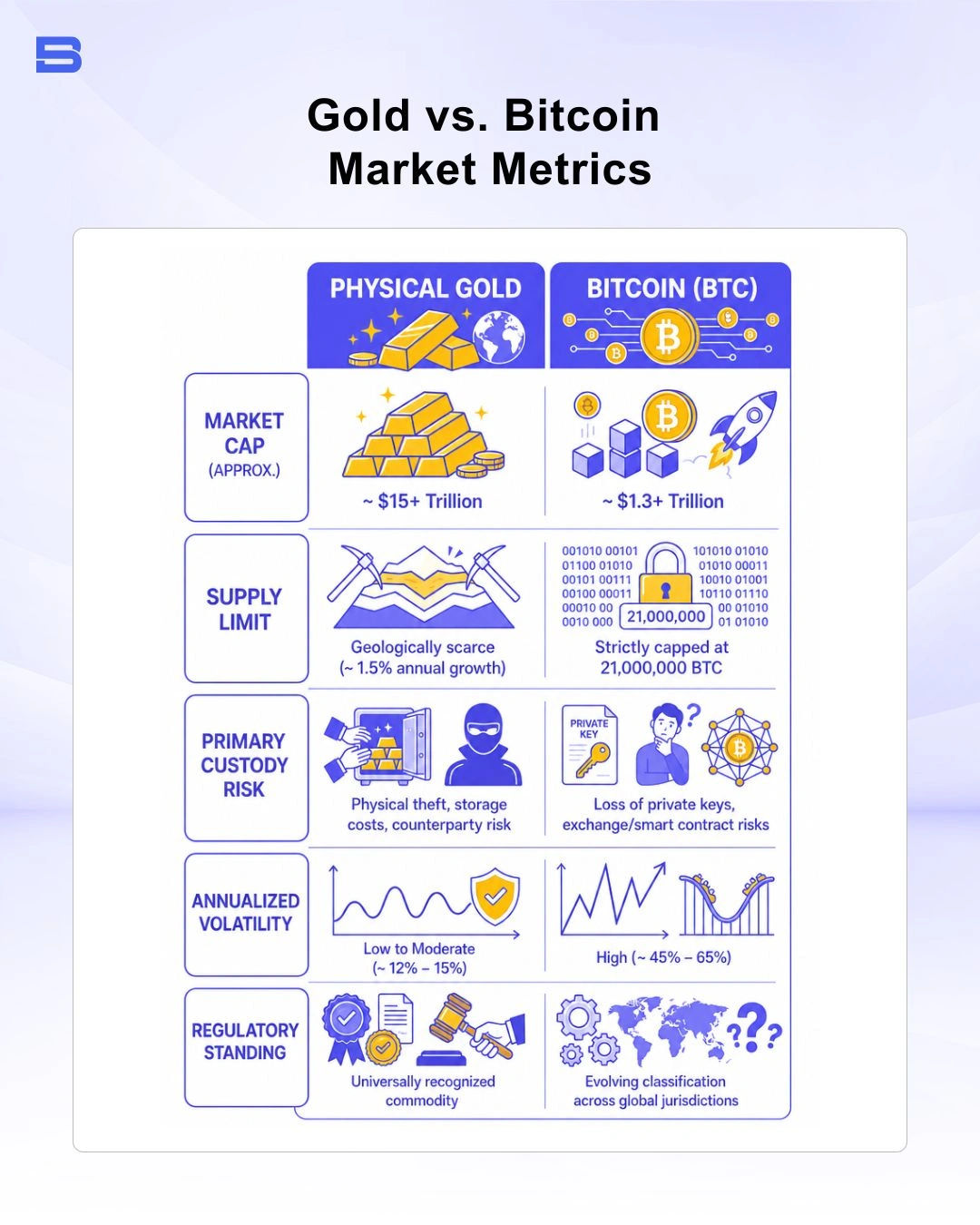
Gold has fulfilled these criteria for over 5,000 years. Its scarcity is constrained by physical geology — according to the World Gold Council, mining annual supply growth averages roughly 1.5% to 2% per year. It does not corrode, requires no electricity to maintain, and possesses intrinsic demand across industrial applications, jewelry, and central bank reserves.
Bitcoin, introduced in 2009, engineered these exact characteristics into code. Its total supply is algorithmically capped at 21 million coins, with its supply issuance rate halving roughly every four years. It is infinitely divisible into smaller units (Satoshis) and can be transferred globally across a decentralized peer-to-peer network without centralized intermediaries.
Historical Inflation Hedging: Gold's Track Record vs. BTC's Growth
When evaluating an inflation hedge, timeline matters tremendously. Gold's track record as an inflation hedge spans centuries. During periods of rampant fiat debasement or geopolitical conflict, physical gold historically maintains real purchasing power. However, over shorter multi-year horizons, gold's price performance can remain range-bound, occasionally lagging behind consumer price index (CPI) spikes.
Bitcoin, by contrast, has delivered exponential historical growth since its inception, vastly outperforming traditional asset classes over decade-long horizons. Yet calling Bitcoin a pure inflation hedge remains debatable. In high-inflation macroeconomic environments marked by aggressive central bank rate hikes, Bitcoin has frequently traded like a high-beta tech asset — meaning its price swings more sharply than the broader market in both directions — rather than a defensive haven. Investors who bought Bitcoin as an inflation hedge during tight liquidity cycles experienced severe drawdowns before any long-term recovery materialized.
Evaluating the Safe-Haven Status: Real Risk Profiles
Is Bitcoin a haven asset in the traditional economic sense? A true safe-haven asset is expected to hold or increase its value during broader market downturns when equities and risk assets sell off.
When broad market liquidity contracts, gold consistently demonstrates low or negative correlation to equities. Central banks worldwide hold gold on their balance sheets specifically as a reserve asset with zero credit risk. Bitcoin, while non-sovereign and mathematically scarce, remains highly sensitive to global liquidity conditions. During major market panic events, institutional investors often sell liquid crypto holdings alongside risk assets to cover margin calls elsewhere.
Crypto Volatility vs Gold: Drawdowns & Liquidity
Understanding crypto volatility vs gold — based on data spanning the 2015–2025 market cycles — is essential for realistic risk management and position sizing. Higher upside potential in digital assets is mathematically counterbalanced by significant downside volatility.
- Gold Volatility: According to historical data compiled by the World Gold Council, physical gold has experienced annualized volatility of roughly 12% to 15%, with maximum cyclical drawdowns rarely exceeding 20% to 30% over multi-year bear markets.
- Bitcoin Volatility: According to on-chain and market data compiled by CoinMetrics, Bitcoin's annualized volatility has typically ranged between 45% and 65%, and historical cycle drawdowns have repeatedly reached 70% to 80% peak-to-trough before finding market bottoms.
Consider a practical scenario: If you allocate $10,000 into gold during a market correction, a typical defensive drawdown might see your capital dip to $8,500 before stabilizing. The same $10,000 allocated into Bitcoin during a crypto bear market cycle could temporarily drop to $2,500 or $3,000. Ask yourself: Does your personal risk tolerance and liquidity timeline allow you to sit through a 70% unrealized portfolio drop without panic-selling?
Storing Physical Gold vs Custody of Digital BTC
The practical realities of ownership differ sharply between physical commodities and cryptographic tokens. Both eliminate counterparty risk if held directly, but each introduces distinct operational hurdles.
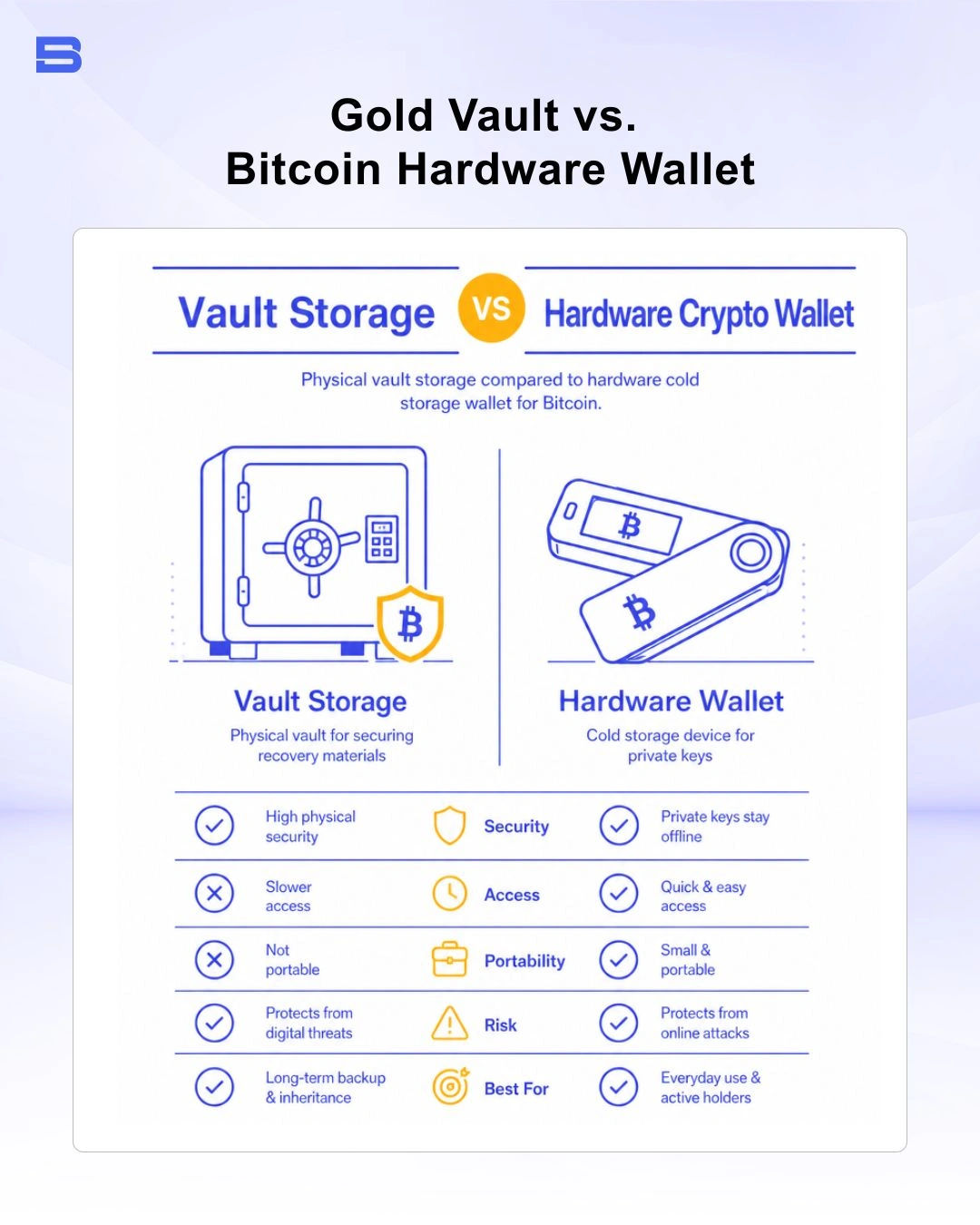
Holding physical gold requires secure physical infrastructure. Investors must choose between home safes, bank safety deposit boxes, or institutional vaulting services. In Southeast Asia, products like official sovereign coins or localized bullion like Kijang Emas offer direct physical ownership, though secondary market resale requires physical verification and purity testing. Alternatively, precious metals trading via paper contracts or pool accounts avoids physical handling but reintroduces institutional counterparty reliance.
Custody of digital Bitcoin removes physical weight entirely. You can hold millions of dollars in value on a physical hardware cold storage wallet no larger than a USB drive, secured by a 24-word seed phrase. However, self-custody shifts 100% of the security responsibility to you. If you lose your private key or fall victim to a phishing attack, there is no customer service hotline or banking insurance to recover your assets.
How to Trade Gold vs Bitcoin (Execution & Accessibility)
Gaining exposure to either asset has become remarkably accessible for modern retail investors, thanks to expanding market infrastructure regulated by authorities like the Securities Commission Malaysia (SC) or the US Securities and Exchange Commission (SEC).
Trading Gold
- Spot OTC & Futures: Active traders use spot contracts or futures to capitalize on short-term price movements using leverage.
- Exchange-Traded Funds (ETFs): Physically-backed gold ETFs allow investors to buy gold exposure directly through standard stock brokerage accounts without handling physical metal.
- Physical Bullion: Purchasing physical bars or coins directly from authorized dealers or banks.
Trading Bitcoin
- Regulated Spot Exchanges: Investors can buy and hold actual BTC on regulated Digital Asset Exchanges (DAX). If you are learning how to trade Bitcoin, starting on a locally licensed exchange provides direct fiat gateway access and regulatory oversight.
- Spot Crypto ETFs: Globally listed spot Bitcoin ETFs allow traditional investors to hold Bitcoin price exposure inside standard investment portfolios.
- Derivatives & Contracts for Difference (CFDs): Advanced traders trade crypto derivatives or CFDs to speculate on price direction in both rising and falling markets.
If you are exploring broader market instruments, learning how to trade Ethereum or understanding altcoins like XRP follows similar platform mechanics, though altcoins carry unique technology risks beyond Bitcoin's established monetary framework.
Asset Allocation: How to Use Both in a Balanced Portfolio
Rather than viewing gold vs bitcoin as an all-or-nothing binary choice, many sophisticated modern investors utilize both assets in complementary roles within a broader portfolio diversification strategy.
- Gold as Capital Preservation: Gold acts as the defensive anchor. A 5% to 10% allocation to gold helps dampen overall portfolio volatility, protect against currency depreciation, and preserve purchasing power during prolonged recessions.
- Bitcoin as Asymmetric Growth: Bitcoin acts as the high-beta innovation allocation. A conservative 1% to 3% position offers meaningful upside exposure to digital asset adoption without endangering overall portfolio solvency during severe cyclical drawdowns.
For example, in a classic 60/40 stocks-and-bonds portfolio, substituting a small portion of fixed income with a 5% gold and 2% Bitcoin allocation can enhance potential risk-adjusted returns without drastically altering the portfolio's core defensive balance.
When building an allocation strategy around gold vs Bitcoin, most advisors treat the two as complementary rather than competing holdings.
The Bottom Line
When comparing gold vs Bitcoin, the right choice depends entirely on your financial goals, investment horizon, and personal appetite for risk. Physical gold remains the ultimate defensive anchor for capital preservation and tail-risk protection. Bitcoin represents a high-growth, technology-driven store of value with significant long-term upside—and matching downside volatility. By clearly defining your risk tolerance, you can decide whether gold, Bitcoin, or a balanced allocation to both best serves your wealth strategy.
- What Can You Trade? A Guide to Forex, Stocks, and More
- CFD Trading for Beginners
- What is CFD Trading and How Does It Work?
- Forex vs. Stocks: Which Market Suits You Best?
- How to Diversify a Portfolio Across Asset Classes
- How Dividend Stocks Work: Yields, Risks, and Strategies
- Silver Trading Explained: A Guide for Retail Investors
- Precious Metals Trading: A Complete Guide for Beginners
- Natural Gas Trading: A Guide to the Market
- Structured Warrants Malaysia: How They Work and Risks
- What Is the KLCI Index and How to Trade It
- Gold Investment in Malaysia: A Complete Guide for Beginners
- What Is Kijang Emas and How to Invest in It
- Value Investing Explained: How to Find Undervalued Stocks
- How to Trade Bitcoin Safely: A Complete Market Guide
- Growth Investing Explained: Strategies, Metrics, and Risks
- What Is Digital Gold Malaysia and How to Invest
- Crypto Trading Strategies for Beginners
- Gold vs Bitcoin: Key Differences, Risks, and Strategies
- Sukuk: A Guide for Beginners to Islamic Bonds
- What Is FCPO (Crude Palm Oil Futures) and How to Trade It
- How to Identify and Invest in Shariah-Compliant Stocks
- Timber Investment: Is It Worth It?
- Gold ETF Malaysia: A Guide for Beginners
- What Are Malaysian Government Securities (MGS)?
- Corporate Bonds Malaysia: A Guide for Beginners
- China A-Shares Trading Guide for Malaysian Investors
- What Is a Silver ETF and How to Invest in It?
- How to Trade XRP: A Practical Guide for Retail Investors
- How to Trade Solana (SOL): A Guide for Beginners
- What Are Gold Futures and How Do They Work?
- Money Market Fund in Malaysia: A Guide for Beginners
- Property Investment Malaysia: Direct Real Estate or M-REITs?
- What Is Binance Coin and How Does It Work?
- Green Sukuk: A Guide for Beginners to Islamic ESG Investing
- What Is Shiba Inu (SHIB) and How to Trade It
- What Is USDT? A Complete Guide to Tether for Beginners
- What Is Dogecoin and How to Trade It Safely for Beginners
- Cardano: A Guide for Beginners to Trade This Cryptocurrency
- Polkadot: A Guide to Trading This Cryptocurrency
- Tron: A Guide for Beginners to Trading This Cryptocurrency
- What Is Litecoin (LTC)? A Guide to Trading Digital Silver
- What Is Chainlink (LINK) and How to Trade It
- How to Trade Pepe Coin: Spot, Leverage, and Risk Management
- Near Protocol: A Guide to Trading This Cryptocurrency
- Trading Polygon Crypto: A Practical Guide for Beginners
- Trade Toncoin: Understanding the TON Ecosystem and Risks
- Cosmos Crypto: Ecosystem Architecture, Tokenomics, and Risks
- Stellar Crypto: A Guide to Trading This Cryptocurrency
- Avalanche Crypto Explained: A Practical Guide for Traders
- What Is Worldcoin? How to Trade WLD and Manage Risk
- Aptos: A Guide for Beginners to Trading This Cryptocurrency
- Sui Crypto Explained: Tokenomics and Trading Guide
- Celestia: A Guide to Trading This Cryptocurrency
- Decentraland: A Guide to Trading This Cryptocurrency
- What Is Arbitrum? How to Trade the Leading Layer 2 Network
- Sei Crypto: A Guide to Trading This Cryptocurrency
- What Is Injective Protocol and How to Trade INJ Safely
Disclaimer: The content on this page is intended for educational and informational purposes only. It does not constitute financial, investment, tax, or legal advice, and should not be interpreted as a recommendation to buy, sell, or hold any financial instrument or asset. Trading and investing involve significant risk, including the possible loss of your entire capital. Products such as forex, CFDs, and cryptocurrencies carry additional risks due to leverage, high volatility, and limited regulatory protection in some jurisdictions. Past performance of any financial instrument does not guarantee future results. Any market views, forecasts, or opinions expressed are those of the author at the time of writing and may not reflect current market conditions. Platform features, fees, and regulatory status are subject to change — always verify information directly with the relevant provider or regulator before making any financial decision. BrokerSpecs may receive compensation from third parties featured on this site. Always conduct your own due diligence and consider seeking advice from a licensed financial professional before investing.