



Related Tags
You are watching a blue-chip stock on Bursa Malaysia climb 2% over a single session—a solid, respectable move for a large-cap company. Yet right next to it on your trading platform, an instrument linked to that same stock surges by 15%.
Welcome to the world of structured warrants. These proprietary derivatives offer retail traders high-leverage exposure to price movements without requiring the full capital needed to own the underlying stock directly. However, the same leverage that amplifies gains on the upside accelerates losses on the downside. Before entering a trade, understanding the mechanics, costs, and unique risks of structured warrants Malaysia is essential for protecting your capital.
What Are Structured Warrants in Malaysia?
Structured warrants Malaysia are leveraged financial instruments issued by third-party financial institutions—typically major investment banks such as Macquarie, Kenanga, or RHB Investment Bank—and traded directly on Bursa Malaysia.
Unlike buying physical shares, purchasing a structured warrant gives you the right, but not the obligation, to track the price movement of an underlying asset. That underlying asset can be a local Malaysian stock, an index (such as the FTSE Bursa Malaysia KLCI, commonly abbreviated as the FBM KLCI), an Exchange-Traded Fund (ETF), or even foreign equities and indices.
When you trade a structured warrant, you do not own the underlying company. Consequently, warrant holders receive no dividend payouts, hold no voting rights at annual general meetings, and have no direct claim on the company’s assets. You are purely trading a financial contract backed by the creditworthiness of the issuing investment bank.
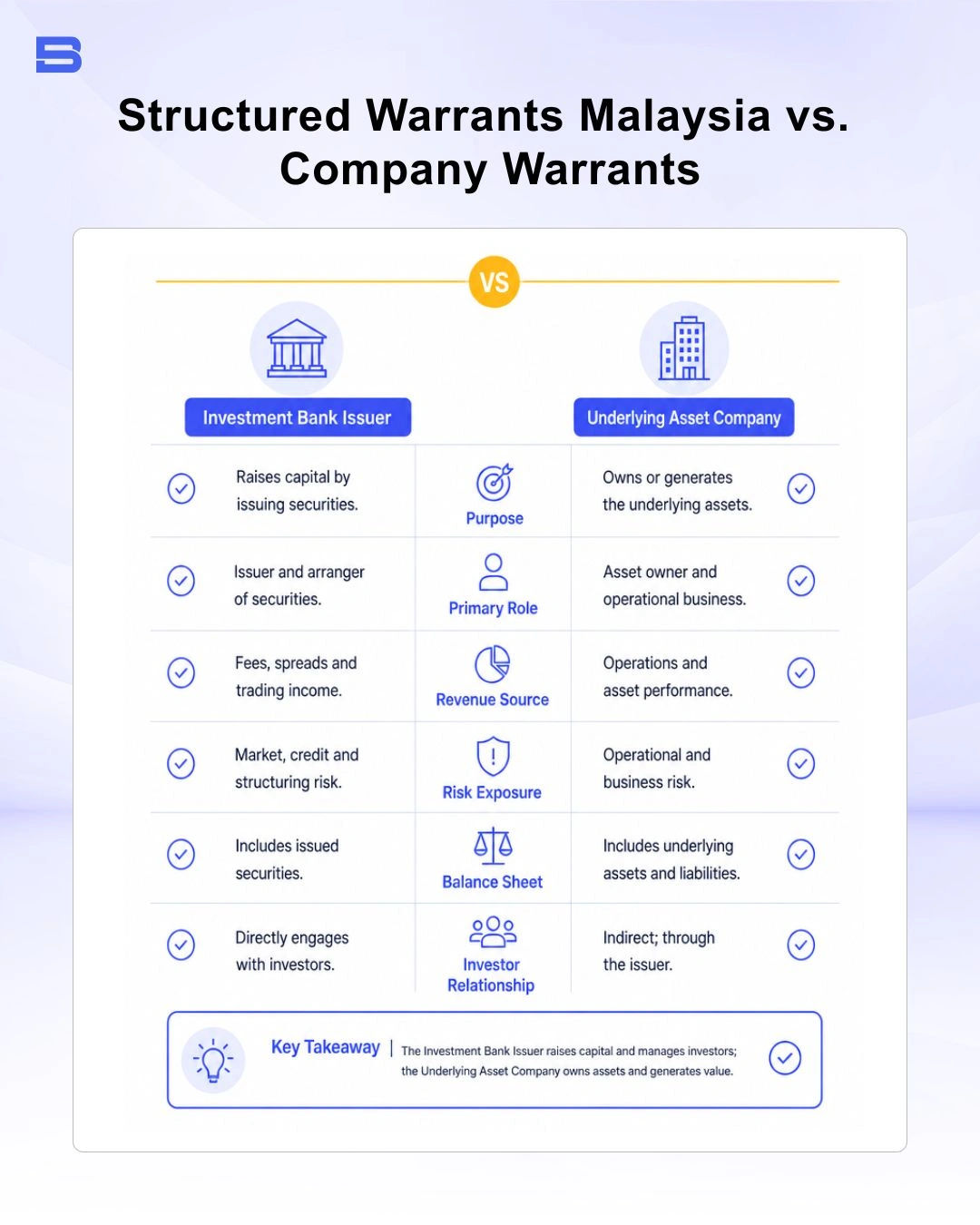
Structured Warrants vs. Company Warrants: Key Differences
It is common for beginners on Bursa Malaysia to confuse structured warrants with company warrants. While both trade as leveraged instruments, their structure and purpose differ significantly.
How Do Structured Warrants Work on Bursa Malaysia?
Trading a structured warrant on Bursa Malaysia is mechanically similar to trading regular shares. They have their own stock codes (e.g., 5183C2 or 0166P1), live bid-ask spreads, and order books. However, their market prices are derived dynamically from the price action of the underlying stock or index.
To interpret a warrant's price movements, you must understand three core parameters:
Exercise Price and Conversion Ratio
- Exercise Price (Strike Price): The predetermined price at which the warrant holder has the right to buy (Call) or sell (Put) the underlying asset.
- Conversion Ratio: The number of warrants required to equal one unit of the underlying asset. For instance, a conversion ratio of 5:1 means you need five warrants to represent one share of the underlying stock.
Cash Settlement at Expiry
In some international markets, exercising an option or warrant results in the physical delivery of shares. On Bursa Malaysia, all structured warrants are strictly cash-settled at expiry.
If your warrant expires In-The-Money (ITM), the issuer automatically calculates the net cash settlement amount based on the average market price of the underlying asset over the final five trading days before expiry. The cash payout is credited directly to your Central Depository System (CDS) account, minus a small administrative fee. If the warrant expires Out-Of-The-Money (OTM), it expires worthless, and no cash payout occurs.
Understanding Effective Gearing and Leverage
Leverage in structured warrants is measured by the Effective Gearing Ratio. This ratio indicates how many times faster the warrant’s price is expected to move relative to a 1% move in the underlying share price.
Worked Example: Suppose Stock A is trading at RM5.00. You purchase a Call Warrant priced at RM0.20 with an Effective Gearing of 5x.
- Upside Scenario: If Stock A rises by +2% (from RM5.00 to RM5.10), your Call Warrant is expected to rise by approximately +10% (5 x 2%), moving from RM0.20 to RM0.22.
- Downside Scenario: If Stock A falls by -2% (from RM5.00 to RM4.90), your Call Warrant will fall by approximately -10%, dropping from RM0.20 to RM0.18.
While a 5x return accelerates capital growth during favorable market trends, a quick downward swing can rapidly erode your initial capital outlay.
Call Warrants vs. Put Warrants: Spotting the Difference
Structured warrants allow retail traders to take positions in both rising and falling markets.
- Call Warrants (Identified by 'C' in the name): Purchased when you expect the underlying asset to rise in value.
- Put Warrants (Identified by 'P' in the name): Purchased when you expect the underlying asset to decline in value.
Worked Scenario: Direct Stock Purchase vs. Call Warrant Trade
To see how leverage impacts performance, consider a trader with an allocation of RM1,000 looking at a hypothetical blue-chip stock priced at RM10.00.
- Trader A (Direct Share Ownership): Buys 100 shares of Stock X at RM10.00 = RM1,000 invested.
- Trader B (Call Warrant): Buys Call Warrant X-C1 with a conversion ratio of 4:1, an exercise price of RM10.00, and a warrant price of RM0.25. RM1,000 buys 4,000 warrants. Effective Gearing = 10x.
If Stock X rises by 10% to RM11.00:
- Trader A earns a 10% gain on RM1,000 = RM100 profit.
- Trader B’s warrant price rises by roughly 100% (10% stock move x 10x gearing) from RM0.25 to RM0.50. 4,000 warrants are now worth RM2,000 = RM1,000 profit.
Conversely, if Stock X drops by 10% to RM9.00:
- Trader A incurs a 10% unrealized loss = RM100 loss (and can hold the shares indefinitely).
- Trader B’s warrant loses roughly 100% of its value = RM1,000 loss (total loss of invested capital).
Understanding Warrant Status
A warrant's pricing sensitivity changes depending on its moneyness status:
- In-The-Money (ITM): For a Call, the stock price is above the exercise price. For a Put, the stock price is below the exercise price. ITM warrants carry higher intrinsic value and move more closely with the underlying stock.
- At-The-Money (ATM): The stock price is equal to (or very close to) the exercise price.
- Out-Of-The-Money (OTM): For a Call, the stock price is below the exercise price. For a Put, the stock price is above the exercise price. OTM warrants consist purely of time value and carry higher risk.
Key Risks of Trading Warrants on Bursa Malaysia
Because structured warrants Malaysia are decaying derivatives rather than permanent equity stakes, trading them requires strict risk management.
Time Decay (Theta) and Volatility Risk
Unlike physical shares that can be held indefinitely during market downturns, structured warrants have a fixed expiration date.
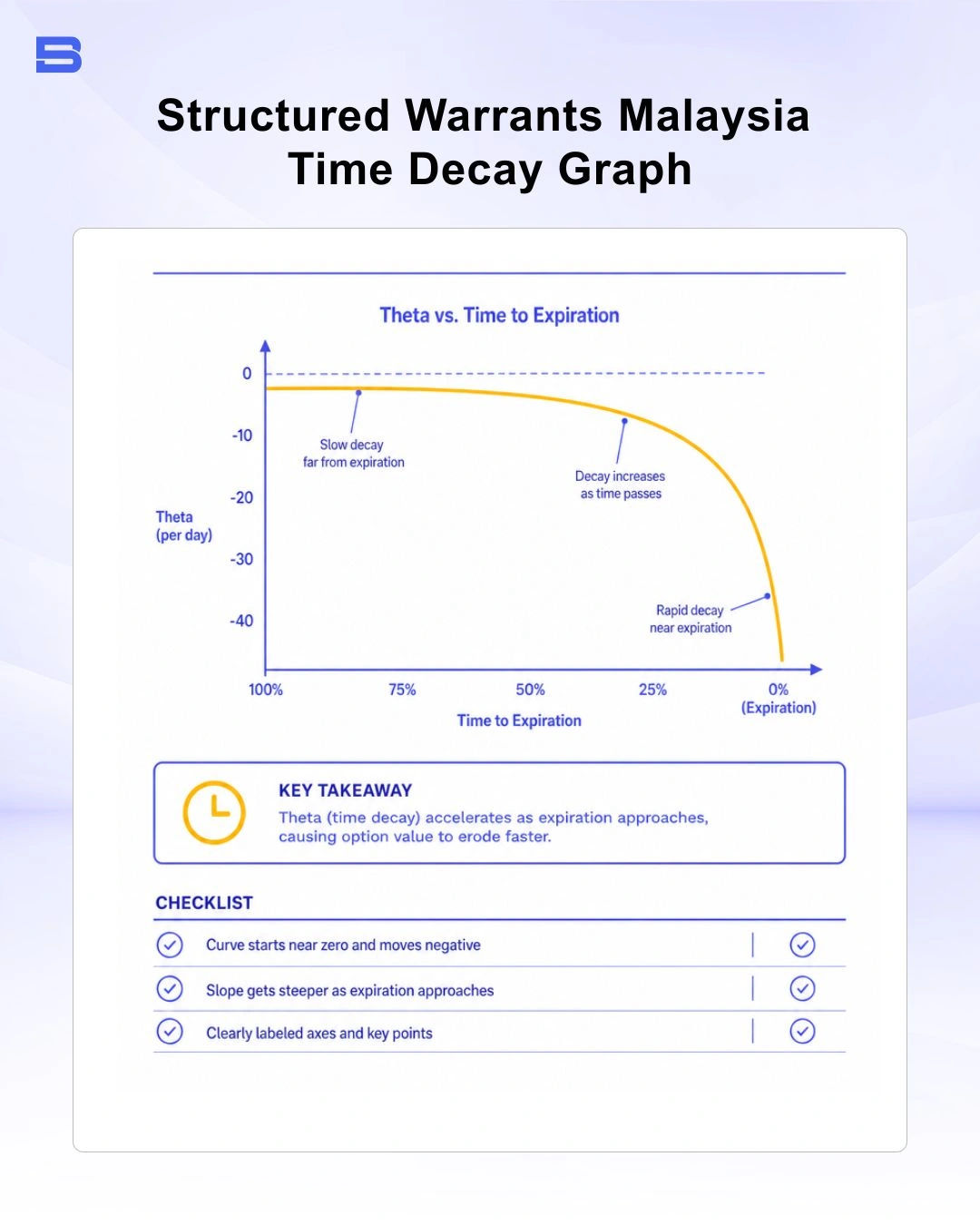
- Time Decay (Theta): Every single day a warrant moves closer to its expiration date, it loses a portion of its time value. This decay accelerates significantly during the final 30 to 60 days before maturity. Even if the underlying stock stays completely flat, your warrant position will decrease in value daily due to theta decay.
- Implied Volatility (Vega): Warrant prices are heavily influenced by market expectations of volatility. If implied volatility drops, warrant prices can fall even if the underlying stock price does not change.
Total Loss at Zero-Value Expiry
If a structured warrant Malaysia expires Out-Of-The-Money, its settlement value drops to RM0.00. Unlike holding direct equity—where holding through a market drawdown allows time for a potential recovery—an OTM warrant reaching maturity results in a complete 100% loss of your invested principal.
Shariah Compliance and Malaysian Market Nuances
A crucial consideration for Muslim traders in Malaysia is the Shariah status of structured warrants.
According to the Shariah Advisory Council (SAC) of the Securities Commission Malaysia (SC), structured warrants listed on Bursa Malaysia are generally classified as non-Shariah-compliant. This classification stems from the fact that structured warrants are cash-settled option contracts that do not involve the direct transfer of underlying asset ownership or underlying Shariah-compliant equities during settlement.
For traders seeking Shariah-compliant avenues for wealth accumulation or leveraged exposure, alternative instruments listed on Bursa Malaysia include:
- Shariah-Compliant Company Warrants (issued directly by listed Islamic-compliant stocks)
- How to Buy ETFs in Malaysia: A Beginner's Guide (focusing on Islamic index ETF Malaysia)
- REIT Malaysia: A Beginner's Guide to Real Estate Investment Trusts (selecting Islamic REIT options)
- Unit Trust vs Trading: Which Should Beginners Choose in Malaysia? (Islamic unit trust funds)
Conclusion: Are Structured Warrants Right for You?
Structured warrants Malaysia offer a capital-efficient tool for active traders seeking short-term tactical opportunities or downside hedging on Bursa Malaysia. However, due to time decay and leverage risks, they are generally ill-suited for long-term buy-and-hold investors. If you choose to trade structured warrants, ensure you utilize strict stop-loss strategies and allocate only capital you can afford to lose.
- What Can You Trade? A Guide to Forex, Stocks, and More
- CFD Trading for Beginners
- What is CFD Trading and How Does It Work?
- Forex vs. Stocks: Which Market Suits You Best?
- How to Diversify a Portfolio Across Asset Classes
- How Dividend Stocks Work: Yields, Risks, and Strategies
- Silver Trading Explained: A Guide for Retail Investors
- Precious Metals Trading: A Complete Guide for Beginners
- Natural Gas Trading: A Guide to the Market
- Structured Warrants Malaysia: How They Work and Risks
- What Is the KLCI Index and How to Trade It
- Gold Investment in Malaysia: A Complete Guide for Beginners
- What Is Kijang Emas and How to Invest in It
- Value Investing Explained: How to Find Undervalued Stocks
- How to Trade Bitcoin Safely: A Complete Market Guide
- Growth Investing Explained: Strategies, Metrics, and Risks
- What Is Digital Gold Malaysia and How to Invest
- Crypto Trading Strategies for Beginners
- Gold vs Bitcoin: Key Differences, Risks, and Strategies
- Sukuk: A Guide for Beginners to Islamic Bonds
- What Is FCPO (Crude Palm Oil Futures) and How to Trade It
- How to Identify and Invest in Shariah-Compliant Stocks
- Timber Investment: Is It Worth It?
- Gold ETF Malaysia: A Guide for Beginners
- What Are Malaysian Government Securities (MGS)?
- Corporate Bonds Malaysia: A Guide for Beginners
- China A-Shares Trading Guide for Malaysian Investors
- What Is a Silver ETF and How to Invest in It?
- How to Trade XRP: A Practical Guide for Retail Investors
- How to Trade Solana (SOL): A Guide for Beginners
- What Are Gold Futures and How Do They Work?
- Money Market Fund in Malaysia: A Guide for Beginners
- Property Investment Malaysia: Direct Real Estate or M-REITs?
- What Is Binance Coin and How Does It Work?
- Green Sukuk: A Guide for Beginners to Islamic ESG Investing
- What Is Shiba Inu (SHIB) and How to Trade It
- What Is USDT? A Complete Guide to Tether for Beginners
- What Is Dogecoin and How to Trade It Safely for Beginners
- Cardano: A Guide for Beginners to Trade This Cryptocurrency
- Polkadot: A Guide to Trading This Cryptocurrency
- Tron: A Guide for Beginners to Trading This Cryptocurrency
- What Is Litecoin (LTC)? A Guide to Trading Digital Silver
- What Is Chainlink (LINK) and How to Trade It
- How to Trade Pepe Coin: Spot, Leverage, and Risk Management
- Near Protocol: A Guide to Trading This Cryptocurrency
- Trading Polygon Crypto: A Practical Guide for Beginners
- Trade Toncoin: Understanding the TON Ecosystem and Risks
- Cosmos Crypto: Ecosystem Architecture, Tokenomics, and Risks
- Stellar Crypto: A Guide to Trading This Cryptocurrency
- Avalanche Crypto Explained: A Practical Guide for Traders
- What Is Worldcoin? How to Trade WLD and Manage Risk
- Aptos: A Guide for Beginners to Trading This Cryptocurrency
- Sui Crypto Explained: Tokenomics and Trading Guide
- Celestia: A Guide to Trading This Cryptocurrency
- Decentraland: A Guide to Trading This Cryptocurrency
- What Is Arbitrum? How to Trade the Leading Layer 2 Network
- Sei Crypto: A Guide to Trading This Cryptocurrency
- What Is Injective Protocol and How to Trade INJ Safely
Disclaimer: The content on this page is intended for educational and informational purposes only. It does not constitute financial, investment, tax, or legal advice, and should not be interpreted as a recommendation to buy, sell, or hold any financial instrument or asset. Trading and investing involve significant risk, including the possible loss of your entire capital. Products such as forex, CFDs, and cryptocurrencies carry additional risks due to leverage, high volatility, and limited regulatory protection in some jurisdictions. Past performance of any financial instrument does not guarantee future results. Any market views, forecasts, or opinions expressed are those of the author at the time of writing and may not reflect current market conditions. Platform features, fees, and regulatory status are subject to change — always verify information directly with the relevant provider or regulator before making any financial decision. BrokerSpecs may receive compensation from third parties featured on this site. Always conduct your own due diligence and consider seeking advice from a licensed financial professional before investing.