



Related Tags
A well-defined crypto trading strategy can help you make more disciplined decisions in a market known for rapid and unpredictable price movements. Since crypto markets operate 24/7, significant price changes can occur even when you are away from your screen.
Learning how to trade Bitcoin with clear entry and exit rules, position sizing, and risk-management parameters can reduce emotional decision-making. Whether you are pursuing short-term trades or long-term accumulation, a structured approach helps you manage risk and protect your trading capital.
Core Fundamentals of a Crypto Trading Strategy
A crypto trading strategy is a predefined set of rules that governs when you enter a trade, how much capital you allocate, where you set price targets, and when you exit to limit losses. Without a systematic approach, traders risk making reactive choices based on fear of missing out (FOMO) or panic selling during sudden market drawdowns.
Trading methodologies generally fall into two primary operational models:
- Active Trading: Position holding times range from a few seconds to several weeks. Active traders rely heavily on technical analysis, order flow dynamics, and momentum indicators to capture short-term price movements.
- Passive Accumulation: Strategic focus centers on a long-term holding horizon (months to years), using systematic buying intervals to average out entry costs despite short-term price volatility.
Spot Trading Strategies vs. Derivatives Execution
Before choosing a technical strategy, you must select your market venue mechanism:
- Spot Trading: Involves buying the underlying digital asset directly. When you execute a spot order, you own the token and can transfer it to a private wallet. Risk is limited to the total capital invested (i.e., your position value cannot drop below zero).
- Derivatives (Futures & Perpetual Swaps): Involves trading financial contracts that track the price of the asset rather than direct token ownership. Derivatives allow traders to use leverage to amplify exposure.
Leverage amplifies both potential profits and potential losses. For example, with 10× leverage, a 10% adverse price movement would theoretically eliminate 100% of the initial margin, although actual liquidation may occur earlier depending on the broker's margin requirements. The US Commodity Futures Trading Commission (CFTC) warns that leveraged retail forex trading can result in the rapid loss of all deposited funds and potentially additional losses. About two out of three retail forex customers lose money, according to CFTC data (as of August 2026) from registered US forex dealers.
Active Crypto Trading Strategy Approaches
Active strategies demand constant market monitoring, strict execution discipline, and quick technical assessment.
Scalping Crypto
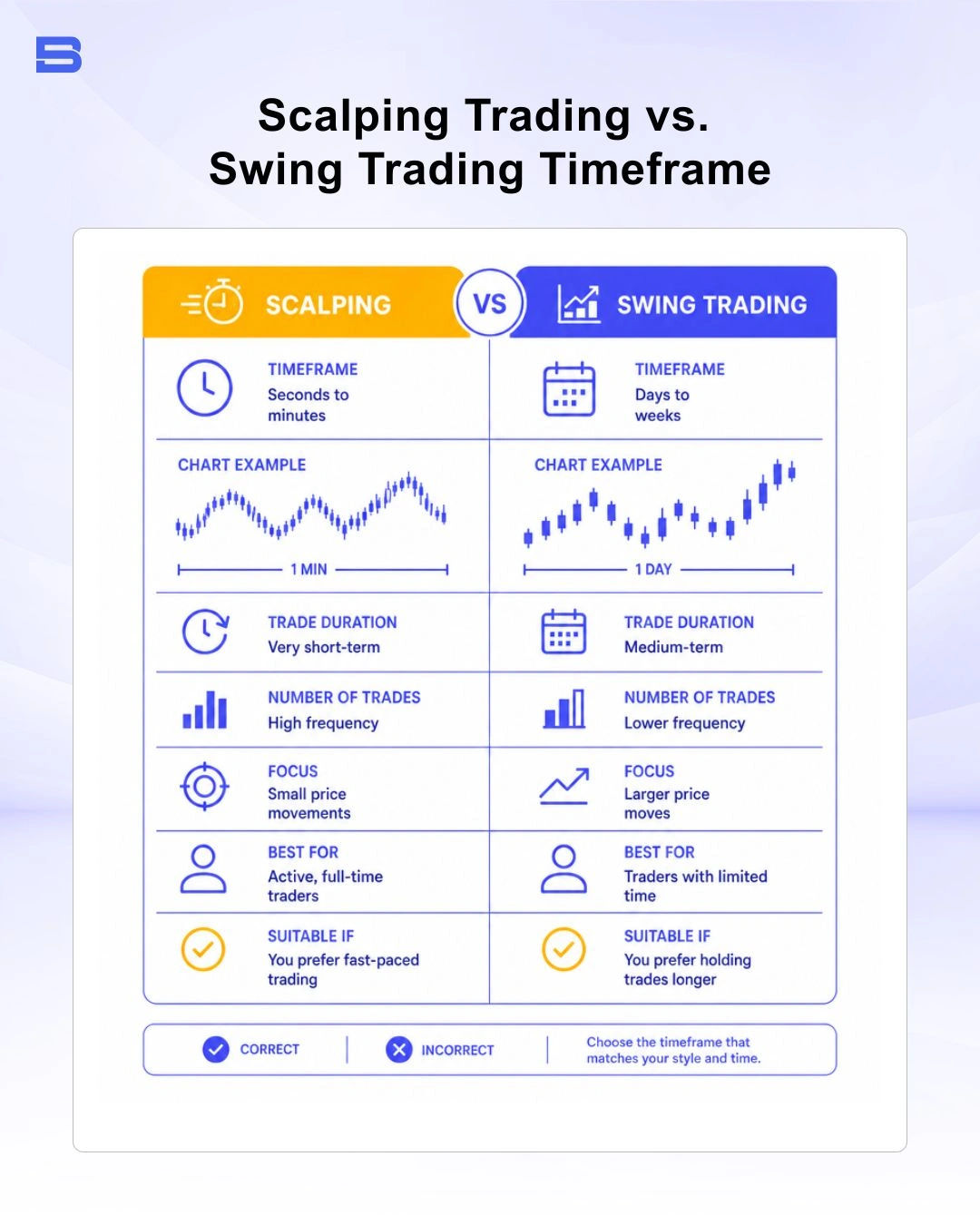
Scalping is an active strategy focused on capturing minor price fluctuations across ultra-short timeframes (1-minute to 15-minute charts).
- Execution Window: Seconds to minutes.
- Target Move: 0.2% to 1.0% per trade.
- Core Dynamics: Scalpers analyze order book depth, market momentum, and bid-ask spread liquidity to enter and exit positions rapidly.
- Key Risks: High trading volume generates significant transaction fees. Network fees or exchange taker fees can quickly erode small profit margins if not factored into the strategy.
Crypto Swing Trading
Swing trading aims to capture market momentum over intermediate timeframes. Instead of monitoring tick-by-tick movements, swing traders hold positions to catch multi-day shifts in market structure.
- Execution Window: Several days to several weeks.
- Technical Framework: Traders identify entry points near established support levels or trendlines, utilizing indicators like the Relative Strength Index (RSI), which shows whether an asset is overbought or oversold, and Moving Average Convergence Divergence (MACD), which tracks the relationship between two moving averages to confirm momentum shifts.
- Market Context: Swing trading allows beginner and intermediate traders to participate in broader trends without needing to monitor charts around the clock.
Cross-Exchange Crypto Arbitrage
Arbitrage exploits price differences for the same digital asset across different exchange venues. For example, if Bitcoin trades at $60,000 on Exchange A and $60,150 on Exchange B, an arbitrageur buys on Exchange A and sells on Exchange B simultaneously.
While theoretically straightforward, execution involves operational friction. Transfer delays, network congestion, order execution latency, and withdrawal fees often diminish price discrepancies before trades can settle.
Passive & Accumulation Frameworks
Passive frameworks focus on asset building while reducing the stress of timing short-term market tops and bottoms.
Dollar-Cost Averaging (DCA) for Passive Holdings
Dollar-Cost Averaging (DCA) involves investing a fixed dollar amount into a cryptocurrency at regular, automated intervals (e.g., $100 every Sunday) regardless of current price levels.
DCA Scenario Example ($100 Monthly Purchases):
- Month 1: Crypto Price = $50 --> Purchased: 2.00 Tokens;
- Month 2: Crypto Price = $25 --> Purchased: 4.00 Tokens (Market dip)
- Month 3: Crypto Price = $40 --> Purchased: 2.50 Tokens
- Total Capital Invested: $300
- Total Tokens Accumulated: 8.50 Tokens
- Average Cost Per Token: $35.29 (Current Market Price: $40.00)
By systematically purchasing during both market rallies and corrections, DCA lowers your average cost per token over time and removes emotional hesitation during market pullbacks.
Combining Active Strategies with Bitcoin Execution
Bitcoin (BTC) serves as the liquidity anchor for the crypto market. Active strategies applied to Bitcoin benefit from deeper order books, lower slippage, and narrower bid-ask spreads compared to smaller-cap alternatives.
Applying Strategies to High-Liquidity Altcoins
When applying swing or momentum strategies to high-liquidity altcoins like Ethereum, traders must account for higher beta relative to Bitcoin (beta measures how much more sharply an asset's price tends to move compared to Bitcoin's).
Beyond how altcoins move relative to Bitcoin, it's also worth stepping back to see how Bitcoin itself behaves against other macro assets during different market regimes. Altcoins often exhibit larger percentage swings during market expansions and deeper drawdowns during market corrections.
Gold vs Bitcoin in Macro Risk Regimes
Understanding asset behavior during broader macroeconomic shifts is vital for overall portfolio management. While traditional gold functions as a long-established safe-haven asset during systemic drawdowns, Bitcoin exhibits dual characteristics—behaving as a high-beta technology risk asset during liquidity squeezes and as an inflation hedge during monetary expansion cycles. Comparing these assets helps traders adjust exposure depending on global macroeconomic conditions.
Risk Management in Crypto and Position Sizing Formulas
Risk management is the foundational pillar of any sustainable crypto trading strategy. Capital preservation ensures that a series of consecutive losing trades will not drain your account.
Mandatory Position Sizing Rules
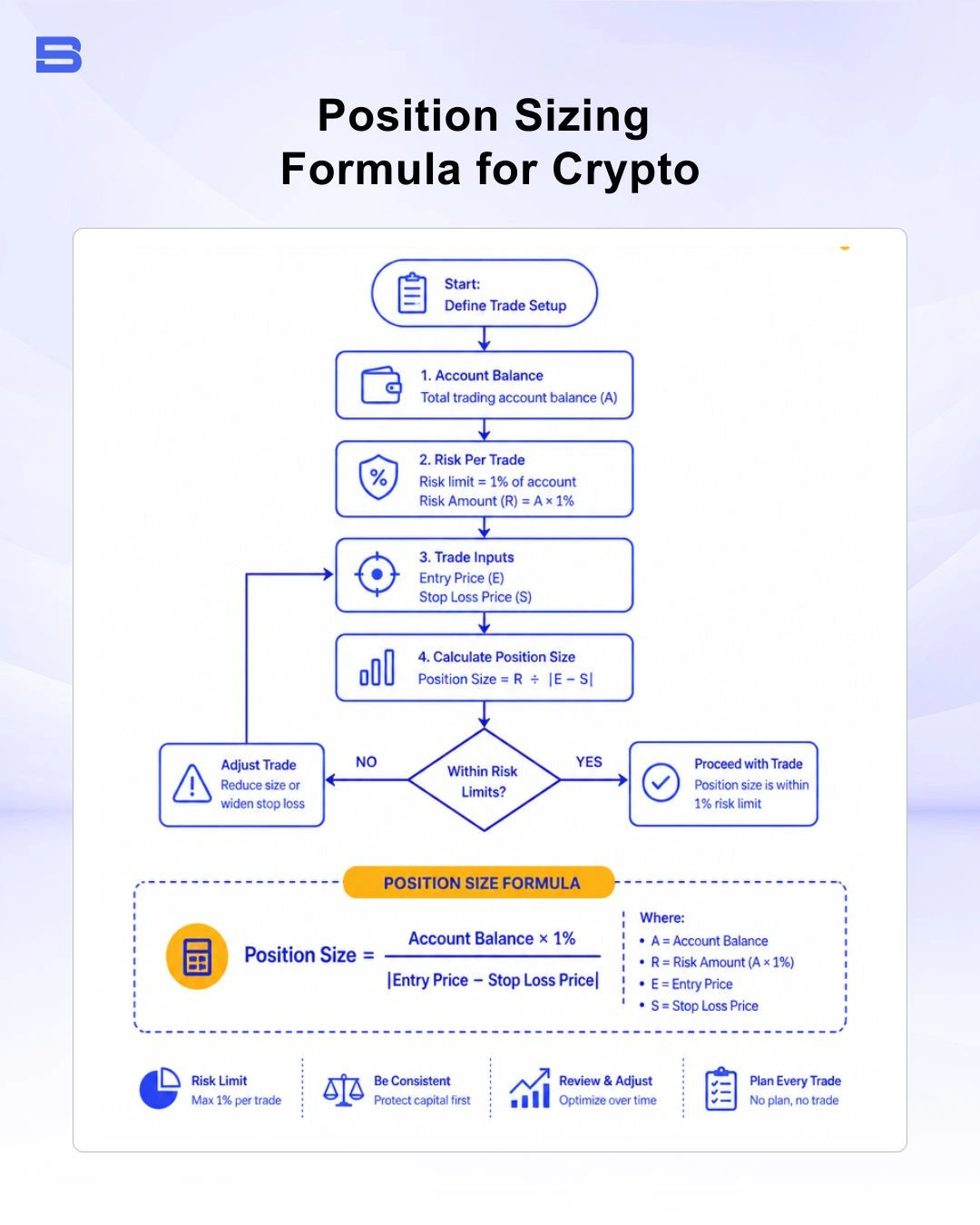
Never determine trade size based on intuition. Use a fixed mathematical formula based on account equity and stop-loss distance:
Position Size = (Account Capital) x (Risk Percentage per Trade) / (Entry Price - Stop-Loss Price)
Worked Example:
- Total Account Capital: $10,000
- Max Risk Per Trade: 1% ($100 total potential loss cap)
- Asset Entry Price: $100
- Stop-Loss Distance: Set at $95 (5% distance from entry)
In this scenario, if the price drops to $95, your stop-loss order is designed to close the trade near that level, targeting a loss of approximately $100 (1% of your account balance). Keep in mind that in fast-moving or highly volatile markets, stop-loss orders are not guaranteed to fill at the exact price, so actual losses can be larger than planned due to slippage or price gaps. Applying strict money management rules ensures your portfolio remains stable even during unexpected market corrections.
Risk Management Guardrails
- Set Hard Stop-Losses: Always define your exit price before opening a position.
- Limit Overall Leverage: Avoid excessive leverage; high multiplier leverage significantly increases your chances of rapid liquidation.
- Cold Storage Safety: Keep active trading capital on regulated exchanges, while securing long-term holdings in non-custodial hardware wallets.
Conclusion
Developing a successful crypto trading strategy requires aligning your execution style with your personal risk tolerance, available time, and trading goals. Whether you choose active swing trading or passive dollar-cost averaging, consistent capital preservation remains far more important than pursuing short-term yields. Define your parameters, follow strict position sizing formulas, and keep risk management at the core of every trade decision.
- What Can You Trade? A Guide to Forex, Stocks, and More
- CFD Trading for Beginners
- What is CFD Trading and How Does It Work?
- Forex vs. Stocks: Which Market Suits You Best?
- How to Diversify a Portfolio Across Asset Classes
- How Dividend Stocks Work: Yields, Risks, and Strategies
- Silver Trading Explained: A Guide for Retail Investors
- Precious Metals Trading: A Complete Guide for Beginners
- Natural Gas Trading: A Guide to the Market
- Structured Warrants Malaysia: How They Work and Risks
- What Is the KLCI Index and How to Trade It
- Gold Investment in Malaysia: A Complete Guide for Beginners
- What Is Kijang Emas and How to Invest in It
- Value Investing Explained: How to Find Undervalued Stocks
- How to Trade Bitcoin Safely: A Complete Market Guide
- Growth Investing Explained: Strategies, Metrics, and Risks
- What Is Digital Gold Malaysia and How to Invest
- Crypto Trading Strategies for Beginners
- Gold vs Bitcoin: Key Differences, Risks, and Strategies
- Sukuk: A Guide for Beginners to Islamic Bonds
- What Is FCPO (Crude Palm Oil Futures) and How to Trade It
- How to Identify and Invest in Shariah-Compliant Stocks
- Timber Investment: Is It Worth It?
- Gold ETF Malaysia: A Guide for Beginners
- What Are Malaysian Government Securities (MGS)?
- Corporate Bonds Malaysia: A Guide for Beginners
- China A-Shares Trading Guide for Malaysian Investors
- What Is a Silver ETF and How to Invest in It?
- How to Trade XRP: A Practical Guide for Retail Investors
- How to Trade Solana (SOL): A Guide for Beginners
- What Are Gold Futures and How Do They Work?
- Money Market Fund in Malaysia: A Guide for Beginners
- Property Investment Malaysia: Direct Real Estate or M-REITs?
- What Is Binance Coin and How Does It Work?
- Green Sukuk: A Guide for Beginners to Islamic ESG Investing
- What Is Shiba Inu (SHIB) and How to Trade It
- What Is USDT? A Complete Guide to Tether for Beginners
- What Is Dogecoin and How to Trade It Safely for Beginners
- Cardano: A Guide for Beginners to Trade This Cryptocurrency
- Polkadot: A Guide to Trading This Cryptocurrency
- Tron: A Guide for Beginners to Trading This Cryptocurrency
- What Is Litecoin (LTC)? A Guide to Trading Digital Silver
- What Is Chainlink (LINK) and How to Trade It
- How to Trade Pepe Coin: Spot, Leverage, and Risk Management
- Near Protocol: A Guide to Trading This Cryptocurrency
- Trading Polygon Crypto: A Practical Guide for Beginners
- Trade Toncoin: Understanding the TON Ecosystem and Risks
- Cosmos Crypto: Ecosystem Architecture, Tokenomics, and Risks
- Stellar Crypto: A Guide to Trading This Cryptocurrency
- Avalanche Crypto Explained: A Practical Guide for Traders
- What Is Worldcoin? How to Trade WLD and Manage Risk
- Aptos: A Guide for Beginners to Trading This Cryptocurrency
- Sui Crypto Explained: Tokenomics and Trading Guide
- Celestia: A Guide to Trading This Cryptocurrency
- Decentraland: A Guide to Trading This Cryptocurrency
- What Is Arbitrum? How to Trade the Leading Layer 2 Network
- Sei Crypto: A Guide to Trading This Cryptocurrency
- What Is Injective Protocol and How to Trade INJ Safely
Disclaimer: The content on this page is intended for educational and informational purposes only. It does not constitute financial, investment, tax, or legal advice, and should not be interpreted as a recommendation to buy, sell, or hold any financial instrument or asset. Trading and investing involve significant risk, including the possible loss of your entire capital. Products such as forex, CFDs, and cryptocurrencies carry additional risks due to leverage, high volatility, and limited regulatory protection in some jurisdictions. Past performance of any financial instrument does not guarantee future results. Any market views, forecasts, or opinions expressed are those of the author at the time of writing and may not reflect current market conditions. Platform features, fees, and regulatory status are subject to change — always verify information directly with the relevant provider or regulator before making any financial decision. BrokerSpecs may receive compensation from third parties featured on this site. Always conduct your own due diligence and consider seeking advice from a licensed financial professional before investing.