



Related Tags
Entering the equity market for the first time can feel overwhelming when faced with fluctuating stock charts and unpredictable price swings. Dividend investing offers a different approach: earning periodic cash payments simply for holding shares in profitable businesses.
While capital appreciation depends on market sentiment, dividends represent direct payouts from a company's real profits. Understanding how dividend stocks work, how to evaluate their sustainability, and how to avoid high-yield traps allows you to build a portfolio tailored for long-term income generation.
What Are Dividend Stocks and How Do They Work?
A dividend stock represents a share in a publicly traded company that routinely distributes a portion of its earnings back to shareholders. When a corporation generates profits, its board of directors chooses either to reinvest those funds into business expansion or distribute them as cash payments to equity holders.
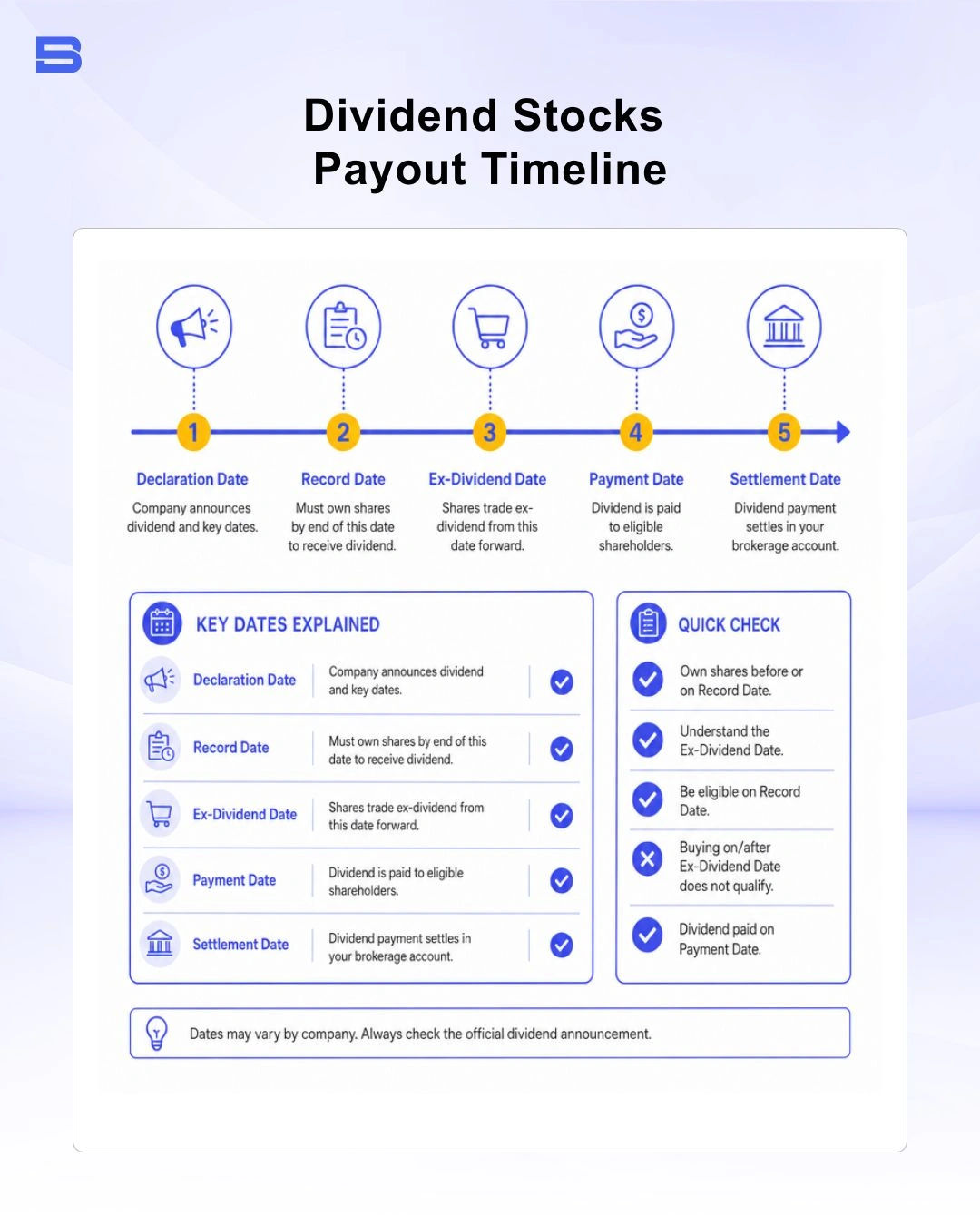
The payout mechanism operates around four crucial dates on the financial calendar:
- Declaration Date: The board announces the dividend amount, record date, and payment date.
- Ex-Dividend Date: The cutoff date for dividend eligibility. You must purchase the stock before this date to receive the upcoming payout.
- Record Date: The date the company finalizes its register of eligible shareholders (usually one business day after the ex-dividend date).
- Payment Date: The day cash is credited directly to your brokerage account or Central Depository System (CDS) account.
Payout frequency varies depending on local market conventions. US companies typically pay dividends quarterly, European firms often pay semi-annually or annually, while Malaysian equities listed on Bursa Malaysia generally distribute interim and final dividends twice a year.
Key Metrics: Dividend Yield vs. Dividend Payout Ratio
Evaluating dividend stocks requires looking beyond the raw cash amount per share. Two fundamental financial metrics help assess income return and payment safety: Dividend Yield and Dividend Payout Ratio.
Dividend Yield = (Annual Dividend per Share / Current Stock Price) x 100%
Dividend yield measures the annual income generated relative to the stock's current market price. For example, a company paying $2.00 in annual dividends with a stock price of $40.00 provides a 5% yield. However, because yield moves inversely to share price, a falling stock price artificially inflates the yield—making secondary metrics essential.
Dividend Payout Ratio = (Total Dividends Paid / Net Income) x 100%
The payout ratio measures the proportion of net earnings allocated to dividends. A payout ratio of 40% to 60% indicates a healthy balance, showing the company retains enough capital for debt clearance and growth while rewarding investors. Payout ratios exceeding 80%—outside specialized structures like Real Estate Investment Trusts—suggest the dividend may become unsustainable if profits dip.
Evaluating Dividend Stocks: Avoiding the "Yield Trap"
A common mistake among retail investors is selecting stocks based purely on high yield. Excessively high dividend yields—often above 8% to 10%—frequently signal a business in distress, creating a high-risk phenomenon known as a yield trap.
A yield trap occurs when a stock's price crashes due to deteriorating fundamentals, causing its calculated yield to surge. If the company subsequently cuts or eliminates its dividend to preserve cash, investors suffer both capital losses and a reduction in income.
To identify sustainable dividend opportunities, look for consistent earnings growth and a history of rising payouts rather than a high static yield. Analyzing balance sheet health—specifically low debt-to-equity levels—ensures the company can maintain payments through economic downturns.
Blue Chip Dividend Stocks vs. High-Yield Opportunities
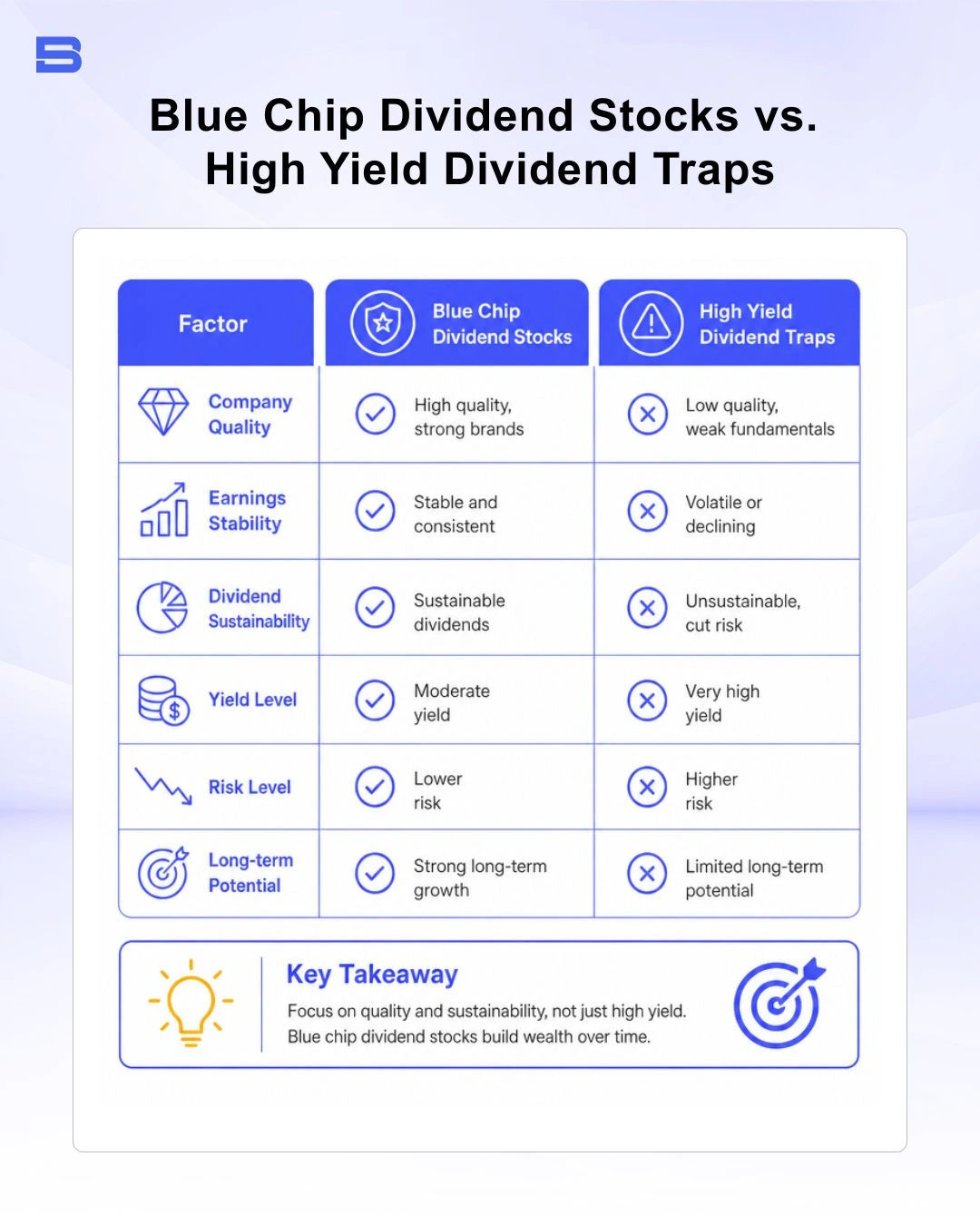
Established blue-chip companies with durable competitive advantages prioritize steady dividend growth over aggressive headline numbers, offering greater reliability over a multi-year investment horizon.
How Dividend Investing Fits Into Value and Growth Strategies
Dividend investing bridges the gap between capital preservation and long-term capital appreciation. Understanding how dividend stocks fit alongside value investing and growth investing helps align your portfolio with your overall financial strategy.
- Growth Investing: Focuses on companies reinvesting 100% of their profits back into expansion (e.g., technology startups). These stocks usually offer zero or negligible dividends, relying entirely on share price appreciation for returns.
- Value Investing: Involves purchasing undervalued assets trading below their intrinsic value. Value stocks frequently pay solid dividends, providing investors with tangible cash flow while waiting for the broader market to re-evaluate the company's valuation.
- Dividend Growth Investing: Combines elements of both growth and value. It targets mature, profitable companies capable of growing their dividend payouts year after year, protecting your income stream against inflationary pressures.
Reinvesting cash distributions through a Dividend Reinvestment Plan (DRIP) compounds your returns over time by purchasing additional shares without extra brokerage commission costs.
How to Buy Dividend Stocks in Malaysia
Investing in dividend-paying equities on Bursa Malaysia requires setting up the necessary trading infrastructure. Local market participants must open two distinct accounts through a licensed broker:
- Central Depository System (CDS) Account: Managed by Bursa Malaysia Depository, this account records share ownership electronically under your name.
- Trading Account: Provided by a participating brokerage firm, allowing you to execute buy and sell orders on the exchange.
If you are just getting started locally, reviewing how a CDS account Malaysia functions is an essential preliminary step. Dividend distributions from Malaysian public listed companies are credited directly to the bank account linked to your CDS profile via eDividend services.
Shariah-Compliant Dividend Stocks
Muslim investors in Malaysia can build income portfolios adhering to Islamic financial principles. The Shariah Advisory Council (SAC) of the Securities Commission Malaysia (SC) screens listed equities bi-annually based on financial ratios and business activity benchmarks.
To qualify as shariah-compliant stocks, companies must meet specific quantitative thresholds regarding debt levels and interest-bearing deposits, alongside qualitative checks ensuring core operations avoid non-permissible sectors like conventional banking, gambling, and alcohol sales.
Foreign Dividend Stocks and Tax Considerations for Malaysian Investors
Diversifying into global markets, such as the US equity market, introduces international dividend opportunities alongside distinct tax obligations enforced by authorities such as the U.S. Internal Revenue Service (IRS).
Malaysian residents expanding internationally should take note of withholding taxes on foreign income:
- Malaysian Dividends: Single-tier dividend systems mean distributions received from Malaysian companies are tax-exempt at the individual retail level.
- US Dividends: According to the US Internal Revenue Service (IRS), the United States imposes a standard 30% Dividend Withholding Tax (DWT) on nonresident foreign investors, absent a reduced treaty rate.
Tax Deduction Worked Example
To visualize the impact of foreign withholding tax, consider two parallel dividend distributions:
- Malaysian Equities: You own shares in a Bursa Malaysia firm that declares a gross dividend of RM100. Under the single-tier system, the net cash credited to your account is RM100 (0% tax withheld).
- US Equities: You own shares in a US corporation declaring a gross dividend payout of $100. The 30% US non-resident withholding tax automatically deducts $30, crediting a net sum of $70 to your brokerage account.
When planning to explore how to buy US stocks in Malaysia, factor in foreign withholding tax rates, currency conversion fees, and cross-border transfer charges to evaluate total net yield accurately.
The Bottom Line
Dividend stocks offer a well-established approach to accumulating wealth, generating consistent income, and buffering portfolios against market volatility. Success requires focusing on fundamental balance sheet strength, sustainable payout ratios, and continuous dividend growth rather than chasing volatile high-yield traps.
Whether holding local dividend payers through Bursa Malaysia or diversifying into global markets, maintaining realistic yield expectations and accounting for tax structures ensures your passive income strategy remains durable over the long term.
- What Can You Trade? A Guide to Forex, Stocks, and More
- CFD Trading for Beginners
- What is CFD Trading and How Does It Work?
- Forex vs. Stocks: Which Market Suits You Best?
- How to Diversify a Portfolio Across Asset Classes
- How Dividend Stocks Work: Yields, Risks, and Strategies
- Silver Trading Explained: A Guide for Retail Investors
- Precious Metals Trading: A Complete Guide for Beginners
- Natural Gas Trading: A Guide to the Market
- Structured Warrants Malaysia: How They Work and Risks
- What Is the KLCI Index and How to Trade It
- Gold Investment in Malaysia: A Complete Guide for Beginners
- What Is Kijang Emas and How to Invest in It
- Value Investing Explained: How to Find Undervalued Stocks
- How to Trade Bitcoin Safely: A Complete Market Guide
- Growth Investing Explained: Strategies, Metrics, and Risks
- What Is Digital Gold Malaysia and How to Invest
- Crypto Trading Strategies for Beginners
- Gold vs Bitcoin: Key Differences, Risks, and Strategies
- Sukuk: A Guide for Beginners to Islamic Bonds
- What Is FCPO (Crude Palm Oil Futures) and How to Trade It
- How to Identify and Invest in Shariah-Compliant Stocks
- Timber Investment: Is It Worth It?
- Gold ETF Malaysia: A Guide for Beginners
- What Are Malaysian Government Securities (MGS)?
- Corporate Bonds Malaysia: A Guide for Beginners
- China A-Shares Trading Guide for Malaysian Investors
- What Is a Silver ETF and How to Invest in It?
- How to Trade XRP: A Practical Guide for Retail Investors
- How to Trade Solana (SOL): A Guide for Beginners
- What Are Gold Futures and How Do They Work?
- Money Market Fund in Malaysia: A Guide for Beginners
- Property Investment Malaysia: Direct Real Estate or M-REITs?
- What Is Binance Coin and How Does It Work?
- Green Sukuk: A Guide for Beginners to Islamic ESG Investing
- What Is Shiba Inu (SHIB) and How to Trade It
- What Is USDT? A Complete Guide to Tether for Beginners
- What Is Dogecoin and How to Trade It Safely for Beginners
- Cardano: A Guide for Beginners to Trade This Cryptocurrency
- Polkadot: A Guide to Trading This Cryptocurrency
- Tron: A Guide for Beginners to Trading This Cryptocurrency
- What Is Litecoin (LTC)? A Guide to Trading Digital Silver
- What Is Chainlink (LINK) and How to Trade It
- How to Trade Pepe Coin: Spot, Leverage, and Risk Management
- Near Protocol: A Guide to Trading This Cryptocurrency
- Trading Polygon Crypto: A Practical Guide for Beginners
- Trade Toncoin: Understanding the TON Ecosystem and Risks
- Cosmos Crypto: Ecosystem Architecture, Tokenomics, and Risks
- Stellar Crypto: A Guide to Trading This Cryptocurrency
- Avalanche Crypto Explained: A Practical Guide for Traders
- What Is Worldcoin? How to Trade WLD and Manage Risk
- Aptos: A Guide for Beginners to Trading This Cryptocurrency
- Sui Crypto Explained: Tokenomics and Trading Guide
- Celestia: A Guide to Trading This Cryptocurrency
- Decentraland: A Guide to Trading This Cryptocurrency
- What Is Arbitrum? How to Trade the Leading Layer 2 Network
- Sei Crypto: A Guide to Trading This Cryptocurrency
- What Is Injective Protocol and How to Trade INJ Safely
Disclaimer: The content on this page is intended for educational and informational purposes only. It does not constitute financial, investment, tax, or legal advice, and should not be interpreted as a recommendation to buy, sell, or hold any financial instrument or asset. Trading and investing involve significant risk, including the possible loss of your entire capital. Products such as forex, CFDs, and cryptocurrencies carry additional risks due to leverage, high volatility, and limited regulatory protection in some jurisdictions. Past performance of any financial instrument does not guarantee future results. Any market views, forecasts, or opinions expressed are those of the author at the time of writing and may not reflect current market conditions. Platform features, fees, and regulatory status are subject to change — always verify information directly with the relevant provider or regulator before making any financial decision. BrokerSpecs may receive compensation from third parties featured on this site. Always conduct your own due diligence and consider seeking advice from a licensed financial professional before investing.