


Related Tags
Entering the cryptocurrency market for the first time can feel overwhelming, especially when encountering tokens that originated as internet memes rather than serious financial protocols. You might see headlines about rapid price spikes, social media hype, and extreme volatility, leaving you wondering whether Dogecoin is a legitimate asset or merely speculative gambling. Navigating this market requires cutting through the online hype and understanding the underlying mechanics, risks, and trading strategies before placing your first order.
Dogecoin occupies a unique position in the digital asset landscape. While it started as a lighthearted alternative to traditional cryptocurrencies, it has grown into one of the most widely recognized digital assets by market capitalization. Whether you are considering active short-term trading or simply want to understand how it operates, establishing a clear risk management framework is essential before allocating any capital.
What Is Dogecoin and How Does It Work?
Dogecoin (DOGE) was created in December 2013 by software engineers Billy Markus and Jackson Palmer as a satirical response to the sudden surge of speculative cryptocurrencies. Built using open-source code derived from Litecoin, Dogecoin was designed to be an accessible, lighthearted peer-to-peer digital currency featuring the popular Shiba Inu dog meme as its logo. Despite its humorous origins, the underlying network operates on a fully functional, decentralized blockchain that enables users to transfer value globally without central intermediaries.
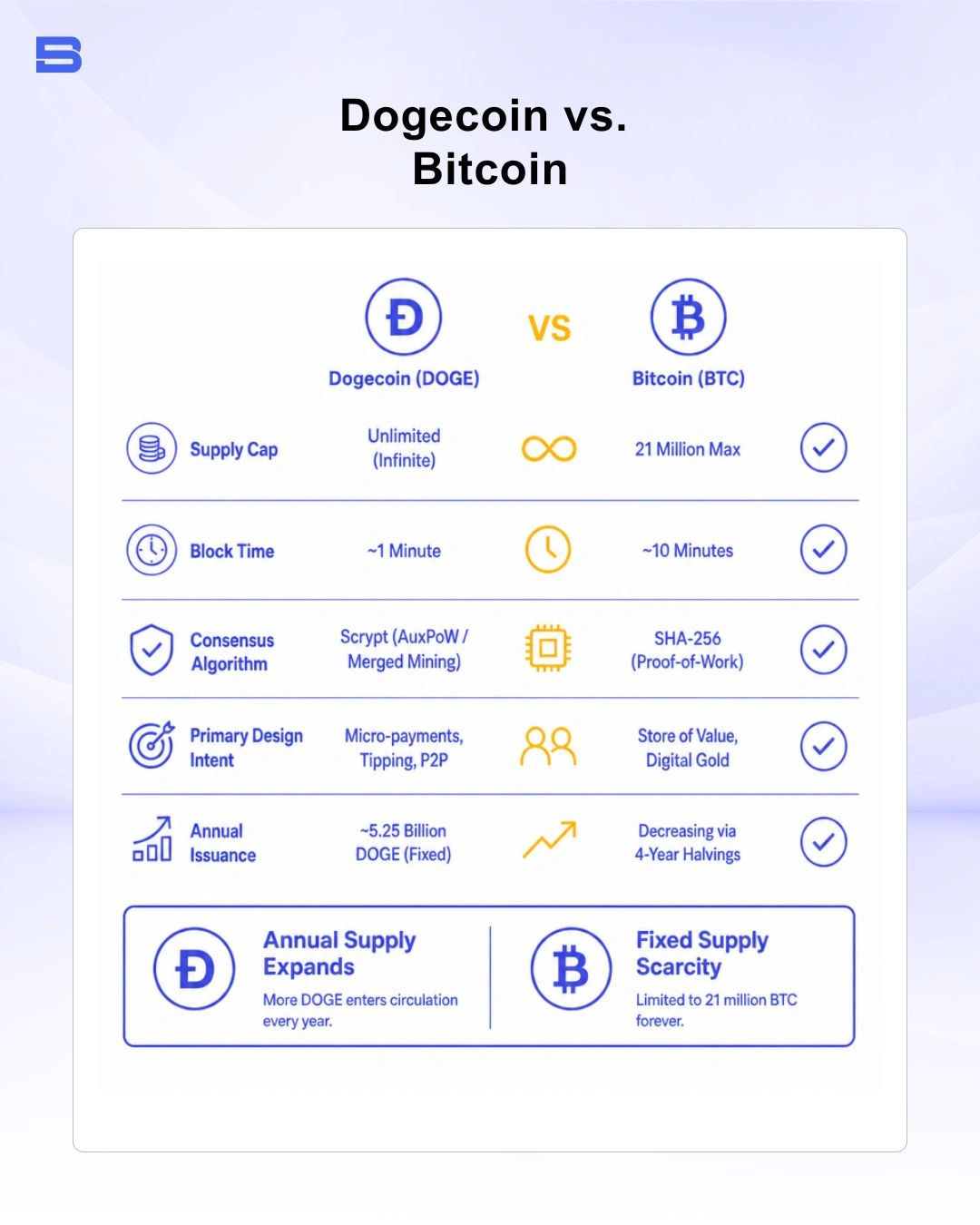
The protocol relies on Scrypt, a memory-intensive hashing algorithm (as opposed to Bitcoin's SHA-256), which allows for faster transaction processing speeds compared to earlier blockchain networks. While Bitcoin blocks take approximately 10 minutes to finalize, Dogecoin processes blocks in roughly one minute. This structural speed, combined with minimal network transaction fees, initially made Dogecoin popular for micro-transactions, online tipping, and small peer-to-peer payments across social media platforms.
Proof of Work and Dogecoin Mining Mechanics
To secure the network and validate transactions, Dogecoin uses a Proof-of-Work (PoW) consensus mechanism. Miners run specialized computer hardware to solve complex mathematical puzzles, adding verified blocks of transactions to the public ledger. In return for securing the blockchain, miners receive newly minted DOGE as a block reward.
In 2014, the Dogecoin network implemented Auxiliary Proof-of-Work (AuxPoW), enabling "merged mining" with Litecoin. This mechanism allows miners to simultaneously mine both Litecoin and Dogecoin without requiring additional computational power or electrical energy. Merged mining substantially boosted Dogecoin's network security by leveraging Litecoin's established hash rate, protecting the network from potential 51% attacks.
Dogecoin vs. Bitcoin: Infinite Supply vs. Digital Gold
Understanding the structural differences between Dogecoin and Bitcoin is fundamental for any trader. While Bitcoin was engineered as "digital gold" with a strict scarcity model, Dogecoin was intentionally designed with inflationary tokenomics to encourage spending rather than long-term hoarding.
Bitcoin has a hard supply cap fixed at 21 million coins, with its issuance rate halving roughly every four years. In contrast, Dogecoin has no maximum supply limit. The network issues a fixed reward of 10,000 new DOGE per minute, translating to approximately 5.25 billion new tokens added to the circulating supply every year. Because the annual issuance remains fixed while the total circulating supply grows, the absolute rate of inflation gradually decreases over time, but the absolute supply expands infinitely.
For active traders, this supply structure means that long-term price holding relies heavily on sustained demand outpacing constant token emission. If buying demand slows down, the continuous influx of new supply creates natural downward pressure on price over extended horizons.
Understanding Meme Coins: Dogecoin, Shiba Inu, and Pepe Coin
Dogecoin established a distinct category within the cryptocurrency ecosystem known as "meme coins"—digital assets whose brand identity, public awareness, and price movements are primarily driven by internet culture, community enthusiasm, and viral social media trends rather than complex technological utility.
As the digital asset market matured, rival tokens emerged to capture similar retail sentiment. Projects such as Shiba Inu and Pepe Coin entered the market, introducing alternative tokenomics, ecosystem features, and network designs. While Dogecoin operates on its own dedicated Layer-1 blockchain, many newer meme coins are launched as secondary tokens on existing smart contract networks.
Dogecoin vs. Shiba Inu: Key Differences
The primary distinction between Dogecoin and Shiba Inu lies in their underlying network infrastructure. Dogecoin runs on its own standalone Proof-of-Work blockchain, functioning as a native settlement network for payments. Shiba Inu (SHIB), launched in 2020, was created as an ERC-20 token — a standardized token format built on top of the Ethereum blockchain rather than its own network.
Because Shiba Inu operates on Ethereum, its ecosystem can integrate decentralized finance (DeFi) applications, non-fungible tokens (NFTs), and decentralized exchanges like ShibaSwap. However, this flexibility comes with higher transaction fees (gas) during periods of Ethereum network congestion. Dogecoin maintains simpler, lower-cost transfers, but lacks native smart contract functionality.
How Trading Dogecoin Compares to Bitcoin and Ethereum
Trading Dogecoin requires a different tactical approach than trading Bitcoin or trading Ethereum. Major market-cap cryptocurrencies generally benefit from deeper liquidity pools, institutional investment products such as spot exchange-traded funds (ETFs), and underlying utility metrics like decentralized application adoption or global payment settlement volume.
When assessing gold vs Bitcoin as potential store-of-value assets, institutional investors evaluate inflation hedging characteristics, fixed supply constraints, and macroeconomic liquidity. Dogecoin, by contrast, operates with minimal institutional participation and responds heavily to retail market sentiment, viral social media trends, and high-profile public endorsements.
Layer-1 Utility vs. Meme Coin Dynamics
Smart contract platforms like Ethereum, Solana, or specialized blockchain networks such as Sei, Cosmos, and Chainlink derive fundamental value from network fees, developer activity, and total value locked (TVL). Their market valuations reflect utility growth and platform adoption.
Dogecoin does not support complex smart contracts natively. Consequently, its price action is less anchored to technical adoption metrics and far more sensitive to shifts in market sentiment. During bullish market cycles, Dogecoin can experience aggressive speculative rallies driven by retail enthusiasm. Conversely, during market downturns, speculative meme tokens frequently encounter severe drawdowns as liquidity retreats toward higher-cap assets.
Risk Management: Is Dogecoin Safe to Trade?
Is Dogecoin safe to trade? The short answer depends entirely on your execution method and risk protocol. While the Dogecoin blockchain itself is secure and stable, trading the asset carries significant financial risk due to extreme price volatility, rapid shifts in social media sentiment, and sharp liquidity gaps. Regulatory authorities, including the US Securities and Exchange Commission (SEC) and the Securities Commission Malaysia (SC), consistently warn retail investors regarding the speculative risks inherent in digital asset trading.
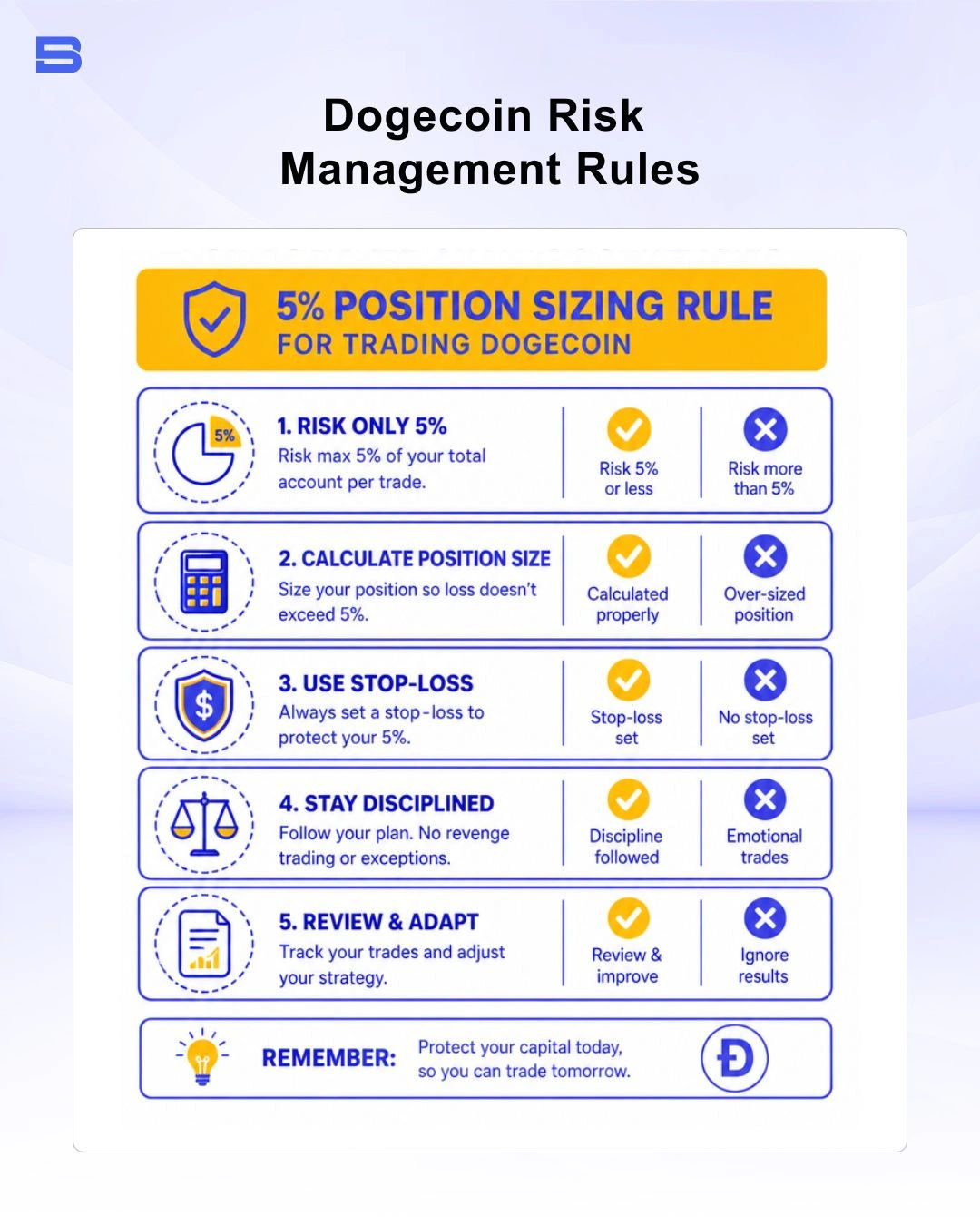
To trade volatile cryptocurrencies safely, implementing strict risk management parameters is essential. You should never risk capital you cannot afford to lose, and you must establish clear entry, take-profit, and stop-loss boundaries before executing any trade.
Worked Example: Managing Capital Risk on DOGE
Suppose you have a total trading account capital of $10,000. To protect your portfolio, you adhere to a strict rule: you will never risk 2% of your total account value (200) on a single trade.
You analyze the DOGE price chart and identify a setup where DOGE is trading at $0.10. You decide to open a long position, establishing a stop-loss level at $0.095 (a 5% decline from your entry price).
- Total Trading Capital: $10,000
- Max Risk Per Trade (2%): $200
- Entry Price: $0.10
- Stop-Loss Price: $0.095 (Risk = $0.005 per token, or 5%)
- Position Size Calculation: $200 Max Risk / $0.005 Risk per Token = 40,000 DOGE
- Total Position Value: 40,000 DOGE × $0.10 = $4,000 (40% of total capital)
By enforcing a pre-calculated stop-loss, if the market shifts suddenly and DOGE drops to $0.095, your position automatically closes, limiting your actual loss to exactly $200 (2% of your total capital). High-volatility assets like Dogecoin magnify potential returns when market momentum is in your favor, but unmanaged leverage and absent stop-loss orders accelerate portfolio drawdowns just as quickly during adverse market moves.
Conclusion
Trading Dogecoin presents distinct opportunities for active market participants seeking exposure to high-volatility digital assets. However, its inflationary issuance schedule and reliance on social media sentiment mean that long-term success requires discipline rather than speculative enthusiasm. By prioritizing capital preservation, applying calculated position sizing, and maintaining defined stop-loss orders, you can navigate meme coin market dynamics while protecting your broader trading portfolio.
- What Can You Trade? A Guide to Forex, Stocks, and More
- CFD Trading for Beginners
- What is CFD Trading and How Does It Work?
- Forex vs. Stocks: Which Market Suits You Best?
- How to Diversify a Portfolio Across Asset Classes
- How Dividend Stocks Work: Yields, Risks, and Strategies
- Silver Trading Explained: A Guide for Retail Investors
- Precious Metals Trading: A Complete Guide for Beginners
- Natural Gas Trading: A Guide to the Market
- Structured Warrants Malaysia: How They Work and Risks
- What Is the KLCI Index and How to Trade It
- Gold Investment in Malaysia: A Complete Guide for Beginners
- What Is Kijang Emas and How to Invest in It
- Value Investing Explained: How to Find Undervalued Stocks
- How to Trade Bitcoin Safely: A Complete Market Guide
- Growth Investing Explained: Strategies, Metrics, and Risks
- What Is Digital Gold Malaysia and How to Invest
- Crypto Trading Strategies for Beginners
- Gold vs Bitcoin: Key Differences, Risks, and Strategies
- Sukuk: A Guide for Beginners to Islamic Bonds
- What Is FCPO (Crude Palm Oil Futures) and How to Trade It
- How to Identify and Invest in Shariah-Compliant Stocks
- Timber Investment: Is It Worth It?
- Gold ETF Malaysia: A Guide for Beginners
- What Are Malaysian Government Securities (MGS)?
- Corporate Bonds Malaysia: A Guide for Beginners
- China A-Shares Trading Guide for Malaysian Investors
- What Is a Silver ETF and How to Invest in It?
- How to Trade XRP: A Practical Guide for Retail Investors
- How to Trade Solana (SOL): A Guide for Beginners
- What Are Gold Futures and How Do They Work?
- Money Market Fund in Malaysia: A Guide for Beginners
- Property Investment Malaysia: Direct Real Estate or M-REITs?
- What Is Binance Coin and How Does It Work?
- Green Sukuk: A Guide for Beginners to Islamic ESG Investing
- What Is Shiba Inu (SHIB) and How to Trade It
- What Is USDT? A Complete Guide to Tether for Beginners
- What Is Dogecoin and How to Trade It Safely for Beginners
- Cardano: A Guide for Beginners to Trade This Cryptocurrency
- Polkadot: A Guide to Trading This Cryptocurrency
- Tron: A Guide for Beginners to Trading This Cryptocurrency
- What Is Litecoin (LTC)? A Guide to Trading Digital Silver
- What Is Chainlink (LINK) and How to Trade It
- How to Trade Pepe Coin: Spot, Leverage, and Risk Management
- Near Protocol: A Guide to Trading This Cryptocurrency
- Trading Polygon Crypto: A Practical Guide for Beginners
- Trade Toncoin: Understanding the TON Ecosystem and Risks
- Cosmos Crypto: Ecosystem Architecture, Tokenomics, and Risks
- Stellar Crypto: A Guide to Trading This Cryptocurrency
- Avalanche Crypto Explained: A Practical Guide for Traders
- What Is Worldcoin? How to Trade WLD and Manage Risk
- Aptos: A Guide for Beginners to Trading This Cryptocurrency
- Sui Crypto Explained: Tokenomics and Trading Guide
- Celestia: A Guide to Trading This Cryptocurrency
- Decentraland: A Guide to Trading This Cryptocurrency
- What Is Arbitrum? How to Trade the Leading Layer 2 Network
- Sei Crypto: A Guide to Trading This Cryptocurrency
- What Is Injective Protocol and How to Trade INJ Safely
Disclaimer: The content on this page is intended for educational and informational purposes only. It does not constitute financial, investment, tax, or legal advice, and should not be interpreted as a recommendation to buy, sell, or hold any financial instrument or asset. Trading and investing involve significant risk, including the possible loss of your entire capital. Products such as forex, CFDs, and cryptocurrencies carry additional risks due to leverage, high volatility, and limited regulatory protection in some jurisdictions. Past performance of any financial instrument does not guarantee future results. Any market views, forecasts, or opinions expressed are those of the author at the time of writing and may not reflect current market conditions. Platform features, fees, and regulatory status are subject to change — always verify information directly with the relevant provider or regulator before making any financial decision. BrokerSpecs may receive compensation from third parties featured on this site. Always conduct your own due diligence and consider seeking advice from a licensed financial professional before investing.