



Related Tags
Investing in gold traditionally meant purchasing physical coins or bullion, finding secure storage, and accepting potentially wide jeweler buy-sell spreads. Today, investors can access gold prices more conveniently through a gold ETF Malaysia offering. Exchange-Traded Funds (ETFs) backed by physical gold provide a liquid and potentially more cost-efficient way to gain exposure to the precious metal without the challenges of owning and storing physical bullion.
Whether your goal is to hedge against currency risk, diversify your portfolio, or add a safe-haven asset, understanding how a gold ETF Malaysia works—as well as how gold ETFs operate in global markets—is an important first step before investing.
What Is a Gold ETF and How Does It Work in Malaysia?
A gold ETF Malaysia is a pooled investment fund listed on a stock exchange that aims to track the price of gold. Instead of purchasing and storing physical gold bars or coins yourself, you buy ETF units through a brokerage account. The fund manager typically holds physical gold bullion in secure, independently audited vaults, often through established global precious-metals storage centers.
Each ETF unit represents a fractional interest in the fund's underlying gold holdings, commonly measured in grams or troy ounces. As international gold prices change, including prices referenced by benchmarks such as the London Bullion Market Association (LBMA) Gold Price, the ETF's market price generally moves in the same direction, although fees, tracking differences, and market conditions can affect performance.
For Malaysian investors, a gold ETF Malaysia provides a convenient way to gain exposure to gold through the stock market without the practical challenges of buying, storing and insuring physical bullion. Investors can trade ETF units through a brokerage account during the relevant stock exchange's trading hours, much like buying and selling listed shares.
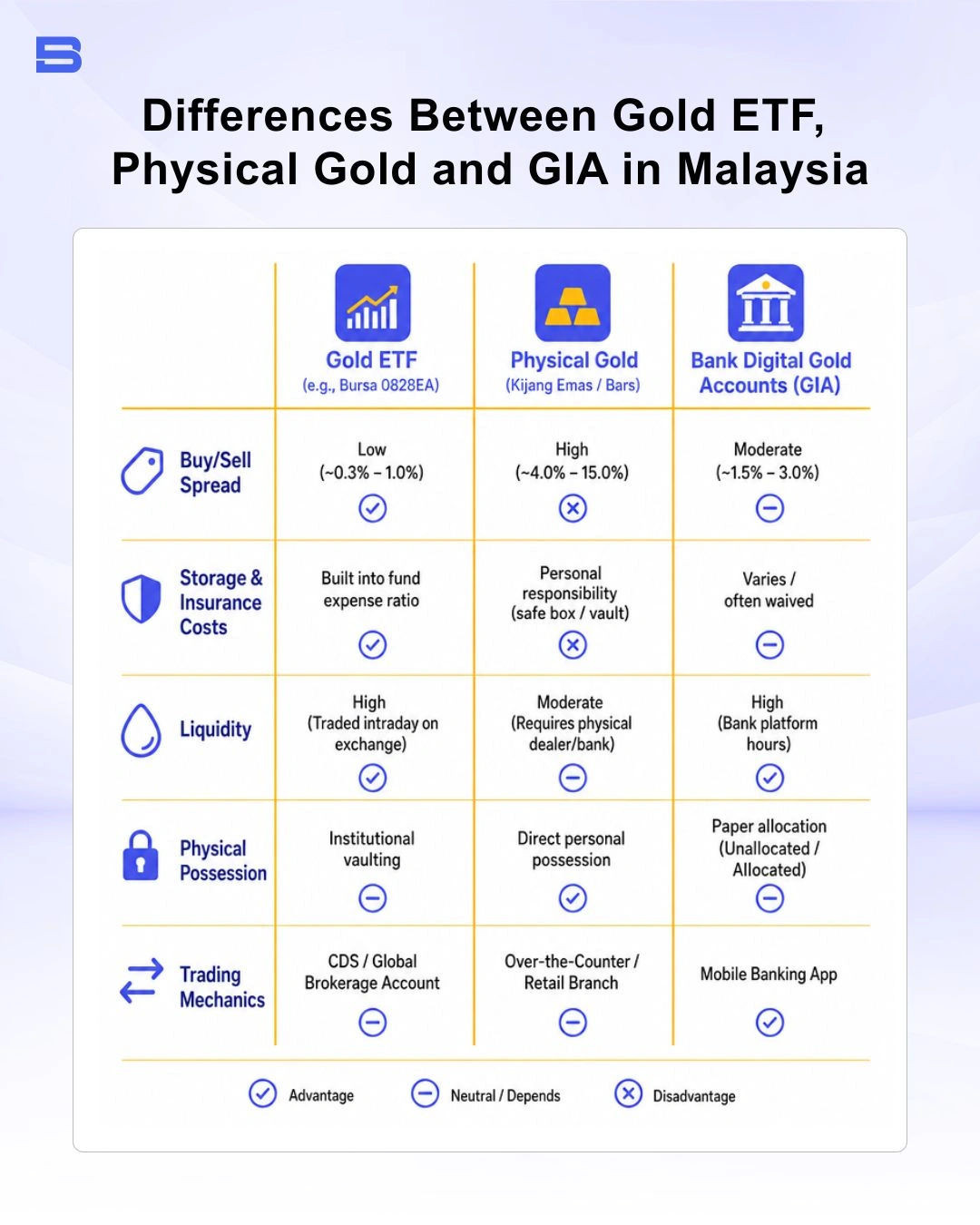
Local vs. Global Options: TradePlus 0828EA vs. US Gold ETFs
Malaysian investors primarily choose between locally listed instruments on Bursa Malaysia and larger, globally listed international ETFs.
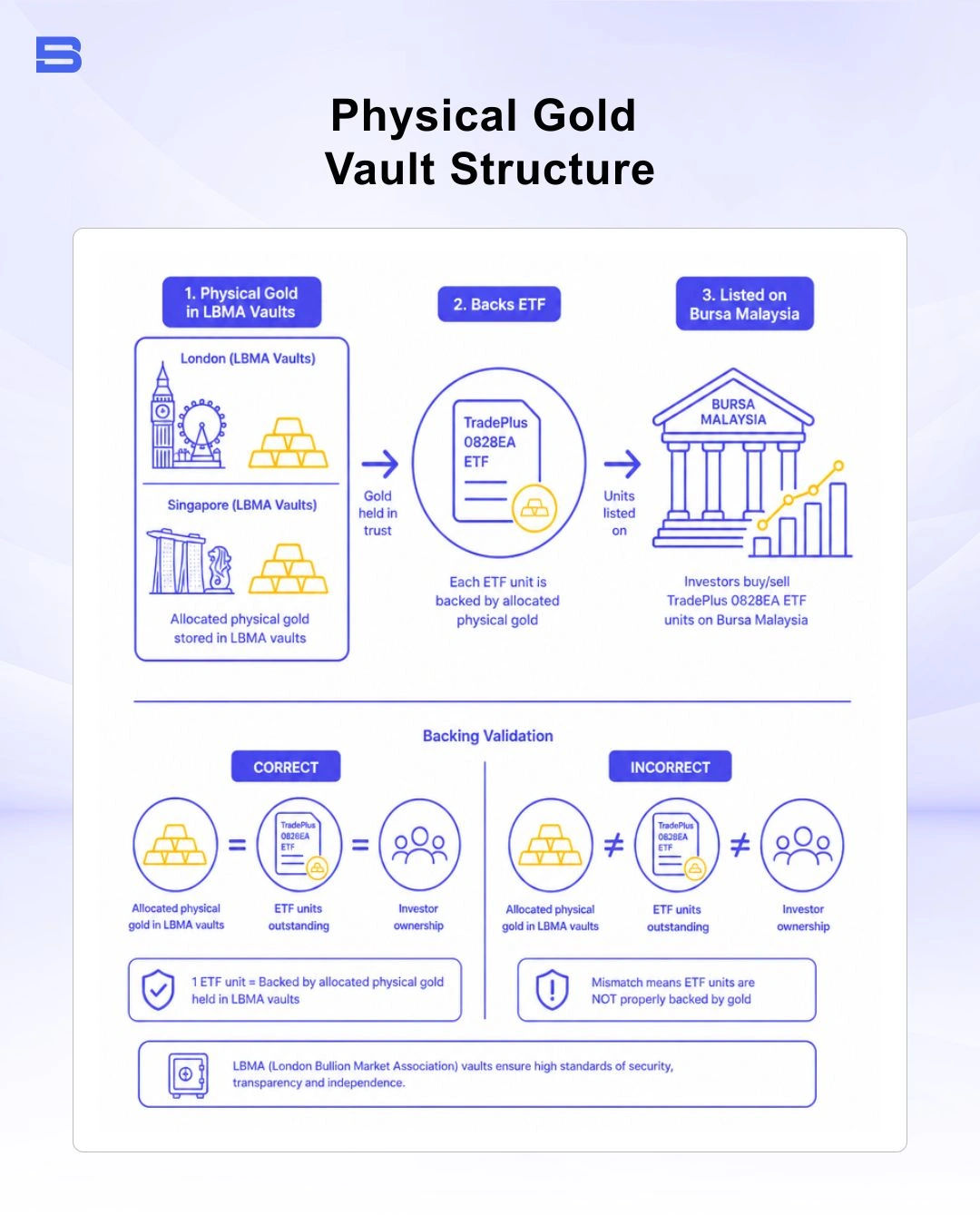
TradePlus Shariah Gold Tracker (0828EA): Bursa Malaysia Listing
The primary locally listed option on Bursa Malaysia is the TradePlus Shariah Gold Tracker (Stock Code: 0828EA, Short Name: GOLDETF). Listed in Malaysian Ringgit (MYR), it tracks the LBMA Gold Price AM benchmark.
Key facts regarding 0828EA:
- Trading Unit: 1 lot equals 100 units.
- Base Currency: Base NAV is tracked in US dollars (USD), but units trade on Bursa in MYR.
- Annual Expenses: Per the TradePlus Shariah Gold Tracker fund fact sheet, the management fee is 0.30% p.a. plus custody/vaulting fees (0.20% p.a.), creating a competitive total expense ratio compared to physical storage.
Holding a locally listed fund eliminates the need to remit funds internationally, making it accessible for retail accounts linked to local banks.
Global Gold ETFs (SPDR GLD, VanEck GDX) vs. Local Listing
Investors seeking higher liquidity or foreign currency diversification often look to US-listed funds.
- SPDR Gold Shares (GLD): One of the largest physically backed gold ETFs by assets under management, offering high daily trading volume and tight spreads.
- VanEck Gold Miners ETF (GDX): Rather than tracking physical gold directly, GDX holds equity shares in global gold mining companies. Mining equities offer leveraged exposure to gold price movements, though they introduce corporate operational risks.
While global ETFs offer higher trading volume, local investors must factor in USD/MYR exchange rate fluctuations, foreign currency conversion fees, and potential international brokerage fees.
Shariah Compliance and Physical Backing Rules
For Muslim investors, the is trading haram debate often highlights the necessity of strict Shariah screening for commodity instruments. Under Islamic jurisprudence (Fiqh muamalat), gold is classified as a Ribawi item. Trading gold requires immediate delivery (qabd) and must be backed 100% by real physical gold.
The TradePlus Shariah Gold Tracker (0828EA) adheres strictly to the AAOIFI (Accounting and Auditing Organization for Islamic Financial Institutions) Shariah Standard on Gold. According to the TradePlus Shariah Gold Tracker's Shariah compliance disclosures, the fund maintains at least 95% of its Net Asset Value (NAV) in physical gold bars of 99.99% purity, stored in LBMA-accredited vaults in Singapore. Independent Shariah advisers audit the physical holdings periodically to maintain compliance.
Gold ETF vs. Physical Gold (Kijang Emas, Bullion Bars)
Many traditional investors prefer holding physical gold coins like the Bank Negara Malaysia Kijang Emas or gold bullion bars. However, comparing physical gold to exchange-traded units reveals significant structural trade-offs.
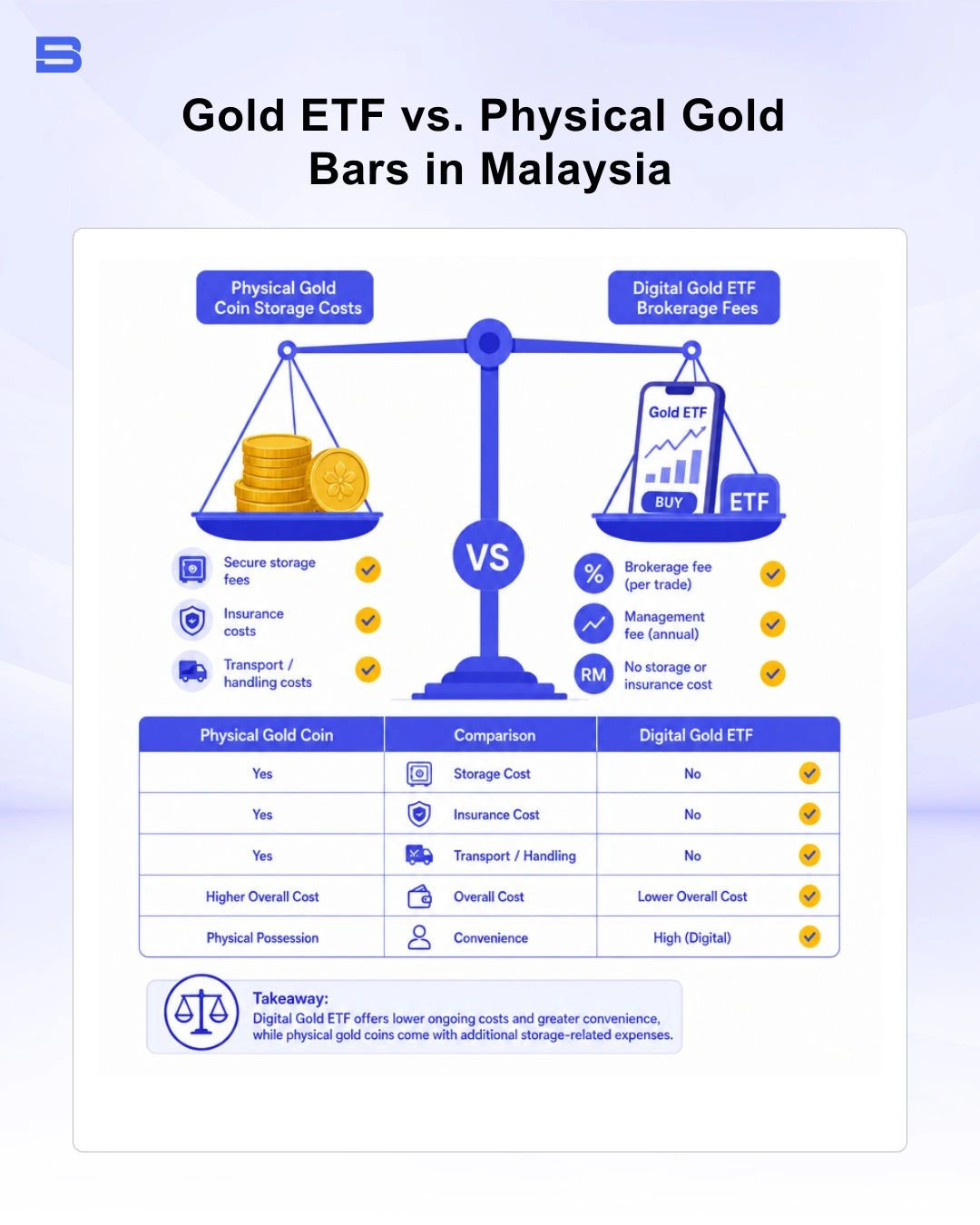
Cost Efficiency and Spreads
When buying physical gold coins or small bars, retail buyers pay a markup above the spot price. When selling back, dealers apply a discount. According to typical retail pricing observed across licensed Malaysian bullion dealers, the buy-sell spread for physical gold coins and small bars generally ranges between 4% and 15%. In contrast, trading 0828EA on Bursa Malaysia involves standard brokerage commissions and tight market spreads (often under 1%).
Storage, Safety, and Insurance
Storing physical bullion at home presents theft risks, while safe deposit boxes incur annual rental fees. A gold ETF incorporates storage, vault insurance, and security costs directly into its annual management fee, eliminating personal storage logistics.
Liquidity and Settlement
Selling physical coins requires visiting a designated bank branch or licensed gold dealer during business hours. ETF units can be liquidated instantly during stock market trading hours, with cash settling according to standard T+2 exchange cycles.
Gold ETF vs. Digital Gold Accounts in Malaysia
For investors comparing options, digital gold Malaysia accounts differ from ETFs in one key way: pricing transparency.
Bank digital gold accounts often operate on an "unallocated" basis, meaning the bank owes you gold value rather than holding specifically allocated bullion bars directly in your name. Furthermore, banks set buy and sell prices unilaterally twice a day.
Gold ETFs trade on an open exchange order book, where market forces determine real-time continuous pricing. Investors can place limit orders or market orders transparently throughout the trading day.
Step-by-Step Guide: How to Buy Gold ETFs in Malaysia
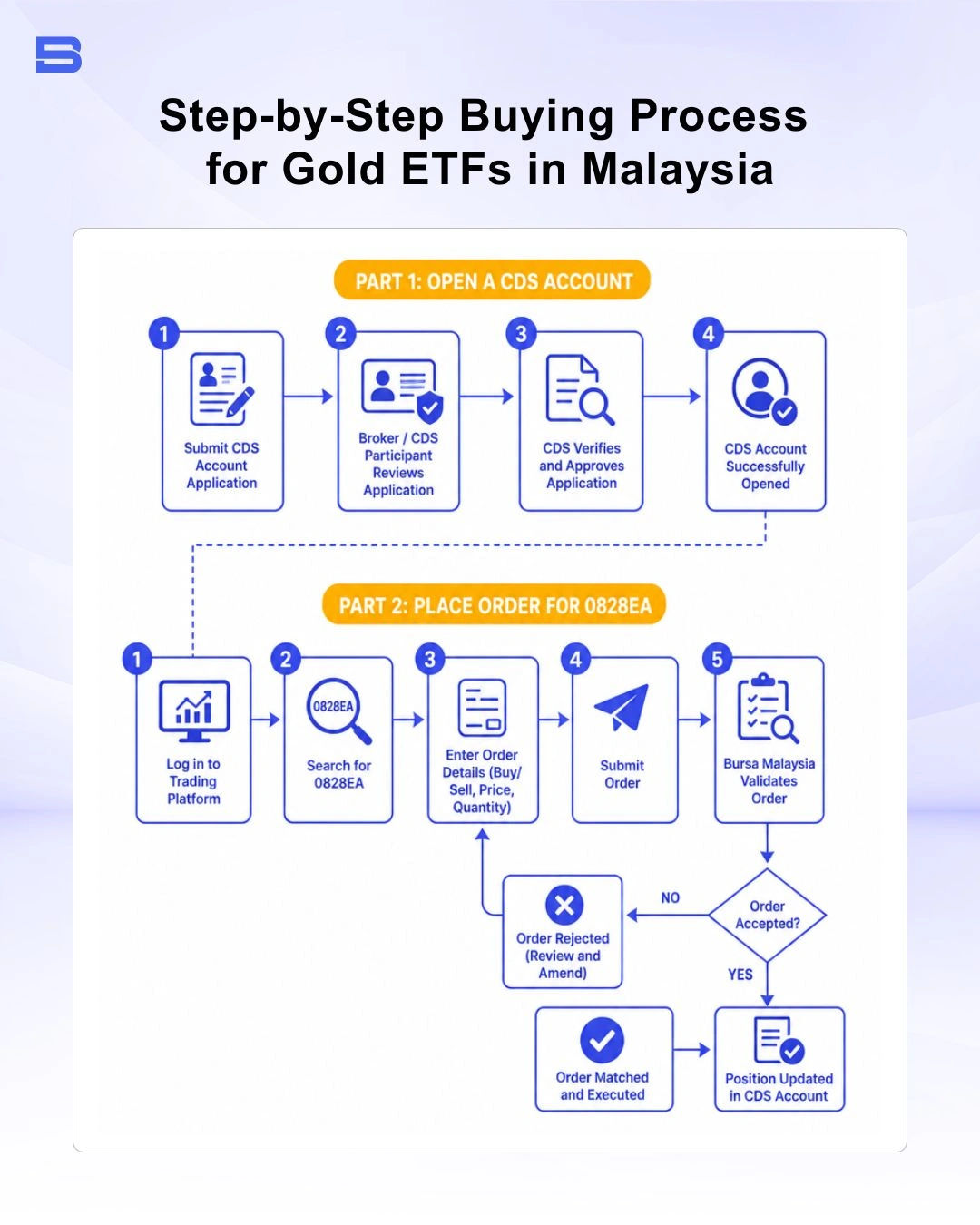
Investing in gold ETFs requires access to a stock brokerage account.
Path 1: Buying Local Bursa Malaysia ETFs (0828EA)
- Open a CDS Account: You must open a Central Depository System (CDS) account in Malaysia with a broker licensed by the Securities Commission Malaysia (SC). Participating brokers include MPlus, CGS International, Moomoo MY, or Kenanga.
- Deposit Funds: Transfer Ringgit Malaysia (MYR) into your brokerage trust account.
- Search the Ticker: Search for stock code 0828EA or ticker GOLDETF on your trading platform.
- Place a Trade Order: Enter your desired limit or market price. Remember that Bursa Malaysia trades in standard lots (1 lot = 100 units).
Path 2: Buying Global Gold ETFs (US Listings: GLD, GDX)
- Open a Global Brokerage Account: Sign up with an SC-regulated platform offering foreign market access or a recognized international broker (e.g., Interactive Brokers, Moomoo, Webull).
- Convert Currency: Deposit MYR and convert it to USD within the platform, taking note of conversion rates.
- Execute Order: Search for ticker GLD (SPDR Gold Shares) or GDX (VanEck Gold Miners). Foreign exchanges frequently allow fractional share purchases, eliminating the strict 100-unit lot minimum required on Bursa.
Key Risks to Evaluate Before Investing
While gold is widely considered a portfolio diversifier, investing in gold ETFs carries specific risks that every retail trader must evaluate.
Market and Price Risk
Gold prices do not yield dividends or interest payments. Price movements depend entirely on macroeconomic factors, including US Federal Reserve interest rate policy, global inflation trends, and geopolitical stability. If real interest rates rise sharply, non-yielding assets like gold often face downward price pressure.
Tracking Error
A gold ETF’s performance may slightly diverge from the spot price of gold. This difference—known as tracking error—occurs due to management expense deductions, vault fees, cash drag, and execution spreads.
Foreign Exchange Risk
For local funds like 0828EA, the underlying asset is priced internationally in USD, while the ETF trades on Bursa in MYR. If spot gold prices remain flat in USD terms but the Ringgit appreciates significantly against the US Dollar, the MYR-denominated unit price of the ETF may drop.
Where Gold ETFs Fit in Your Precious Metals Strategy
Financial advisors typically recommend allocating between 5% and 10% of a balanced portfolio to gold as a risk hedge. Gold ETFs provide the liquid core for this strategy.
Investors looking beyond gold can also explore broader precious metals trading instruments, such as silver ETF offerings or exchange-traded gold futures (like Bursa Malaysia's FGLD contract). While futures contracts offer leveraged exposure suited for short-term speculation, physically backed gold ETFs remain better suited for long-term strategic hedging without margin call liabilities.
Conclusion
A gold ETF Malaysia gives investors a convenient way to gain exposure to global gold price movements without the need to purchase, store, or insure physical bullion. These funds can offer greater liquidity and transparency while potentially reducing the high premiums and buy-sell spreads often associated with retail gold products.
For Malaysian investors, options such as TradePlus Shariah Gold Tracker (0828EA), alongside comparable gold ETFs available in international markets, allow gold exposure to be incorporated directly into a brokerage portfolio. This makes it easier to use gold as part of a broader asset-allocation strategy while avoiding the practical challenges of physical ownership.
However, a gold ETF Malaysia should still be considered within the context of your overall investment strategy. Before investing, assess factors such as your financial objectives, investment horizon, risk tolerance, fund fees, and desired allocation to precious metals.
- What Can You Trade? A Guide to Forex, Stocks, and More
- CFD Trading for Beginners
- What is CFD Trading and How Does It Work?
- Forex vs. Stocks: Which Market Suits You Best?
- How to Diversify a Portfolio Across Asset Classes
- How Dividend Stocks Work: Yields, Risks, and Strategies
- Silver Trading Explained: A Guide for Retail Investors
- Precious Metals Trading: A Complete Guide for Beginners
- Natural Gas Trading: A Guide to the Market
- Structured Warrants Malaysia: How They Work and Risks
- What Is the KLCI Index and How to Trade It
- Gold Investment in Malaysia: A Complete Guide for Beginners
- What Is Kijang Emas and How to Invest in It
- Value Investing Explained: How to Find Undervalued Stocks
- How to Trade Bitcoin Safely: A Complete Market Guide
- Growth Investing Explained: Strategies, Metrics, and Risks
- What Is Digital Gold Malaysia and How to Invest
- Crypto Trading Strategies for Beginners
- Gold vs Bitcoin: Key Differences, Risks, and Strategies
- Sukuk: A Guide for Beginners to Islamic Bonds
- What Is FCPO (Crude Palm Oil Futures) and How to Trade It
- How to Identify and Invest in Shariah-Compliant Stocks
- Timber Investment: Is It Worth It?
- Gold ETF Malaysia: A Guide for Beginners
- What Are Malaysian Government Securities (MGS)?
- Corporate Bonds Malaysia: A Guide for Beginners
- China A-Shares Trading Guide for Malaysian Investors
- What Is a Silver ETF and How to Invest in It?
- How to Trade XRP: A Practical Guide for Retail Investors
- How to Trade Solana (SOL): A Guide for Beginners
- What Are Gold Futures and How Do They Work?
- Money Market Fund in Malaysia: A Guide for Beginners
- Property Investment Malaysia: Direct Real Estate or M-REITs?
- What Is Binance Coin and How Does It Work?
- Green Sukuk: A Guide for Beginners to Islamic ESG Investing
- What Is Shiba Inu (SHIB) and How to Trade It
- What Is USDT? A Complete Guide to Tether for Beginners
- What Is Dogecoin and How to Trade It Safely for Beginners
- Cardano: A Guide for Beginners to Trade This Cryptocurrency
- Polkadot: A Guide to Trading This Cryptocurrency
- Tron: A Guide for Beginners to Trading This Cryptocurrency
- What Is Litecoin (LTC)? A Guide to Trading Digital Silver
- What Is Chainlink (LINK) and How to Trade It
- How to Trade Pepe Coin: Spot, Leverage, and Risk Management
- Near Protocol: A Guide to Trading This Cryptocurrency
- Trading Polygon Crypto: A Practical Guide for Beginners
- Trade Toncoin: Understanding the TON Ecosystem and Risks
- Cosmos Crypto: Ecosystem Architecture, Tokenomics, and Risks
- Stellar Crypto: A Guide to Trading This Cryptocurrency
- Avalanche Crypto Explained: A Practical Guide for Traders
- What Is Worldcoin? How to Trade WLD and Manage Risk
- Aptos: A Guide for Beginners to Trading This Cryptocurrency
- Sui Crypto Explained: Tokenomics and Trading Guide
- Celestia: A Guide to Trading This Cryptocurrency
- Decentraland: A Guide to Trading This Cryptocurrency
- What Is Arbitrum? How to Trade the Leading Layer 2 Network
- Sei Crypto: A Guide to Trading This Cryptocurrency
- What Is Injective Protocol and How to Trade INJ Safely
Disclaimer: The content on this page is intended for educational and informational purposes only. It does not constitute financial, investment, tax, or legal advice, and should not be interpreted as a recommendation to buy, sell, or hold any financial instrument or asset. Trading and investing involve significant risk, including the possible loss of your entire capital. Products such as forex, CFDs, and cryptocurrencies carry additional risks due to leverage, high volatility, and limited regulatory protection in some jurisdictions. Past performance of any financial instrument does not guarantee future results. Any market views, forecasts, or opinions expressed are those of the author at the time of writing and may not reflect current market conditions. Platform features, fees, and regulatory status are subject to change — always verify information directly with the relevant provider or regulator before making any financial decision. BrokerSpecs may receive compensation from third parties featured on this site. Always conduct your own due diligence and consider seeking advice from a licensed financial professional before investing.