


Related Tags
You are looking to trade decentralized financial derivatives, but high gas fees on Ethereum and network congestion on generic Layer-1 blockchains keep slipping your entries. While most blockchains handle smart contracts for gaming or digital art as an afterthought alongside payments, Injective was built specifically for low-latency financial markets, using a fully on-chain order book instead of the smart-contract patchwork most Layer-1s rely on for trading.
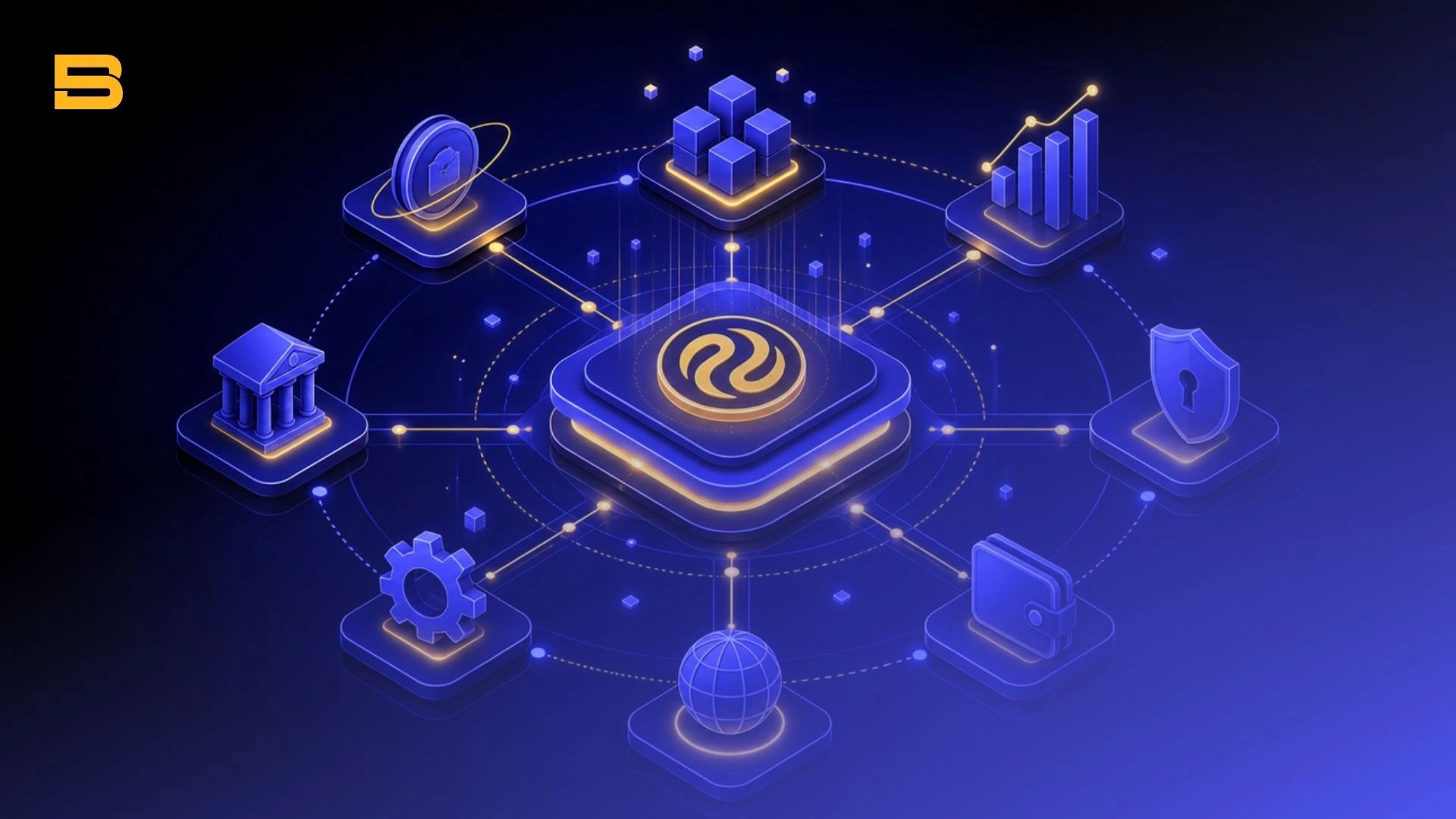
Injective Protocol is an interoperable, Layer-1 blockchain optimized for building decentralized finance (DeFi) applications, featuring a fully decentralized on-chain order book. Internalized bridging modules allow native interoperability across Celestia ecosystems, Cosmos frameworks, Solana, and Ethereum.
What Is Injective and How Does It Work?
Injective Protocol operates as a specialized Layer-1 network built to power decentralized derivatives trading, perpetual futures, spot exchanges, and cross-chain money markets. Unlike conventional general-purpose blockchains, the protocol incorporates core financial primitives directly into its base layer protocol.
In simple terms, a Layer-1 blockchain is the base network that processes and secures every transaction, and DeFi (decentralized finance) means trading, lending, and other financial activity happening directly on that network without a bank or broker in the middle. Injective is a Layer-1 built specifically for this kind of trading.
Core Architecture of Injective
It provides developers with pre-built, plug-and-play modules. Instead of deploying custom smart contracts for standard functions, dApps on Injective tap directly into native protocol-level features:
- Native Central Limit Order Book (CLOB): Decentralized order matching operates entirely on-chain.
- Binary Options & Derivatives Engines: Direct execution modules for complex structured products.
- Interoperable Smart Contracts: Supports CosmWasm, a smart-contract framework built for Cosmos-based chains, enabling seamless cross-chain execution.
Cosmos SDK and Tendermint Consensus
This protocol utilizes a Proof-of-Stake (PoS) consensus mechanism built on the Cosmos Software Development Kit (SDK) and powered by Tendermint core, the consensus engine that lets validators agree on transactions almost instantly. This architecture delivers high-throughput transaction execution required by high-frequency financial trading applications.
While it is deeply connected to Ethereum via its custom Peggy bridge — the tool that lets assets move between Injective and Ethereum — it is not an Ethereum Layer-2 scaling solution; it is an independent, highly scalable Layer-1 network integrated into the Cosmos crypto ecosystem.
On-Chain Order Book Mechanics
Traditional decentralized exchanges (DEXs) rely on Automated Market Makers (AMMs) like Uniswap, where liquidity pools set asset prices through mathematical ratios. In contrast, it implements a fully decentralized central limit order book (CLOB).
To neutralize Maximal Extractable Value (MEV) front-running — a major issue on traditional public ledgers where miners or bots reorder transactions to profit from traders — this protocol utilizes Frequent Batch Auctions (FBA). Under FBA execution:
- Orders placed during a discrete time block are collected into a single pool.
- At the end of the batch interval, all orders are executed simultaneously at a single uniform clearing price.
- Bots are unable to front-run trades, securing fairer price execution for retail participants.
Key Features of Injective
Injective stands out in the decentralized finance space by offering institutional trading capabilities directly to retail traders without relying on centralized intermediaries.
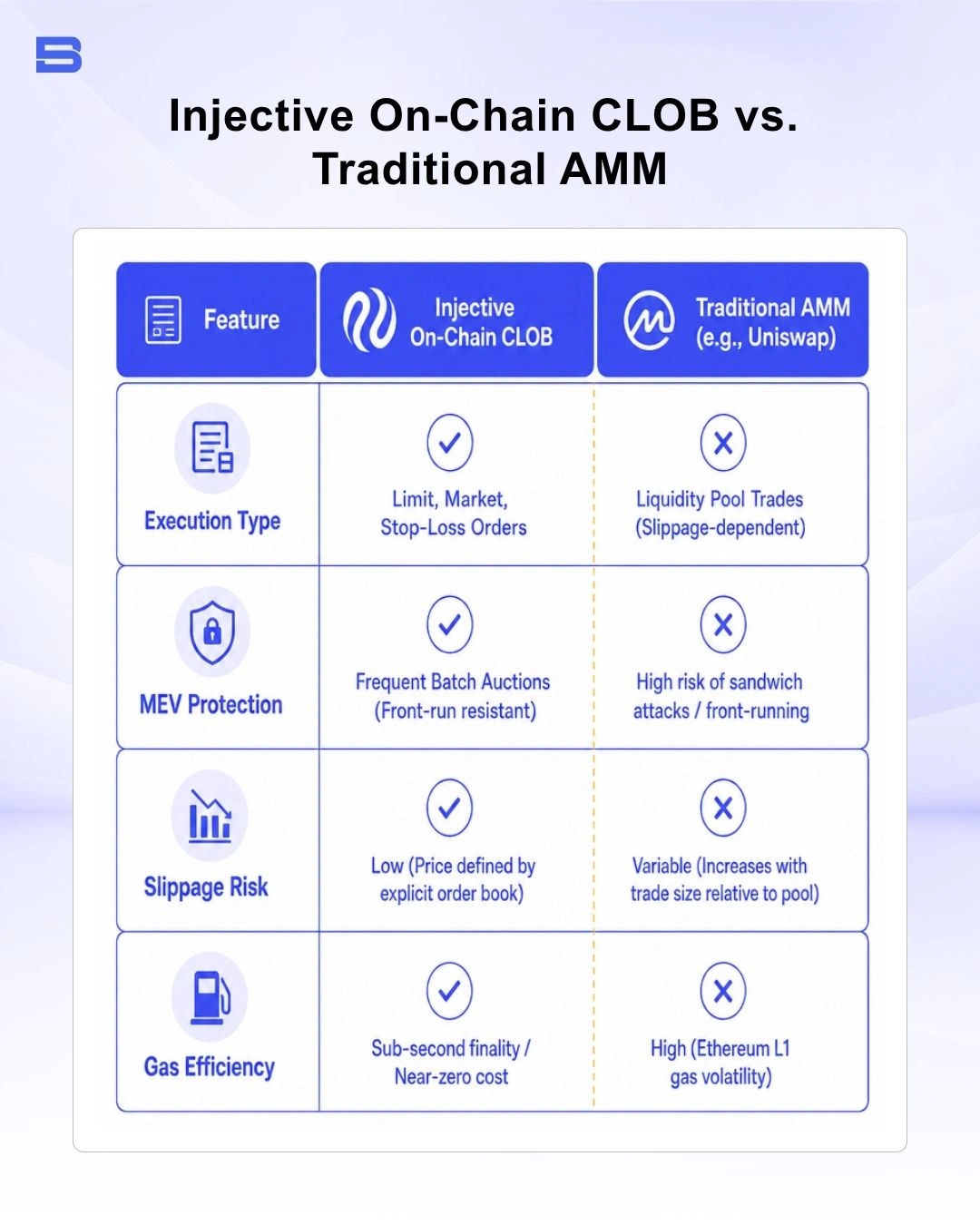
- Zero Gas Fees for End Users: Independent dApps built on Injective can eliminate gas fees for traders through third-party fee delegation mechanisms.
- Weekly Deflationary Token Auctions: Injective historically directed 60% of exchange fees into a weekly Burn Auction, where the winning bidder's INJ was permanently burned. Since INJ 2.0, dApps and protocols can contribute varying amounts of their fees to the auction, while Injective's current tokenomics also incorporates monthly community buybacks that permanently remove INJ from supply.
- Real-World Asset (RWA) Tokenization: Native infrastructure allowing seamless creation and trading of tokenized traditional equities, foreign exchange pairs, and commodities.
Injective Ecosystem and Interoperability
Interoperability is a central focus for Injective. Through the Inter-Blockchain Communication (IBC) protocol, it connects to other high-performance chains like Near Protocol, Sui, and Decentraland.
This cross-chain functionality allows liquidity to flow smoothly across ecosystems. Users can bridge assets seamlessly from Ethereum, Solana, or Cosmos networks to use as collateral in Injective-based trading dApps without passing through centralized custodians.
Risks and Downsides of Injective
Trading and holding INJ involves structural and financial risks that must be carefully considered alongside its technological benefits.
- Leverage Liquidation Risk: Injective enables high-leverage perpetual futures trading. While leverage expands exposure, it accelerates capital loss when the market moves against your position.
- Worked example: A $1,000 position placed with 20:1 perpetual leverage creates $20,000 in market exposure, where a 5% adverse price move results in a total $1,000 margin liquidation.
- Smart Contract & Bridge Vulnerabilities: Cross-chain bridge architecture and complex DeFi protocols carry inherent risks of exploits, bugs, or malicious attacks.
- Liquidity Variations: During extreme market shifts, liquidity depth on decentralized order books can thin out rapidly compared to top-tier centralized exchanges, causing wider spreads.
- Regulatory Uncertainty: Derivatives trading infrastructure operates under rigorous regulatory scrutiny globally, including frameworks enforced by the Securities Commission Malaysia (SC). Future regulatory changes could impact decentralized leverage access.
How to Trade Injective (INJ) Safely
If you decide to participate in the INJ ecosystem, practicing sound risk management is essential to safeguard your trading capital.
- Select Qualified Venues: When trading spot INJ or perpetual contracts, choose reputable centralized exchanges or fully audited decentralized exchanges compliant with international investor safety standards, such as those monitored by the Monetary Authority of Singapore (MAS).
- Use Hardware Storage: Store non-active spot INJ tokens in a secure non-custodial hardware wallet rather than leaving funds on active exchange balances.
- Employ Strict Order Risk Management: Always implement explicit stop-loss orders on leveraged derivatives trades to prevent total account liquidation during sudden volatility spikes. Compare risk management approaches across assets by reviewing guides on How to Trade Bitcoin, Gold vs Bitcoin, and How to Trade Ethereum.
Conclusion
Injective is a blockchain designed specifically for decentralized finance, combining an on-chain orderbook, fast transaction finality, and financial infrastructure for trading applications. Its native INJ token supports network security through staking, governance, transaction fees, and the ecosystem’s burn mechanisms.
INJ offers exposure to a growing DeFi ecosystem but also carries the risks common to cryptocurrencies, including high volatility, liquidity risks, and sharp market drawdowns. This protocol’s buyback-and-burn mechanisms can reduce token supply over time, but they do not eliminate price risk.
- What Can You Trade? A Guide to Forex, Stocks, and More
- CFD Trading for Beginners
- What is CFD Trading and How Does It Work?
- Forex vs. Stocks: Which Market Suits You Best?
- How to Diversify a Portfolio Across Asset Classes
- How Dividend Stocks Work: Yields, Risks, and Strategies
- Silver Trading Explained: A Guide for Retail Investors
- Precious Metals Trading: A Complete Guide for Beginners
- Natural Gas Trading: A Guide to the Market
- Structured Warrants Malaysia: How They Work and Risks
- What Is the KLCI Index and How to Trade It
- Gold Investment in Malaysia: A Complete Guide for Beginners
- What Is Kijang Emas and How to Invest in It
- Value Investing Explained: How to Find Undervalued Stocks
- How to Trade Bitcoin Safely: A Complete Market Guide
- Growth Investing Explained: Strategies, Metrics, and Risks
- What Is Digital Gold Malaysia and How to Invest
- Crypto Trading Strategies for Beginners
- Gold vs Bitcoin: Key Differences, Risks, and Strategies
- Sukuk: A Guide for Beginners to Islamic Bonds
- What Is FCPO (Crude Palm Oil Futures) and How to Trade It
- How to Identify and Invest in Shariah-Compliant Stocks
- Timber Investment: Is It Worth It?
- Gold ETF Malaysia: A Guide for Beginners
- What Are Malaysian Government Securities (MGS)?
- Corporate Bonds Malaysia: A Guide for Beginners
- China A-Shares Trading Guide for Malaysian Investors
- What Is a Silver ETF and How to Invest in It?
- How to Trade XRP: A Practical Guide for Retail Investors
- How to Trade Solana (SOL): A Guide for Beginners
- What Are Gold Futures and How Do They Work?
- Money Market Fund in Malaysia: A Guide for Beginners
- Property Investment Malaysia: Direct Real Estate or M-REITs?
- What Is Binance Coin and How Does It Work?
- Green Sukuk: A Guide for Beginners to Islamic ESG Investing
- What Is Shiba Inu (SHIB) and How to Trade It
- What Is USDT? A Complete Guide to Tether for Beginners
- What Is Dogecoin and How to Trade It Safely for Beginners
- Cardano: A Guide for Beginners to Trade This Cryptocurrency
- Polkadot: A Guide to Trading This Cryptocurrency
- Tron: A Guide for Beginners to Trading This Cryptocurrency
- What Is Litecoin (LTC)? A Guide to Trading Digital Silver
- What Is Chainlink (LINK) and How to Trade It
- How to Trade Pepe Coin: Spot, Leverage, and Risk Management
- Near Protocol: A Guide to Trading This Cryptocurrency
- Trading Polygon Crypto: A Practical Guide for Beginners
- Trade Toncoin: Understanding the TON Ecosystem and Risks
- Cosmos Crypto: Ecosystem Architecture, Tokenomics, and Risks
- Stellar Crypto: A Guide to Trading This Cryptocurrency
- Avalanche Crypto Explained: A Practical Guide for Traders
- What Is Worldcoin? How to Trade WLD and Manage Risk
- Aptos: A Guide for Beginners to Trading This Cryptocurrency
- Sui Crypto Explained: Tokenomics and Trading Guide
- Celestia: A Guide to Trading This Cryptocurrency
- Decentraland: A Guide to Trading This Cryptocurrency
- What Is Arbitrum? How to Trade the Leading Layer 2 Network
- Sei Crypto: A Guide to Trading This Cryptocurrency
- What Is Injective Protocol and How to Trade INJ Safely
Disclaimer: The content on this page is intended for educational and informational purposes only. It does not constitute financial, investment, tax, or legal advice, and should not be interpreted as a recommendation to buy, sell, or hold any financial instrument or asset. Trading and investing involve significant risk, including the possible loss of your entire capital. Products such as forex, CFDs, and cryptocurrencies carry additional risks due to leverage, high volatility, and limited regulatory protection in some jurisdictions. Past performance of any financial instrument does not guarantee future results. Any market views, forecasts, or opinions expressed are those of the author at the time of writing and may not reflect current market conditions. Platform features, fees, and regulatory status are subject to change — always verify information directly with the relevant provider or regulator before making any financial decision. BrokerSpecs may receive compensation from third parties featured on this site. Always conduct your own due diligence and consider seeking advice from a licensed financial professional before investing. Portions of this article were prepared with the assistance of AI tools and reviewed by our editorial team before publication.