



Related Tags
As global equity markets swing on central bank policy shifts and volatile rate cycles, institutional and retail investors alike increasingly look toward real physical assets to cushion their portfolios. While real estate and precious metals command most headlines, timberland represents a quiet, historically resilient asset class that operates on a fundamentally different financial cadence.
Investing in timber means acquiring real rights to growing commercial forests. It blends natural capital preservation with structural inflation protection, yielding returns through physical tree growth and wood production. But is timber investment actually worth the capital lock-up and unique operational risks? Understanding how timber assets work—and how to access them—is key to determining if forest capital fits your broader portfolio.
Understanding Timber Investment: How Forest Assets Generate Value
Timber investment revolves around commercial forestry management, where timberland is acquired, grown, harvested, and sold into global supply chains. Unlike traditional agricultural commodities that spoil if harvested late, timberland offers a rare commercial feature: trees continue to store value as long as they remain in the ground.
The revenue engine of a timber asset relies on three core economic drivers:
- Tree Growth (Biological Yield): The physical volume of merchantable wood increases every year naturally.
- Land Value Appreciation: The underlying land value scales with local economic development and changing land-use rights.
- Timber Market Prices: The end market price of sawlogs, pulpwood, and lumber responds to construction and industrial activity.
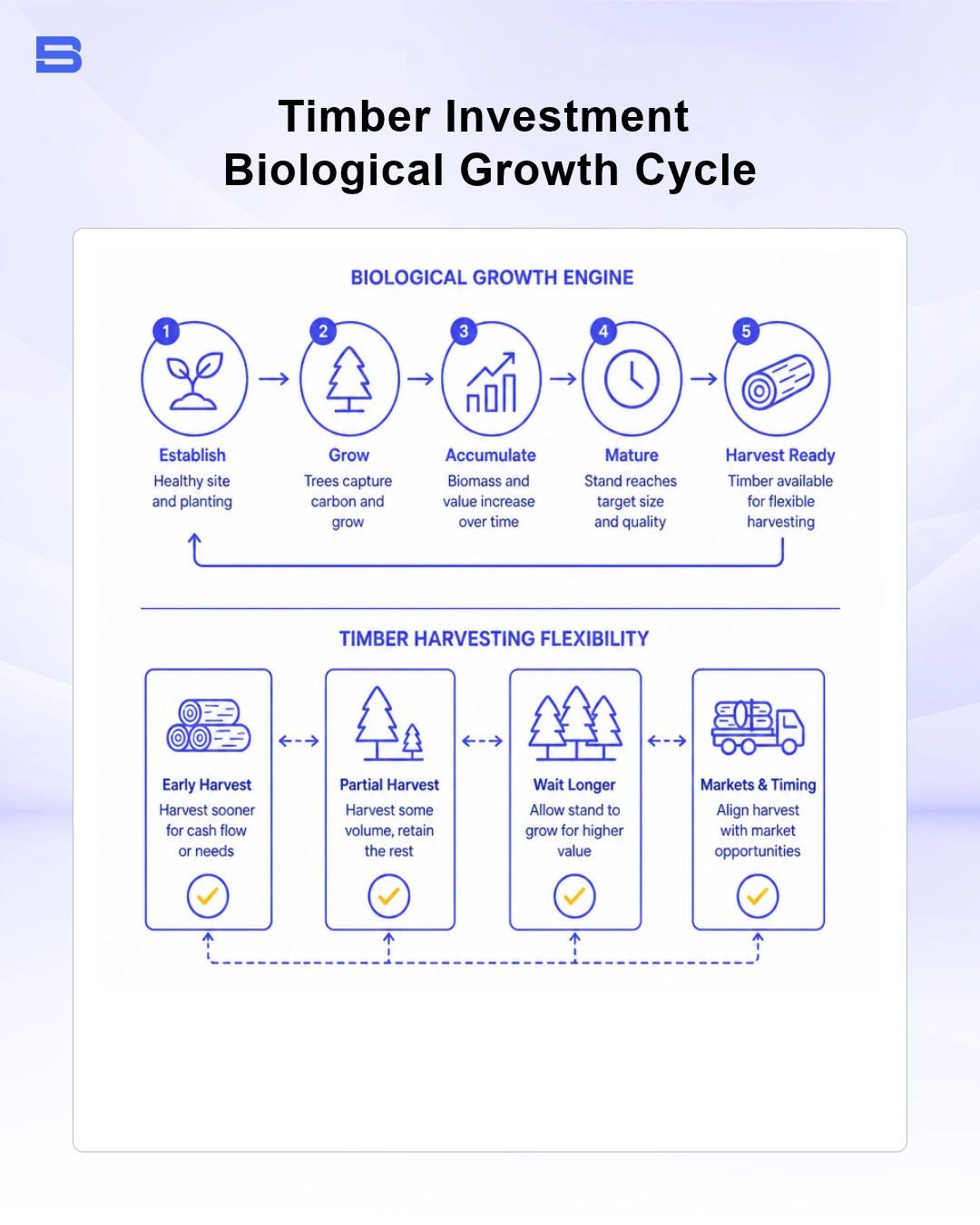
The Biological Growth Rate: Real Value Accrual Independent of Markets
At the heart of timberland investment is the biological growth rate. A planted forest expands in both timber volume and wood quality every single year, regardless of interest rates, stock market sell-offs, or geopolitical crises. A young tree suitable only for low-value paper pulp eventually grows into high-value sawtimber used in home construction and furniture manufacturing.
This internal growth engine adds a layer of return that is disconnected from financial market sentiment. While equity prices fluctuate based on investor confidence, a commercial pine or hardwood forest accrues physical volume quietly on its own schedule.
Capitalizing on Timber Harvest Timings
The most powerful risk-management feature of physical timber is harvest optionality. If global timber prices crash during an economic downturn, a timberland manager is not forced to cut and sell trees at a loss.
Instead, the manager can delay harvesting for several years. During this holding period, the trees do not degrade; they continue to grow, moving into higher product classes and accumulating volume. Once lumber prices recover, the manager harvests a larger, higher-value asset, effectively storing capital "on the stump."
Core Characteristics of Timberland Investment
Timberland investment exhibits structural characteristics that distinguish it from mainstream financial instruments. Historically favored by university endowments and pension funds, timberland serves as a portfolio stabilizer rather than a quick speculative engine.
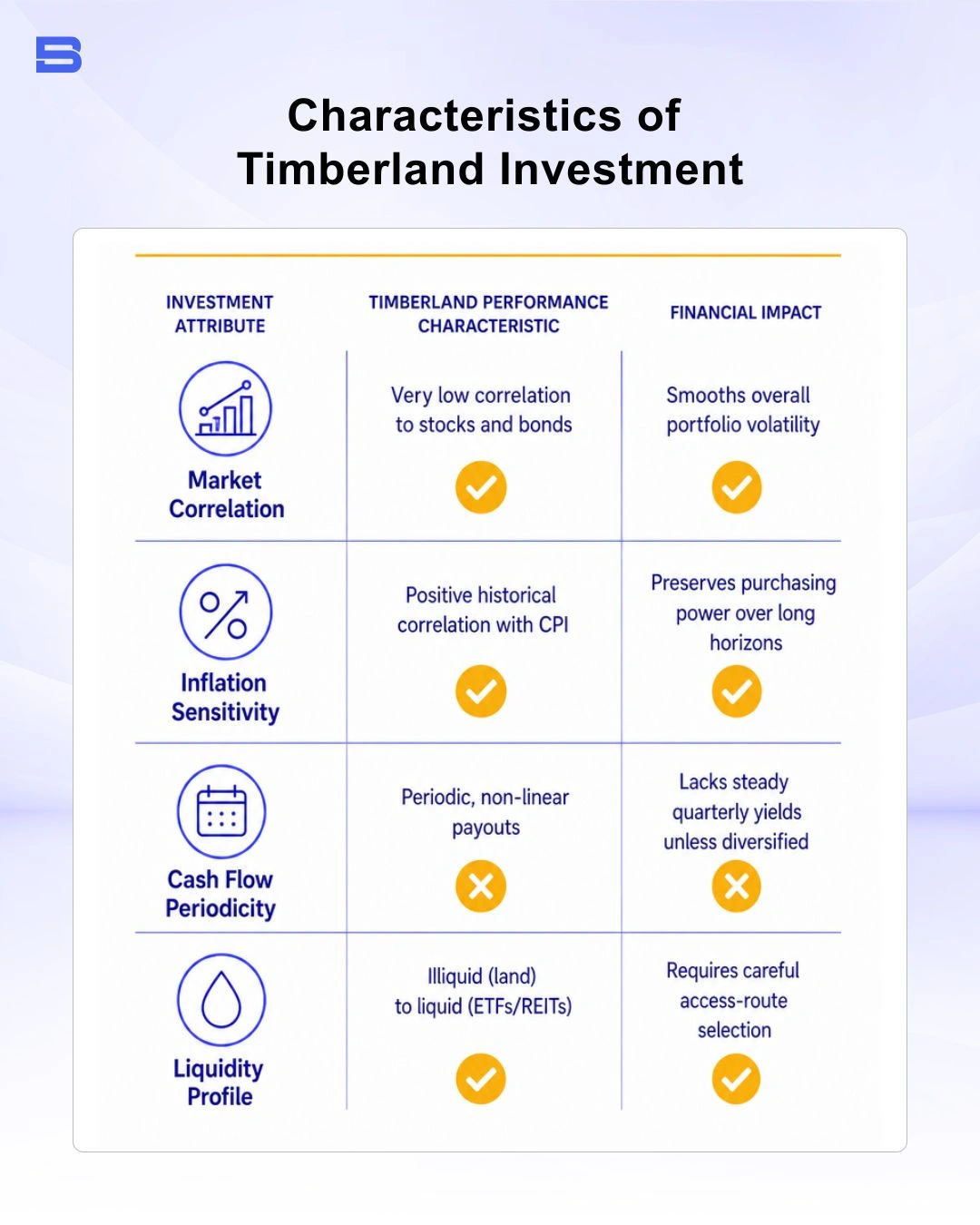
Inflation Hedging and Market Non-Correlation
Timber prices are directly tied to basic building blocks of the economy: housing starts, packaging, infrastructure, and consumer goods. Historically, timberland returns have shown a strong positive correlation with inflation indices. As raw material costs rise across the broader economy, the value of standing timber adjusts upward accordingly.
Furthermore, because biological growth drives a major portion of total returns, timberland historically maintains a low correlation to public equity markets. This structural independence helps reduce overall portfolio drawdowns during major stock market contractions.
Portfolio Diversification Mechanics
Integrating real assets like forestland into a multi-asset portfolio expands the efficient frontier. Institutions utilize timber assets to balance fixed-income yields—which lose purchasing power during inflationary spikes—with an asset that grows in real physical volume over decades.
When combined with traditional equities and fixed income, timberland acts as a structural shock absorber.
How Do You Invest in Timber? Retail and Institutional Access Routes
According to the US Securities and Exchange Commission (SEC), private-market investing — historically concentrated among institutional investors, family offices, and high-net-worth individuals — now offers multiple access points, depending on an investor's capital, liquidity needs, eligibility, and investment horizon.
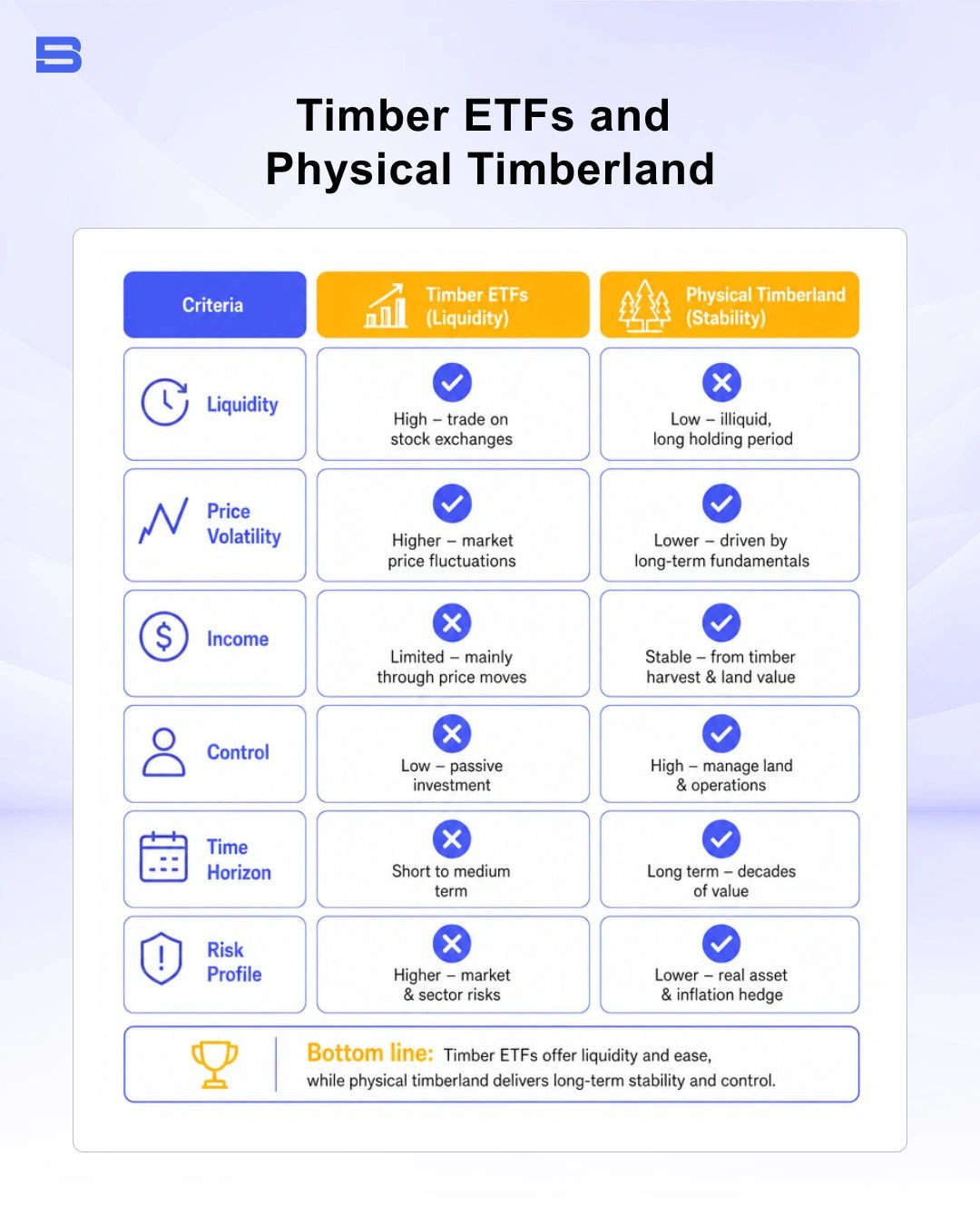
Public Equities: Timber Exchange-Traded Funds (ETFs) and Timber REITs
For retail investors who require liquidity and low entry thresholds, public equities offer immediate access to forest supply chains.
- Timber ETFs: Exchange-traded funds like the iShares Global Timber & Forestry ETF (WOOD) or Invesco Morgan Stanley Capital International (MSCI) Global Timber ETF (CUT) aggregate global forest product companies, timberland owners, and paper packaging producers. They offer instant diversification and intraday liquidity, though their pricing correlates more tightly with broader stock markets than physical timberland.
- Timber REITs: Real Estate Investment Trusts (REITs) such as Weyerhaeuser (WY) and Rayonier (RYN) own and manage large portfolios of timberland. Under US federal tax rules, REITs generally must distribute at least 90% of their REIT taxable income annually to shareholders to maintain REIT status. This structure allows investors to gain exposure to timberland through publicly traded equities.
Direct Timberland and TIMOs
For accredited and institutional investors seeking pure asset exposure free from stock market sentiment, private options exist:
- Timberland Investment Management Organizations (TIMOs): TIMOs act as specialized managers that pool private equity capital to buy, manage, and harvest physical commercial forests on behalf of institutional clients. They require substantial minimum commitments and multi-year capital lock-ups.
- Direct Acreage Ownership: Purchasing private forest acreage directly gives full land control. However, this approach carries heavy management overhead, requiring local forestry consultants, property maintenance, tax administration, and land oversight.
Beyond timber, accredited investors frequently evaluate private equity infrastructure or direct alternative yields via private placement vehicles.
Timber Investment vs. Farmland Investment: Asset Class Comparison
If you're evaluating real assets, you'll likely weigh timberland alongside farmland investment. While both rely on biological assets and land ownership, their operational dynamics differ significantly.
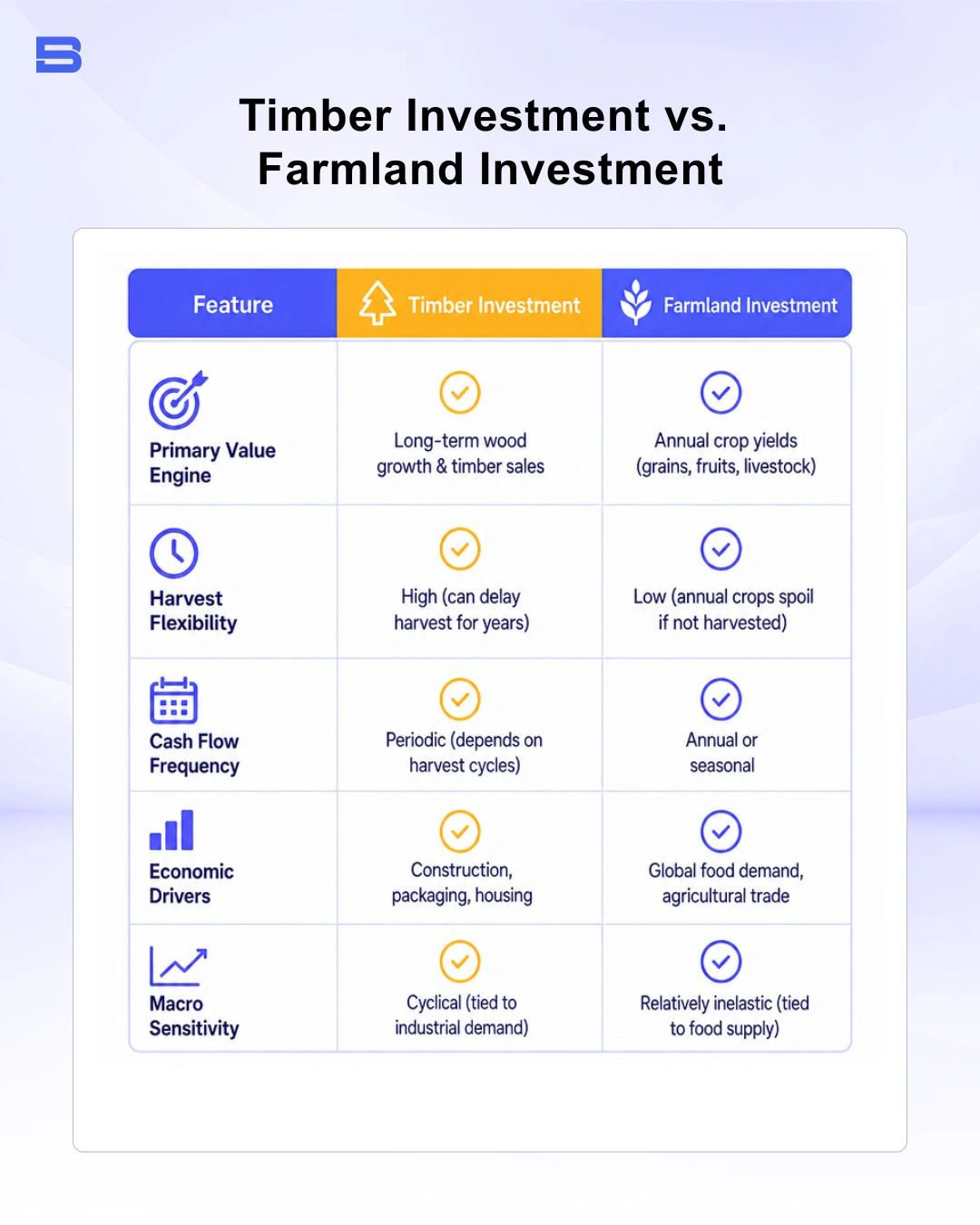
While farmland offers consistent annual cash flow from crop harvests, timberland provides greater harvest flexibility. If crop prices plummet, a farmer must still harvest and sell at market rates; a forest owner simply leaves the trees standing to accumulate further volume.
Sustainability and Environmental Factors in Timberland Assets
Modern forestry management increasingly integrates Environmental, Social, and Governance (ESG) investing principles. Sustainable forest management certifications—such as the Forest Stewardship Council (FSC) or Sustainable Forestry Initiative (SFI)—ensure commercial harvesting maintains soil health, protects watersheds, and preserves biodiversity.
Furthermore, standing timber serves as a natural carbon sink. This carbon storage capacity creates commercial opportunities through carbon credit trading. Forest owners can sometimes earn offset credits by extending timber harvest rotations or preserving high-conservation acreage, creating a secondary revenue stream alongside traditional wood product sales.
For investors interested in sustainable private capital models, exploring alternative impact strategies through venture funding or private markets provides a broader view of private allocation options.
Essential Risk Management: Timberland Risks and Mitigation
Despite its defensive reputation, timberland is not without risk. A balanced investment strategy requires weighing biological, environmental, and market exposure carefully alongside the capital upside — no single ratio applies to every portfolio.
Biological and Physical Hazards
Natural disasters represent the most direct threat to standing forest inventory:
- Wildfires & Severe Weather: A catastrophic wildfire or hurricane can destroy decades of standing timber value overnight. Mitigation relies on geographic diversification across multiple climate regions and specialized timberland hazard insurance.
- Pests and Disease: Outbreaks like the mountain pine beetle can ruin vast tracts of commercial softwood. Sustainable forest management practices, thin-out treatments, and planting mixed species help reduce infestation risks.
Illiquidity and Market Demand Risks
Physical timberland is inherently illiquid. Buying or selling a forest parcel requires environmental audits, land surveys, and extensive due diligence that can take months or years. Investors who need immediate cash availability risk being forced to sell land at a discount.
Additionally, timber values are tied to macro construction cycles. A prolonged crash in global housing starts reduces demand for lumber, depressing timber prices. While harvest optionality helps cushion this risk, long-term downturns can delay anticipated cash distributions. Investors comparing alternative private yield options might also examine short-term yield structures like invoice financing or alternative credit options to balance liquidity needs.
Balancing Timberland in Your Strategy
Timber investment offers a distinct combination of biological asset accumulation, inflation protection, and low correlation to traditional equity markets. Whether accessed through public timber REITs for market liquidity or private TIMOs for direct exposure, forest assets can act as a stabilizing foundation within a broader portfolio.
However, the advantages of physical timberland must be balanced against its illiquidity, extended investment horizons, and biological risks. By matching your allocation route to your liquidity needs and risk tolerance, timberland can serve as an effective real-asset anchor for long-term wealth preservation.
- What Can You Trade? A Guide to Forex, Stocks, and More
- CFD Trading for Beginners
- What is CFD Trading and How Does It Work?
- Forex vs. Stocks: Which Market Suits You Best?
- How to Diversify a Portfolio Across Asset Classes
- How Dividend Stocks Work: Yields, Risks, and Strategies
- Silver Trading Explained: A Guide for Retail Investors
- Precious Metals Trading: A Complete Guide for Beginners
- Natural Gas Trading: A Guide to the Market
- Structured Warrants Malaysia: How They Work and Risks
- What Is the KLCI Index and How to Trade It
- Gold Investment in Malaysia: A Complete Guide for Beginners
- What Is Kijang Emas and How to Invest in It
- Value Investing Explained: How to Find Undervalued Stocks
- How to Trade Bitcoin Safely: A Complete Market Guide
- Growth Investing Explained: Strategies, Metrics, and Risks
- What Is Digital Gold Malaysia and How to Invest
- Crypto Trading Strategies for Beginners
- Gold vs Bitcoin: Key Differences, Risks, and Strategies
- Sukuk: A Guide for Beginners to Islamic Bonds
- What Is FCPO (Crude Palm Oil Futures) and How to Trade It
- How to Identify and Invest in Shariah-Compliant Stocks
- Timber Investment: Is It Worth It?
- Gold ETF Malaysia: A Guide for Beginners
- What Are Malaysian Government Securities (MGS)?
- Corporate Bonds Malaysia: A Guide for Beginners
- China A-Shares Trading Guide for Malaysian Investors
- What Is a Silver ETF and How to Invest in It?
- How to Trade XRP: A Practical Guide for Retail Investors
- How to Trade Solana (SOL): A Guide for Beginners
- What Are Gold Futures and How Do They Work?
- Money Market Fund in Malaysia: A Guide for Beginners
- Property Investment Malaysia: Direct Real Estate or M-REITs?
- What Is Binance Coin and How Does It Work?
- Green Sukuk: A Guide for Beginners to Islamic ESG Investing
- What Is Shiba Inu (SHIB) and How to Trade It
- What Is USDT? A Complete Guide to Tether for Beginners
- What Is Dogecoin and How to Trade It Safely for Beginners
- Cardano: A Guide for Beginners to Trade This Cryptocurrency
- Polkadot: A Guide to Trading This Cryptocurrency
- Tron: A Guide for Beginners to Trading This Cryptocurrency
- What Is Litecoin (LTC)? A Guide to Trading Digital Silver
- What Is Chainlink (LINK) and How to Trade It
- How to Trade Pepe Coin: Spot, Leverage, and Risk Management
- Near Protocol: A Guide to Trading This Cryptocurrency
- Trading Polygon Crypto: A Practical Guide for Beginners
- Trade Toncoin: Understanding the TON Ecosystem and Risks
- Cosmos Crypto: Ecosystem Architecture, Tokenomics, and Risks
- Stellar Crypto: A Guide to Trading This Cryptocurrency
- Avalanche Crypto Explained: A Practical Guide for Traders
- What Is Worldcoin? How to Trade WLD and Manage Risk
- Aptos: A Guide for Beginners to Trading This Cryptocurrency
- Sui Crypto Explained: Tokenomics and Trading Guide
- Celestia: A Guide to Trading This Cryptocurrency
- Decentraland: A Guide to Trading This Cryptocurrency
- What Is Arbitrum? How to Trade the Leading Layer 2 Network
- Sei Crypto: A Guide to Trading This Cryptocurrency
- What Is Injective Protocol and How to Trade INJ Safely
Disclaimer: The content on this page is intended for educational and informational purposes only. It does not constitute financial, investment, tax, or legal advice, and should not be interpreted as a recommendation to buy, sell, or hold any financial instrument or asset. Trading and investing involve significant risk, including the possible loss of your entire capital. Products such as forex, CFDs, and cryptocurrencies carry additional risks due to leverage, high volatility, and limited regulatory protection in some jurisdictions. Past performance of any financial instrument does not guarantee future results. Any market views, forecasts, or opinions expressed are those of the author at the time of writing and may not reflect current market conditions. Platform features, fees, and regulatory status are subject to change — always verify information directly with the relevant provider or regulator before making any financial decision. BrokerSpecs may receive compensation from third parties featured on this site. Always conduct your own due diligence and consider seeking advice from a licensed financial professional before investing.