



Related Tags
Entering the Malaysian equity market for the first time can feel overwhelming when daily headlines bounce between soaring banking shares and sudden commodity sell-offs. Instead of analyzing hundreds of individual stock charts, institutional investors and retail traders alike track a single unified figure to gauge the country's economic temperature: the FTSE Bursa Malaysia KLCI. Understanding how this benchmark operates—and the specific execution instruments used to trade it—is a foundational skill for anyone building a portfolio in Southeast Asia.
What Is the FTSE Bursa Malaysia KLCI Index?
The FTSE Bursa Malaysia KLCI (FBM KLCI), commonly referred to as the KLCI index, is the primary market benchmark tracking the top 30 eligible companies listed on Bursa Malaysia's Main Market by free-float market capitalization.
Jointly maintained by FTSE Russell and Bursa Malaysia, the index uses a free-float market capitalization weighting methodology. Rather than simply taking a company’s raw size, the index calculation considers only the shares available for public trading, excluding restricted holdings such as cross-holdings, strategic government stakes, and insider lock-ups. To qualify for constituent inclusion during the semi-annual reviews in June and December, a stock must pass two critical filters:
- Free-Float Screening: Under the FTSE Bursa Malaysia Index Series Ground Rules, a company must have at least 15% free float to be eligible for inclusion in the index.
- Liquidity Screening: Constituent candidates must turn over a sufficient percentage of their equity daily to ensure the index reflects tradable market depth rather than illiquid price spikes.
Top 30 Heavyweights and Sector Composition
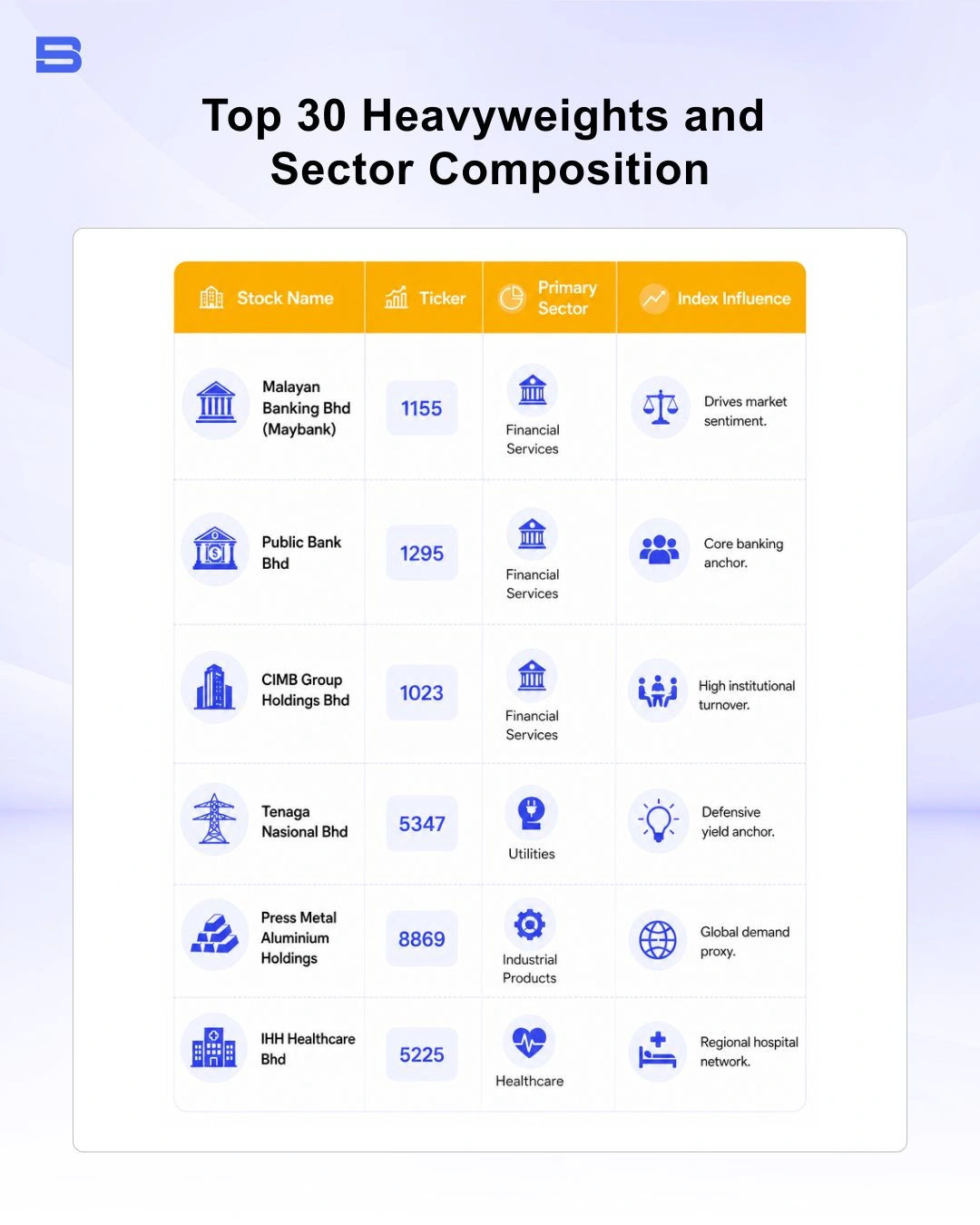
Because the index relies on market-cap weighting, performance is heavily concentrated in a handful of corporate giants. According to the FTSE Bursa Malaysia KLCI factsheet, the banking sector represents the largest sector allocation, accounting for approximately 44% of the index as of February 27, 2026. Consequently, broad market movements in Malaysia often correlate directly with central bank interest rate decisions and commercial banking credit growth.
The infographic below outlines key constituents that frequently hold significant weight within the benchmark:
Ways to Gain Exposure to the KLCI Index
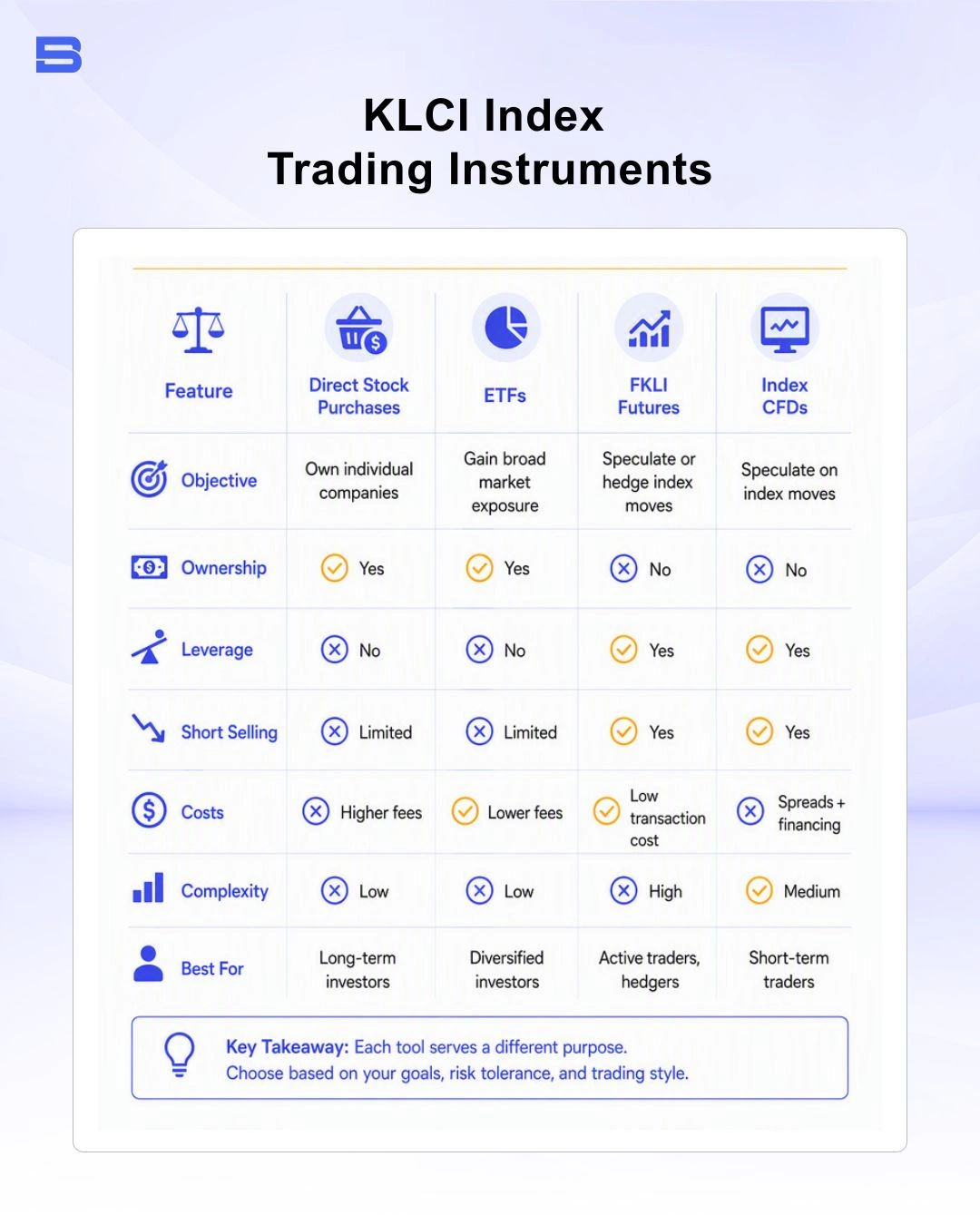
Traders and investors looking to participate in the performance of the KLCI Index do not need to buy all 30 companies manually. Depending on your capital size, risk tolerance, and investment horizon, several execution methods exist for index trading.
Buying Direct Constituent Stocks
The most straightforward way to gain exposure is to manually purchase shares of individual blue-chip constituents listed on the exchange. To do this legally in Malaysia, an investor opens a direct or nominee Central Depository System (CDS) account in Malaysia through an SC-regulated broker approved by the Securities Commission Malaysia (SC).
- Pros: Complete control over company selection, voting rights, and direct collection of corporate dividends.
- Cons: Capital-intensive to construct a diversified 30-stock portfolio, with high cumulative transaction fees across multiple order tickets.
KLCI Index ETFs (0820EA)
For broad exposure in a single order ticket, investors use exchange-traded funds (ETFs). In Malaysia, the FTSE Bursa Malaysia KLCI ETF (Ticker: 0820EA) passively tracks the underlying benchmark.
Instead of buying 30 separate stocks, purchasing shares of 0820EA gives you proportional exposure to the full basket. If you are learning how to buy ETFs in Malaysia, this ETF trades on Bursa Malaysia like a standard stock, requiring no specialized futures clearance.
- Pros: Low capital barrier, instant diversification across all 30 component stocks, and low management expense ratios.
- Cons: Lower daily trading volume compared to Western index ETFs, which can lead to wider bid-ask spreads during volatile sessions.
Trading FKLI Futures vs Spot KLCI
For active traders requiring short-term flexibility, market liquidity centers on derivative markets. FKLI (FTSE Bursa Malaysia KLCI Futures) is a ringgit-denominated index futures contract traded on Bursa Malaysia Derivatives.
Unlike spot stocks or ETFs, FKLI allows traders to take both long (buying) and short (selling) positions using financial leverage.
- Leverage and Margins: Rather than paying the full cash value of the index, per Bursa Malaysia Derivatives' contract specifications, traders post an initial margin requirement to control a contract representing MYR 50 per index point. Leverage amplifies returns when your market directional bias is correct, but it accelerates capital destruction just as quickly when prices move against you—a sharp market shift can wipe out your initial margin balance rapidly.
- Expiration and Cash Settlement: FKLI contracts operate on monthly expiration cycles and settle in cash, making them popular for institutional hedging against cash equity drawdowns.
KLCI Index CFDs for International Traders
Global retail traders often access Malaysian equities through Contracts for Difference (CFDs) provided by international brokerages. Index CFDs mirror the price fluctuations of the underlying spot KLCI index or FKLI price action without requiring a direct Malaysian CDS account.
- Pros: Allows flexible micro-lot position sizing, lower initial margin thresholds, and easy short-selling functionality.
- Cons: Over-the-counter (OTC) execution means counterparty risk rests with the CFD broker, and open positions held past daily market closes accrue overnight financing fees (swap rates).
Market Characteristics and Risks of the KLCI Index
Before allocating capital to the Malaysian benchmark, traders should evaluate its unique structural traits:
Dividend Yield vs Growth Dynamics
Historically, the KLCI index has functioned as an income and defensive benchmark rather than a high-growth technology engine, thanks to heavy financial, utility, and telecommunication allocations. In June 2025, the FBM KLCI had a 12-month forward dividend yield of 4.2%, according to CIMB Securities as quoted by The Star. However, capital appreciation can trail regional tech-heavy indices trading during global equity bull runs.
Concentration Risk
Because the financial services sector — which includes banking — accounts for more than 40% of the FBM KLCI's weighting as of February 27, 2026, sector-specific developments in banking can have a significant influence on the index, potentially making its performance less representative of broader economic conditions. Investors seeking broader real estate or mid-cap exposure often supplement their holdings by researching REIT Malaysia or sector-specific unit trusts.
Currency and Volatility Considerations
For international traders operating in US Dollar (USD) or Singapore Dollar (SGD), trading the KLCI introduces foreign exchange risk tied to the Malaysian Ringgit (MYR). Additionally, while local market circuit breakers enforce price stability during extreme market distress, foreign capital outflows can lead to prolonged consolidation periods.
Conclusion
The FTSE Bursa Malaysia KLCI remains the primary gauge for measuring blue-chip performance and economic health in Malaysia. Whether you choose passive indexing through the 0820EA ETF, direct blue-chip stock ownership, or tactical trading via FKLI futures, balancing your potential returns against leverage and sector concentration risk is essential for long-term trading sustainability.
- What Can You Trade? A Guide to Forex, Stocks, and More
- CFD Trading for Beginners
- What is CFD Trading and How Does It Work?
- Forex vs. Stocks: Which Market Suits You Best?
- How to Diversify a Portfolio Across Asset Classes
- How Dividend Stocks Work: Yields, Risks, and Strategies
- Silver Trading Explained: A Guide for Retail Investors
- Precious Metals Trading: A Complete Guide for Beginners
- Natural Gas Trading: A Guide to the Market
- Structured Warrants Malaysia: How They Work and Risks
- What Is the KLCI Index and How to Trade It
- Gold Investment in Malaysia: A Complete Guide for Beginners
- What Is Kijang Emas and How to Invest in It
- Value Investing Explained: How to Find Undervalued Stocks
- How to Trade Bitcoin Safely: A Complete Market Guide
- Growth Investing Explained: Strategies, Metrics, and Risks
- What Is Digital Gold Malaysia and How to Invest
- Crypto Trading Strategies for Beginners
- Gold vs Bitcoin: Key Differences, Risks, and Strategies
- Sukuk: A Guide for Beginners to Islamic Bonds
- What Is FCPO (Crude Palm Oil Futures) and How to Trade It
- How to Identify and Invest in Shariah-Compliant Stocks
- Timber Investment: Is It Worth It?
- Gold ETF Malaysia: A Guide for Beginners
- What Are Malaysian Government Securities (MGS)?
- Corporate Bonds Malaysia: A Guide for Beginners
- China A-Shares Trading Guide for Malaysian Investors
- What Is a Silver ETF and How to Invest in It?
- How to Trade XRP: A Practical Guide for Retail Investors
- How to Trade Solana (SOL): A Guide for Beginners
- What Are Gold Futures and How Do They Work?
- Money Market Fund in Malaysia: A Guide for Beginners
- Property Investment Malaysia: Direct Real Estate or M-REITs?
- What Is Binance Coin and How Does It Work?
- Green Sukuk: A Guide for Beginners to Islamic ESG Investing
- What Is Shiba Inu (SHIB) and How to Trade It
- What Is USDT? A Complete Guide to Tether for Beginners
- What Is Dogecoin and How to Trade It Safely for Beginners
- Cardano: A Guide for Beginners to Trade This Cryptocurrency
- Polkadot: A Guide to Trading This Cryptocurrency
- Tron: A Guide for Beginners to Trading This Cryptocurrency
- What Is Litecoin (LTC)? A Guide to Trading Digital Silver
- What Is Chainlink (LINK) and How to Trade It
- How to Trade Pepe Coin: Spot, Leverage, and Risk Management
- Near Protocol: A Guide to Trading This Cryptocurrency
- Trading Polygon Crypto: A Practical Guide for Beginners
- Trade Toncoin: Understanding the TON Ecosystem and Risks
- Cosmos Crypto: Ecosystem Architecture, Tokenomics, and Risks
- Stellar Crypto: A Guide to Trading This Cryptocurrency
- Avalanche Crypto Explained: A Practical Guide for Traders
- What Is Worldcoin? How to Trade WLD and Manage Risk
- Aptos: A Guide for Beginners to Trading This Cryptocurrency
- Sui Crypto Explained: Tokenomics and Trading Guide
- Celestia: A Guide to Trading This Cryptocurrency
- Decentraland: A Guide to Trading This Cryptocurrency
- What Is Arbitrum? How to Trade the Leading Layer 2 Network
- Sei Crypto: A Guide to Trading This Cryptocurrency
- What Is Injective Protocol and How to Trade INJ Safely
Disclaimer: The content on this page is intended for educational and informational purposes only. It does not constitute financial, investment, tax, or legal advice, and should not be interpreted as a recommendation to buy, sell, or hold any financial instrument or asset. Trading and investing involve significant risk, including the possible loss of your entire capital. Products such as forex, CFDs, and cryptocurrencies carry additional risks due to leverage, high volatility, and limited regulatory protection in some jurisdictions. Past performance of any financial instrument does not guarantee future results. Any market views, forecasts, or opinions expressed are those of the author at the time of writing and may not reflect current market conditions. Platform features, fees, and regulatory status are subject to change — always verify information directly with the relevant provider or regulator before making any financial decision. BrokerSpecs may receive compensation from third parties featured on this site. Always conduct your own due diligence and consider seeking advice from a licensed financial professional before investing.