


Related Tags
Imagine checking your Web3 wallet and seeing several thousand dollars worth of Ether and stablecoins sitting completely dormant. In traditional banking, those deposits might earn a negligible fractional interest rate while the financial institution lends them out.
In decentralized finance (DeFi), yield farming offers a different arrangement: protocols invite you to lock those idle assets into automated smart contracts, advertising projected annual returns from about 5% to well into triple digits as of November 2026, though these projections are not guaranteed and your capital may lose value.
What Is Yield Farming?
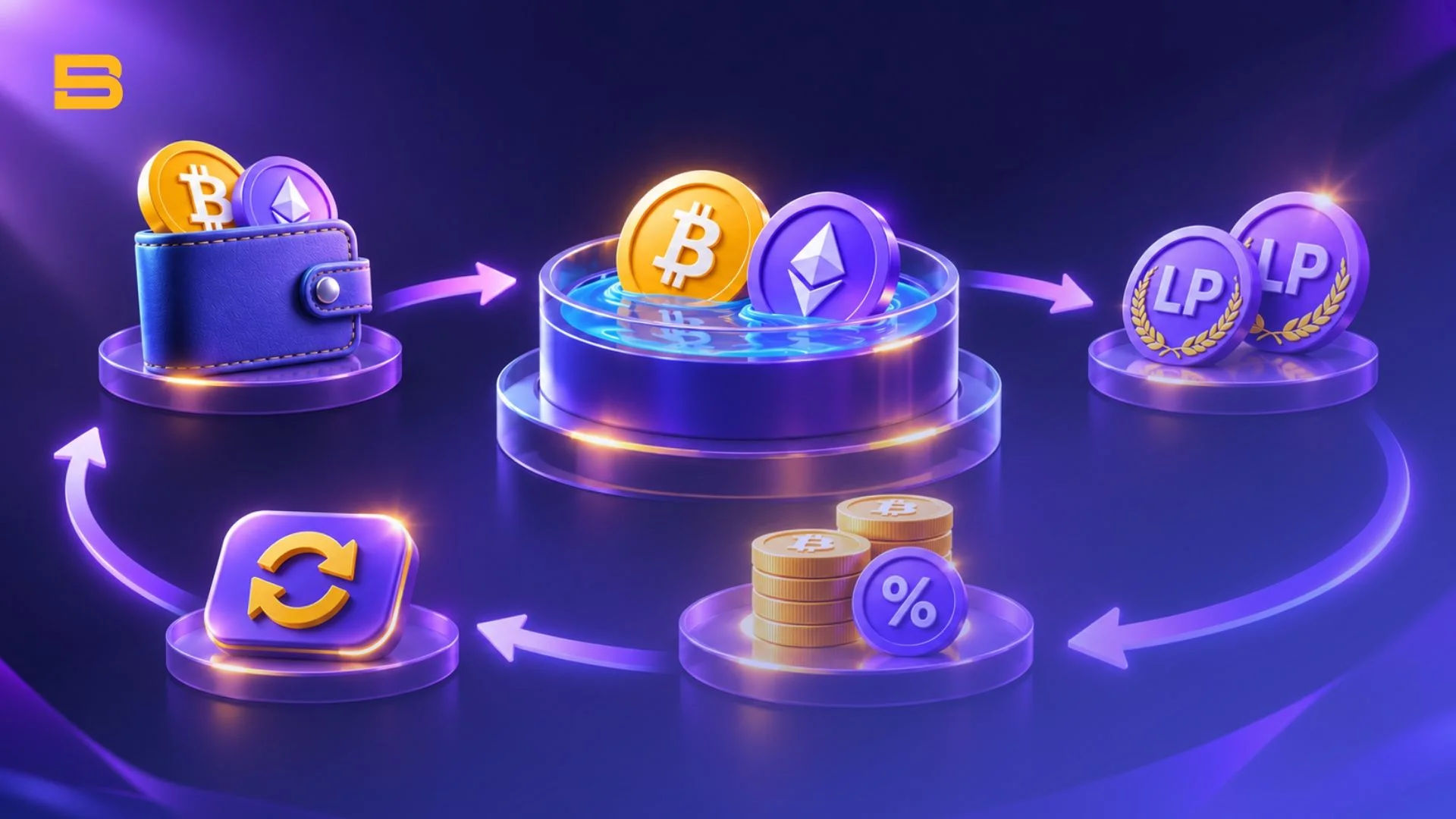
Yield farming is a decentralized finance mechanism where cryptocurrency holders lock digital assets into smart-contract-based liquidity pools to earn transaction fees and token incentives. Instead of relying on a centralized intermediary, market participants supply liquidity directly to autonomous software programs known as Automated Market Makers (AMMs).
When you deposit assets into a farm, you provide the balance sheet capital that allows other decentralized participants to trade, borrow, or swap tokens peer-to-peer. In return for underwriting this market liquidity, the protocol awards you a portion of every trading fee generated by the pool.
To boost adoption and deepen order books, protocols often sweeten the arrangement through liquidity mining incentives. This involves distributing secondary native governance tokens directly to liquidity providers on top of base swap fees. While this secondary layer can raise published return figures, it also exposes your capital to severe token dilution and systemic protocol risks.
How Liquidity Pools Work in Yield Farming
At the center of any yield farm is the liquidity pool, a smart contract containing paired reserves of cryptocurrency tokens. Traditional financial exchanges use centralized order books where market makers match individual bids and asks. Decentralized protocols instead use mathematical algorithms to price assets dynamically based on the ratio of tokens held in reserve. The most common is the constant product formula, x × y = k, where x and y are the reserves of the two tokens and k is a constant.
When you contribute capital, you must supply equal values of both paired assets, such as $1,000 worth of ETH alongside $1,000 worth of USDC. Once confirmed on the blockchain, the contract mints Liquidity Provider (LP) tokens representing your proportionate claim on the pool’s total reserves. Every time a trader swaps tokens through that pool, a trading fee (commonly between 0.05% and 0.30% as of the publication date of this article, depending on the protocol and pool) is distributed proportionally among all LP token holders.
A 2024 working paper from the Bank for International Settlements (BIS) on Uniswap v3 found that liquidity provision was concentrated among a small group of sophisticated providers, while retail providers tended to earn a smaller share of fees and lower risk-adjusted returns. If trading volume dries up, fee revenue collapses while underlying asset exposure remains entirely unhedged.
The Role of Tokenomics and Reward Dilution
Published yield farming yields often look high because they combine base swap fees with secondary governance token emissions. This dynamic is dictated entirely by a protocol’s tokenomics, which govern how quickly new tokens are minted and released into circulating supply.
If a farm emits millions of new governance tokens daily to pay liquidity providers, aggressive sell pressure frequently follows as farmers harvest and dump rewards immediately. Without continuous external utility or organic demand, reward tokens can suffer rapid depreciation, causing your realized return to end up far below the headline rate advertised at deposit.
What Is Impermanent Loss in Yield Farming?
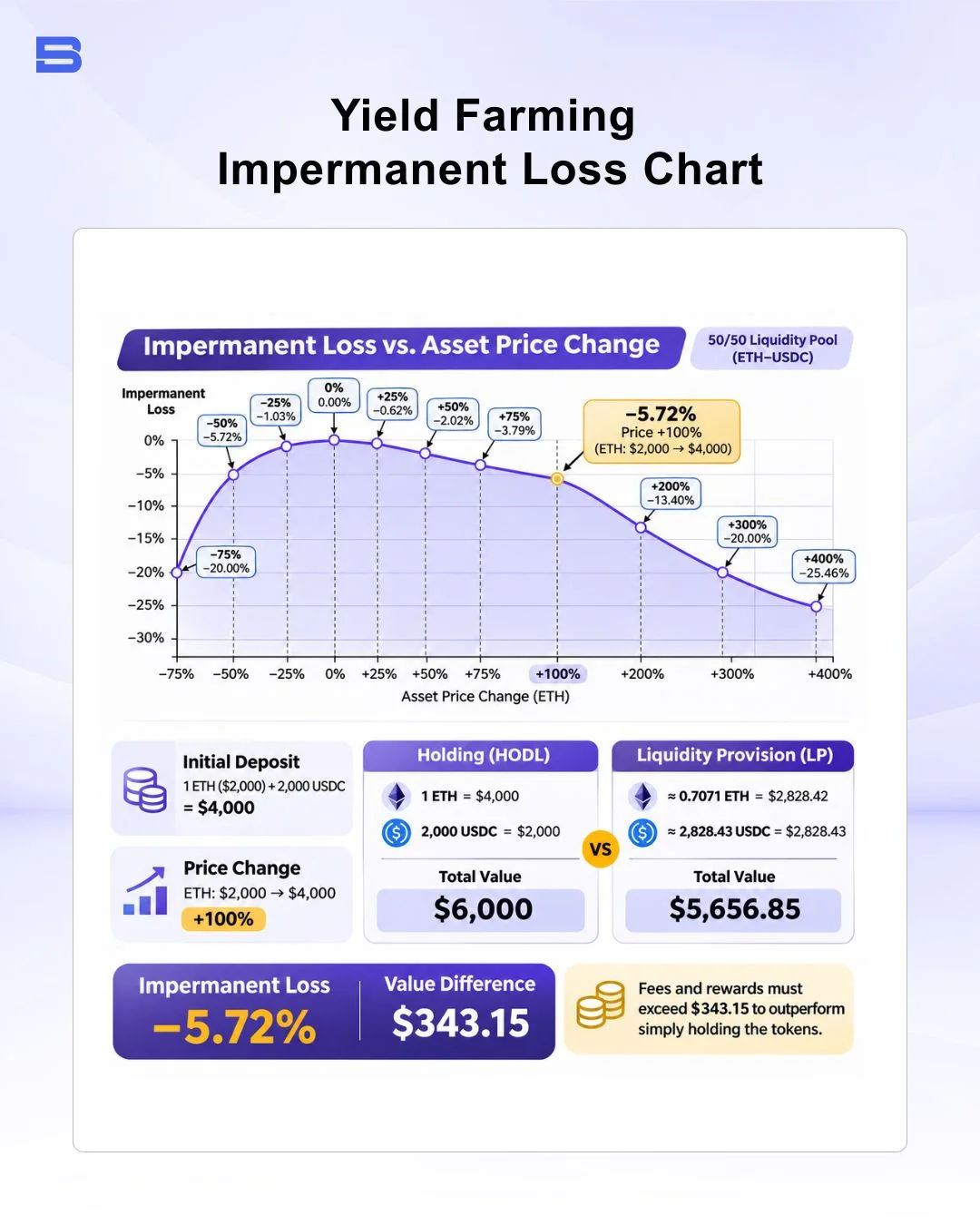
Impermanent loss in yield farming represents the percentage difference in total portfolio value between supplying assets to a liquidity pool versus simply holding them in a private wallet. This divergence happens because AMM pricing formulas constantly rebalance your deposit toward whichever asset is dropping in relative price, effectively selling the appreciating asset early while accumulating more of the depreciating one.
Consider a concrete worked example:
Suppose you deposit 1 ETH (valued at $2,000) and 2,000 USDC into a standard 50/50 liquidity pool, representing a total capital commitment of $4,000.
Over the next two months, broader market demand causes the price of ETH to double from $2,000 to $4,000:
- Holding Scenario (HODL): If you had kept the tokens in your non-custodial wallet, you would own 1 ETH ($4,000) and 2,000 USDC, bringing your total portfolio value to $6,000.
- Liquidity Provision Scenario: Arbitrageurs (traders who profit from price gaps between markets) rebalance the pool to reflect the external $4,000 market price. Applying the constant product formula, your share of the pool now contains approximately 0.7071 ETH and 2,828.43 USDC.
- Outcome: Your combined liquidity pool holdings are now valued at $5,656.85, consisting of $2,828.42 and $2,828.43 across the two pool positions.
Comparing the two outcomes reveals a divergence of $343.15, meaning you suffered an impermanent loss of roughly 5.72% relative to holding. If the swap fees and liquidity rewards earned during those two months failed to exceed $343.15, you experienced an absolute net loss compared to simple passive holding.
The loss is termed "impermanent" because it can theoretically reverse if token ratios return to their initial state, but it becomes permanent the exact second you withdraw your assets.
Yield Farming vs. Staking: Key Differences
While frequently conflated in retail marketing campaigns, yield farming and single-asset crypto staking represent fundamentally different mechanisms, risk profiles, and operational complexities. Understanding what staking is in crypto is essential before allocating capital across decentralized applications.
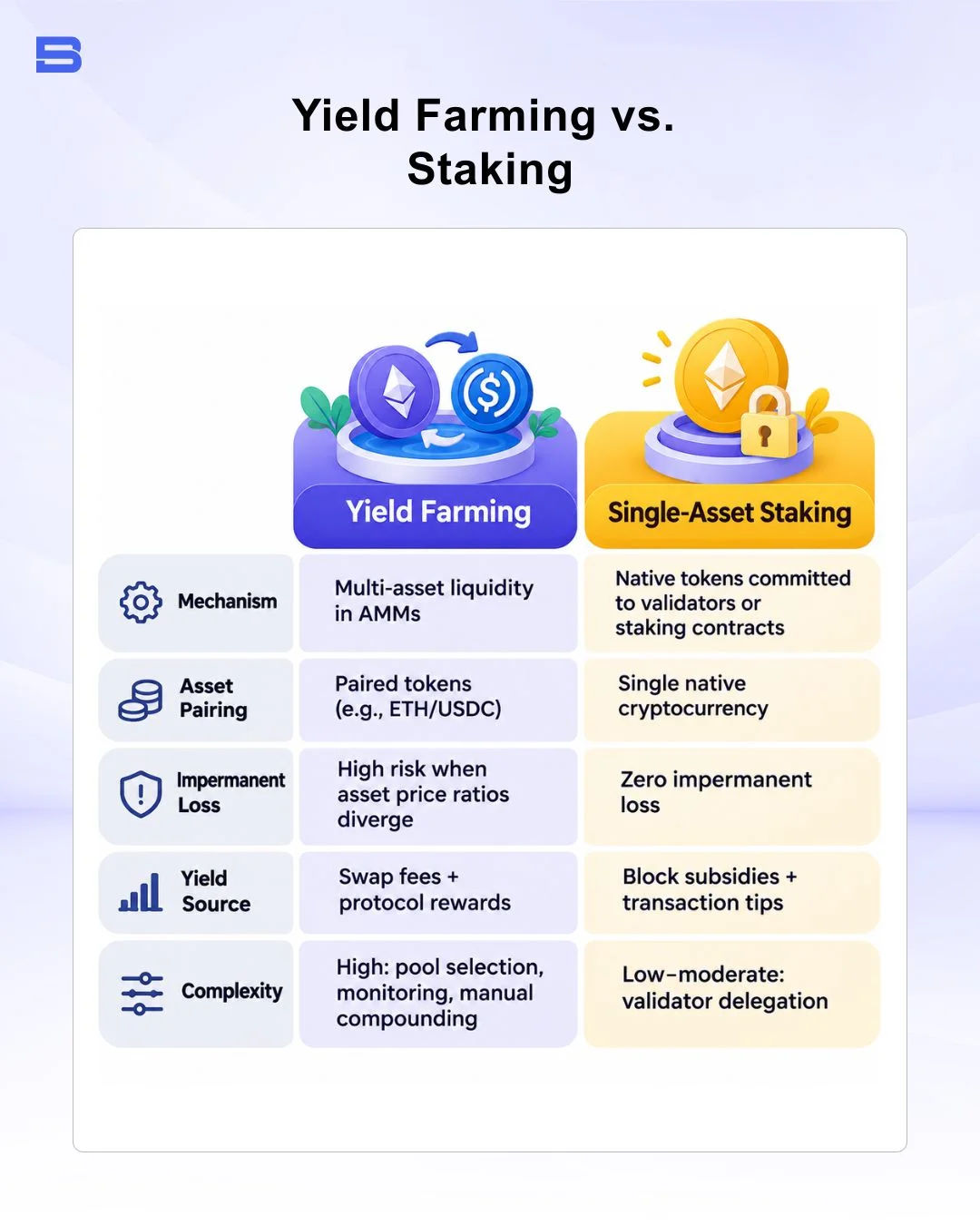
Staking involves committing a single proof-of-stake asset (such as ETH or SOL) to validate blockchain transactions and secure the underlying consensus network. Yield farming, by contrast, requires pairing multiple assets within external application-level smart contracts to facilitate decentralized exchange trading.
Strategic Risk Management in Yield Farming
Yield farming is not a passive savings account. It is an active market-making strategy exposed to severe counterparty, technical, and market risks. Smart contract vulnerabilities are a serious threat because a single coding flaw, logic exploit, or attack can drain a liquidity pool’s reserves in seconds and may leave your LP tokens worthless.
Regulatory authorities, including the US Securities and Exchange Commission (SEC) and the Monetary Authority of Singapore (MAS), have cautioned that decentralized finance activity can fall outside licensing and investor-protection frameworks, so retail participants may lack protections such as deposit insurance.
Advanced liquidity providers often deploy delta-hedging strategies to mitigate market exposure. By opening an offsetting short position on centralized derivative exchanges or utilizing decentralized perpetual protocols, traders can hedge the directional price swings of their volatile pool assets. However, hedging carries its own distinct operational expenses, specifically requiring you to manage the funding rate (the periodic payment between traders holding long and short perpetual positions) and monitor leverage liquidation thresholds.
Readers who want directional exposure under formal regulatory oversight may compare these approaches with CFD trading, where licensed brokers operate under a regulator’s rules. However, CFDs are leveraged products, and the level of regulatory protection varies by jurisdiction.
Calculating APY vs. APR in DeFi Yields
Evaluating farm returns requires distinguishing between Annual Percentage Rate (APR) and Annual Percentage Yield (APY). APR reflects simple, uncompounded annual interest generated by fees and rewards over 12 months. APY accounts for the mathematical compounding effect of reinvesting those earned rewards back into the principal liquidity pool.
A protocol advertising a 100% APR yields a substantially higher APY if you harvest and reinvest rewards daily. However, high-frequency compounding also racks up blockchain network transaction fees, which can quickly consume returns in smaller retail portfolios. Always calculate projected yields net of gas costs and token depreciation.
Conclusion
Yield farming provides transparent mechanics for crypto holders to earn a share of decentralized exchange fees, functioning as on-chain market makers rather than passive depositors. However, headline yields must always be weighed against impermanent loss, emissions dilution, and contract vulnerabilities.
Evaluating a farm requires dissecting its underlying tokenomics, auditing status, and net fee generation before deploying your capital. Limiting the share of your capital placed in any single farm can reduce concentration risk, and unusually high advertised yields may signal a scam or unsustainable incentives.
- What Can You Trade? A Guide to Forex, Stocks, and More
- CFD Trading for Beginners
- What is CFD Trading and How Does It Work?
- Forex vs. Stocks: Which Market Suits You Best?
- How to Diversify a Portfolio Across Asset Classes
- How Dividend Stocks Work: Yields, Risks, and Strategies
- Silver Trading Explained: A Guide for Retail Investors
- Precious Metals Trading: A Complete Guide for Beginners
- Natural Gas Trading: A Guide to the Market
- Structured Warrants Malaysia: How They Work and Risks
- What Is the KLCI Index and How to Trade It
- Gold Investment in Malaysia: A Complete Guide for Beginners
- What Is Kijang Emas and How to Invest in It
- Value Investing Explained: How to Find Undervalued Stocks
- How to Trade Bitcoin Safely: A Complete Market Guide
- Growth Investing Explained: Strategies, Metrics, and Risks
- What Is Digital Gold Malaysia and How to Invest
- Crypto Trading Strategies for Beginners
- Gold vs Bitcoin: Key Differences, Risks, and Strategies
- Sukuk: A Guide for Beginners to Islamic Bonds
- What Is FCPO (Crude Palm Oil Futures) and How to Trade It
- How to Identify and Invest in Shariah-Compliant Stocks
- Timber Investment: Is It Worth It?
- Gold ETF Malaysia: A Guide for Beginners
- What Are Malaysian Government Securities (MGS)?
- Corporate Bonds Malaysia: A Guide for Beginners
- China A-Shares Trading Guide for Malaysian Investors
- What Is a Silver ETF and How to Invest in It?
- How to Trade XRP: A Practical Guide for Retail Investors
- How to Trade Solana (SOL): A Guide for Beginners
- What Are Gold Futures and How Do They Work?
- Money Market Fund in Malaysia: A Guide for Beginners
- Property Investment Malaysia: Direct Real Estate or M-REITs?
- What Is Binance Coin and How Does It Work?
- Green Sukuk: A Guide for Beginners to Islamic ESG Investing
- What Is Shiba Inu (SHIB) and How to Trade It
- What Is USDT? A Complete Guide to Tether for Beginners
- What Is Dogecoin and How to Trade It Safely for Beginners
- Cardano: A Guide for Beginners to Trade This Cryptocurrency
- Polkadot: A Guide to Trading This Cryptocurrency
- Tron: A Guide for Beginners to Trading This Cryptocurrency
- What Is Litecoin (LTC)? A Guide to Trading Digital Silver
- What Is Chainlink (LINK) and How to Trade It
- How to Trade Pepe Coin: Spot, Leverage, and Risk Management
- Near Protocol: A Guide to Trading This Cryptocurrency
- Trading Polygon Crypto: A Practical Guide for Beginners
- Trade Toncoin: Understanding the TON Ecosystem and Risks
- Cosmos Crypto: Ecosystem Architecture, Tokenomics, and Risks
- Stellar Crypto: A Guide to Trading This Cryptocurrency
- Avalanche Crypto Explained: A Practical Guide for Traders
- What Is Worldcoin? How to Trade WLD and Manage Risk
- Aptos: A Guide for Beginners to Trading This Cryptocurrency
- Sui Crypto Explained: Tokenomics and Trading Guide
- Celestia: A Guide to Trading This Cryptocurrency
- Decentraland: A Guide to Trading This Cryptocurrency
- What Is Arbitrum? How to Trade the Leading Layer 2 Network
- Sei Crypto: A Guide to Trading This Cryptocurrency
- What Is Injective Protocol and How to Trade INJ Safely
Disclaimer: The content on this page is intended for educational and informational purposes only. It does not constitute financial, investment, tax, or legal advice, and should not be interpreted as a recommendation to buy, sell, or hold any financial instrument or asset. Trading and investing involve significant risk, including the possible loss of your entire capital. Products such as forex, CFDs, and cryptocurrencies carry additional risks due to leverage, high volatility, and limited regulatory protection in some jurisdictions. Past performance of any financial instrument does not guarantee future results. Any market views, forecasts, or opinions expressed are those of the author at the time of writing and may not reflect current market conditions. Platform features, fees, and regulatory status are subject to change — always verify information directly with the relevant provider or regulator before making any financial decision. BrokerSpecs may receive compensation from third parties featured on this site. Always conduct your own due diligence and consider seeking advice from a licensed financial professional before investing. Portions of this article were prepared with the assistance of AI tools and reviewed by our editorial team before publication.