



Related Tags
The global forex market continues to evolve rapidly, and in 2026, emerging markets will take center stage. With faster economic growth, expanding digital ecosystems, and shifting global trade dynamics, these markets offer exciting opportunities for forex traders.
However, alongside the potential for higher returns comes increased volatility and risk. Understanding the trends shaping emerging market currencies is essential for traders looking to capitalize on this dynamic environment.
What is an Emerging Market?
Emerging markets represent a dynamic middle ground in the global economy for nations that have transitioned from a developing status but have not yet achieved the structural characteristics of advanced economies. It is often mentioned by investors when they are discussing growth opportunities beyond developed economies.
Characterized by industrialization, rising consumer demand, and infrastructure modernization, these developing regions offer high growth potential. However, despite accelerated growth, these regions may face issues in political volatility, evolving regulatory frameworks, and less predictable financial markets.
In forex trading, emerging-market currencies are often referred to as exotic pairs. They are typically traded against major currencies, such as the US dollar (USD). These pairings represent a geographical spectrum, spanning the high-tech manufacturing hubs of Asia, the resource-rich economies of Latin America, the burgeoning markets of Africa, and Eastern Europe, reflecting both the opportunities and complexities that define emerging market trading.
Key Emerging Market Trends in 2026
In 2026, emerging markets have solidified their roles as primary engines of the global economy, contributing to total world growth. This dominance is fueled by a massive surge in corporate earnings, specifically within technology and manufacturing sectors. The following are the factors of the emerging market in 2026:
Digital Transformation and Fintech Expansion
Emerging economies are increasingly bypassing legacy financial infrastructure in favor of a digital-first evolution. By leveraging traditional banking systems, these developing countries are utilizing mobile payments, digital wallets, and fintech platforms to increase currency flow in local markets.
Commodity-Driven Currency Movements
Many emerging markets rely heavily on commodity exports such as oil, metals, and agricultural products. Their currencies are strongly influenced by global commodity prices. Traders generally monitor these price movements to anticipate currency fluctuations.
Interest Rate Divergence
To maintain price stability and attract foreign capital, emerging market central banks frequently set interest rates significantly higher than those in developed nations. It creates an opportunity for carry trades where investors can profit from interest rate differentials between currencies.
De-dollarization Trends
Some countries are reducing their reliance on the US dollar in international trade. Bilateral agreements and trade are done in local currency. This transition signals a potential change in the forex market dynamics.
Geopolitical Realignments
Trade alliances and geopolitical partnerships remain the primary drivers of emerging market volatility in 2026. Supply chain diversification and new economic corridors are affecting currency demand and stability.
The global financial ecosystem is undergoing structural changes driven by technological leapfrogging, geopolitical realignment, and a move toward a multipolar monetary system. Through digital innovation and trade partnerships, these nations are becoming less dependent on Western financial anchors and more reliant on localized tech-driven economic ecosystems.
Opportunities in Emerging Forex Market Trading
Trading in the emerging forex market provides a high-reward environment fueled by elevated volatility, robust economic expansion, and attractive interest rate premiums. By shifting focus toward exotic pairs such as USD/MXN or USD/ZAR, investors can exploit substantial price swings and achieve a level of portfolio diversification that standard currency pairs cannot offer.
Trading in the emerging forex market provides a high-reward environment fueled by elevated volatility, robust economic expansion, and attractive interest rate premiums. By shifting focus toward exotic pairs such as USD/MXN or USD/ZAR, investors can exploit substantial price swings and achieve a level of portfolio diversification that standard currency pairs cannot offer.
Opportunities include benefiting from high-yield carry trades, tapping into long-term economic expansion of countries such as India and Vietnam, and capitalizing on market volatility driven by political or economic developments.
Key opportunities include:
High Volatility, Great Profit Potential
Major currency pairs often move in predictable patterns, whereas emerging market currencies are characterized by significant price fluctuations. For a trader, this instability is not a risk, but a primary driver of profitability.
Carry Trade Opportunities
Emerging economies often maintain higher interest rates to attract capital or combat inflation. However, for traders, this creates a yield advantage, allowing them to earn passive returns simply by holding a high-yielding currency against one with lower rates.
Undervalued Currency Potential
Economic or political conflict can lead to the undervaluation of emerging market currencies. For long-term investors, this temporary downward movement represents a strategic entry point for potentially significant gains as these currencies may strengthen over time.
Portfolio Diversification
Relying solely on major pairs like EUR/USD or GBP/USD can leave the portfolio vulnerable. By integrating emerging market currencies, a portfolio can help diversify across a broad range of economic drivers.
Emerging market currencies offer several compelling advantages for forex traders. Their higher volatility compared to major pairs creates more frequent price movements, which can translate into greater profit opportunities. Additionally, elevated interest rates in many emerging economies make them attractive for carry trades, allowing traders to benefit from profit differentials.
Beyond short-term gains, these currencies may also present long-term opportunities as periods of economic or political instability can lead to undervaluation. Incorporating emerging market currencies into a trading strategy can enhance portfolio diversification by reducing reliance on major currency pairs and spreading exposure across a wider range of economic drivers.
Risks of Trading Emerging Market Currencies
Trading in emerging markets also involves considerable risks, such as heightened volatility, limited liquidity, and elevated transaction costs. These markets are particularly vulnerable to political instability, abrupt policy changes, capital controls, and sharp reactions to global economic shifts and commodity price movements.
As a result, navigating emerging market currencies typically demands a high level of experience and active, disciplined risk management. Understanding these risks is essential for any trader looking to move beyond the relative safety of the currencies.
Primary risk factors:
Political and Regulatory Instability
In emerging markets, political risk is the primary driver of currency value as these markets are more sensitive to changes in governance and laws than their developed counterparts.
Liquidity Challenges
Emerging market currencies occupy a tier with significantly less depth than the majors. Because there are fewer participants buying and selling at any given moment, the cost of doing business can vary widely.
Inflation and Economic Volatility
Macroeconomic instability acts as a powerful downward force on currency value. When inflation outpaces economic growth, it weakens the purchasing power of the currency and triggers a cycle of devaluation that can be difficult for central banks to break.
External Debt Exposure
Emerging nations rely on foreign-currency debt that is mostly denominated in US Dollars. This creates an uncertain link between currency stability and global monetary policy when the Federal Reserve adjusts interest rates.
Emerging markets are exposed to structural risks that can impact their stability. Political and regulatory uncertainty typically plays a central role, as it can quickly influence market confidence. Limited liquidity can also lead to wider spreads and inconsistent trading conditions.
Engaging with emerging markets requires an understanding of the unique structural pressures that can undermine currency stability. While these markets offer high rewards, they are susceptible to a specific set of risks that can override traditional market logic.
Best Emerging Market Currency Pairs to Watch in 2026
Based on the 2026 economic outlook, several emerging market currency pairs are expected to experience heightened volatility and increased trading opportunities, supported by shifting global manufacturing trends, AI-driven economic expansion, and evolving regional trade relationships.
Below are some of the top emerging market currency pairs to keep an eye on in 2026: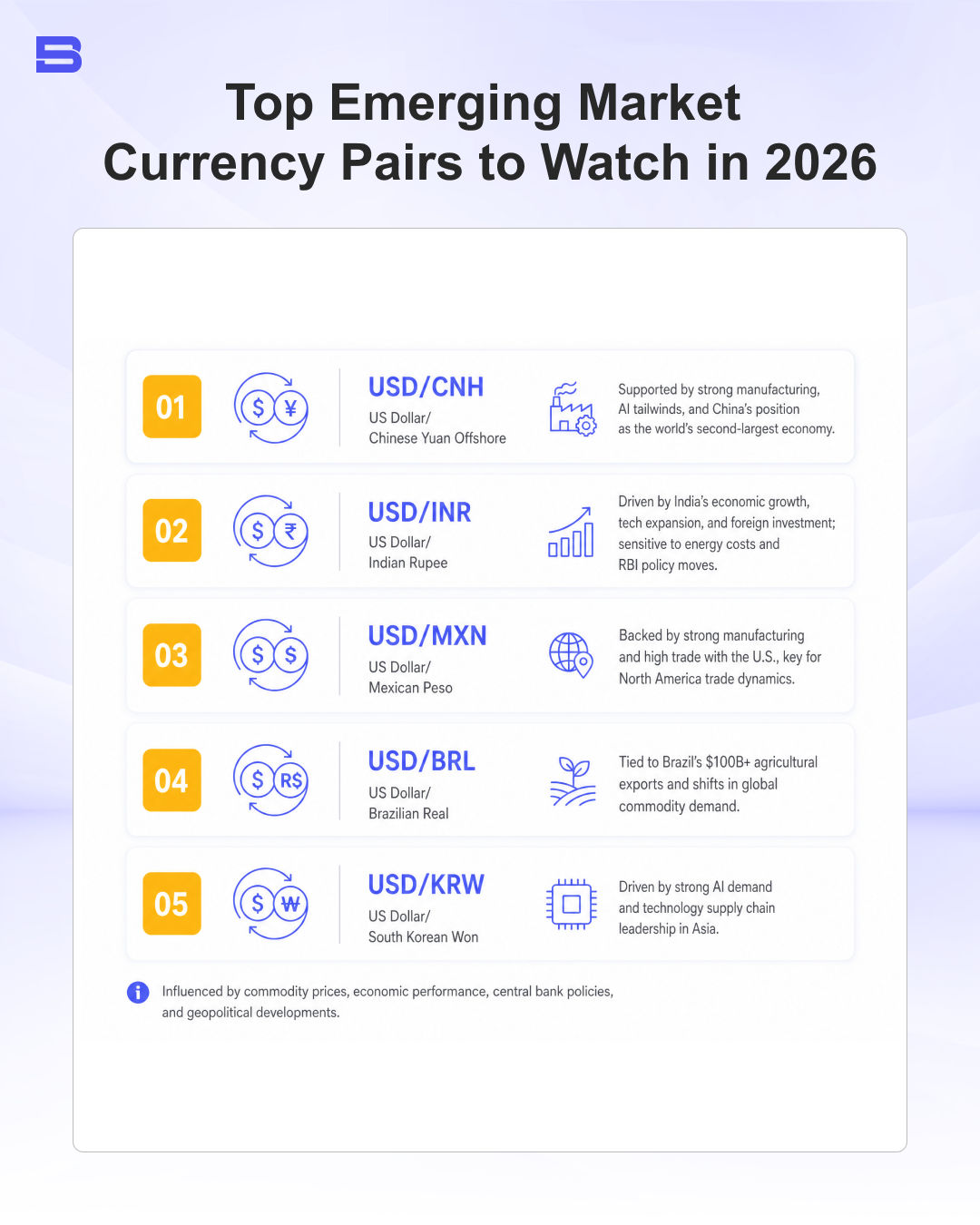
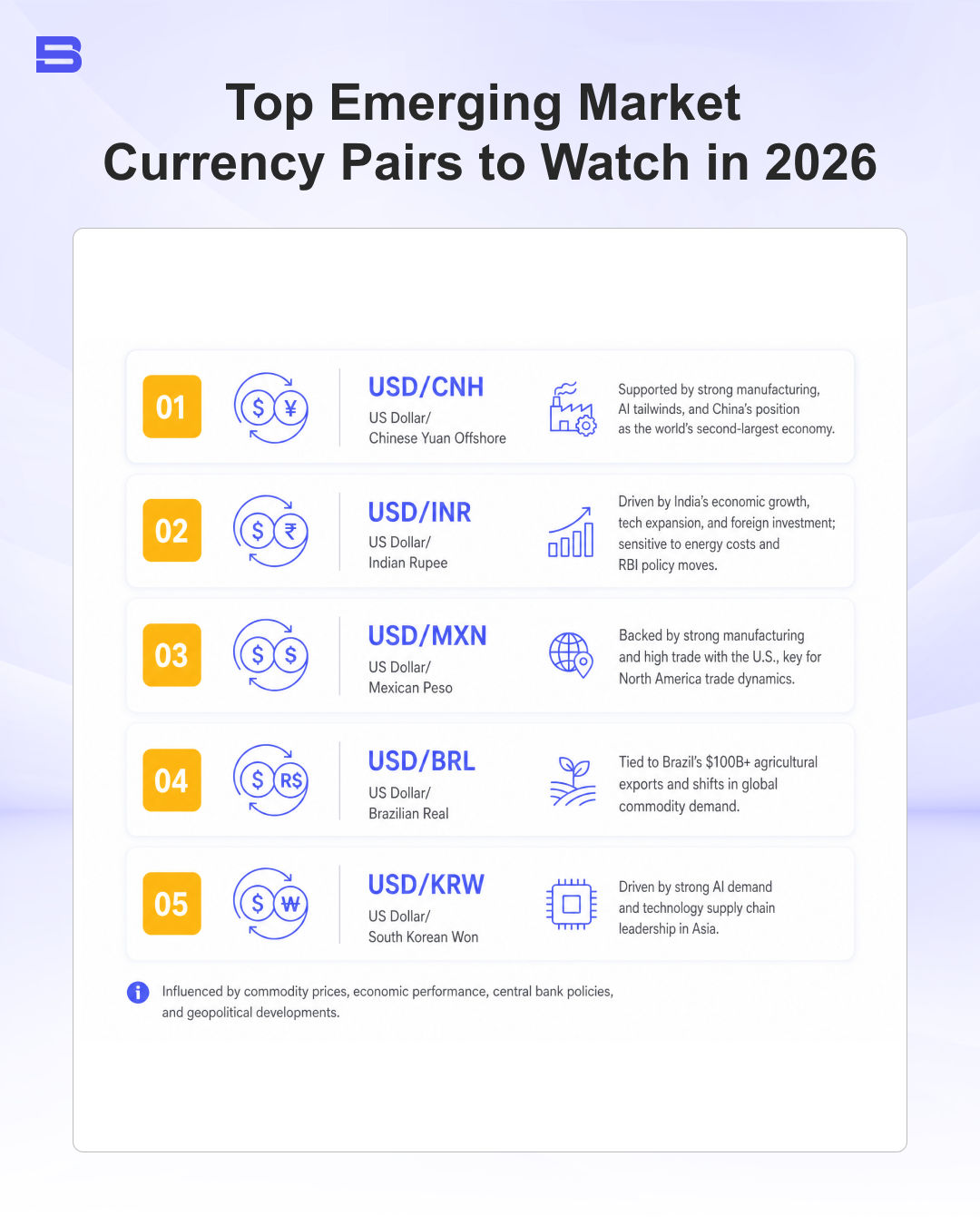
These currencies are shaped by a combination of commodity price movements, economic performance, central bank policies, and geopolitical developments, creating both opportunities and risks for forex traders.
Strategies for Trading Emerging Markets
Optimizing emerging market exposure in the current trends demands a multi-layered approach, such as monitoring GDP and inflation data. Having effective strategies can help you adapt to potential market shifts and maintain disciplined risk management through tools like stop-loss orders to handle high volatility.
Additionally, diversifying across different countries and using instruments such as ETFs or American Depositary Receipts (ADRs) can help reduce overall risk exposure. In 2026, the emerging market performance is divided based on technological utility. Trading strategies have shifted from general index tracking to selective exposure.
Key Trading Strategies:
Focus on Risk Management
Due to an increase in market volatility, traders should implement appropriate position sizing and use stop-loss orders to help limit potential losses.
Rely on Fundamental Analysis
Economic indicators such as inflation rates, GDP growth, and central bank policies play a significant role in shaping emerging markets.
Monitor Global Macro Trends
Keep an eye on macroeconomic drivers, specifically US monetary policy, fluctuations in commodity markets, and shifts in global trade dynamics.
Use Hedging Techniques
Utilizing hedging mechanisms serves as a vital tool against market volatility, particularly when navigating economic ambiguity.
Successful emerging market trading requires a strong focus on risk management, fundamental analysis, and awareness of global macroeconomic trends. Traders should manage volatility through proper position sizing, stop-loss orders, and hedging strategies, while closely monitoring economic indicators such as inflation rates and GDP growth to make informed decisions.
Future Outlook: Beyond 2026
The 2026 outlook for emerging market currencies remains a high-stakes landscape, with demand for high price volatility and political exposure. Navigating these dynamics effectively requires more than just an appetite for growth. It also requires discipline and a commitment to sophisticated hedging to survive sudden shifts in liquidity.
While emerging markets are capturing a larger share of global trade and evolving into more stable, liquid asset classes, they have not yet shed their inherent vulnerabilities. Despite this progress, emerging markets still may face persistent challenges, including political uncertainty, economic imbalances, and uneven growth conditions, which remain a significant risk for long-term currency positions.
Disclaimer: The content on this page is intended for educational and informational purposes only. It does not constitute financial, investment, tax, or legal advice, and should not be interpreted as a recommendation to buy, sell, or hold any financial instrument or asset. Trading and investing involve significant risk, including the possible loss of your entire capital. Products such as forex, CFDs, and cryptocurrencies carry additional risks due to leverage, high volatility, and limited regulatory protection in some jurisdictions. Past performance of any financial instrument does not guarantee future results. Any market views, forecasts, or opinions expressed are those of the author at the time of writing and may not reflect current market conditions. Platform features, fees, and regulatory status are subject to change — always verify information directly with the relevant provider or regulator before making any financial decision. BrokerSpecs may receive compensation from third parties featured on this site. Always conduct your own due diligence and consider seeking advice from a licensed financial professional before investing. Portions of this article were prepared with the assistance of AI tools and reviewed by our editorial team before publication.