


Related Tags
Entering the world of fixed-income investing often presents a difficult trade-off for climate-conscious investors who also seek Shariah-compliant opportunities. You want your capital to generate predictable income, but you also want assurance that your funds are actively supporting clean energy and sustainable infrastructure—without breaching Islamic financial principles.
For years, ethical investors had to choose between conventional green bonds that carry interest (riba) or standard Islamic bonds that lacked explicit environmental mandates. Green sukuk bridge this exact gap. By combining the asset-backed structure of Islamic finance with strict sustainability criteria, these instruments allow you to fund tangible, eco-friendly projects while earning fixed-income yields.
What Is a Green Sukuk and How Does It Work?
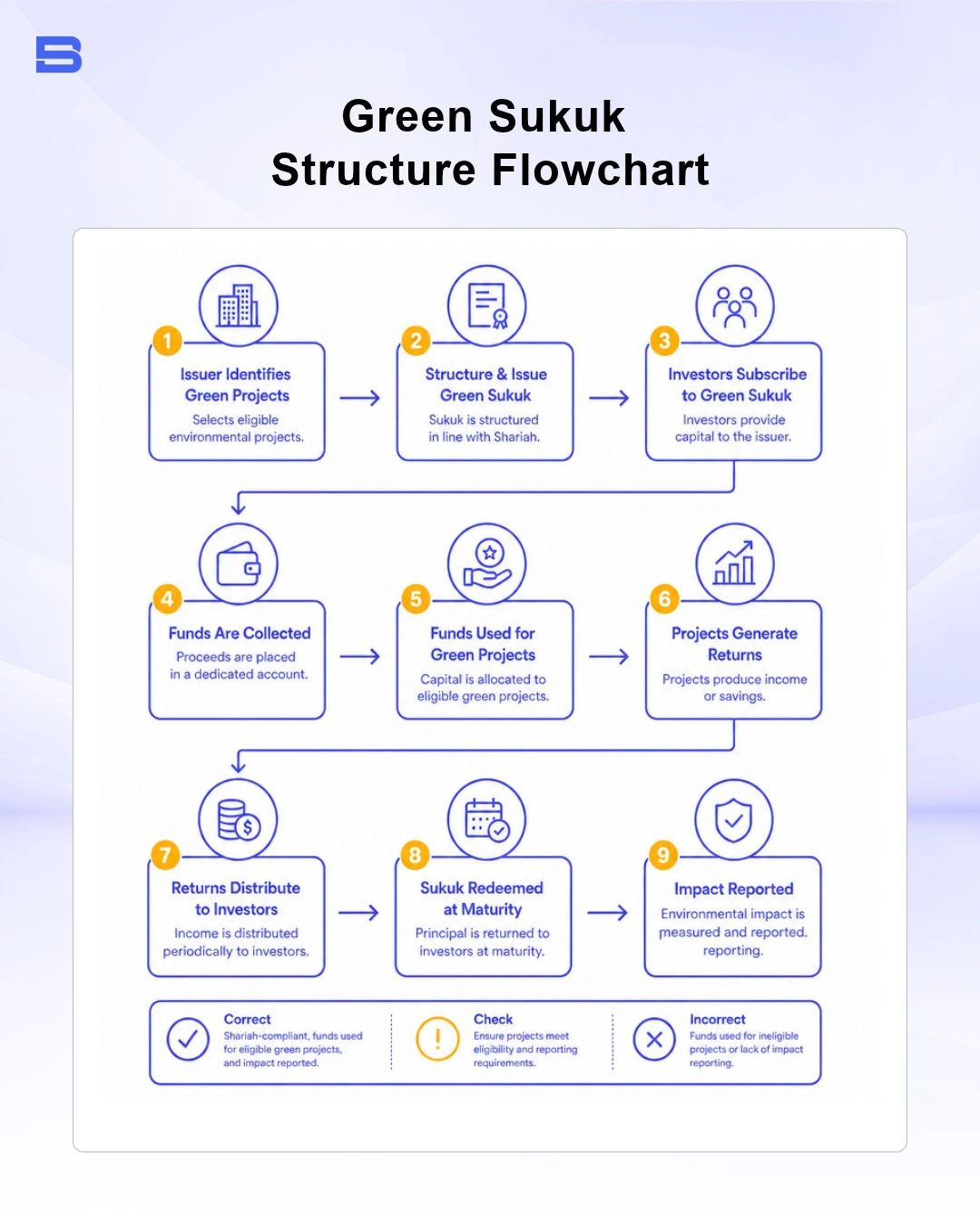
A green sukuk is an asset-backed or asset-based Islamic financial certificate where the proceeds are strictly earmarked to finance or refinance climate-friendly and environmentally sustainable projects. Unlike conventional bonds—which represent a direct debt obligation paying interest—a sukuk represents undivided partial ownership in a tangible underlying asset or business venture.
When an entity issues a green sukuk, the capital raised from investors is placed into an independent Special Purpose Vehicle (SPV). The SPV uses these funds to acquire or construct specific eco-friendly assets, such as solar farms, hydroelectric facilities, or energy-efficient real estate. Yields distributed to you as an investor are derived from the commercial income generated by these underlying assets—such as revenues from selling renewable electricity—rather than interest payments.
The regulatory framework for these instruments is backed by rigorous institutional standards. In Malaysia, for example, issuers operate under the Securities Commission Malaysia (SC) Sustainable and Responsible Investment (SRI) Sukuk Framework. Globally, issuers align with the International Capital Market Association (ICMA) Green Bond Principles.
Shariah Compliance and ESG Alignment
Islamic finance naturally intersects with Environmental, Social, and Governance (ESG) principles. Shariah principles strictly prohibit riba (usury/interest), gharar (excessive uncertainty), and investment in non-ethical industries such as alcohol, gambling, or tobacco.
Green sukuk build upon this baseline by introducing environmental stewardship (khilafah). Under Shariah governance, money cannot simply generate money out of thin air; capital must be anchored to real, productive physical assets. Because green infrastructure requires significant physical capital—such as wind turbines, railway grids, or water recycling plants—the asset-backed nature of Shariah finance provides an ideal legal and structural vehicle for green funding.
Green Sukuk vs. Standard Sukuk: What Is the Difference?
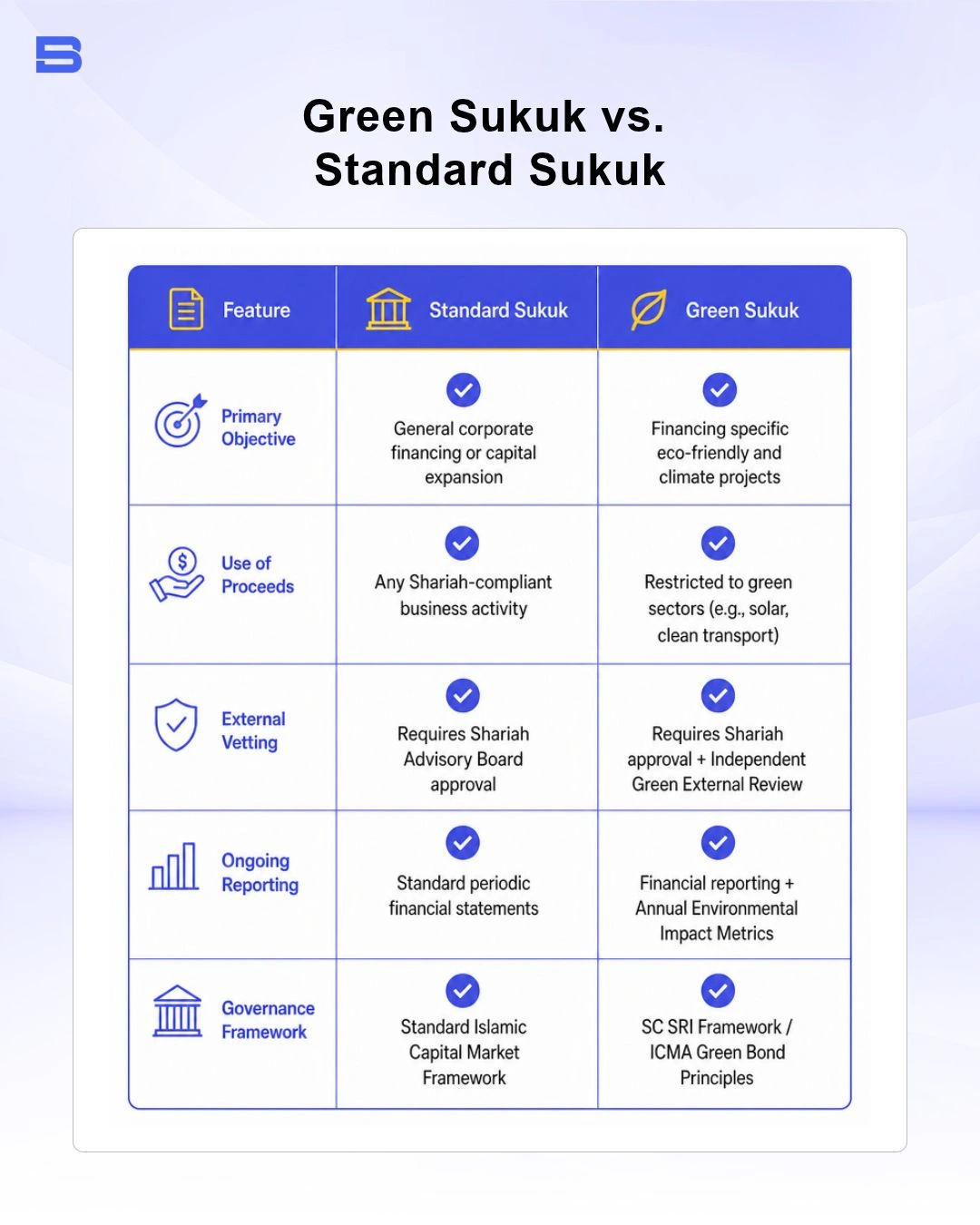
While both standard sukuk and green sukuk follow Islamic commercial law, their operational mandates and reporting obligations differ significantly.
Standard sukuk allow issuers to deploy raised capital for general corporate purposes, working capital, or refinancing existing debt, provided the activities remain Shariah-compliant. A green sukuk, however, legally restricts the use of proceeds exclusively to pre-approved environmental activities. Furthermore, green sukuk issuers must undergo an independent third-party framework assessment before issuance and commit to annual impact reporting.
How Green Sukuk Fits Into ESG Investing
Sustainable Islamic finance has expanded beyond its traditional regional base, with ESG sukuk becoming an increasingly important segment of global sustainable fixed-income markets. According to Fitch Ratings, global outstanding ESG sukuk reached approximately US$58 billion at the end of 2025, up around 30% year on year.
Issuance was concentrated in key Islamic finance markets, led by Saudi Arabia, Malaysia, the UAE and Indonesia.
For investors building a diversified portfolio, green sukuk offer an effective asset class for ESG investing. Institutional asset managers use these securities to meet carbon-reduction mandates without taking on equity-market volatility.
As governments globally commit to net-zero targets, demand for green fixed income continues to outpace primary market supply, leading to strong subscription rates during initial public offerings.
Green Sukuk vs. Other Malaysian Fixed-Income Instruments
Understanding where green sukuk sit within the local landscape requires comparing them to standard benchmark instruments available to retail and institutional investors.
In Malaysia, the primary risk-free fixed-income benchmarks are Malaysian government securities (conventional MGS) and Government Investment Issues (GII, the Islamic sovereign equivalent). Conventional corporate bonds in Malaysia sit at the higher end of the yield curve, offering higher returns in exchange for private credit risk.
These instruments generally occupy a middle tier in terms of return and credit risk. Green sukuk issued by the government (or government-linked entities) tend to carry the same strong credit ratings as MGS/GII. Green sukuk issued by private companies usually pay a bit more, since you're taking on more risk tied to that company's own financial health.
Benefits and Risks of Investing in Green Sukuk
Like any investment asset, green sukuk present a specific mix of potential advantages and structural risks that you must evaluate before allocating capital.
Investment Benefits
- Predictable Income Streams: Regular profit distributions provide a stable cash flow profile similar to conventional bonds.
- Dual Ethical Screening: Investments pass both Shariah compliance reviews and independent ESG audit standards.
- Capital Protection via Underlying Assets: The asset-backed or asset-based structure means your investment is secured by physical infrastructure or operational leases.
- Tax Incentives: In Malaysia, regulatory and government measures, such as SC Malaysia support for sustainable sukuk issuance through tax deductions on qualifying SRI sukuk issuance costs and grant schemes that help offset external review expenses. These incentives are designed to reduce issuance costs and encourage the development of Malaysia's sustainable Islamic capital market.
Key Investment Risks
- Credit and Default Risk: A green label does not eliminate corporate credit risk. If the project company or corporate guarantor faces financial distress, coupon payments can be delayed or suspended.
- Greenwashing Risk: There is a risk that an issuer fails to allocate capital as promised or overstates the environmental benefits of the underlying asset.
- Secondary Market Liquidity: Many institutional investors hold green sukuk to maturity due to strong ESG mandates, which can lead to lower trading volume on secondary markets for individual retail traders.
- Yield Parity: Green sukuk usually do not pay a "premium" yield over conventional instruments of the same credit rating; you are investing for ethical alignment and risk diversification, not above-market returns.
Worked Investment Scenario
Consider an investor allocating RM10,000 into a corporate green sukuk issued under the SC SRI framework with an AA2 credit rating (a strong investment-grade rating on the national scale, signaling low default risk), paying an indicative profit rate of 4.2% p.a. with semi-annual payouts.
- Annual Distribution: RM10,000 x 4.2% = RM420 per year (paid as RM210 every six months).
- 5-Year Total Return: Over a 5-year tenure, total distributions equal RM2,100, assuming no credit default occurs.
- Risk Consideration: If the project issuer experiences operational delays—such as grid connection issues at a solar plant—the credit rating agency may downgrade the paper (e.g., from AA2 to A1). While your principal remains tied to the underlying infrastructure asset, a rating downgrade lowers the paper's market value if you attempt to sell it on the secondary exchange before maturity.
Conclusion
Green sukuk represent a practical convergence of Islamic financial principles and modern environmental stewardship. By securing capital to tangible, eco-friendly assets, these instruments provide a transparent way to earn fixed-income yields while supporting the global transition to a low-carbon economy.
When building your fixed-income portfolio, remember that a green label does not substitute for fundamental financial analysis. Always evaluate the underlying issuer's credit rating, project viability, and secondary market liquidity alongside its environmental credentials to ensure the investment aligns with your long-term risk tolerance and financial goals.
- What Can You Trade? A Guide to Forex, Stocks, and More
- CFD Trading for Beginners
- What is CFD Trading and How Does It Work?
- Forex vs. Stocks: Which Market Suits You Best?
- How to Diversify a Portfolio Across Asset Classes
- How Dividend Stocks Work: Yields, Risks, and Strategies
- Silver Trading Explained: A Guide for Retail Investors
- Precious Metals Trading: A Complete Guide for Beginners
- Natural Gas Trading: A Guide to the Market
- Structured Warrants Malaysia: How They Work and Risks
- What Is the KLCI Index and How to Trade It
- Gold Investment in Malaysia: A Complete Guide for Beginners
- What Is Kijang Emas and How to Invest in It
- Value Investing Explained: How to Find Undervalued Stocks
- How to Trade Bitcoin Safely: A Complete Market Guide
- Growth Investing Explained: Strategies, Metrics, and Risks
- What Is Digital Gold Malaysia and How to Invest
- Crypto Trading Strategies for Beginners
- Gold vs Bitcoin: Key Differences, Risks, and Strategies
- Sukuk: A Guide for Beginners to Islamic Bonds
- What Is FCPO (Crude Palm Oil Futures) and How to Trade It
- How to Identify and Invest in Shariah-Compliant Stocks
- Timber Investment: Is It Worth It?
- Gold ETF Malaysia: A Guide for Beginners
- What Are Malaysian Government Securities (MGS)?
- Corporate Bonds Malaysia: A Guide for Beginners
- China A-Shares Trading Guide for Malaysian Investors
- What Is a Silver ETF and How to Invest in It?
- How to Trade XRP: A Practical Guide for Retail Investors
- How to Trade Solana (SOL): A Guide for Beginners
- What Are Gold Futures and How Do They Work?
- Money Market Fund in Malaysia: A Guide for Beginners
- Property Investment Malaysia: Direct Real Estate or M-REITs?
- What Is Binance Coin and How Does It Work?
- Green Sukuk: A Guide for Beginners to Islamic ESG Investing
- What Is Shiba Inu (SHIB) and How to Trade It
- What Is USDT? A Complete Guide to Tether for Beginners
- What Is Dogecoin and How to Trade It Safely for Beginners
- Cardano: A Guide for Beginners to Trade This Cryptocurrency
- Polkadot: A Guide to Trading This Cryptocurrency
- Tron: A Guide for Beginners to Trading This Cryptocurrency
- What Is Litecoin (LTC)? A Guide to Trading Digital Silver
- What Is Chainlink (LINK) and How to Trade It
- How to Trade Pepe Coin: Spot, Leverage, and Risk Management
- Near Protocol: A Guide to Trading This Cryptocurrency
- Trading Polygon Crypto: A Practical Guide for Beginners
- Trade Toncoin: Understanding the TON Ecosystem and Risks
- Cosmos Crypto: Ecosystem Architecture, Tokenomics, and Risks
- Stellar Crypto: A Guide to Trading This Cryptocurrency
- Avalanche Crypto Explained: A Practical Guide for Traders
- What Is Worldcoin? How to Trade WLD and Manage Risk
- Aptos: A Guide for Beginners to Trading This Cryptocurrency
- Sui Crypto Explained: Tokenomics and Trading Guide
- Celestia: A Guide to Trading This Cryptocurrency
- Decentraland: A Guide to Trading This Cryptocurrency
- What Is Arbitrum? How to Trade the Leading Layer 2 Network
- Sei Crypto: A Guide to Trading This Cryptocurrency
- What Is Injective Protocol and How to Trade INJ Safely
Disclaimer: The content on this page is intended for educational and informational purposes only. It does not constitute financial, investment, tax, or legal advice, and should not be interpreted as a recommendation to buy, sell, or hold any financial instrument or asset. Trading and investing involve significant risk, including the possible loss of your entire capital. Products such as forex, CFDs, and cryptocurrencies carry additional risks due to leverage, high volatility, and limited regulatory protection in some jurisdictions. Past performance of any financial instrument does not guarantee future results. Any market views, forecasts, or opinions expressed are those of the author at the time of writing and may not reflect current market conditions. Platform features, fees, and regulatory status are subject to change — always verify information directly with the relevant provider or regulator before making any financial decision. BrokerSpecs may receive compensation from third parties featured on this site. Always conduct your own due diligence and consider seeking advice from a licensed financial professional before investing.