


Related Tags
You are analyzing the structure of modern decentralized networks, looking at how independent blockchains exchange value and data without a central intermediary. The solution relies on a hub-and-spoke model where security, tokenomics, and cross-chain messaging intersect.
Before diving into Cosmos crypto's architecture, it helps to know the basics: a blockchain is a shared ledger maintained by a network of computers called validators, and 'consensus' is simply the process those validators use to agree on which transactions are valid.
What Is Cosmos Crypto and How Does the Hub Work?
Cosmos crypto refers to an ecosystem of sovereign, application-specific blockchains built to interact seamlessly via dedicated interoperability protocols. Unlike monolithic networks where every decentralized application (dApp) competes for shared execution space, Cosmos crypto operates on a modular "Internet of Blockchains" paradigm.
At the center of this topology sits the Cosmos Hub, a Proof-of-Stake (PoS) blockchain secured by its native token, ATOM. The Cosmos Hub acts as a primary router and security coordinator for connected chains, facilitating liquidity transfer and inter-chain validation across the network.
The Technical Architecture: CometBFT and IBC v2
The core engine driving the Cosmos crypto framework consists of two primary layers: consensus and communication. CometBFT (the evolved implementation of Tendermint Core)serves as the Byzantine Fault Tolerant consensus engine — meaning the network keeps agreeing on the correct transaction history even if some validators act dishonestly or go offline — offering immediate finality
Inter-Blockchain Communication (IBC) allows distinct state machines to stream data packets directly to one another. Through light-client verification, Chain A validates the header state of Chain B without trusting a third-party bridge or centralized multi-sig custodian. IBC v2 expands this framework, optimizing packet batching and reducing relayer overhead across complex multi-hop routes.
Understanding Sovereign Application-Specific Blockchains
In traditional smart contract platforms, developers deploy code within fixed computational boundaries. Application-specific blockchains (app-chains) grant developers full customization over their underlying stack, from execution engines (EVM, or Ethereum Virtual Machine, and CosmWasm) to custom transaction prioritization rules. Platforms like dYdX and Injective transitioned to dedicated Cosmos SDK chains to eliminate gas spike exposure and optimize order-book latency.
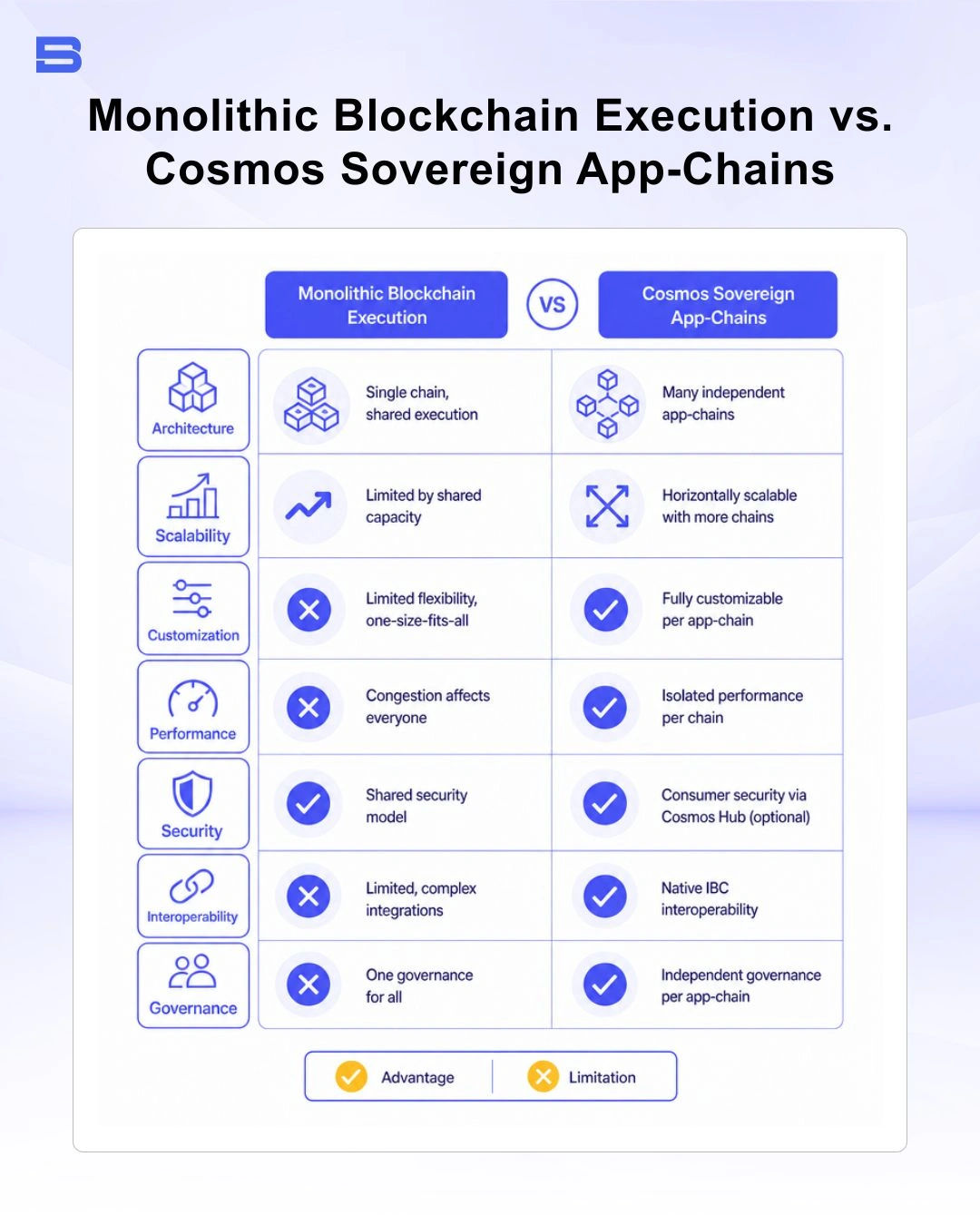
Structural Differences: Sovereign App-Chains vs. Shared Security
Architectural design choices dictate how security and sovereign execution interact across different multi-chain models:
- Sovereign App-Chains: Maintain their own independent validator set. This maximizes governance independence but requires bootstrapping economic security from scratch.
- Polkadot Model: Relies on a centralized Relay Chain where parachains lease shared security, limiting independent validator customization.
- Replicated Security (ICS v2): Allows the Cosmos Hub's validator set to secure opt-in "consumer chains," giving app-chains access to the Hub's staked ATOM capital while maintaining localized execution control.
ATOM Tokenomics: Staking, Variable Inflation, and Value Capture
ATOM functions as the primary staking and governance asset for the Cosmos Hub. Network security relies on token holders delegating ATOM to active validators who validate blocks and enforce state transitions.
- Staking Mechanism: Staked ATOM can generate rewards from block provisions and transaction fees. As of 2026, unbonding requires a strict 21-day lockup period, during which the ATOM cannot be transferred and remains subject to applicable slashing risks.
- Dynamic Inflation: ATOM uses an algorithmic inflation model that adjusts based on the proportion of ATOM bonded for staking. As of 2026, it targets a 67% bonded ratio, with annual inflation capped between 7% and 20%.
- Tokenomics Overhaul: Recent governance initiatives focus on capping inflation limits, redirecting protocol revenue to the Hub treasury, and expanding value capture via Replicated Security fees and Interchain Scheduler MEV (Maximal Extractable Value) auctions.
If you stake 1,000 ATOM at a nominal yield of 14% while overall inflation sits at 10%, your net real yield is approximately 4% before validator commission fees. This net yield can shrink further if ATOM's market price falls significantly during the 21-day unbonding window, since staked and unbonding tokens cannot be sold to exit the position.
Risks in Trading Cosmos: IBC Security, Module Vulnerabilities, and Volatility
Trading and holding Cosmos crypto ecosystem assets involves distinct technological and market-level risk vectors:
- IBC Relayer Latency & Liquid Security: While IBC protocol logic is mathematically robust, relayer infrastructure relies on off-chain operators. High network congestion can delay cross-chain packet execution, introducing arbitrage slippage or temporary liquid staking mispegs.
- Module Vulnerabilities: Custom Cosmos SDK modules or CosmWasm smart contracts may introduce code exploits. Flaws in shared modules (such as cross-chain EVM precompiles) require rapid, synchronized validator patching across independent chains.
- Unbonding Illiquidity: The 21-day unbonding period prevents quick position liquidations during severe market drawdowns. Traders using liquid staking derivatives (LSDs) face secondary market discount risk if LSD-ATOM liquidity pools destabilize.
Regulatory authorities, such as the US Securities and Exchange Commission (SEC) and the Commodity Futures Trading Commission (CFTC), routinely issue risk disclosures emphasizing that technical complexity, cross-chain bridge dependencies, and liquid staking derivatives increase structural risk exposure for digital asset market participants.
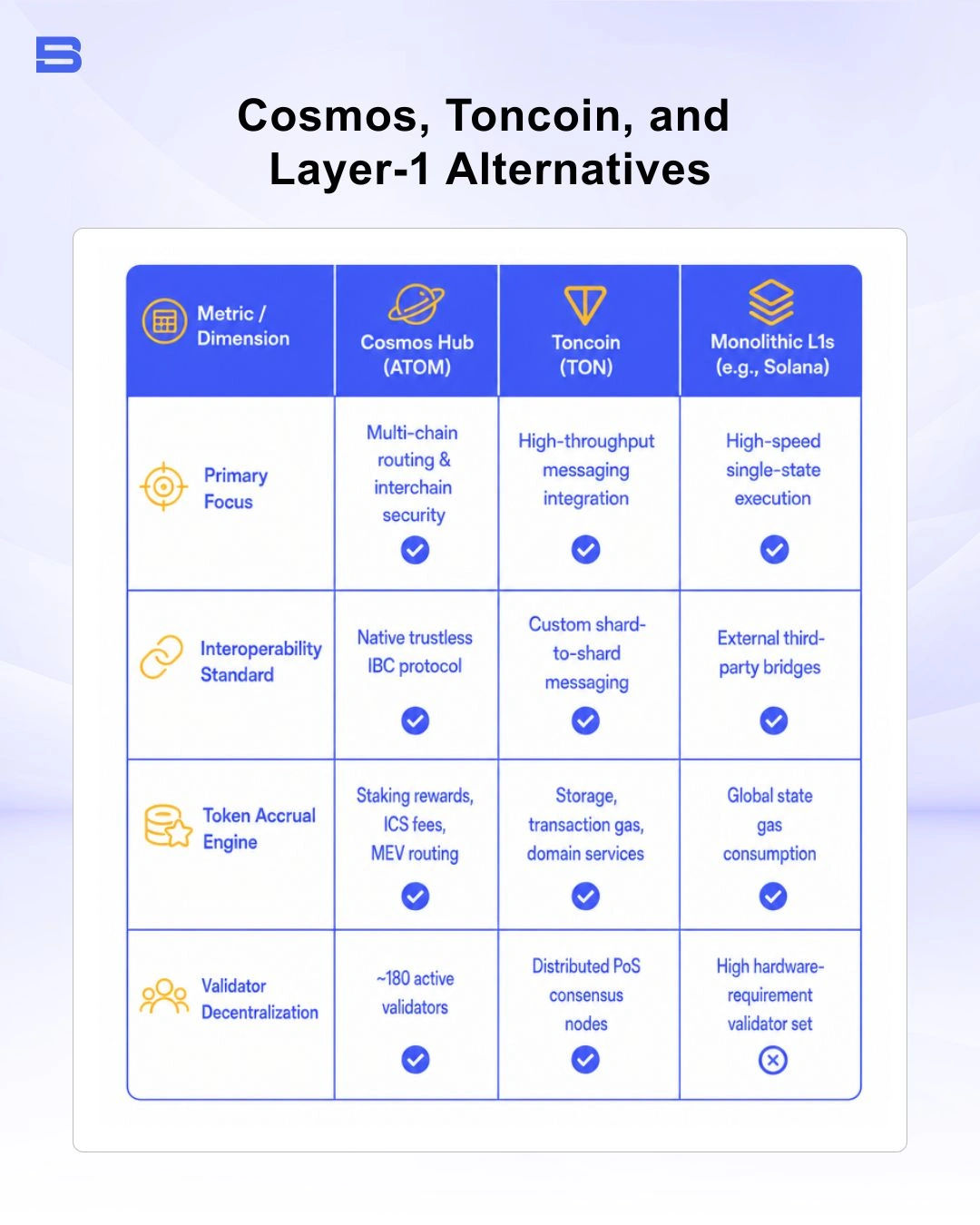
Comparing Ecosystem Metrics: Cosmos Crypto, Toncoin, and Layer-1 Alternatives
Evaluating layer-1 architecture requires comparing network execution models, validator distribution, and value-accrual mechanics:
Cosmos Crypto: Key Takeaways for New Traders
Cosmos crypto stands out for its interoperable blockchain architecture, using the Cosmos SDK, CometBFT, and IBC to connect independent blockchains within a broader ecosystem. ATOM plays a central role in securing the Cosmos Hub through staking, supporting governance, and rewarding validators and delegators.
However, you should consider ATOM’s inflation and evolving tokenomics, alongside staking, validator, governance, competition, and broader cryptocurrency market risks. Cosmos’ ongoing efforts to refine ATOM’s economic model also show that its tokenomics remain an area of active development.
Overall, Cosmos offers a compelling approach to blockchain interoperability, but ATOM should be evaluated based on both the ecosystem’s long-term adoption and the sustainability of its token economics, rather than technology alone.
- What Can You Trade? A Guide to Forex, Stocks, and More
- CFD Trading for Beginners
- What is CFD Trading and How Does It Work?
- Forex vs. Stocks: Which Market Suits You Best?
- How to Diversify a Portfolio Across Asset Classes
- How Dividend Stocks Work: Yields, Risks, and Strategies
- Silver Trading Explained: A Guide for Retail Investors
- Precious Metals Trading: A Complete Guide for Beginners
- Natural Gas Trading: A Guide to the Market
- Structured Warrants Malaysia: How They Work and Risks
- What Is the KLCI Index and How to Trade It
- Gold Investment in Malaysia: A Complete Guide for Beginners
- What Is Kijang Emas and How to Invest in It
- Value Investing Explained: How to Find Undervalued Stocks
- How to Trade Bitcoin Safely: A Complete Market Guide
- Growth Investing Explained: Strategies, Metrics, and Risks
- What Is Digital Gold Malaysia and How to Invest
- Crypto Trading Strategies for Beginners
- Gold vs Bitcoin: Key Differences, Risks, and Strategies
- Sukuk: A Guide for Beginners to Islamic Bonds
- What Is FCPO (Crude Palm Oil Futures) and How to Trade It
- How to Identify and Invest in Shariah-Compliant Stocks
- Timber Investment: Is It Worth It?
- Gold ETF Malaysia: A Guide for Beginners
- What Are Malaysian Government Securities (MGS)?
- Corporate Bonds Malaysia: A Guide for Beginners
- China A-Shares Trading Guide for Malaysian Investors
- What Is a Silver ETF and How to Invest in It?
- How to Trade XRP: A Practical Guide for Retail Investors
- How to Trade Solana (SOL): A Guide for Beginners
- What Are Gold Futures and How Do They Work?
- Money Market Fund in Malaysia: A Guide for Beginners
- Property Investment Malaysia: Direct Real Estate or M-REITs?
- What Is Binance Coin and How Does It Work?
- Green Sukuk: A Guide for Beginners to Islamic ESG Investing
- What Is Shiba Inu (SHIB) and How to Trade It
- What Is USDT? A Complete Guide to Tether for Beginners
- What Is Dogecoin and How to Trade It Safely for Beginners
- Cardano: A Guide for Beginners to Trade This Cryptocurrency
- Polkadot: A Guide to Trading This Cryptocurrency
- Tron: A Guide for Beginners to Trading This Cryptocurrency
- What Is Litecoin (LTC)? A Guide to Trading Digital Silver
- What Is Chainlink (LINK) and How to Trade It
- How to Trade Pepe Coin: Spot, Leverage, and Risk Management
- Near Protocol: A Guide to Trading This Cryptocurrency
- Trading Polygon Crypto: A Practical Guide for Beginners
- Trade Toncoin: Understanding the TON Ecosystem and Risks
- Cosmos Crypto: Ecosystem Architecture, Tokenomics, and Risks
- Stellar Crypto: A Guide to Trading This Cryptocurrency
- Avalanche Crypto Explained: A Practical Guide for Traders
- What Is Worldcoin? How to Trade WLD and Manage Risk
- Aptos: A Guide for Beginners to Trading This Cryptocurrency
- Sui Crypto Explained: Tokenomics and Trading Guide
- Celestia: A Guide to Trading This Cryptocurrency
- Decentraland: A Guide to Trading This Cryptocurrency
- What Is Arbitrum? How to Trade the Leading Layer 2 Network
- Sei Crypto: A Guide to Trading This Cryptocurrency
- What Is Injective Protocol and How to Trade INJ Safely
Disclaimer: The content on this page is intended for educational and informational purposes only. It does not constitute financial, investment, tax, or legal advice, and should not be interpreted as a recommendation to buy, sell, or hold any financial instrument or asset. Trading and investing involve significant risk, including the possible loss of your entire capital. Products such as forex, CFDs, and cryptocurrencies carry additional risks due to leverage, high volatility, and limited regulatory protection in some jurisdictions. Past performance of any financial instrument does not guarantee future results. Any market views, forecasts, or opinions expressed are those of the author at the time of writing and may not reflect current market conditions. Platform features, fees, and regulatory status are subject to change — always verify information directly with the relevant provider or regulator before making any financial decision. BrokerSpecs may receive compensation from third parties featured on this site. Always conduct your own due diligence and consider seeking advice from a licensed financial professional before investing.