


Related Tags
Entering the cryptocurrency market often feels like stepping into a purely digital realm of code and cryptography. However, standing in front of a sleek, chrome sphere that scans your iris introduces a stark physical component to the space. This hardware device—known as the Orb—is the centerpiece of Worldcoin, an ambitious biometric identity and cryptocurrency project founded by OpenAI Chief Executive Officer Sam Altman alongside Alex Blania.
For retail traders, Worldcoin (WLD) represents a unique financial instrument. It sits at the intersection of artificial intelligence, global identity verification, and decentralized finance. Before allocating capital to WLD, you need a grounded breakdown of its technology, tokenomics, regulatory landscape, and inherent trading risks.
What Is Worldcoin?
Worldcoin is a decentralized proof-of-personhood protocol designed to establish a global digital identity network while distributing a native utility token. As artificial intelligence advances, distinguishing between human online activity and automated AI agents becomes increasingly challenging.
Worldcoin aims to solve this "proof-of-personhood" problem by creating a secure digital credential that confirms an individual is a real, unique human without revealing their underlying real-world identity.
The project operates through two distinct layers: the World ID network, which handles identity verification, and the WLD token, which serves as a financial and governance incentive within the ecosystem.
Who Is Behind Worldcoin?
Worldcoin was co-founded in 2019 by Sam Altman, Alex Blania, and Max Novendstern. The primary corporate entity driving its ongoing development is Tools for Humanity (TFH), a software and hardware company based in San Francisco and Bavaria.
Governance and protocol oversight are managed independently by the Worldcoin Foundation, a non-profit organization registered in the Cayman Islands. While Sam Altman's prominent role in AI through OpenAI brings immense public attention and speculative interest to the asset, TFH and the Foundation manage protocol upgrades, hardware distribution, and ecosystem grant allocations.
The Orb and World ID Biometric System
At the heart of the network sits the physical Worldcoin Orb, a custom hardware scanner about the size of a bowling ball. When a user looks into the Orb's camera lens, the device captures high-resolution infrared photographs of their iris patterns.
The hardware converts these optical iris patterns into a unique numerical code known as an "iris hash." The device then checks this hash against a central registry to ensure the individual has not registered previously. Once uniqueness is verified, the network issues a World ID credential directly to the user's mobile device via the World App.
Crucially, the protocol employs zero-knowledge cryptography, allowing users to prove their unique human status to third-party applications without disclosing their personal details or iris data. According to the development team, raw biometric images are deleted by default once the numerical hash is generated, unless a user explicitly opts in to data custody backups.
Understanding WLD Tokenomics and Market Mechanics
For active market participants, evaluating Worldcoin requires a detailed look at its token distribution model, unlock schedules, and circulating market dynamics. WLD is an ERC-20 token hosted primarily on the Ethereum mainnet and the Optimism Layer-2 network.
WLD has an initial supply cap of 10 billion tokens, fixed for the first 15 years following its July 2023 launch. The current allocation is divided among four major groups. The April 2025 World whitepaper shows that the allocation has since been revised to the World Community (75%), Team (11.1%), TFH Investors (13.6%), and TFH Reserve (0.3%).
After 15 years, governance may authorize inflation of up to 1.5% annually.
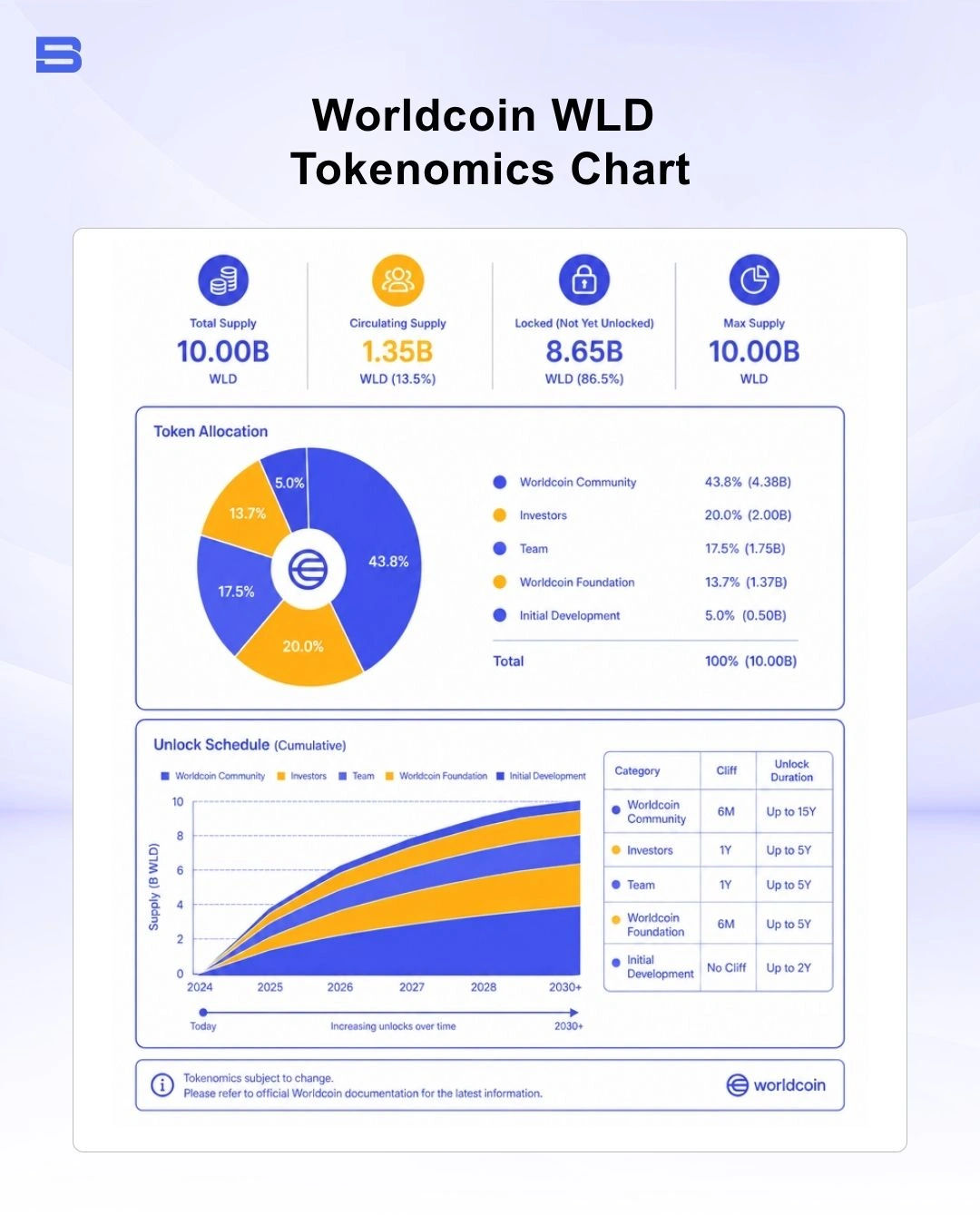
A critical metric for traders to monitor is the low circulating supply relative to the fully diluted valuation (FDV). At launch, only a tiny fraction of the 10 billion total tokens was unlocked and circulating in the open market.
When institutional insider unlocks begin, linear daily emissions continuously expand the available float. This constant structural supply inflation can create sustained downward price pressure unless market demand from new users and utility adoption expands at an equal or faster pace.
To understand how supply unlocks impact position sizing, consider a trader holding a $1,000 long position in WLD spot tokens. If scheduled insider vesting unlocks release millions of new tokens into the circulating supply over a single month, the token's circulating market capitalization can increase while the individual unit price drops.
If total demand remains stagnant during a daily emission unlock of 3.2 million tokens, the individual token price must adjust downward by several percentage points to absorb the newly minted liquid float.
Regulatory Concerns and Biometric Data Privacy
Trading biometric-linked assets carries regulatory risks distinct from traditional Layer-1 blockchains. Because Worldcoin relies on physical iris scanning, it has faced intense scrutiny from privacy regulators worldwide.
European data protection agencies—including France's Commission Nationale de l’Informatique et des Libertés (CNIL), Germany's Bayerisches Landesamt für Datenschutzaufsicht (BayLDA), and the UK's Information Commissioner's Office (ICO)—have launched inquiries into whether Worldcoin's biometric collection complies with stringent General Data Protection Regulation (GDPR) mandates.
Concerns center on consent mechanics, the irreversibility of biometric hashes, and data retention policies. In several jurisdictions, including Spain, Portugal, Kenya, and Hong Kong, regulatory authorities issued temporary bans or cease-and-desist orders halting Orb operations pending full investigations.
In Southeast Asia, retail investors must navigate varying regional regulatory frameworks. In Malaysia, digital asset exchanges and digital token issuances operate under the oversight of the Securities Commission Malaysia (SC). Traders in the region should verify whether a platform offering WLD spot or derivative contracts is registered as a Recognized Market Operator (RMO) or operating legally within local investor protection boundaries.
Any sudden regulatory action—such as an outright ban on Orb operations in a major market—can trigger sharp, localized volatility spikes across global exchanges.
Comparing Worldcoin Against Major Crypto Assets (XRP and USDT)
To evaluate where WLD fits into a diversified crypto portfolio, it helps to compare its utility, risk profile, and emission mechanics directly against established market benchmarks like XRP, USDT, and Bitcoin. Understanding how to trade Bitcoin provides a helpful market baseline before managing altcoin volatility.
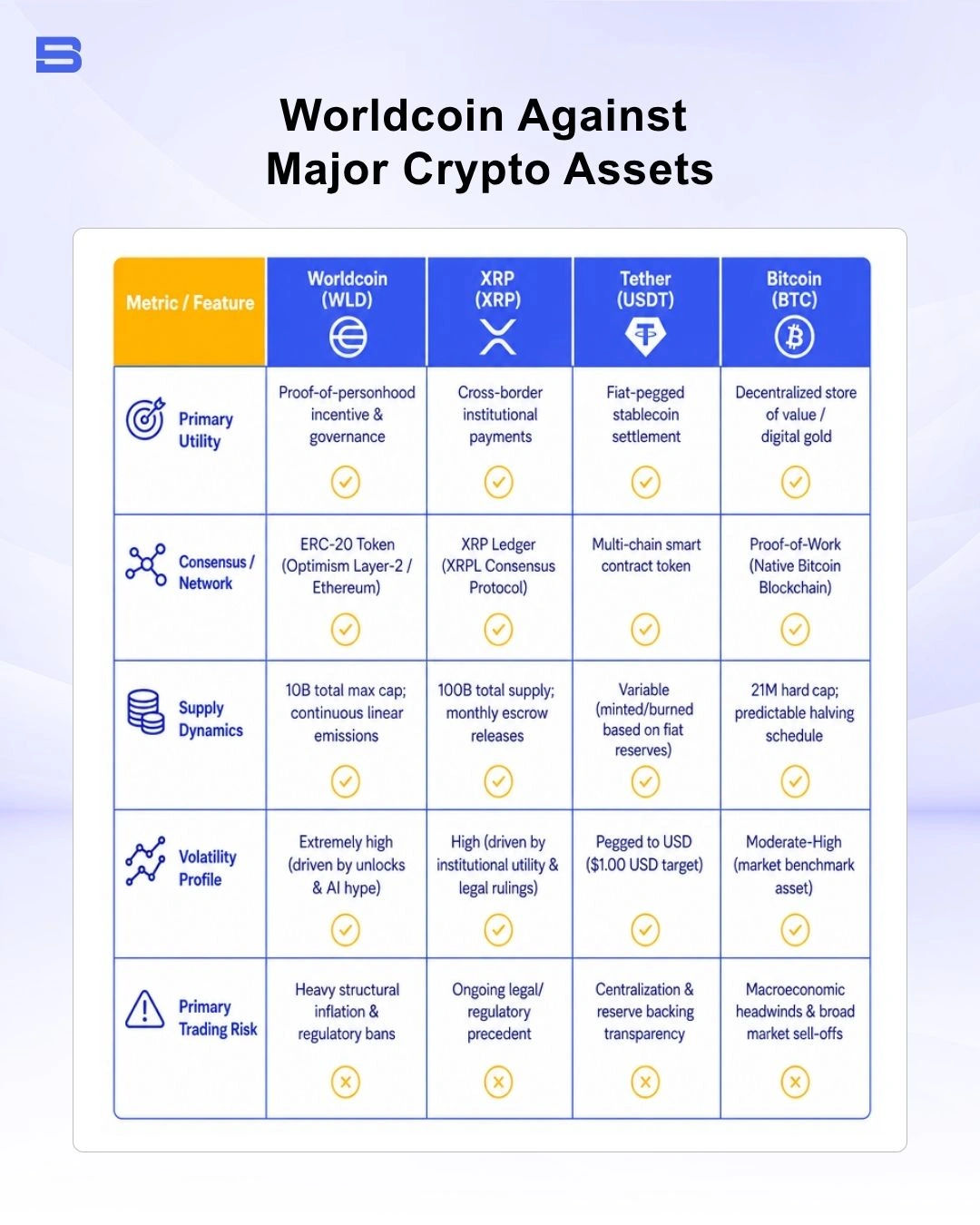
While assets like USDT offer price stability for hedging cash positions and XRP focuses on institutional liquidity routing, WLD behaves as a high-beta altcoin. Its price action reflects narrative shifts surrounding artificial intelligence development, global biometric adoption trends, and major token unlock milestones.
How to Trade Worldcoin: Step-by-Step
Trading WLD requires an active risk management strategy due to its swift price swings and continuous supply expansion. Whether you choose spot buying or derivatives, follow these structured steps:
Step 1: Select a Regulated Platform or Licensed RMO
Begin by choosing an exchange that supports WLD trading pairs (typically WLD/USDT or WLD/USD). Ensure the venue complies with your local jurisdiction's licensing requirements, such as SC-approved platforms for Malaysian retail traders or Monetary Authority of Singapore (MAS) licensed entities in Singapore.
Step 2: Analyze Technical Levels and On-Chain Unlocks
Before placing an order, review technical support and resistance levels on your charting software. Check external analytics dashboards—such as token unlock tracking tools—to verify whether a major cliff unlock or daily linear distribution surge is approaching within your planned trade window.
Step 3: Implement Risk Controls and Position Sizing
Given WLD's intraday price swings, never risk more capital on a single position than your risk tolerance allows (typically 1% to 2% of your total liquid account equity). Always place a hard stop-loss order below key technical support to protect your capital against sudden market downturns or unexpected regulatory headlines.
Final Takeaways: Worldcoin
World, formerly known as Worldcoin, combines World ID, WLD, and World Chain — the project's dedicated Ethereum Layer-2 network — to create a blockchain-based identity and financial ecosystem designed around proof of human uniqueness. WLD provides utility within the network and has governance properties, while World Chain serves as the main venue for WLD activity.
Trading WLD requires balancing its potential growth in digital identity and financial applications against significant market, regulatory, technology, and tokenomics risks. Traders should use appropriate position sizing, stop-losses, and risk limits rather than relying solely on the project's long-term potential.
- What Can You Trade? A Guide to Forex, Stocks, and More
- CFD Trading for Beginners
- What is CFD Trading and How Does It Work?
- Forex vs. Stocks: Which Market Suits You Best?
- How to Diversify a Portfolio Across Asset Classes
- How Dividend Stocks Work: Yields, Risks, and Strategies
- Silver Trading Explained: A Guide for Retail Investors
- Precious Metals Trading: A Complete Guide for Beginners
- Natural Gas Trading: A Guide to the Market
- Structured Warrants Malaysia: How They Work and Risks
- What Is the KLCI Index and How to Trade It
- Gold Investment in Malaysia: A Complete Guide for Beginners
- What Is Kijang Emas and How to Invest in It
- Value Investing Explained: How to Find Undervalued Stocks
- How to Trade Bitcoin Safely: A Complete Market Guide
- Growth Investing Explained: Strategies, Metrics, and Risks
- What Is Digital Gold Malaysia and How to Invest
- Crypto Trading Strategies for Beginners
- Gold vs Bitcoin: Key Differences, Risks, and Strategies
- Sukuk: A Guide for Beginners to Islamic Bonds
- What Is FCPO (Crude Palm Oil Futures) and How to Trade It
- How to Identify and Invest in Shariah-Compliant Stocks
- Timber Investment: Is It Worth It?
- Gold ETF Malaysia: A Guide for Beginners
- What Are Malaysian Government Securities (MGS)?
- Corporate Bonds Malaysia: A Guide for Beginners
- China A-Shares Trading Guide for Malaysian Investors
- What Is a Silver ETF and How to Invest in It?
- How to Trade XRP: A Practical Guide for Retail Investors
- How to Trade Solana (SOL): A Guide for Beginners
- What Are Gold Futures and How Do They Work?
- Money Market Fund in Malaysia: A Guide for Beginners
- Property Investment Malaysia: Direct Real Estate or M-REITs?
- What Is Binance Coin and How Does It Work?
- Green Sukuk: A Guide for Beginners to Islamic ESG Investing
- What Is Shiba Inu (SHIB) and How to Trade It
- What Is USDT? A Complete Guide to Tether for Beginners
- What Is Dogecoin and How to Trade It Safely for Beginners
- Cardano: A Guide for Beginners to Trade This Cryptocurrency
- Polkadot: A Guide to Trading This Cryptocurrency
- Tron: A Guide for Beginners to Trading This Cryptocurrency
- What Is Litecoin (LTC)? A Guide to Trading Digital Silver
- What Is Chainlink (LINK) and How to Trade It
- How to Trade Pepe Coin: Spot, Leverage, and Risk Management
- Near Protocol: A Guide to Trading This Cryptocurrency
- Trading Polygon Crypto: A Practical Guide for Beginners
- Trade Toncoin: Understanding the TON Ecosystem and Risks
- Cosmos Crypto: Ecosystem Architecture, Tokenomics, and Risks
- Stellar Crypto: A Guide to Trading This Cryptocurrency
- Avalanche Crypto Explained: A Practical Guide for Traders
- What Is Worldcoin? How to Trade WLD and Manage Risk
- Aptos: A Guide for Beginners to Trading This Cryptocurrency
- Sui Crypto Explained: Tokenomics and Trading Guide
- Celestia: A Guide to Trading This Cryptocurrency
- Decentraland: A Guide to Trading This Cryptocurrency
- What Is Arbitrum? How to Trade the Leading Layer 2 Network
- Sei Crypto: A Guide to Trading This Cryptocurrency
- What Is Injective Protocol and How to Trade INJ Safely
Disclaimer: The content on this page is intended for educational and informational purposes only. It does not constitute financial, investment, tax, or legal advice, and should not be interpreted as a recommendation to buy, sell, or hold any financial instrument or asset. Trading and investing involve significant risk, including the possible loss of your entire capital. Products such as forex, CFDs, and cryptocurrencies carry additional risks due to leverage, high volatility, and limited regulatory protection in some jurisdictions. Past performance of any financial instrument does not guarantee future results. Any market views, forecasts, or opinions expressed are those of the author at the time of writing and may not reflect current market conditions. Platform features, fees, and regulatory status are subject to change — always verify information directly with the relevant provider or regulator before making any financial decision. BrokerSpecs may receive compensation from third parties featured on this site. Always conduct your own due diligence and consider seeking advice from a licensed financial professional before investing.