


Related Tags
Picture watching an energy commodity price chart hover quietly, only to jump 4% in seconds the moment a weekly storage report drops. Trading natural gas offers dynamic market opportunities, but navigating its price swings safely requires a firm grasp of underlying mechanics rather than pure guesswork. This guide breaks down how natural gas trading works, what drives its sudden movements, and how you can manage your downside risk effectively.
What Is Natural Gas Trading and How Does the Market Work?
Natural gas trading involves buying and selling natural gas derivative contracts, or in some cases arranging physical delivery, based on expectations of changes in global supply and demand. As a major energy commodity, natural gas is widely used to generate electricity, heat homes and businesses, and support industrial production worldwide.
Unlike precious metals such as gold, natural gas is relatively costly and complex to store and transport. Its distribution depends heavily on pipeline networks and Liquefied Natural Gas (LNG) carriers, making regional markets particularly sensitive to infrastructure constraints, supply disruptions, weather conditions, and sudden changes in demand. For more information on commodity derivatives and market oversight, refer to the US Commodity Futures Trading Commission (CFTC).
Major Global Benchmarks: Henry Hub vs. TTF
When you engage in natural gas trading, your platform typically tracks one of two primary global pricing standards:
- Henry Hub Natural Gas (NG): Based in Louisiana, US, this is the global standard for natural gas futures traded on the New York Mercantile Exchange (NYMEX). Prices are quoted in US dollars (USD) per million British Thermal Units (MMBtu).
- Title Transfer Facility (TTF): Based in the Netherlands, TTF is the primary benchmark for European natural gas, priced in Euros per Megawatt-hour (MWh).
For global traders—including those across Southeast Asia—US Henry Hub contract for differences (CFDs) are the most widely available instrument for retail trading platforms.
Fundamental Price Drivers in the Energy Sector
To trade natural gas intelligently, you must understand the core fundamentals that dictate supply and demand.
Fundamental Price Drivers: The EIA Storage Report
Every Thursday, the US Energy Information Administration (EIA) releases its weekly Natural Gas Storage Report. This report details the amount of natural gas held in underground storage facilities across the United States.
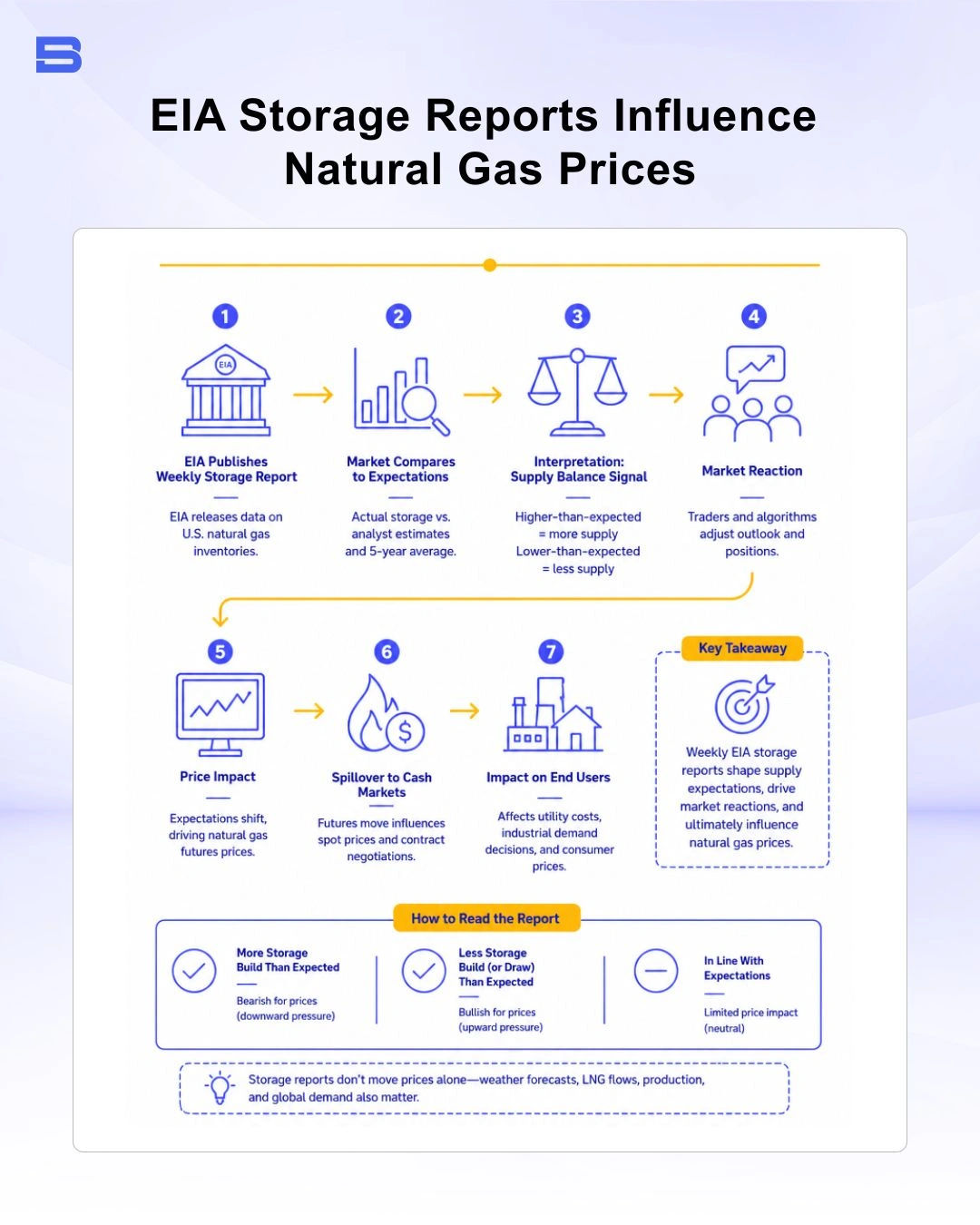
- Lower-than-expected injection (or higher draw): Signals tighter supply or higher demand, often pushing prices higher.
- Higher-than-expected injection (or lower draw): Signals surplus supply, often pressuring prices lower.
Market Fact: Prices in this market often experience sharp volatility spikes following the EIA release.
Market Seasonality and Weather Spikes
Weather patterns are the primary catalyst for short-term demand shocks:
- Winter Heating Demand (November – March): Cold snaps increase residential and commercial heating demand, driving rapid storage withdrawals.
- Summer Cooling Demand (July – August): Heatwaves boost air conditioning use, increasing electricity generation from gas-fired power plants.
Execution Methods: How Do You Trade Natural Gas in Practice?
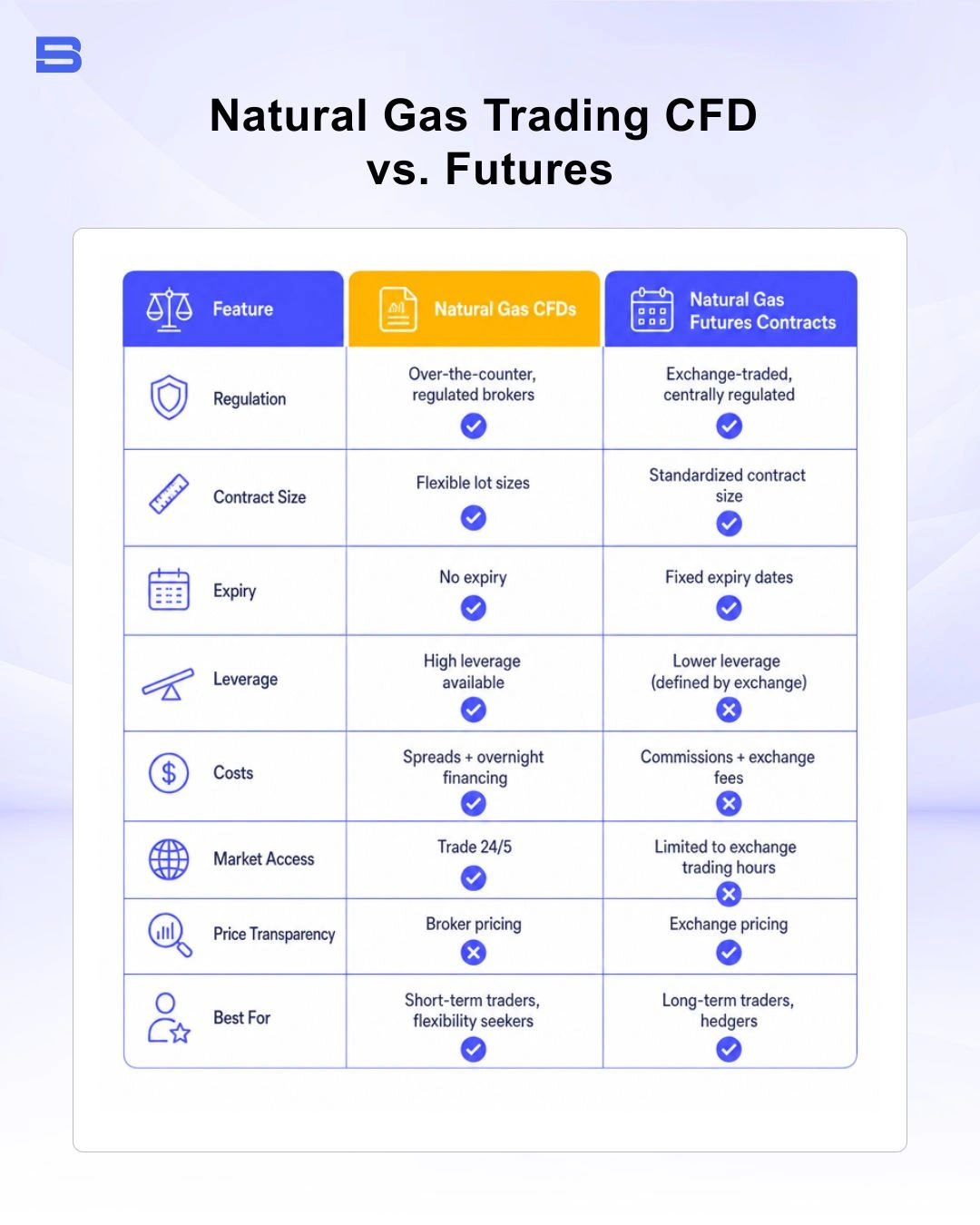
As retail traders, you generally do not take delivery of physical gas tankers; instead, you trade financial derivatives through regulated brokers.
Trading Instruments: Natural Gas CFDs vs Futures
Passive investors seeking long-term exposure may also consider Energy Exchange-Traded Funds (ETFs) or Exchange-Traded Notes (ETNs) that track gas index baskets rather than actively traded contracts.
Managing Risk and Natural Gas Volatility
Natural gas trading is known for significant price volatility due to its tendency for rapid price gapping. Developing a disciplined risk management strategy is non-negotiable.
Leveraged Risk Calculation Example
Leverage amplifies your returns when you are right, but it accelerates capital destruction just as quickly when the market moves against you.
Suppose you open a buy position on Natural Gas CFDs valued at $10,000 using 1:10 leverage, requiring a margin deposit of $1,000:
- Position Value: $10,000
- Your Margin Deposit: $1,000
- Favorable 3% Move (+3%): Your profit is $300, delivering a 30% return on your $1,000 margin deposit.
- Adverse 3% Move (-3%): Your loss is $300, resulting in a 30% loss of your deposited margin.
A sudden 10% price gap caused by an unexpected EIA storage surplus would result in a $1,000 loss, completely wiping out your initial margin.
Essential Risk Guidelines
- Avoid Holding Through EIA Releases: Entering market orders seconds before inventory releases exposes your account to spread widening and slippage.
- Use Guaranteed Stop-Loss Orders: Regular stop-loss orders may suffer slippage during major weekend gaps or sudden weather headlines.
- Keep Position Sizes Conservative: Allocate no more than 1–2% of your total account equity to any single energy trade.
How Natural Gas Fits into Broader Commodity Trading
Integrating natural gas alongside other instruments can balance your overall exposure. For instance, combining tactical energy trades with long-term defensive holdings such as precious metals trading or broader index assets allows you to capture commodity volatility without exposing your entire portfolio to regional weather risks.
Key Takeaways for Natural Gas Trading Beginners
Natural gas trading presents unique opportunities due to its liquidity and distinct fundamental drivers. However, long-term market participation requires managing its signature volatility through strict position sizing, awareness of seasonal trends, and clear stop-loss limits.
- What Can You Trade? A Guide to Forex, Stocks, and More
- CFD Trading for Beginners
- What is CFD Trading and How Does It Work?
- Forex vs. Stocks: Which Market Suits You Best?
- How to Diversify a Portfolio Across Asset Classes
- How Dividend Stocks Work: Yields, Risks, and Strategies
- Silver Trading Explained: A Guide for Retail Investors
- Precious Metals Trading: A Complete Guide for Beginners
- Natural Gas Trading: A Guide to the Market
- Structured Warrants Malaysia: How They Work and Risks
- What Is the KLCI Index and How to Trade It
- Gold Investment in Malaysia: A Complete Guide for Beginners
- What Is Kijang Emas and How to Invest in It
- Value Investing Explained: How to Find Undervalued Stocks
- How to Trade Bitcoin Safely: A Complete Market Guide
- Growth Investing Explained: Strategies, Metrics, and Risks
- What Is Digital Gold Malaysia and How to Invest
- Crypto Trading Strategies for Beginners
- Gold vs Bitcoin: Key Differences, Risks, and Strategies
- Sukuk: A Guide for Beginners to Islamic Bonds
- What Is FCPO (Crude Palm Oil Futures) and How to Trade It
- How to Identify and Invest in Shariah-Compliant Stocks
- Timber Investment: Is It Worth It?
- Gold ETF Malaysia: A Guide for Beginners
- What Are Malaysian Government Securities (MGS)?
- Corporate Bonds Malaysia: A Guide for Beginners
- China A-Shares Trading Guide for Malaysian Investors
- What Is a Silver ETF and How to Invest in It?
- How to Trade XRP: A Practical Guide for Retail Investors
- How to Trade Solana (SOL): A Guide for Beginners
- What Are Gold Futures and How Do They Work?
- Money Market Fund in Malaysia: A Guide for Beginners
- Property Investment Malaysia: Direct Real Estate or M-REITs?
- What Is Binance Coin and How Does It Work?
- Green Sukuk: A Guide for Beginners to Islamic ESG Investing
- What Is Shiba Inu (SHIB) and How to Trade It
- What Is USDT? A Complete Guide to Tether for Beginners
- What Is Dogecoin and How to Trade It Safely for Beginners
- Cardano: A Guide for Beginners to Trade This Cryptocurrency
- Polkadot: A Guide to Trading This Cryptocurrency
- Tron: A Guide for Beginners to Trading This Cryptocurrency
- What Is Litecoin (LTC)? A Guide to Trading Digital Silver
- What Is Chainlink (LINK) and How to Trade It
- How to Trade Pepe Coin: Spot, Leverage, and Risk Management
- Near Protocol: A Guide to Trading This Cryptocurrency
- Trading Polygon Crypto: A Practical Guide for Beginners
- Trade Toncoin: Understanding the TON Ecosystem and Risks
- Cosmos Crypto: Ecosystem Architecture, Tokenomics, and Risks
- Stellar Crypto: A Guide to Trading This Cryptocurrency
- Avalanche Crypto Explained: A Practical Guide for Traders
- What Is Worldcoin? How to Trade WLD and Manage Risk
- Aptos: A Guide for Beginners to Trading This Cryptocurrency
- Sui Crypto Explained: Tokenomics and Trading Guide
- Celestia: A Guide to Trading This Cryptocurrency
- Decentraland: A Guide to Trading This Cryptocurrency
- What Is Arbitrum? How to Trade the Leading Layer 2 Network
- Sei Crypto: A Guide to Trading This Cryptocurrency
- What Is Injective Protocol and How to Trade INJ Safely
Disclaimer: The content on this page is intended for educational and informational purposes only. It does not constitute financial, investment, tax, or legal advice, and should not be interpreted as a recommendation to buy, sell, or hold any financial instrument or asset. Trading and investing involve significant risk, including the possible loss of your entire capital. Products such as forex, CFDs, and cryptocurrencies carry additional risks due to leverage, high volatility, and limited regulatory protection in some jurisdictions. Past performance of any financial instrument does not guarantee future results. Any market views, forecasts, or opinions expressed are those of the author at the time of writing and may not reflect current market conditions. Platform features, fees, and regulatory status are subject to change — always verify information directly with the relevant provider or regulator before making any financial decision. BrokerSpecs may receive compensation from third parties featured on this site. Always conduct your own due diligence and consider seeking advice from a licensed financial professional before investing.