



Related Tags
Imagine sitting down with your hard-earned savings and considering the Malaysian property market. Property investment Malaysia can offer opportunities for wealth building through rental income and potential capital appreciation, but the high upfront costs can make direct ownership challenging.
A 10% down payment on a RM500,000 condominium alone would require RM50,000, before factoring in valuation fees, legal costs, stamp duty, and the long-term commitment of a 30-year mortgage.
Fortunately, gaining exposure to real estate does not always mean taking on substantial debt or becoming a landlord. Investors today have access to several ways to participate in the property market, from purchasing physical properties directly to investing in publicly listed real estate securities.
These options allow investors to pursue property-related income and potential capital growth while choosing an approach that better suits their budget, risk tolerance, and investment objectives.
Property Investment Malaysia: Direct Real Estate vs REITs
When evaluating property investment Malaysia, investors generally choose between two distinct strategies: purchasing physical real estate or investing in Real Estate Investment Trusts (REITs). Both vehicles offer exposure to real estate dynamics, but they function under completely different structures, capital demands, and risk parameters.
Major Avenues for Property Exposure in Malaysia
Understanding the types of property investment Malaysia is essential before deploying your capital. Physical real estate ownership involves buying residential units, commercial properties, or industrial spaces directly. You take title to the property, arrange financing through a commercial bank, find tenants, and handle ongoing maintenance.
Conversely, indirect exposure allows you to invest in real estate portfolios through financial instruments traded on capital markets. Instead of purchasing a single apartment, you buy shares or units in vehicles that hold dozens of prime commercial, retail, or industrial assets.
How REITs Work on Bursa Malaysia
A Real Estate Investment Trust (REIT) is a listed investment vehicle that pools capital from investors to acquire, operate, and manage income-generating real estate assets. On Bursa Malaysia, Malaysian Real Estate Investment Trusts (M-REITs) are traded on the stock exchange just like regular equity shares.
To qualify for tax exemption at the REIT level, M-REITs must follow Malaysian tax regulations administered by Lembaga Hasil Dalam Negeri Malaysia (LHDN). Under these rules, M-REITs generally need to distribute at least 90% of their total income to unit holders during the relevant basis period.
This structure allows investors to gain exposure to income-generating real estate without directly purchasing or managing physical properties.
Listed M-REITs can generate returns through income distributions supported by rental income from their underlying property portfolios, as well as potential capital appreciation.
Direct Real Estate vs. REITs in Malaysia
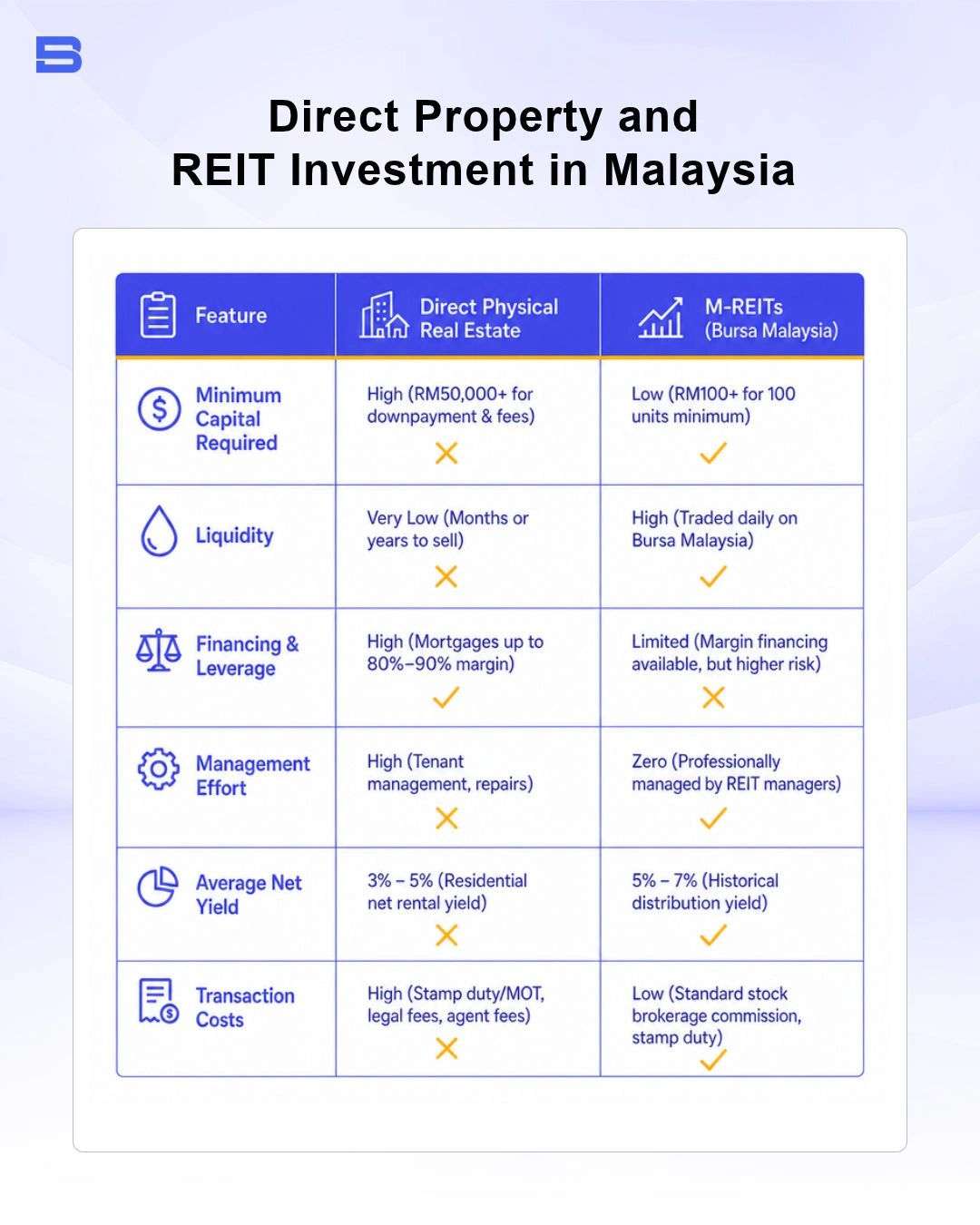
Choosing between direct property ownership and paper-based real estate investments depends on your available capital, desired level of involvement, and willingness to use leverage. If you are considering a REIT Malaysia strategy instead of purchasing property directly, it is useful to compare both options across key investment factors such as upfront costs, income potential, liquidity, leverage, and management responsibilities.
Minimum Capital and Barriers to Entry
The minimum capital required for property investment in Malaysia can vary significantly depending on whether you invest directly in physical property or indirectly through listed real estate securities.
A direct purchase requires substantial upfront capital. For a RM400,000 property, a 10% down payment alone would amount to RM40,000. This is before accounting for applicable stamp duty, legal fees, valuation costs, and other transaction expenses, as stated by the Valuation and Property Services Department. These costs can vary depending on the buyer's circumstances and available exemptions.
By comparison, investing through an M-REIT can provide a much lower entry point. Bursa Malaysia's standard board lot for securities is 100 units. Therefore, if an M-REIT is trading at RM1.50 per unit, one board lot would cost RM150, excluding brokerage and other trading charges. This lower entry requirement allows investors to gain exposure to real estate with significantly less capital and build their position gradually.
Rental Yields and Income Expectations
Examining the expected property investment yield in Malaysia reveals key operational differences.
According to data tracked by Malaysia's National Property Information Centre (NAPIC), as of 2025, residential property historically generates gross rental yields around 4% to 5%, but after accounting for maintenance fees, assessment rates, quit rent (an annual land tax paid to the state government), fire insurance, and tenant vacancy periods, net rental yields often drop to 3% or lower.
According to Bursa Malaysia's REIT sector data (2025), M-REITs — which primarily hold commercial spaces, shopping malls, healthcare facilities, and logistics warehouses — historically deliver distribution yields ranging between 5% and 7% net of corporate-level expenses. Furthermore, because REIT managers negotiate corporate leases with multi-year terms, dividend streams are relatively structured.
Key Risks and Costs to Consider
Every real estate strategy carries inherent trade-offs, and evaluating the risk of property investment Malaysia is critical before committing funds.
Direct Physical Property Risks and Overhead:
- Tenant Vacancy: A vacant residential unit produces zero rental income while mortgage payments and maintenance fees remain due.
- Interest Rate Sensitivity: Rising interest rates set by Bank Negara Malaysia (BNM) directly increase variable-rate mortgage installments, squeezing monthly cash flow.
- Illiquidity Risk: Physical property cannot be liquidated quickly in an emergency without accepting a significant distressed discount.
- Ongoing Maintenance: Roof leaks, plumbing issues, and wear-and-tear demand ongoing cash reserves.
M-REIT Risks and Market Volatility:
- Share Price Volatility: M-REIT unit prices fluctuate daily on the stock exchange based on broader market sentiment, interest rate expectations, and economic trends.
- Lack of Direct Control: You cannot decide when to acquire or sell underlying buildings; all operational decisions rest with the professional management team.
- Refinancing Risk: Commercial real estate trusts carry debt at the fund level, exposing the REIT's distributions to rising corporate borrowing costs.
Alternative Real Estate Exposure via Unit Trusts and Funds
Investors seeking professional diversification without picking individual REIT stocks can consider a property-focused Unit trust strategy. Property-focused unit trust funds pool money from multiple investors to build diversified portfolios of real estate-related assets, including regional REITs, property developer equities, and infrastructure stocks across Malaysia and Southeast Asia.
As an option within unit trust Malaysia, these funds provide investors with broader exposure to the property sector without requiring direct ownership of physical properties. For capital preservation while awaiting real estate entry points, investors frequently hold liquidity in a money market fund, earning prevailing short-term interest rates without locking away funds.
Shariah-Compliant Property and REIT Options
Malaysia is a global hub for Islamic finance, providing extensive options for Muslim investors seeking ethical real estate exposure. The Securities Commission Malaysia (SC) maintains a dedicated list of Shariah-compliant equities and M-REITs updated semi-annually.
Shariah-compliant REITs adhere to strict operational benchmarks. Tenants leasing space within these properties must operate permissible businesses, excluding activities related to conventional banking, gambling, alcohol, or non-halal food production. Furthermore, Islamic REITs utilize Islamic financing (Sukuk) to structure their fund leverage.
Choosing the Right Property Investment Malaysia Strategy
Property investment Malaysia offers viable paths for both large-capital buyers and small-budget passive investors. By matching your strategy to your personal risk tolerance, available capital, and desired level of involvement, you can effectively use real estate to build long-term wealth.
- What Can You Trade? A Guide to Forex, Stocks, and More
- CFD Trading for Beginners
- What is CFD Trading and How Does It Work?
- Forex vs. Stocks: Which Market Suits You Best?
- How to Diversify a Portfolio Across Asset Classes
- How Dividend Stocks Work: Yields, Risks, and Strategies
- Silver Trading Explained: A Guide for Retail Investors
- Precious Metals Trading: A Complete Guide for Beginners
- Natural Gas Trading: A Guide to the Market
- Structured Warrants Malaysia: How They Work and Risks
- What Is the KLCI Index and How to Trade It
- Gold Investment in Malaysia: A Complete Guide for Beginners
- What Is Kijang Emas and How to Invest in It
- Value Investing Explained: How to Find Undervalued Stocks
- How to Trade Bitcoin Safely: A Complete Market Guide
- Growth Investing Explained: Strategies, Metrics, and Risks
- What Is Digital Gold Malaysia and How to Invest
- Crypto Trading Strategies for Beginners
- Gold vs Bitcoin: Key Differences, Risks, and Strategies
- Sukuk: A Guide for Beginners to Islamic Bonds
- What Is FCPO (Crude Palm Oil Futures) and How to Trade It
- How to Identify and Invest in Shariah-Compliant Stocks
- Timber Investment: Is It Worth It?
- Gold ETF Malaysia: A Guide for Beginners
- What Are Malaysian Government Securities (MGS)?
- Corporate Bonds Malaysia: A Guide for Beginners
- China A-Shares Trading Guide for Malaysian Investors
- What Is a Silver ETF and How to Invest in It?
- How to Trade XRP: A Practical Guide for Retail Investors
- How to Trade Solana (SOL): A Guide for Beginners
- What Are Gold Futures and How Do They Work?
- Money Market Fund in Malaysia: A Guide for Beginners
- Property Investment Malaysia: Direct Real Estate or M-REITs?
- What Is Binance Coin and How Does It Work?
- Green Sukuk: A Guide for Beginners to Islamic ESG Investing
- What Is Shiba Inu (SHIB) and How to Trade It
- What Is USDT? A Complete Guide to Tether for Beginners
- What Is Dogecoin and How to Trade It Safely for Beginners
- Cardano: A Guide for Beginners to Trade This Cryptocurrency
- Polkadot: A Guide to Trading This Cryptocurrency
- Tron: A Guide for Beginners to Trading This Cryptocurrency
- What Is Litecoin (LTC)? A Guide to Trading Digital Silver
- What Is Chainlink (LINK) and How to Trade It
- How to Trade Pepe Coin: Spot, Leverage, and Risk Management
- Near Protocol: A Guide to Trading This Cryptocurrency
- Trading Polygon Crypto: A Practical Guide for Beginners
- Trade Toncoin: Understanding the TON Ecosystem and Risks
- Cosmos Crypto: Ecosystem Architecture, Tokenomics, and Risks
- Stellar Crypto: A Guide to Trading This Cryptocurrency
- Avalanche Crypto Explained: A Practical Guide for Traders
- What Is Worldcoin? How to Trade WLD and Manage Risk
- Aptos: A Guide for Beginners to Trading This Cryptocurrency
- Sui Crypto Explained: Tokenomics and Trading Guide
- Celestia: A Guide to Trading This Cryptocurrency
- Decentraland: A Guide to Trading This Cryptocurrency
- What Is Arbitrum? How to Trade the Leading Layer 2 Network
- Sei Crypto: A Guide to Trading This Cryptocurrency
- What Is Injective Protocol and How to Trade INJ Safely
Disclaimer: The content on this page is intended for educational and informational purposes only. It does not constitute financial, investment, tax, or legal advice, and should not be interpreted as a recommendation to buy, sell, or hold any financial instrument or asset. Trading and investing involve significant risk, including the possible loss of your entire capital. Products such as forex, CFDs, and cryptocurrencies carry additional risks due to leverage, high volatility, and limited regulatory protection in some jurisdictions. Past performance of any financial instrument does not guarantee future results. Any market views, forecasts, or opinions expressed are those of the author at the time of writing and may not reflect current market conditions. Platform features, fees, and regulatory status are subject to change — always verify information directly with the relevant provider or regulator before making any financial decision. BrokerSpecs may receive compensation from third parties featured on this site. Always conduct your own due diligence and consider seeking advice from a licensed financial professional before investing.