


Related Tags
Entering a live trade during periods of high crypto market volatility can be frustrating. You place an order, only to watch transaction fees climb and network confirmations lag behind price movements.
Litecoin was created to address these performance bottlenecks directly. Launched in 2011 as one of the earliest alternative cryptocurrencies (altcoins), Litecoin is designed to process digital payments quickly and reliably, at a fraction of a cent per transfer.
What Is Litecoin (LTC) and How Does It Work?
Litecoin (LTC) is an open-source, peer-to-peer cryptocurrency built to function as lightweight digital money. Created by former Google engineer Charlie Lee, the network was developed as an early open-source fork of the Bitcoin Core client.
Rather than competing directly with Bitcoin as a heavy store of value, Litecoin was intentionally designed to handle daily transactional throughput—earning its reputation as the "digital silver" to Bitcoin's "digital gold."
Core Technical Specifications
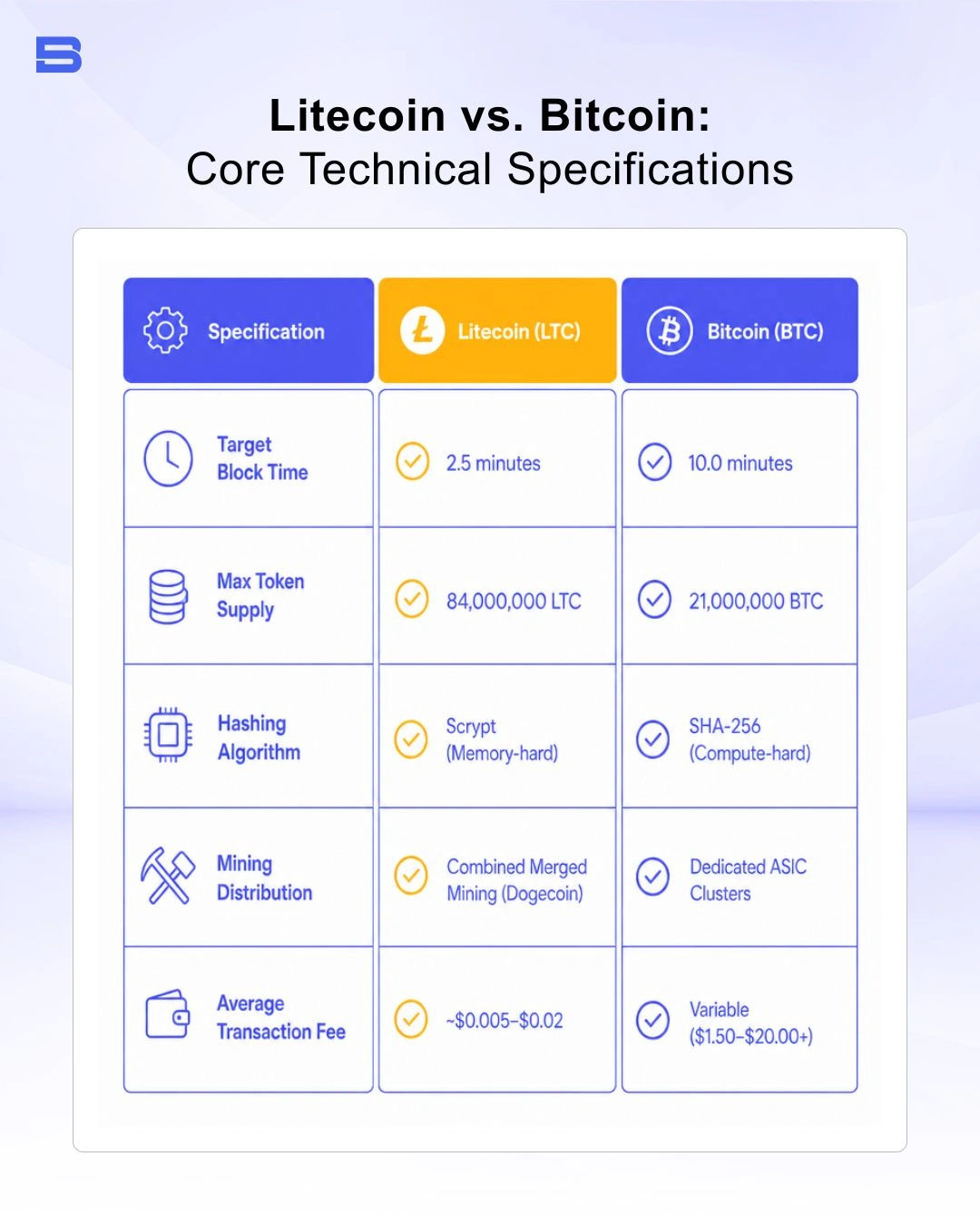
While Litecoin shares foundational code with Bitcoin, its underlying parameters differ significantly to optimize for transaction velocity.
Tokenomics and Supply Dynamics
Litecoin’s total supply cap is hardcoded to exactly 84 million tokens, exactly four times the maximum supply limit of Bitcoin. New LTC enters circulation through Proof-of-Work (PoW) block rewards paid to miners who secure the ledger.
To manage inflation, the network undergoes a "Litecoin halving" roughly every four years (or every 840,000 blocks), cutting the block reward by 50%. This predictable reduction schedule systematically reduces the issuance rate of new supply over time.
Litecoin vs. Bitcoin: Key Operational Differences
Understanding how Litecoin operates compared to Bitcoin requires evaluating both technical throughput and long-term liquidity behavior. If you are learning how to trade Bitcoin, comparing it to Litecoin highlights key trade-offs in blockchain design.
Block Generation and Capacity
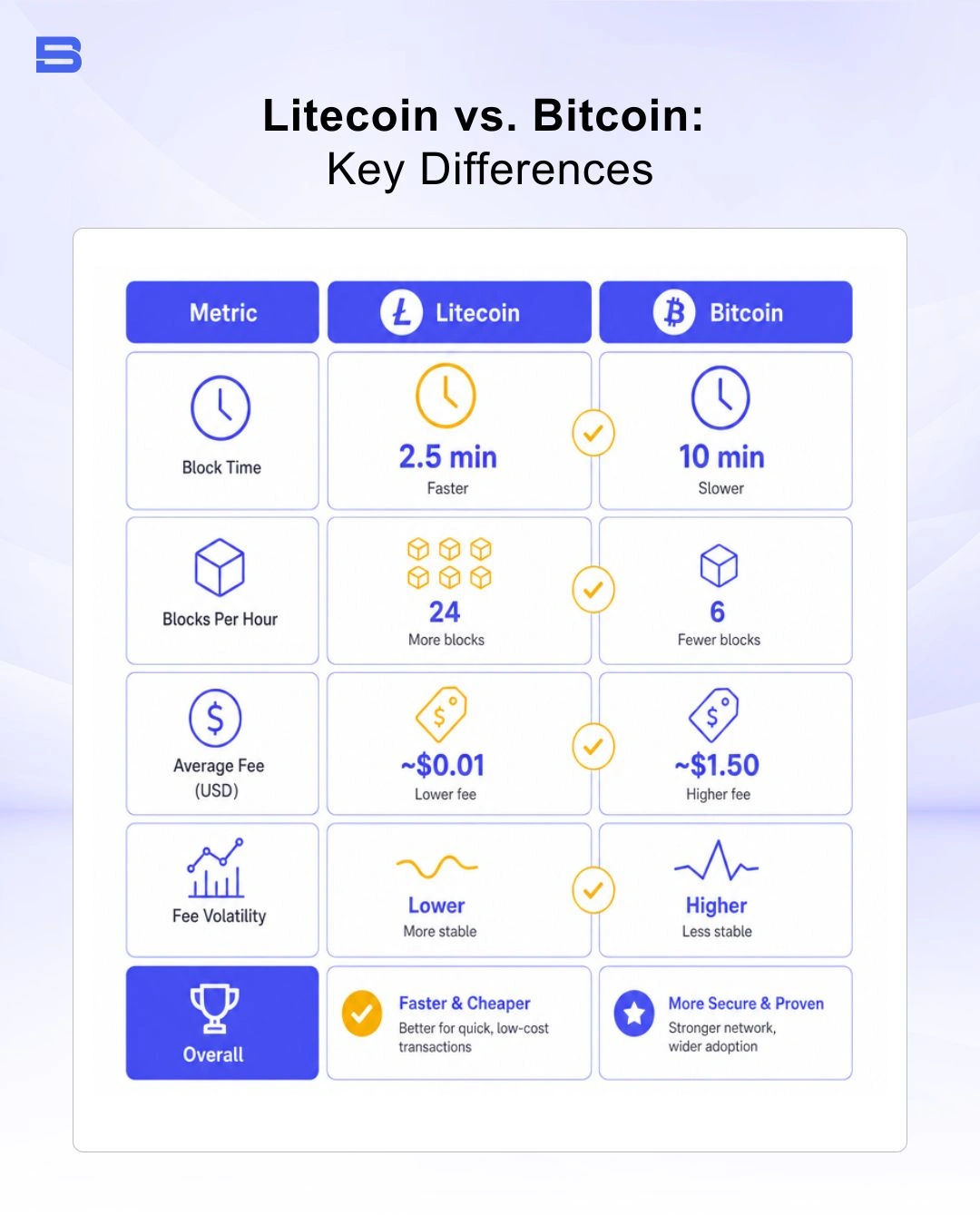
Litecoin produces a new block every 2.5 minutes, compared to Bitcoin's 10-minute average target. This faster block time yields four times the transaction capacity on the base layer, allowing merchant payments to clear much faster with fewer mempool congestion delays.
However, shorter block times mean the ledger grows faster in size, requiring network nodes to handle higher bandwidth and storage requirements over time.
Market Dynamics and Safe Haven Profile
While Bitcoin is increasingly evaluated as a macro hedge or institutional treasury asset, Litecoin trades primarily as an operational payment utility asset. Evaluating gold vs. Bitcoin highlights how digital assets capture safe-haven flows; historically, Litecoin demonstrates a higher beta to Bitcoin's price swings rather than acting as an independent haven.
Primary Use Cases and Real-World Utility
What is Litecoin used for in today's digital asset ecosystem? Its primary utility centers around high-volume micro-payments, merchant settlements, and liquidity transfers between global cryptocurrency exchanges.
- Merchant Payment Settlement: Integrated into major payment processors globally, allowing consumers to pay for online goods with low execution costs.
- Exchange Arbitrage and Inter-Exchange Transfer: Traders frequently convert capital into LTC to transfer funds quickly between exchange platforms to avoid high transfer fees and network delays.
- Smart Contract Integration: Support for smart contract functionality via network upgrades like OmniLite, a protocol extension that lets developers issue and manage tokens directly on the Litecoin blockchain.
Privacy Features and Exchange Compliance
In 2022, Litecoin activated the Mimblewimble Extension Blocks (MWEB) upgrade as an optional privacy feature. MWEB allows users to conduct confidential transactions in which the amount transferred is hidden, while transactions within the MWEB extension block provide greater privacy for senders and receivers. Users can opt in by moving LTC between Litecoin’s transparent main chain and the MWEB extension block.
While optional privacy enhances personal data protection, it introduces regulatory compliance hurdles. Regulators like the Securities Commission Malaysia (SC) and authorities across Europe require strict Anti-Money Laundering (AML) monitoring on digital asset exchanges. Consequently, several centralized exchanges in South Korea, Japan, and Western jurisdictions delisted LTC or disabled MWEB deposits to maintain regulatory licensing compliance.
Litecoin vs. Other Payment Chains: LTC vs. TRON
While Litecoin relies on Proof-of-Work (PoW) security to process transactions, newer blockchains use different consensus mechanisms. Comparing LTC to networks like TRON illustrates the difference between PoW security and delegated Proof-of-Stake (DPoS) architecture, where high transfer volume comes with varying levels of network centralization.
How to Trade Litecoin: Spot Trading vs. LTC CFDs
Traders looking to participate in LTC price movements can choose between holding direct spot assets or trading derivative contracts like Contracts for Difference (CFDs). Each execution model carries distinct operational requirements and financial risk profiles.
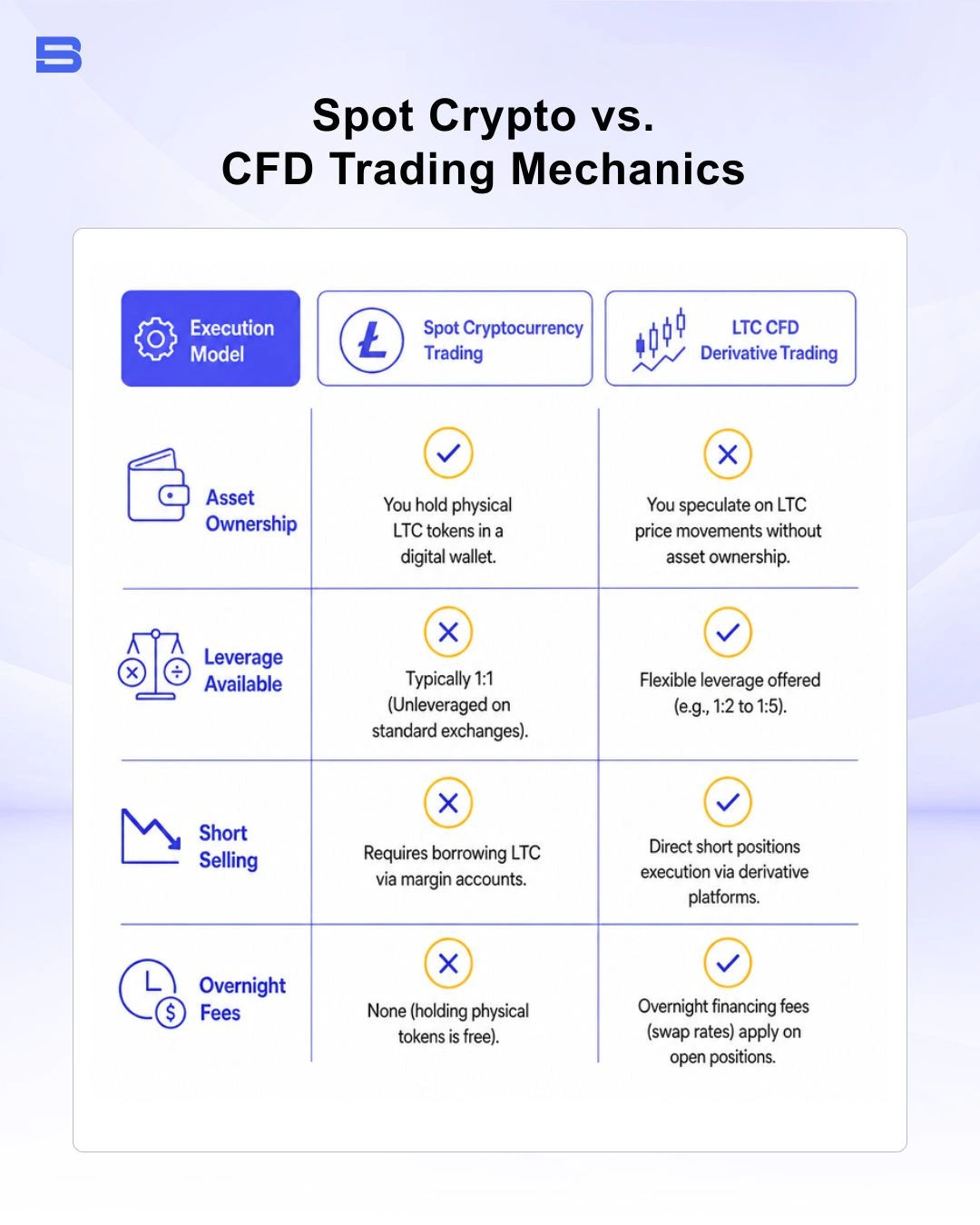
Similar to strategies covered in how to trade Ethereum or speculative token markets like Pepe Coin, selecting the right contract mechanism depends heavily on your capital strategy.
Worked Trading Scenario: Spot Ownership vs. CFD Position
Consider a scenario where LTC is trading at $100 per token:
- Spot Scenario: You purchase 10 LTC directly for a $1,000 cash balance. If the LTC price falls by 20% to $80, your asset value drops to $800, resulting in an unrealized loss of $200. You face no liquidation risk regardless of how long you hold the position.
- CFD Scenario (1:2 Leverage): You open a $1,000 LTC position (10 LTC equivalent) using 1:2 leverage, requiring a margin outlay of $500 from your account balance. Leverage amplifies both gains and potential losses; a 20% decline in LTC price to $80 generates the same $200 loss, which consumes 40% of your initial $500 margin deposit. If the price moves further against your position without a protective stop-loss, you risk facing a margin call or liquidation.
Regulatory Status and Network Security Profile
From a regulatory perspective, Litecoin maintains a relatively clear legal status compared to newer token projects. The US Commodity Futures Trading Commission (CFTC) explicitly classifies Litecoin as a digital commodity alongside Bitcoin and Ethereum, reducing uncertainty around unregistered security distributions.
From a network security standpoint, its Proof-of-Work blockchain has maintained continuous uptime since its inception in 2011. However, like all digital assets, trading LTC involves substantial price drawdown risks.
During previous broad crypto bear cycles, Litecoin has experienced price declines exceeding 80% from major cycle highs. CoinMarketCap records Litecoin's all-time high at $412.96 on May 10, 2021, with the cryptocurrency currently more than 87% below that peak, illustrating the scale of historical drawdowns. Such substantial declines highlight the importance of appropriate position sizing and active risk-management controls when trading LTC.
Final Takeaways: Is Litecoin Worth Trading?
Litecoin (LTC) is a long-established cryptocurrency designed for fast, low-cost peer-to-peer payments. Often referred to as “digital silver,” Litecoin shares similarities with Bitcoin while offering a different network structure and faster block generation. Its MWEB upgrade also provides an optional privacy feature for users seeking greater transaction confidentiality.
Ultimately, understanding how Litecoin works and the risks associated with its price movements can help you make more informed decisions. Whether trading LTC for short-term opportunities or considering longer-term exposure, a clear strategy, appropriate position sizing, and effective risk controls are essential.
- What Can You Trade? A Guide to Forex, Stocks, and More
- CFD Trading for Beginners
- What is CFD Trading and How Does It Work?
- Forex vs. Stocks: Which Market Suits You Best?
- How to Diversify a Portfolio Across Asset Classes
- How Dividend Stocks Work: Yields, Risks, and Strategies
- Silver Trading Explained: A Guide for Retail Investors
- Precious Metals Trading: A Complete Guide for Beginners
- Natural Gas Trading: A Guide to the Market
- Structured Warrants Malaysia: How They Work and Risks
- What Is the KLCI Index and How to Trade It
- Gold Investment in Malaysia: A Complete Guide for Beginners
- What Is Kijang Emas and How to Invest in It
- Value Investing Explained: How to Find Undervalued Stocks
- How to Trade Bitcoin Safely: A Complete Market Guide
- Growth Investing Explained: Strategies, Metrics, and Risks
- What Is Digital Gold Malaysia and How to Invest
- Crypto Trading Strategies for Beginners
- Gold vs Bitcoin: Key Differences, Risks, and Strategies
- Sukuk: A Guide for Beginners to Islamic Bonds
- What Is FCPO (Crude Palm Oil Futures) and How to Trade It
- How to Identify and Invest in Shariah-Compliant Stocks
- Timber Investment: Is It Worth It?
- Gold ETF Malaysia: A Guide for Beginners
- What Are Malaysian Government Securities (MGS)?
- Corporate Bonds Malaysia: A Guide for Beginners
- China A-Shares Trading Guide for Malaysian Investors
- What Is a Silver ETF and How to Invest in It?
- How to Trade XRP: A Practical Guide for Retail Investors
- How to Trade Solana (SOL): A Guide for Beginners
- What Are Gold Futures and How Do They Work?
- Money Market Fund in Malaysia: A Guide for Beginners
- Property Investment Malaysia: Direct Real Estate or M-REITs?
- What Is Binance Coin and How Does It Work?
- Green Sukuk: A Guide for Beginners to Islamic ESG Investing
- What Is Shiba Inu (SHIB) and How to Trade It
- What Is USDT? A Complete Guide to Tether for Beginners
- What Is Dogecoin and How to Trade It Safely for Beginners
- Cardano: A Guide for Beginners to Trade This Cryptocurrency
- Polkadot: A Guide to Trading This Cryptocurrency
- Tron: A Guide for Beginners to Trading This Cryptocurrency
- What Is Litecoin (LTC)? A Guide to Trading Digital Silver
- What Is Chainlink (LINK) and How to Trade It
- How to Trade Pepe Coin: Spot, Leverage, and Risk Management
- Near Protocol: A Guide to Trading This Cryptocurrency
- Trading Polygon Crypto: A Practical Guide for Beginners
- Trade Toncoin: Understanding the TON Ecosystem and Risks
- Cosmos Crypto: Ecosystem Architecture, Tokenomics, and Risks
- Stellar Crypto: A Guide to Trading This Cryptocurrency
- Avalanche Crypto Explained: A Practical Guide for Traders
- What Is Worldcoin? How to Trade WLD and Manage Risk
- Aptos: A Guide for Beginners to Trading This Cryptocurrency
- Sui Crypto Explained: Tokenomics and Trading Guide
- Celestia: A Guide to Trading This Cryptocurrency
- Decentraland: A Guide to Trading This Cryptocurrency
- What Is Arbitrum? How to Trade the Leading Layer 2 Network
- Sei Crypto: A Guide to Trading This Cryptocurrency
- What Is Injective Protocol and How to Trade INJ Safely
Disclaimer: The content on this page is intended for educational and informational purposes only. It does not constitute financial, investment, tax, or legal advice, and should not be interpreted as a recommendation to buy, sell, or hold any financial instrument or asset. Trading and investing involve significant risk, including the possible loss of your entire capital. Products such as forex, CFDs, and cryptocurrencies carry additional risks due to leverage, high volatility, and limited regulatory protection in some jurisdictions. Past performance of any financial instrument does not guarantee future results. Any market views, forecasts, or opinions expressed are those of the author at the time of writing and may not reflect current market conditions. Platform features, fees, and regulatory status are subject to change — always verify information directly with the relevant provider or regulator before making any financial decision. BrokerSpecs may receive compensation from third parties featured on this site. Always conduct your own due diligence and consider seeking advice from a licensed financial professional before investing.