



Related Tags
Putting all your eggs in one basket can expose your portfolio to unnecessary risks. Diversifying your portfolio across asset classes, such as stocks, bonds, real estate, and commodities, can help you build a much safer and well-rounded portfolio.
Since each asset class responds differently to economic changes, combining them helps to smooth out volatility and balance your returns. This method will create a more stable foundation for your portfolio to grow steadily over time.
In this article, we will explore the core benefits of portfolio diversification and provide actionable steps to help you build a well-balanced investment strategy.
What is Diversification?
Diversification means putting a mix of different asset classes and expanding them across a range of industries and geographic regions. It can help reduce your overall investment risk and manage volatility. For diversification to work, the asset classes must not be correlated with each other or move in the same direction to protect from extreme declines. For example, when commodity prices decline, the price of bonds will typically rise, which helps scale down losses in your portfolio value.
Correlation is the backbone of effective diversification. Mixing investments with low or negative correlations helps smooth out market swings and improves your risk-adjusted returns.
However, correlations can also suddenly shift during a market crisis, depending on the asset classes you trade. Common assets that are affected by these issues are equities and bonds, which can decline at the same time based on the economic climate.
To build a strategic diversification, you can combine equities for capital growth, bonds for stability, and real estate or commodities to protect against inflation. Properly balancing these assets harmonizes your portfolio’s performance to meet your broader financial objectives.
Benefits of Diversification
Building portfolio resilience goes beyond choosing individual assets. It requires strategic asset allocation to shield your wealth from market swings.
Here are the primary benefits of asset diversification:
Balances Portfolio Risk
Putting investment in one single asset can amplify risk, especially during a market downturn. Allocating investment across different asset categories dilutes this exposure, ensuring that a drop in one market doesn’t derail your entire portfolio.
Reduces Volatility
Asset classes move through market cycles at varying times. By blending them, you reduce volatility in your portfolio value and foster steady, reliable growth over the long run.
Enhance Portfolio Adaptability
Economic changes rarely impact all asset classes equally. Holding a broad asset mix ensures your portfolio remains flexible and thrives during inflation, growth, or market stagnation.
Support Diverse Investment Objectives
Spreading capital across a range of asset categories helps to bridge the gap between competing short- and long-term financial goals. It can also help in creating a balanced portfolio that accommodates different risks and time horizons.
Diversifying beats the monotony of a single-focus portfolio. Ultimately, this journey transforms the way you invest. By encouraging you to analyze diverse industries, evaluate competing businesses, and spark a genuine interest in the market sectors fueling your wealth, it turns everyday trading into a powerful vehicle for lifelong financial growth.
Steps to Build a Diversified Portfolio
Building a well-diversified portfolio requires a clear evaluation of your financial objectives, risk tolerance, and investment timeline. These can serve as your guidelines in shaping your allocation strategy, allowing you to balance growth potential with downturn protection.
Here is a simple step-by-step roadmap you can follow:
Knowing Your Goals and Risk Tolerance
Whether you are seeking consistent income generation, capital preservation, or aggressive long-term growth, get started by identifying your financial goals and objectives. For example, a younger investor typically will have a different asset mix and objectives than someone approaching retirement.
Select Asset Classes that Fit Your Profile
Your choice of asset classes should directly reflect your financial goals. By integrating a strategic mix of stocks, bonds, and real assets, it can ensure your portfolio remains balanced and protected through market swings.
Allocate Your Assets Strategically
Spread your investment allocation that fits into your personal goals and objectives. For example:
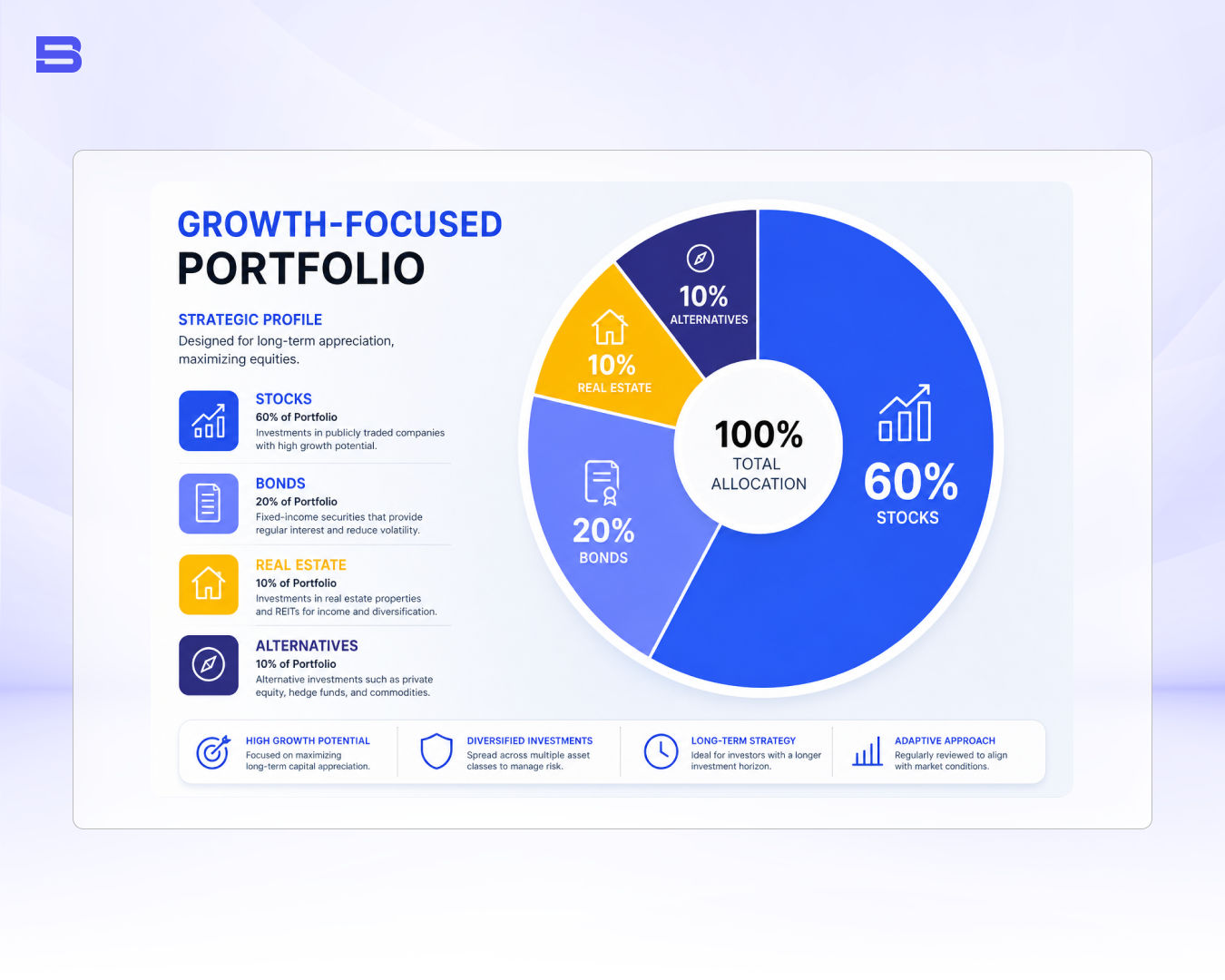
- Growth-focused Portfolio: 60% stocks, 20% bonds, 10% real estate, 10% alternatives
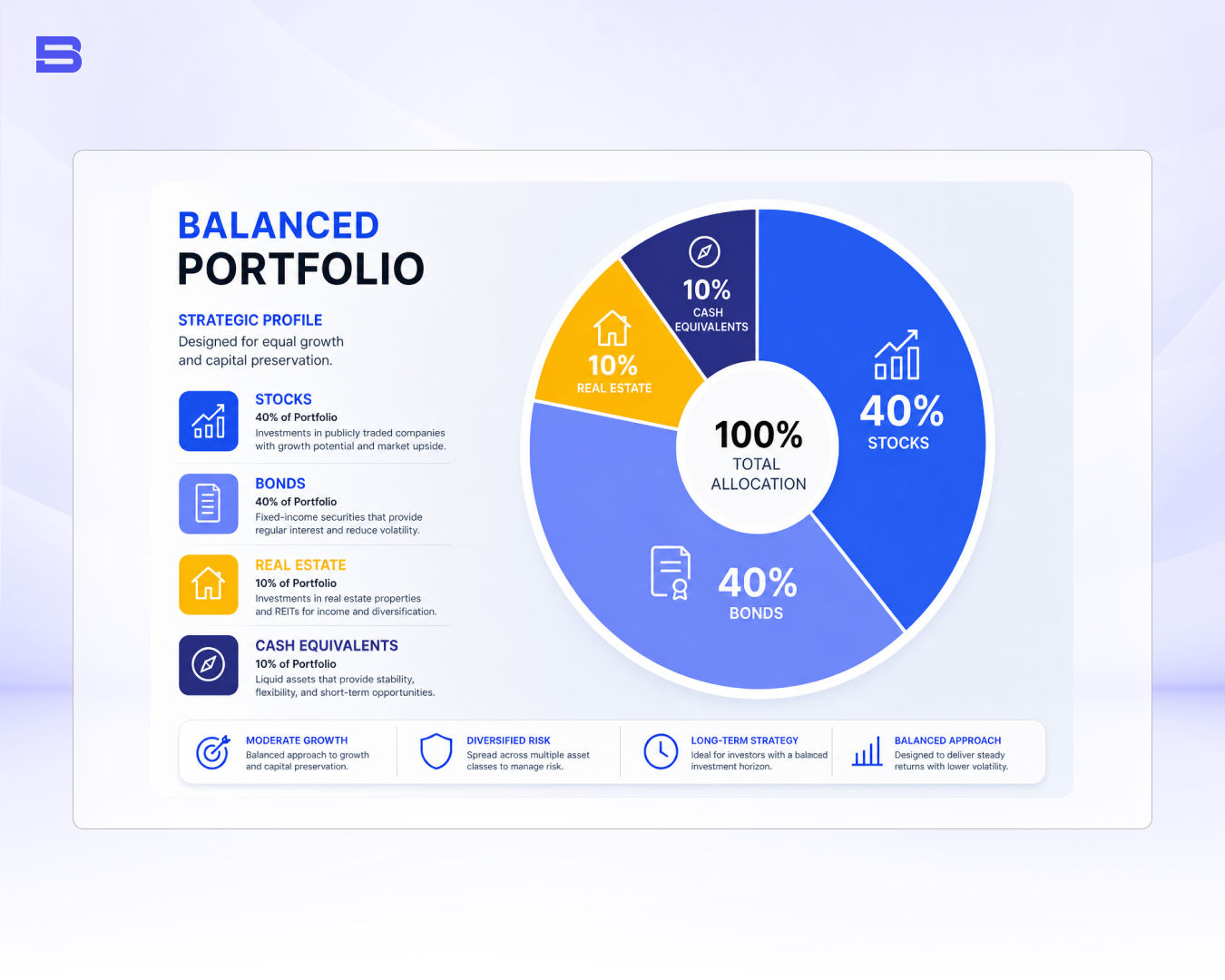
- Balanced Portfolio: 40% stocks, 40% bonds, 10% real estate, 10% cash equivalents
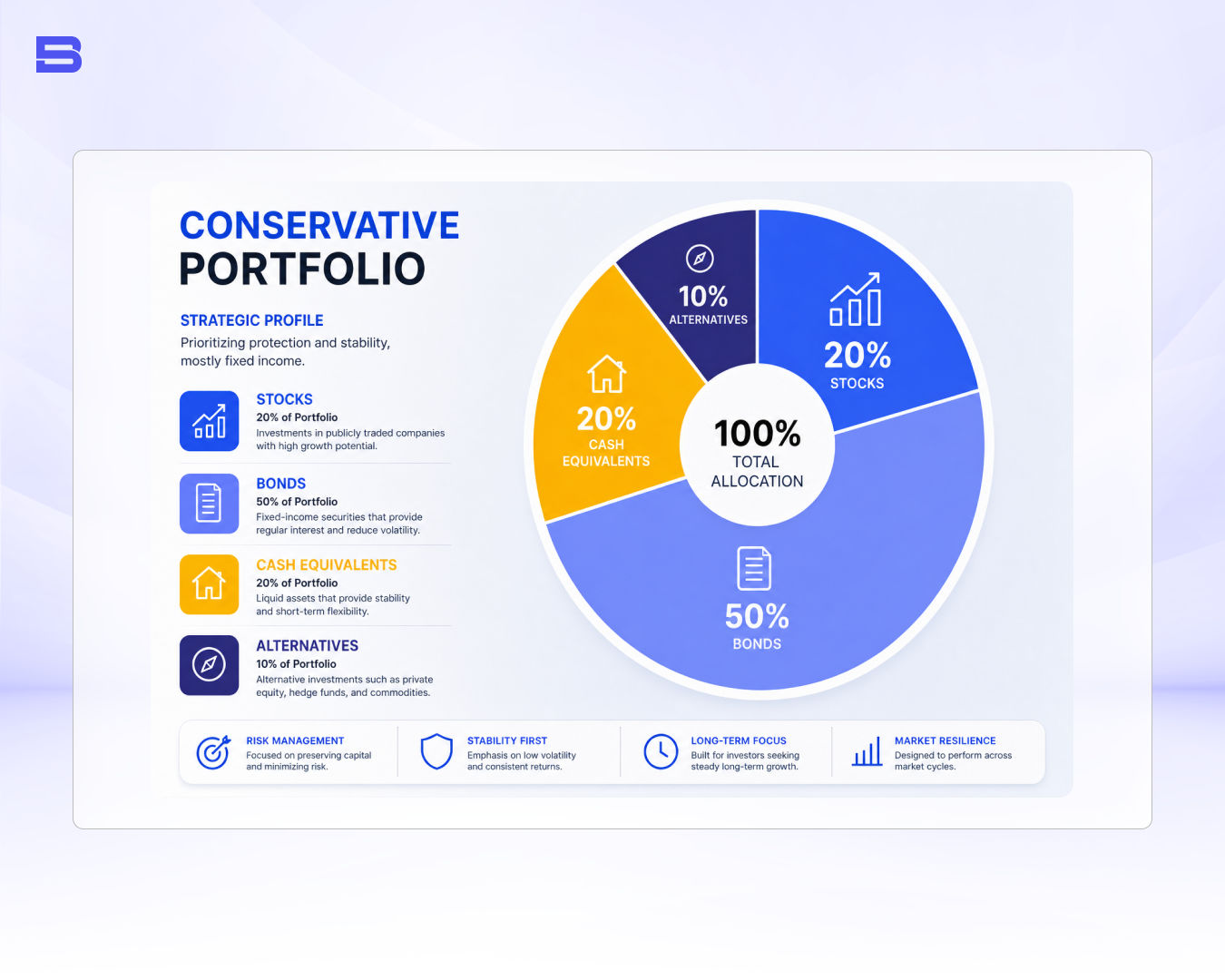
- Conservative Portfolio: 20% stocks, 50% bonds, 20% cash equivalents, 10% alternatives
Illustration as below:
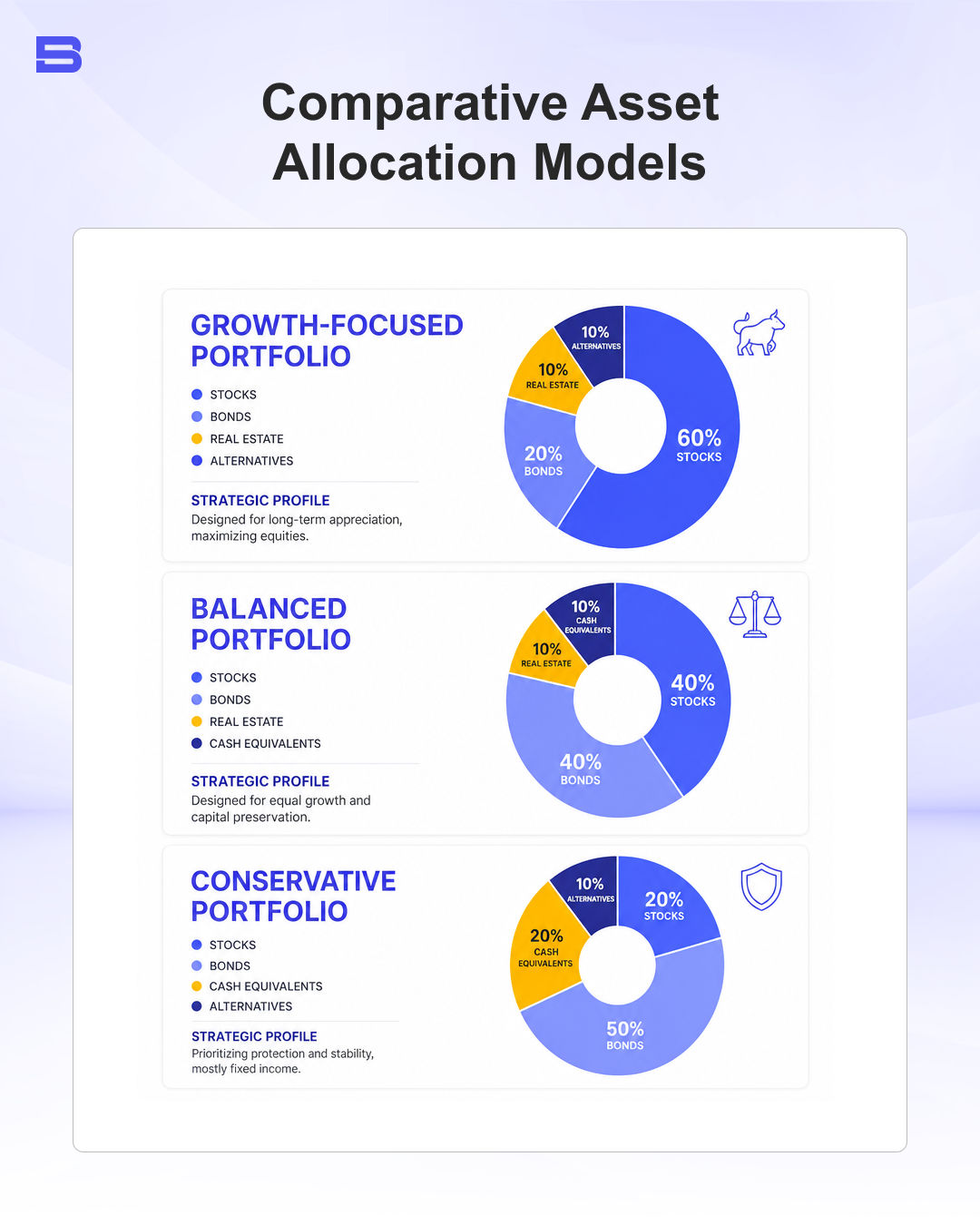
Example of Asset Allocation Strategies
Asset allocation is never one-size-fits-all, as it depends entirely on an individual’s risk profile. These breakdowns highlight how you can structure a portfolio to target specific financial goals to align with your risk tolerance for your long-term growth objectives.
Growth-focused Portfolio
This asset mix focuses entirely on long-term returns and is best suited if you are comfortable navigating higher levels of risk and market volatility.
- 60% stocks: focused on growth-oriented sectors and emerging markets
- 20% bonds: higher-yield or long-term corporate bonds with modest stability
- 10% real estate: to hedge against inflation
- 10% alternatives: including commodities, private equities, or energy assets
Balanced Portfolio
A balanced portfolio delivers reliable growth without excessive volatility. This framework perfectly matches if you prefer a mid-level risk tolerance and a longer investment time horizon.
- 40% stocks: a mix of domestic and international equities for growth potential
- 40% bonds: balanced between corporate and government bonds for stability and income
- 10% real estate: via Real Estate Investment Trust (REIT) or indirect property investments
- 10% cash: equivalent instruments like Treasury bills for liquidity
Conservative Portfolio
This strategy prioritizes capital preservation and income protection. It’s designed specifically for cautious investors or those nearing retirement.
- 20% stocks: diversified across large-capitalization and dividend-paying companies
- 50% bonds: emphasising high-quality government and corporate bonds
- 20% cash: such as savings accounts or other money market funds, for liquidity and capital preservation
- 10% alternatives: low-volatility real estate or commodities for additional diversification
How Correlation Shapes Portfolio Diversification
The success of asset diversification depends on the relationship between the asset investments. This relationship is measured by correlation, which tracks the price movements of two assets aligning. Correlation is scored between -1.0 and +1.0.
- +1.0 (Perfect Positive Correlation)
The asset moves together, rising and falling at the same time. - 0 (No Correlation)
The assets move independently, and one asset has no impact on another. - -1.0 (Perfect Negative Correlation)
The assets move in opposite directions.
To illustrate:
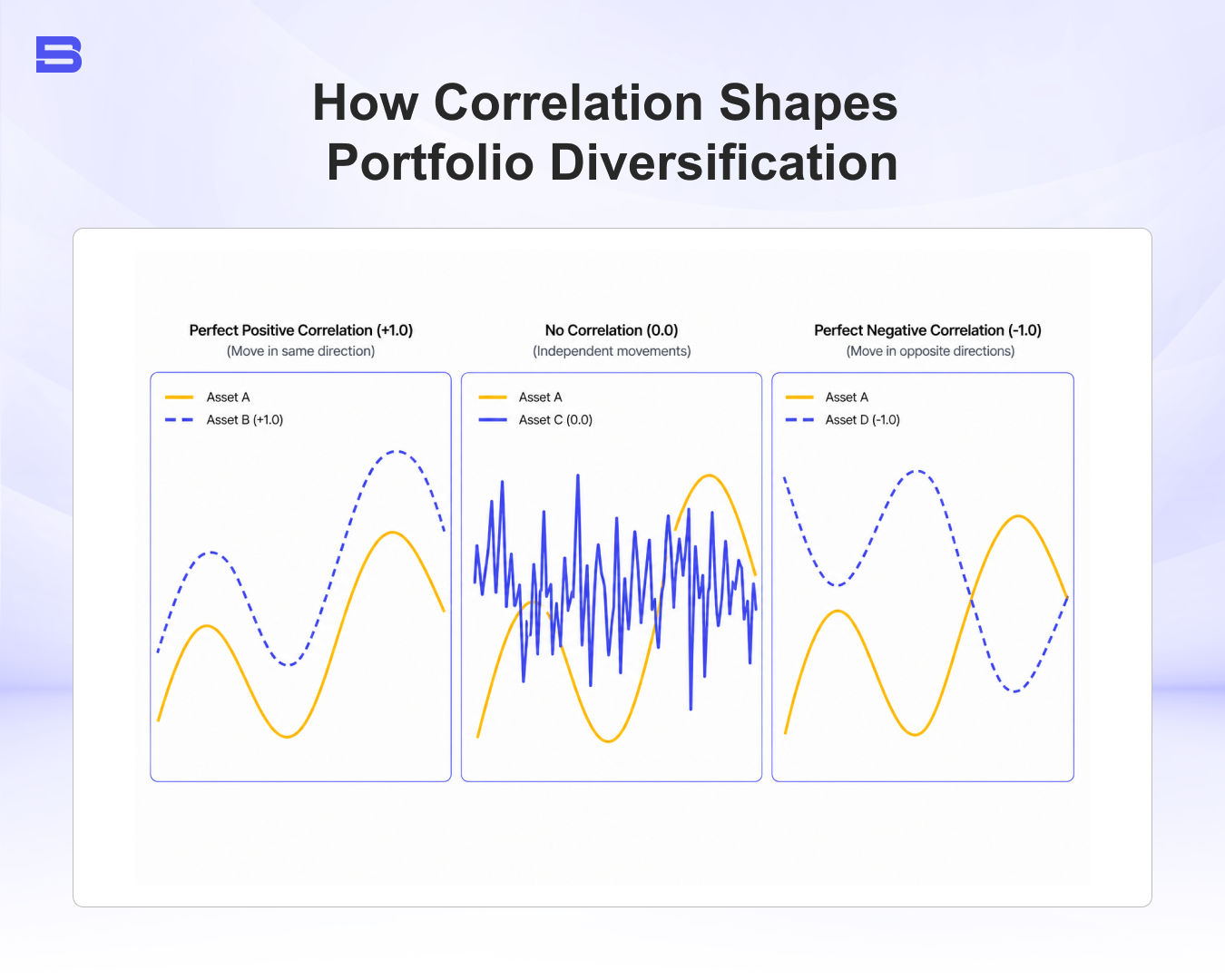
To minimize the portfolio risk, it’s important to add assets with low or negative correlation.
Here are primary examples of correlations across assets:
Positive Correlation
Stocks within the same sectors move in the same direction because they respond to the same economic forces. It amplifies gains and significantly increases vulnerability during market-specific downturns.
Negative Correlation
Government bonds move inversely to equities, acting as a shock absorber when the market falls. This protective relationship can disintegrate when interest rates are hiked.
Zero or Low Correlation
Alternative assets like real estate or commodities operate independently and are generally weak with equities. The lack of alignment strengthens the portfolio's resilience, though it can temporarily shift during macroeconomic shocks.
The goal of asset diversification is to protect your portfolio from major losses, and correlation is one of the tools you can use to achieve it. Correlation is measured on a scale from -1.0 to + 1.0, and understanding it is the secret to building a diversified portfolio that can withstand major shocks.
Diversification requires you to combine asset classes that behave differently under the same economic conditions so that a collapse in one area is offset by stability or growth in another.
Keeping Your Portfolio on Track with Rebalancing
Over time, the fluctuations in asset classes can cause a portfolio to stray away from its original allocation. For example, during a stock market rally, equities may grow to represent a larger share than their intended portfolio, increasing the risk exposure. Rebalancing helps to maintain its objective structure and risk profile.
There are a few ways to rebalance a portfolio:
Scale Back Positions in Outperforming Investments
Sell a portion of the overperforming assets and use the money to buy the underperforming assets to efficiently reset the target allocation.
New Capital Inflow
Instead of selling the existing asset, you can use your savings to allocate to a new investment target.
Redirect Your Payouts
Use investment payouts (dividends or interest) to increase the exposure for assets that need rebalancing.
Persistent rebalancing may cause an increase in transaction fees or tax liability, particularly in taxable accounts. You can minimize these expenses by using tax-advantaged accounts for adjustments. Having clear rebalancing thresholds when an asset class deviates by 5% can also reduce unnecessary trading activity.
Conclusion
Asset allocation is essential for investors that want to build a resilient portfolio that balances risk and growth. When you diversify these asset categories based on their economic changes, you can reduce the impact of market volatility, minimizing loss and ensuring consistent returns for long-term growth.
However, diversification is not a set-it-and-forget-it strategy. You need to monitor your portfolio frequently to ensure asset allocation is consistently aligned with your objectives and financial goals. This method involves rebalancing to handle investment performance and adjusting towards a developed market condition.
- What Can You Trade? A Guide to Forex, Stocks, and More
- CFD Trading for Beginners
- What is CFD Trading and How Does It Work?
- Forex vs. Stocks: Which Market Suits You Best?
- How to Diversify a Portfolio Across Asset Classes
- How Dividend Stocks Work: Yields, Risks, and Strategies
- Silver Trading Explained: A Guide for Retail Investors
- Precious Metals Trading: A Complete Guide for Beginners
- Natural Gas Trading: A Guide to the Market
- Structured Warrants Malaysia: How They Work and Risks
- What Is the KLCI Index and How to Trade It
- Gold Investment in Malaysia: A Complete Guide for Beginners
- What Is Kijang Emas and How to Invest in It
- Value Investing Explained: How to Find Undervalued Stocks
- How to Trade Bitcoin Safely: A Complete Market Guide
- Growth Investing Explained: Strategies, Metrics, and Risks
- What Is Digital Gold Malaysia and How to Invest
- Crypto Trading Strategies for Beginners
- Gold vs Bitcoin: Key Differences, Risks, and Strategies
- Sukuk: A Guide for Beginners to Islamic Bonds
- What Is FCPO (Crude Palm Oil Futures) and How to Trade It
- How to Identify and Invest in Shariah-Compliant Stocks
- Timber Investment: Is It Worth It?
- Gold ETF Malaysia: A Guide for Beginners
- What Are Malaysian Government Securities (MGS)?
- Corporate Bonds Malaysia: A Guide for Beginners
- China A-Shares Trading Guide for Malaysian Investors
- What Is a Silver ETF and How to Invest in It?
- How to Trade XRP: A Practical Guide for Retail Investors
- How to Trade Solana (SOL): A Guide for Beginners
- What Are Gold Futures and How Do They Work?
- Money Market Fund in Malaysia: A Guide for Beginners
- Property Investment Malaysia: Direct Real Estate or M-REITs?
- What Is Binance Coin and How Does It Work?
- Green Sukuk: A Guide for Beginners to Islamic ESG Investing
- What Is Shiba Inu (SHIB) and How to Trade It
- What Is USDT? A Complete Guide to Tether for Beginners
- What Is Dogecoin and How to Trade It Safely for Beginners
- Cardano: A Guide for Beginners to Trade This Cryptocurrency
- Polkadot: A Guide to Trading This Cryptocurrency
- Tron: A Guide for Beginners to Trading This Cryptocurrency
- What Is Litecoin (LTC)? A Guide to Trading Digital Silver
- What Is Chainlink (LINK) and How to Trade It
- How to Trade Pepe Coin: Spot, Leverage, and Risk Management
- Near Protocol: A Guide to Trading This Cryptocurrency
- Trading Polygon Crypto: A Practical Guide for Beginners
- Trade Toncoin: Understanding the TON Ecosystem and Risks
- Cosmos Crypto: Ecosystem Architecture, Tokenomics, and Risks
- Stellar Crypto: A Guide to Trading This Cryptocurrency
- Avalanche Crypto Explained: A Practical Guide for Traders
- What Is Worldcoin? How to Trade WLD and Manage Risk
- Aptos: A Guide for Beginners to Trading This Cryptocurrency
- Sui Crypto Explained: Tokenomics and Trading Guide
- Celestia: A Guide to Trading This Cryptocurrency
- Decentraland: A Guide to Trading This Cryptocurrency
- What Is Arbitrum? How to Trade the Leading Layer 2 Network
- Sei Crypto: A Guide to Trading This Cryptocurrency
- What Is Injective Protocol and How to Trade INJ Safely
Disclaimer: The content on this page is intended for educational and informational purposes only. It does not constitute financial, investment, tax, or legal advice, and should not be interpreted as a recommendation to buy, sell, or hold any financial instrument or asset. Trading and investing involve significant risk, including the possible loss of your entire capital. Products such as forex, CFDs, and cryptocurrencies carry additional risks due to leverage, high volatility, and limited regulatory protection in some jurisdictions. Past performance of any financial instrument does not guarantee future results. Any market views, forecasts, or opinions expressed are those of the author at the time of writing and may not reflect current market conditions. Platform features, fees, and regulatory status are subject to change — always verify information directly with the relevant provider or regulator before making any financial decision. BrokerSpecs may receive compensation from third parties featured on this site. Always conduct your own due diligence and consider seeking advice from a licensed financial professional before investing.