


Related Tags
Imagine trying to execute a high-frequency trading strategy on a highway jammed with bumper-to-bumper traffic. Every time you attempt to merge or make a move, you are forced to pay a massive toll, only for your transaction to sit in a queue while the price moves past your target entry. For years, traders accepted this friction as an inevitable cost of participating in decentralized markets.
Solana was engineered explicitly to eliminate that friction. By rebuilding blockchain consensus from the ground up to prioritize execution speed and sub-cent transaction costs, it transformed how active traders interact with digital assets. However, high speed brings its own operational realities, market dynamics, and risk considerations. Understanding how Solana (SOL) functions—and how to navigate its volatile market environment safely—is essential before executing your first trade.
What Is Solana (SOL) and How Does It Work?
Solana is a high-performance, Layer-1 open-source blockchain network designed to host decentralized applications (dApps), smart contracts, and high-frequency financial tools. At its core, the architecture focuses on scaling network throughput without relying on complex Layer-2 scaling solutions. Its native utility token, SOL, powers transaction validation, smart contract execution, and network governance.
When you execute a trade on Solana, the network processes your request through a global cluster of independent validators. Unlike traditional finance, where clearing houses settle trades days after execution, or older blockchain architectures that batch transactions in periodic blocks, Solana clears transactions in real time. This infrastructure allows retail and institutional traders to interact directly with decentralized order books, automated market makers (AMMs), and centralized exchanges with negligible transaction delay.
Technical Architecture: Proof of History (PoH)
The engineering breakthrough that enables Solana’s execution speed is Proof of History (PoH). Standard blockchains rely on validators reaching consensus on when a transaction occurred through time-consuming network communication.
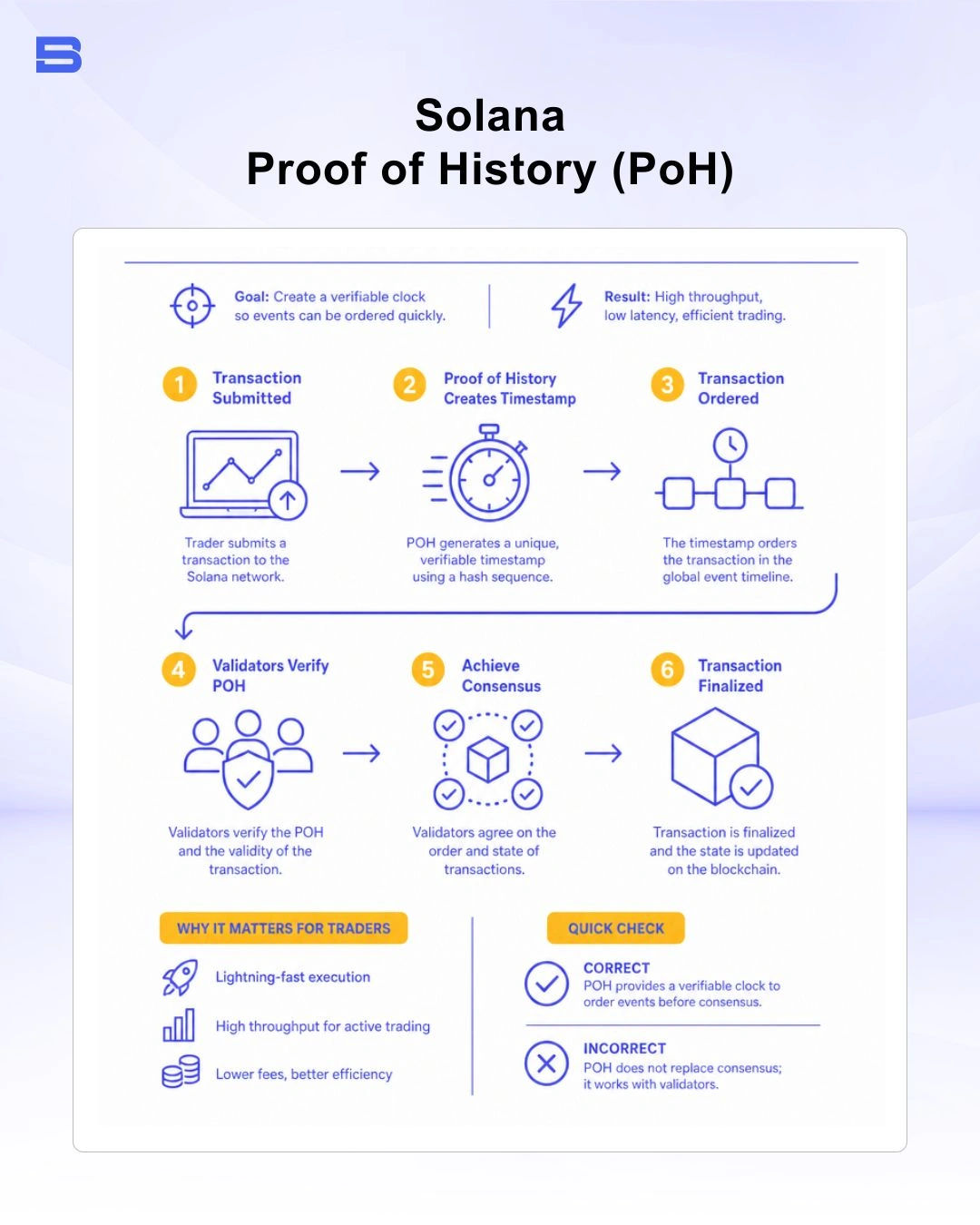
Solana solves this by creating a cryptographic passage of time—a verifiable clock embedded directly into the ledger. PoH works alongside Proof of Stake (PoS), allowing nodes to create a sequential record of events without waiting to broadcast times back and forth across the globe. This cryptographic timestamping reduces network latency, enabling processing speeds that rival centralized legacy systems.
Solana vs Ethereum: Architecture & Fee Comparison
For traders, the primary differences between Solana and established Layer-1 networks like Ethereum come down to transaction cost, latency, and system architecture.
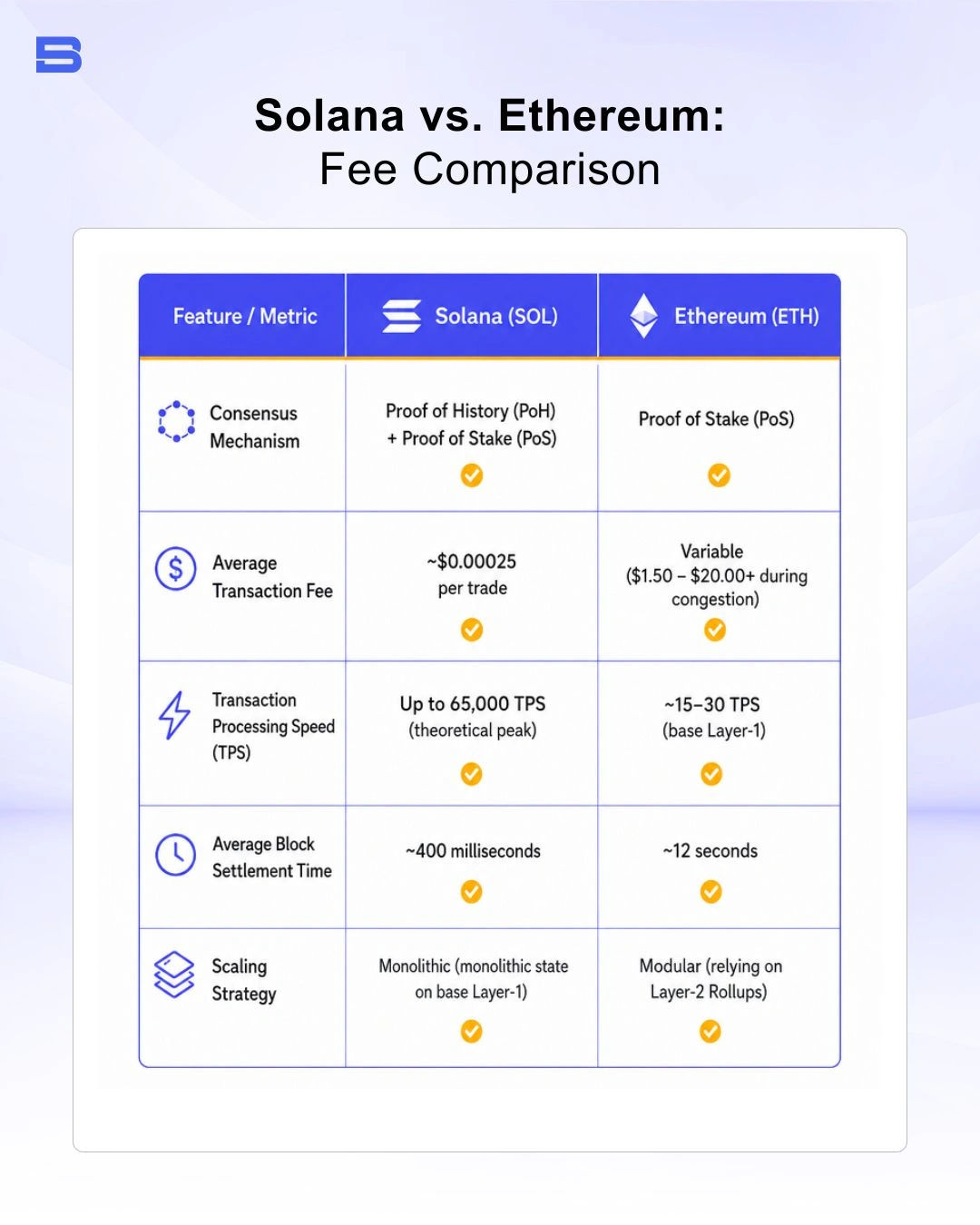
This architectural divergence fundamentally alters trading behavior. Lower gas fees make micro-position adjustments, algorithmic rebalancing, and frequent trade entries economically viable on Solana, whereas higher execution fees on Ethereum favor larger transaction sizes or longer holding horizons.
Popular Solana Trading Strategies
Because Solana provides immediate trade execution, active traders employ distinct strategies to capture short-term momentum, macro swings, or market structure inefficiencies.
Spot Trading vs Margin Trading SOL
Choosing between spot and margin trading depends directly on your capital allocation model and risk tolerance.
- Spot Trading: Involves purchasing physical SOL tokens directly on a spot market or centralized exchange. When you spot trade, you own the underlying asset outright. Your downside risk is limited to the initial capital invested if the token price drops to zero, and there are no ongoing borrowing costs or forced liquidation levels.
- Margin Trading: Involves borrowing funds from a broker or liquidity pool to amplify your exposure to SOL price fluctuations. Margin trading allows you to enter both long (bullish) and short (bearish) positions.
Leverage amplifies your returns when you are right, but it accelerates capital destruction just as quickly when the market moves against you—a 5% market drop on a 10x leveraged position results in a 50% capital loss, triggering potential margin calls or automated liquidation.
Key Strategies for Trading Solana (SOL) vs Bitcoin (BTC)
Trading SOL requires a different tactical mindset than market leaders like Bitcoin. If you are learning how to trade Bitcoin, you will recognize that Bitcoin often acts as a macro market anchor with lower relative volatility.
SOL, by contrast, behaves as a high-beta growth asset. During broader market rallies, SOL frequently outperforms Bitcoin on a percentage basis, making dynamic trend-following and breakout strategies popular among active traders. Conversely, during market pullbacks, SOL often experiences sharper drawdowns. Active traders often monitor the SOL/BTC trading pair to measure capital rotation between safe-haven sentiment and Layer-1 growth assets.
High-Volatility Ecosystem Segments
Solana’s fast processing time and minimal network fees have made it the primary hub for fast-moving market segments, including decentralized finance (DeFi) protocols, non-fungible token (NFT) marketplaces, and high-volatility memecoins.
Trading within these ecosystem segments demands strict position management. Low execution costs can tempt traders into overtrading or chasing short-term price spikes. Implementing predefined profit targets and limit orders helps prevent emotional trade execution during high-volatility events.
Ecosystem Infrastructure & DEX Trading Tools
To trade SOL efficiently outside of traditional centralized brokerages, you need reliable web3 infrastructure:
- Non-Custodial Wallets: Applications such as Phantom Wallet or Solflare provide direct self-custody access to the network. They allow you to hold SOL, interact with decentralized applications, and manage transaction authorization securely.
- Decentralized Exchanges (DEXs): Platforms like Raydium, Orca, and Jupiter aggregate liquidity across the network. Jupiter acts as a primary DEX aggregator, routing your trade across multiple liquidity pools in real time to secure the lowest slippage and tightest spread possible.
- Execution Order Types: While early DEXs only supported basic market swaps, modern Solana tools feature automated limit orders, DCA (dollar-cost averaging) vaults, and real-time order books, giving decentralized traders execution capabilities once limited to institutional platforms.
Solana vs Other High-Throughput Layer-1 Assets
When selecting instruments for your portfolio, it helps to analyze how Solana compares with other major payment and smart contract networks across the digital asset space.
- Solana vs XRP: While both networks emphasize rapid trade clearing and low transaction costs, XRP focuses primarily on cross-border institutional settlements and banking liquidity rails. Solana focuses on a broader application ecosystem, supporting decentralized finance, consumer apps, and composable smart contracts.
- Solana vs Stellar Crypto: Similar to XRP, Stellar is optimized for foreign exchange remittance and tokenized fiat transfers. Solana’s architecture targets general-purpose computational throughput, catering to developers and active traders seeking complex financial derivatives.
- Solana vs Celestia: Celestia operates as a modular data availability network designed to power individual rollups and specialized chains. Solana maintains a unified, monolithic state where all applications share the same global state machine, maximizing cross-protocol liquidity and immediate execution composability.
Key Risks and Volatility in Solana Trading
While Solana’s technology enables seamless trading capabilities, active market participants face serious technical, structural, and regulatory risks.
- Network Stability & Outages: Historically, Solana has experienced instances of network congestion and complete validator outages caused by aggressive bot activity or bug consensus failures. During an outage, trade execution halts completely on-chain, preventing traders from managing open positions, adjusting stop-loss orders, or adding margin.
- Smart Contract Vulnerabilities: Trading via decentralized applications exposes your capital to protocol exploits, flash loan attacks, or liquidity pool drainages. Always verify protocol audits and avoid locking excess capital in untested decentralized applications.
- Extreme Volatility & Drawdowns: Digital assets experience wide price swings driven by macro liquidity changes, shifts in market sentiment, and regulatory news. According to investor advisories from regulatory bodies like the Monetary Authority of Singapore (MAS), retail traders face severe financial exposure due to rapid, unpredictable drawdowns in volatile crypto markets.
Assessing Solana’s Risk-Reward Profile
According to historical price data from CoinGecko, SOL has experienced intra-day price swings of 15% to 20% during high-volatility events; proper position sizing is critical. Risk management frameworks recommend risking no more than 1% to 2% of total trading capital on a single transaction.
For example, if you manage a $10,000 account, your maximum capital risk per trade should be capped at $100 to $200. If you enter a spot SOL position at $150 with a technical stop-loss set at 135 (15 price risk per token), your maximum position size should be limited to 10 SOL ($1,500 total position value). This ensures that even if your stop-loss is hit during a sharp market drop, your overall account equity remains protected. Regulatory authorities such as the US Securities and Exchange Commission (SEC) consistently emphasize that disciplined capital management and explicit risk disclosure are fundamental to surviving highly speculative asset markets.
Conclusion
Solana has established itself as a major foundation for active trading, combining sub-second settlement times with minimal execution costs. Whether you are spot-trading major price swings or utilizing decentralized applications, the network’s high-throughput architecture removes traditional operational bottlenecks. However, performance advantages do not eliminate market risk. By maintaining disciplined position sizing, using protective stop-loss levels, and understanding the operational realities of on-chain infrastructure, you can navigate Solana’s market opportunities while protecting your trading capital.
- What Can You Trade? A Guide to Forex, Stocks, and More
- CFD Trading for Beginners
- What is CFD Trading and How Does It Work?
- Forex vs. Stocks: Which Market Suits You Best?
- How to Diversify a Portfolio Across Asset Classes
- How Dividend Stocks Work: Yields, Risks, and Strategies
- Silver Trading Explained: A Guide for Retail Investors
- Precious Metals Trading: A Complete Guide for Beginners
- Natural Gas Trading: A Guide to the Market
- Structured Warrants Malaysia: How They Work and Risks
- What Is the KLCI Index and How to Trade It
- Gold Investment in Malaysia: A Complete Guide for Beginners
- What Is Kijang Emas and How to Invest in It
- Value Investing Explained: How to Find Undervalued Stocks
- How to Trade Bitcoin Safely: A Complete Market Guide
- Growth Investing Explained: Strategies, Metrics, and Risks
- What Is Digital Gold Malaysia and How to Invest
- Crypto Trading Strategies for Beginners
- Gold vs Bitcoin: Key Differences, Risks, and Strategies
- Sukuk: A Guide for Beginners to Islamic Bonds
- What Is FCPO (Crude Palm Oil Futures) and How to Trade It
- How to Identify and Invest in Shariah-Compliant Stocks
- Timber Investment: Is It Worth It?
- Gold ETF Malaysia: A Guide for Beginners
- What Are Malaysian Government Securities (MGS)?
- Corporate Bonds Malaysia: A Guide for Beginners
- China A-Shares Trading Guide for Malaysian Investors
- What Is a Silver ETF and How to Invest in It?
- How to Trade XRP: A Practical Guide for Retail Investors
- How to Trade Solana (SOL): A Guide for Beginners
- What Are Gold Futures and How Do They Work?
- Money Market Fund in Malaysia: A Guide for Beginners
- Property Investment Malaysia: Direct Real Estate or M-REITs?
- What Is Binance Coin and How Does It Work?
- Green Sukuk: A Guide for Beginners to Islamic ESG Investing
- What Is Shiba Inu (SHIB) and How to Trade It
- What Is USDT? A Complete Guide to Tether for Beginners
- What Is Dogecoin and How to Trade It Safely for Beginners
- Cardano: A Guide for Beginners to Trade This Cryptocurrency
- Polkadot: A Guide to Trading This Cryptocurrency
- Tron: A Guide for Beginners to Trading This Cryptocurrency
- What Is Litecoin (LTC)? A Guide to Trading Digital Silver
- What Is Chainlink (LINK) and How to Trade It
- How to Trade Pepe Coin: Spot, Leverage, and Risk Management
- Near Protocol: A Guide to Trading This Cryptocurrency
- Trading Polygon Crypto: A Practical Guide for Beginners
- Trade Toncoin: Understanding the TON Ecosystem and Risks
- Cosmos Crypto: Ecosystem Architecture, Tokenomics, and Risks
- Stellar Crypto: A Guide to Trading This Cryptocurrency
- Avalanche Crypto Explained: A Practical Guide for Traders
- What Is Worldcoin? How to Trade WLD and Manage Risk
- Aptos: A Guide for Beginners to Trading This Cryptocurrency
- Sui Crypto Explained: Tokenomics and Trading Guide
- Celestia: A Guide to Trading This Cryptocurrency
- Decentraland: A Guide to Trading This Cryptocurrency
- What Is Arbitrum? How to Trade the Leading Layer 2 Network
- Sei Crypto: A Guide to Trading This Cryptocurrency
- What Is Injective Protocol and How to Trade INJ Safely
Disclaimer: The content on this page is intended for educational and informational purposes only. It does not constitute financial, investment, tax, or legal advice, and should not be interpreted as a recommendation to buy, sell, or hold any financial instrument or asset. Trading and investing involve significant risk, including the possible loss of your entire capital. Products such as forex, CFDs, and cryptocurrencies carry additional risks due to leverage, high volatility, and limited regulatory protection in some jurisdictions. Past performance of any financial instrument does not guarantee future results. Any market views, forecasts, or opinions expressed are those of the author at the time of writing and may not reflect current market conditions. Platform features, fees, and regulatory status are subject to change — always verify information directly with the relevant provider or regulator before making any financial decision. BrokerSpecs may receive compensation from third parties featured on this site. Always conduct your own due diligence and consider seeking advice from a licensed financial professional before investing.