


Related Tags
Forex trading and stocks are among the most popular choices among beginner traders looking to start trading. Each market presents distinct opportunities and challenges. For example, forex traders benefit from its high liquidity and a tight spread, whereas stock investors capture value through direct equity ownership and dividend income.
To get a clear picture of how these financial instruments stack up, let’s look at the mechanics of each. While both involve buying and selling, the structure of these markets creates different trading experiences.
What is Forex?
The foreign exchange, also known as forex, is a global market for swapping currency pairs such as EUR/USD. Forex is a decentralized market, or, to put it simply, there is no “main building”, central hub, or exchange that is used to trade forex; instead, it’s a digital web of banks, brokers, and institutions trading directly with one another.
This decentralized structure allows the market to run seamlessly across every time zone, creating a 24-hour cycle of continuous opportunity. In the world of forex, every trade you make is a currency pair—meaning you’re buying one currency while simultaneously selling another. Forex is a leveraged financial instrument that can be both rewarding and risky.
The sheer scale of this activity is staggering, as evidenced by a survey conducted by the Bank for International Settlements, which reported that the daily turnover rate for forex as of April 2025 has risen significantly to around $9.6 trillion per day, making it the largest financial market.
What are Stocks?
In contrast to the fast-paced world of currency exchange, the stock market offers a fundamentally different experience. It allows you to acquire direct equity in specific businesses. Rather than speculating on exchange rates, you are purchasing actual shares of the companies.
One key distinction of stocks is that they give you partial ownership of a company, which entitles you to various rights. For example, buying Apple stocks means you literally own a part of the company.
Some stocks also offer dividends, which entitle you to periodic payments directly from the companies you invest in. You also have the right to vote in the shareholder meeting, which is something not available in forex trading.
Stocks are funneled through official exchanges that provide a clear, public record of prices and volume, such as the NYSE or the Nasdaq. These exchanges have a rigid schedule, traditionally 9:30 AM to 4:00 PM EST for major US markets. The market outside regular trading hours is available, but it typically has lower liquidity and higher risks.
Whether you are a day trader aiming to benefit from short-term price movements or a long-term investor following a buy-and-hold strategy, the stock market provides a regulated and transparent way to participate in the growth of successful global companies.
Would you consider yourself more of a day trader, responding to market news and short-term changes, or an investor focused on building a portfolio for long-term growth?
Difference Between Forex and Stocks?
Deciding between the forex and the stock market is not about identifying a superior platform. It’s about aligning your trading goals, risk tolerance, and your personality type. While the end goal of both is to generate profit through asset exchange, the mechanics are worlds apart.
Comparison at a glance:
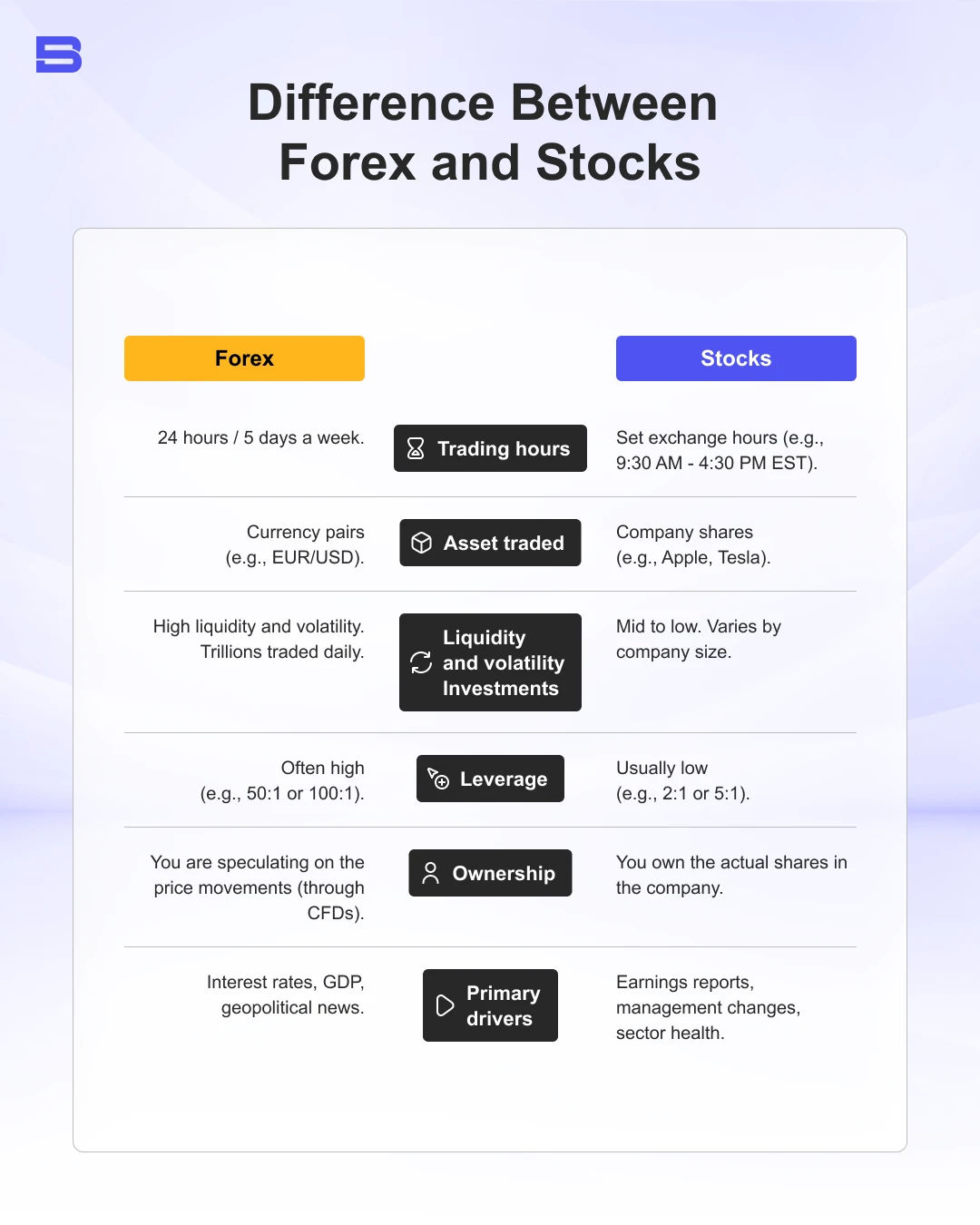
This comparison highlights the fundamental differences between forex and stock, helping you better understand which market aligns with your strategies and financial objectives.
Advantages and Disadvantages of Forex Trading
The forex market is one of the most actively traded financial markets in the world, attracting beginner and experienced traders due to its flexibility, liquidity, and accessibility. Like any other financial market, forex trading offers both benefits and potential risks that you should carefully consider before you join the arena.
Here is a breakdown of those advantages:
Advantages of the Forex Market
- High Liquidity and Tight Spreads
You can enter and exit positions almost instantly because of its massive volume of daily trades. This high trading activity typically results in lower transaction costs (tight spreads) to ensure you can keep more of your earnings.
- 24/5 Market Access
The market operates 24 hours, five days a week, through major global financial hubs. This allows you to be very flexible with your schedule, regardless of your time zone and professional commitments.
- Low-cost and Accessibility
Forex costs are generally integrated into the bid-ask spread, compared to other markets that charge flat per-trade commissions. Accessibility time is not limited to standard trading hours, like stocks.
- Use of Leverage
Through the use of leverage, you can control larger positions with a small margin.
- Two-Way Profit Potential
In forex trading, you’re always buying a currency while simultaneously selling another. This means you can profit from both upward and downward price movements by taking either long or short positions on currency pairs such as EUR/USD.
Disadvantages of the Forex Market
Despite offering accessibility 24-hours a day, it still comes with its own risks. In recent years, the downsides have become even more pronounced, with global markets facing unique geopolitical shifts coupled with high-speed algorithmic trading.
Here are the primary downsides to consider before diving in:
- High Volatility
Currency prices can fluctuate rapidly due to economic news, interest rate changes, and geopolitical events, making it highly volatile.
- High Risk Due to Leverage
Even though leverage can amplify profits, it can also magnify losses. You may lose all of your capital if the market moves against your direction while using high leverage.
- Market Complexity
In forex, you are trading entire economies. You have to track dozens of variables simultaneously, such as inflation rates, geopolitical events, and even trade wars, as these factors can significantly influence price movements.
- Decentralized Global Market (OTC Market)
Unlike stocks that have a specific exchange, forex is traded over-the-counter (OTC). There is no single price for a currency pair, as the prices can vary slightly between brokers. In some regions, it can leave you vulnerable to unethical brokers, as the regulation is light, so these brokers tend to engage in price manipulation and make withdrawal processes difficult.
- Higher Risk of Frauds and Scams
Since forex is decentralized, you need to be careful of unregulated brokers that operate without licenses. Some forex brokers may be registered under offshore jurisdictions with weaker regulations, which can increase the risk of fraud or unfair trading practices.
Forex trading offers distinct advantages like high liquidity, 24-hour market access, and the ability to use leverage to amplify positions. However, these same features introduce significant dangers, such as extreme price swings, the risk of magnified losses exceeding initial deposits, and inconsistent global oversight.
Before participating in the market, you need to carefully assess these factors and apply proper risk management planning to safeguard your capital through technical and fundamental analysis.
The Pros and Cons of the Stock Market
Engaging in the stock market provides a pathway to the financial structure that is characterized by high liquidity and opportunity for substantial capital gains from market movement. While it offers many rewards, it involves certain drawbacks as well. Understanding both pros and cons is essential to developing your risk management plan.
Here are the four primary benefits you can get:
The Pros of the Stock Market
- Dividend Income
Other than potential capital gains, most companies share their financial success through dividend distributions.
- Ownership in a Company
Buying stocks gives you fractional ownership in a company, allowing you to benefit from the company’s success and participate in shareholder voting.
- Potential for Capital Growth
By investing in equities, you can benefit from the growth of the companies. When a business expands its operations and increases profitability, the market value of the shares also rises, allowing you to sell the stocks at a higher price point than your initial investment.
- Portfolio Diversification
You can diversify your investments across industries, different companies, or markets, which helps to minimize the risk of magnifying losses.
The Cons of the Stock Market
While stock trading can be a powerful engine for wealth, the complexity of the market means that you may face several hurdles that can lead to financial losses. These disadvantages include volatility and risk, time, and the knowledge it takes to make a good decision.
Here are the disadvantages of the stock market:
- Market Volatility
Due to economic conditions, companies' performance, market sentiment, and stock prices can fluctuate, which may lead to a sudden loss.
- Economic and Political Factors
A policy shift, such as government decisions on tax reforms or new regulations, can directly impact stock prices as it creates uncertainty for investors.
- Risk of Capital Loss
Equity markets are volatile. If a stock market’s value drops below your entry price, selling at that time will result in a capital loss, where you recoup less than your initial investment.
- Company-specific Risk
A company's market value is often associated with its leadership. When ineffective management makes poor strategic choices, it can lead to the fall of share prices as investors lose faith in the company.
While the stock market provides a path toward wealth accumulation through price appreciation, regular dividend payouts, and portfolio balance, it’s susceptible to market instability and macroeconomic shifts. To navigate this landscape effectively, you can combine research, risk mitigation, and a long-term strategy to equip yourself before trading.
Forex or Stocks: Which Market Should You Trade?
Deciding between forex and stock trading is not about finding a superior market; it’s about finding the one that fits your specific preferences and objectives. Since both options carry unique pros and cons, the right choice ultimately comes down to your personal goals and temperament. There are a few things that you need to consider before making an informed decision:
Time Commitment: How much time are you willing to spend every day to monitor the price action? Your availability will dictate both your trading style and which markets are practical for you.
Personality and Risk: Are you looking at the high-octane volatility found in currency pairs, or do you prefer the fundamental growth patterns of individual companies?
Due Diligence: A conscious choice requires research. Aligning your financial objectives with the mechanics of each market is the only way to trade with confidence.
There are many moving parts to track, but you don’t have to navigate them alone. There are a lot of platforms that provide comprehensive resources and educational tools that you need to weigh these variables and kickstart your trading journey with clarity.
For beginners looking to venture into this arena, it is highly recommended to start with a demo account. It will give you the feel of how to manage risk without a wave of emotions, watching your savings fluctuate.
- What Can You Trade? A Guide to Forex, Stocks, and More
- CFD Trading for Beginners
- What is CFD Trading and How Does It Work?
- Forex vs. Stocks: Which Market Suits You Best?
- How to Diversify a Portfolio Across Asset Classes
- How Dividend Stocks Work: Yields, Risks, and Strategies
- Silver Trading Explained: A Guide for Retail Investors
- Precious Metals Trading: A Complete Guide for Beginners
- Natural Gas Trading: A Guide to the Market
- Structured Warrants Malaysia: How They Work and Risks
- What Is the KLCI Index and How to Trade It
- Gold Investment in Malaysia: A Complete Guide for Beginners
- What Is Kijang Emas and How to Invest in It
- Value Investing Explained: How to Find Undervalued Stocks
- How to Trade Bitcoin Safely: A Complete Market Guide
- Growth Investing Explained: Strategies, Metrics, and Risks
- What Is Digital Gold Malaysia and How to Invest
- Crypto Trading Strategies for Beginners
- Gold vs Bitcoin: Key Differences, Risks, and Strategies
- Sukuk: A Guide for Beginners to Islamic Bonds
- What Is FCPO (Crude Palm Oil Futures) and How to Trade It
- How to Identify and Invest in Shariah-Compliant Stocks
- Timber Investment: Is It Worth It?
- Gold ETF Malaysia: A Guide for Beginners
- What Are Malaysian Government Securities (MGS)?
- Corporate Bonds Malaysia: A Guide for Beginners
- China A-Shares Trading Guide for Malaysian Investors
- What Is a Silver ETF and How to Invest in It?
- How to Trade XRP: A Practical Guide for Retail Investors
- How to Trade Solana (SOL): A Guide for Beginners
- What Are Gold Futures and How Do They Work?
- Money Market Fund in Malaysia: A Guide for Beginners
- Property Investment Malaysia: Direct Real Estate or M-REITs?
- What Is Binance Coin and How Does It Work?
- Green Sukuk: A Guide for Beginners to Islamic ESG Investing
- What Is Shiba Inu (SHIB) and How to Trade It
- What Is USDT? A Complete Guide to Tether for Beginners
- What Is Dogecoin and How to Trade It Safely for Beginners
- Cardano: A Guide for Beginners to Trade This Cryptocurrency
- Polkadot: A Guide to Trading This Cryptocurrency
- Tron: A Guide for Beginners to Trading This Cryptocurrency
- What Is Litecoin (LTC)? A Guide to Trading Digital Silver
- What Is Chainlink (LINK) and How to Trade It
- How to Trade Pepe Coin: Spot, Leverage, and Risk Management
- Near Protocol: A Guide to Trading This Cryptocurrency
- Trading Polygon Crypto: A Practical Guide for Beginners
- Trade Toncoin: Understanding the TON Ecosystem and Risks
- Cosmos Crypto: Ecosystem Architecture, Tokenomics, and Risks
- Stellar Crypto: A Guide to Trading This Cryptocurrency
- Avalanche Crypto Explained: A Practical Guide for Traders
- What Is Worldcoin? How to Trade WLD and Manage Risk
- Aptos: A Guide for Beginners to Trading This Cryptocurrency
- Sui Crypto Explained: Tokenomics and Trading Guide
- Celestia: A Guide to Trading This Cryptocurrency
- Decentraland: A Guide to Trading This Cryptocurrency
- What Is Arbitrum? How to Trade the Leading Layer 2 Network
- Sei Crypto: A Guide to Trading This Cryptocurrency
- What Is Injective Protocol and How to Trade INJ Safely
Disclaimer: The content on this page is intended for educational and informational purposes only. It does not constitute financial, investment, tax, or legal advice, and should not be interpreted as a recommendation to buy, sell, or hold any financial instrument or asset. Trading and investing involve significant risk, including the possible loss of your entire capital. Products such as forex, CFDs, and cryptocurrencies carry additional risks due to leverage, high volatility, and limited regulatory protection in some jurisdictions. Past performance of any financial instrument does not guarantee future results. Any market views, forecasts, or opinions expressed are those of the author at the time of writing and may not reflect current market conditions. Platform features, fees, and regulatory status are subject to change — always verify information directly with the relevant provider or regulator before making any financial decision. BrokerSpecs may receive compensation from third parties featured on this site. Always conduct your own due diligence and consider seeking advice from a licensed financial professional before investing.