


Related Tags
Entering the cryptocurrency market can feel like stepping onto a high-speed roller coaster. You watch a live chart flash green and red, tempted to execute a buy order based on pure momentum—only to see the market reverse seconds later. Deciding how to trade Bitcoin isn't about chasing rapid spikes; it requires a structured approach to execution, disciplined risk control, and a clear understanding of the mechanics behind digital asset markets.
What Is Bitcoin Trading and How Does It Work?
Bitcoin trading involves learning how to trade Bitcoin by speculating on BTC price movements against fiat currencies, such as the US Dollar (BTC/USD) or Malaysian Ringgit (BTC/MYR), and stablecoins like Tether (USDT). Unlike long-term spot investors who buy Bitcoin and hold it in a wallet for years, traders seek to profit from shorter-term price movements over hours, days, or weeks.
When you trade Bitcoin, your orders interact with an order book, where buy orders (bids) are matched with sell orders (asks). Prices continuously change as global supply and demand shift. Depending on your market outlook, you can take one of two primary positions:
- Long Position: Buy Bitcoin expecting its price to increase, then sell at a higher price to potentially earn a profit.
- Short Position: Take a position that benefits from a decline in Bitcoin’s price, typically through derivative instruments.
To trade legally and safely, retail traders rely on regulated venues. In Southeast Asia, platforms operate under strict regulatory oversight. For example, the Securities Commission Malaysia (SC) regulates Recognized Market Operators (RMOs) to operate Digital Asset Exchanges (DAX) to ensure exchange security, custodial compliance, and investor protection.
Spot Ownership vs. Bitcoin CFDs and Futures
Before executing your first order, you must choose the instrument structure that aligns with your trading goals.
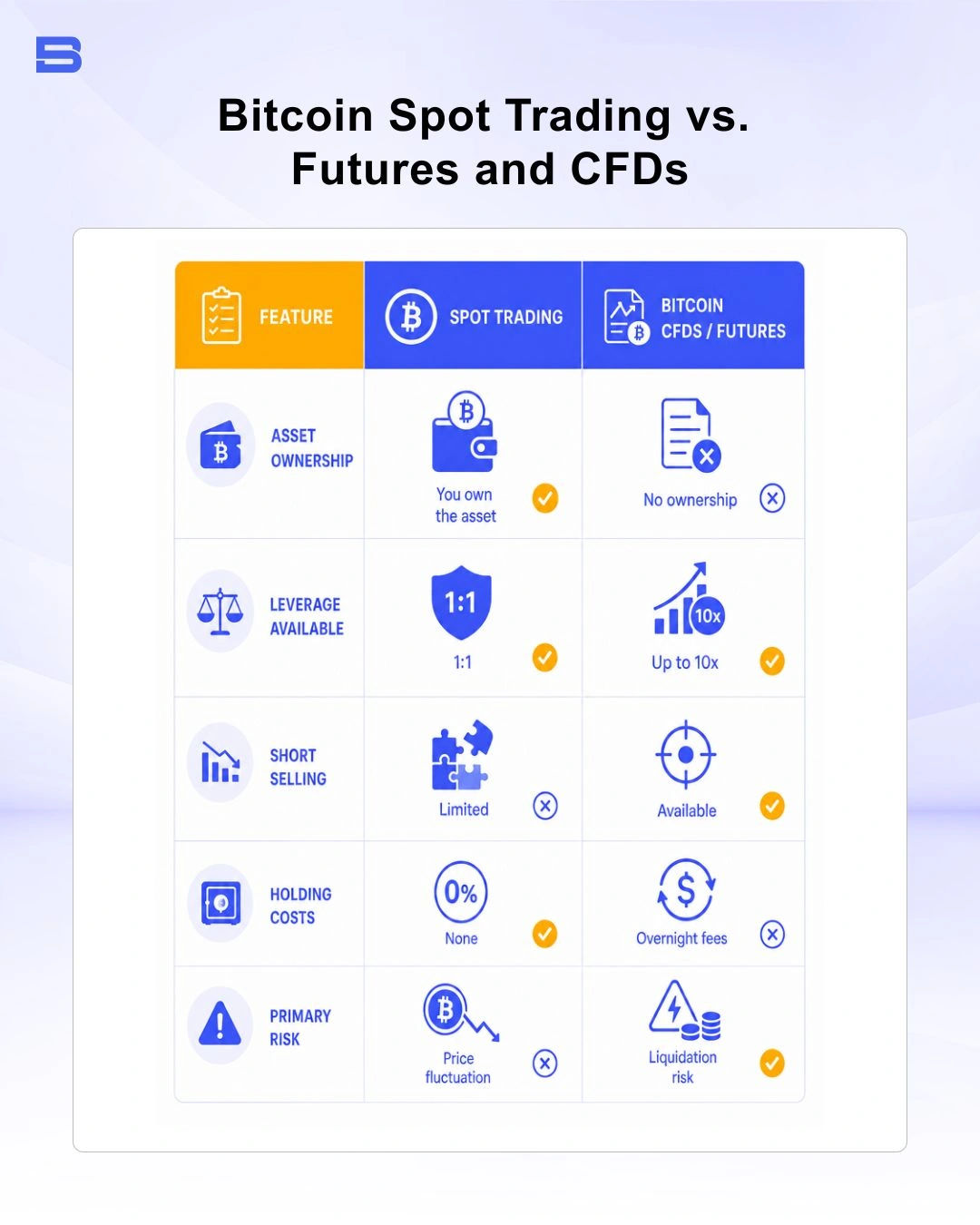
Spot Markets: When you buy on spot trading, you acquire actual, underlying Bitcoin. You can transfer these digital assets to a private hardware wallet. Spot trading carries no leverage-driven liquidation risk, making it the most straightforward entry point for beginners.
Bitcoin CFDs and Futures: Derivatives allow you to speculate on price action without holding the physical asset. Futures and Contracts for Difference (CFDs) offer financial leverage, enabling you to control a larger position size with smaller initial capital. However, derivative contracts introduce overnight funding fees and margin call risks if the market moves against you.
Key Factors That Drive Bitcoin Price Movements
Bitcoin operates as a 24/7 global asset, influenced by a unique blend of macroeconomic factors and industry-specific metrics:
- Supply and Demand (Halving Cycles): Bitcoin’s total supply is capped at 21 million coins. Roughly every four years, the "Halving" event cuts newly minted block rewards in half, altering the supply side of the supply-and-demand dynamic.
- Macroeconomic Trends & Interest Rates: Institutional adoption means Bitcoin correlates with broader monetary policy. High central bank interest rates often pull liquidity out of speculative assets, whereas rate cuts and global monetary expansion historically increase market risk appetite.
- Regulatory Developments: Licensing announcements, country-level trading bans, or approved Spot Exchange-Traded Funds (ETFs) directly impact institutional access and market sentiment.
- Liquidity and Exchange Reserves: High Bitcoin balances sitting on exchange wallets indicate potential selling pressure, while rapid withdrawals into cold storage suggest accumulation by long-term holders.
Essential Bitcoin Trading Strategies for Beginners
Developing a systematic strategy prevents emotional decision-making during fast market swings.
Trend Following and Breakout Strategies
Trend following relies on identifying the market's overarching direction using technical indicators like moving averages. If Bitcoin consistently makes higher highs and higher lows on a daily chart, trend traders look for long entries during temporary pullbacks.
Breakout trading focuses on key horizontal price levels:
- Support: A price level where buying interest has historically been strong enough to prevent the price from falling further.
- Resistance: A price ceiling where selling pressure historically halts upward momentum.
When Bitcoin breaches an established resistance level with surging volume, breakout traders enter, anticipating a volatile expansion higher.
Swing Trading vs. Dollar-Cost Averaging
- Swing Trading: Involves holding positions over several days or weeks to capture medium-term market swings. Swing traders utilize technical tools like chart patterns to capture price swings while mitigating the constant stress of day trading.
- Dollar-Cost Averaging (DCA): DCA involves allocating a fixed dollar amount into Bitcoin at set intervals (e.g., weekly or monthly) regardless of price. DCA removes market-timing stress and smooths out volatility over time, offering an entry framework for long-term participants.
Traders looking to build broader market exposure often diversify across major digital assets, choosing to Trade Ethereum alongside Bitcoin or allocating smaller portfolio shares to alternative Layer-1 networks like Solana.
Risk Management and Safe Bitcoin Trading Practices
Before you can start trading, it helps to understand exactly how to trade Bitcoin safely across different account types. Capital preservation is the absolute priority in crypto trading strategy. High volatility can reward unprepared accounts with sudden, severe drawdowns. Regulatory authorities like the Monetary Authority of Singapore (MAS) explicitly mandate that crypto platforms disclose volatility and capital loss risks to retail users.
Position Sizing and Capital Risk Management
One of the most important protection tools is strict position sizing using the 1% Rule: never risk more than 1% to 2% of your total trading balance on a single trade setup.
To calculate your position size correctly, you must determine your account size, entry price, and stop-loss level before placing an order.
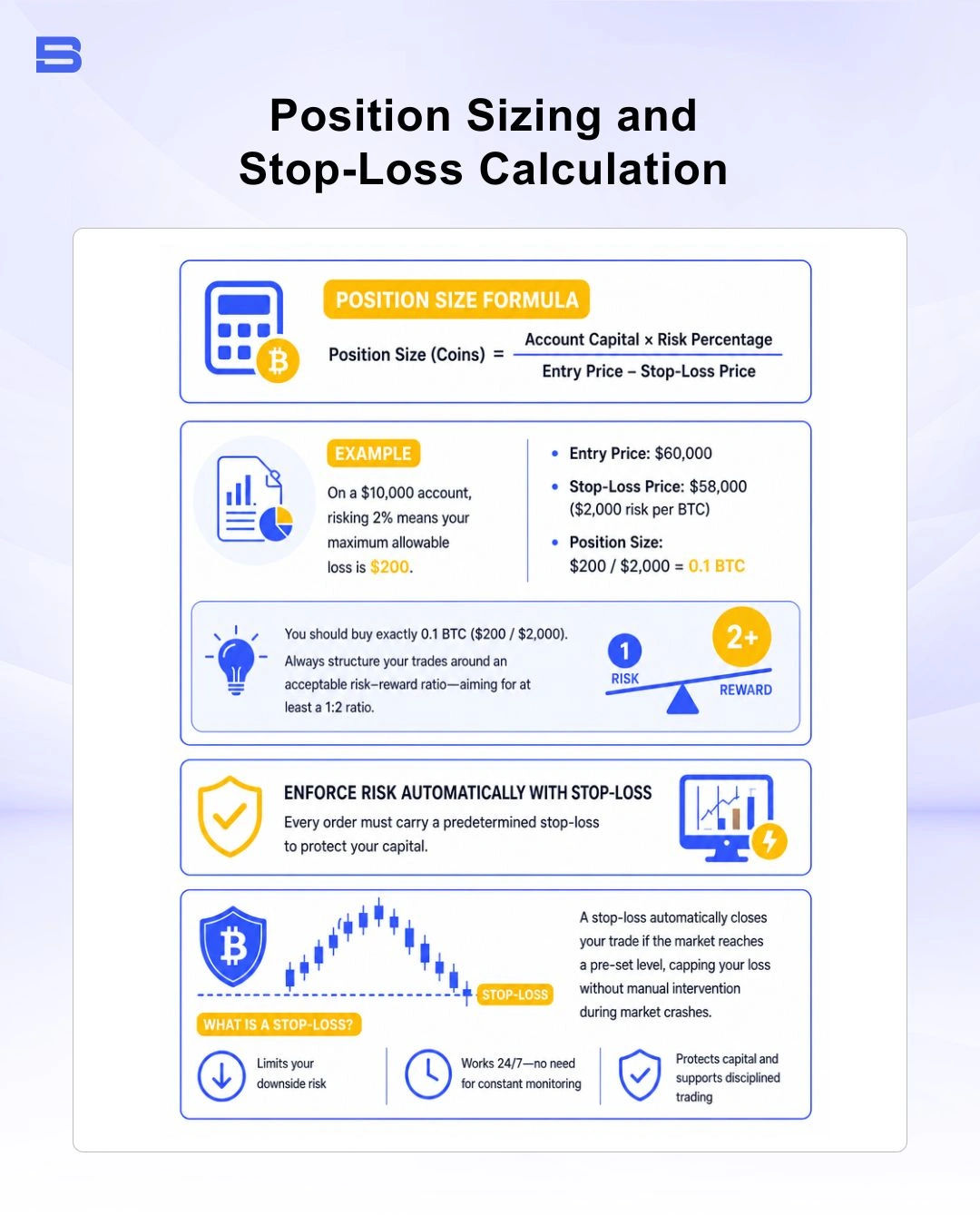
Position Size (Coins) = (Account Capital x Risk Percentage) / (Entry Price - Stop-Loss Price)
For example, on a $10,000 account, risking 2% means your maximum allowable loss is $200. If your entry is at $60,000 and your stop-loss is set at $58,000 ($2,000 risk per BTC), you should buy exactly 0.1 BTC ($200 / $2,000). Always structure your trades around an acceptable risk-reward ratio—aiming for at least a 1:2 ratio so that potential gains outweigh potential losses over time.
To enforce this automatically, every order must carry a predetermined stop-loss level. A stop-loss automatically closes your trade if the market reaches a pre-set level, capping your loss without requiring manual intervention during market crashes.
Understanding Trading Fees, Order Types, and Slippage
Execution costs quietly erode trading performance if ignored:
- Maker Fees vs. Taker Fees: Exchanges charge lower fees (Maker) when you add liquidity to the order book via limit orders, and higher fees (Taker) when you immediately consume liquidity via market orders.
- Order Types: Use Limit Orders to specify the exact price at which you are willing to buy or sell. Market Orders execute instantly at current prices but expose you to slippage.
- Slippage: The difference between the expected price of a trade and the price at which the trade actually executes. During rapid price swings, market orders can slip significantly, executing at far worse prices than anticipated.
Gold vs. Bitcoin: Comparing Risk and Market Characteristics
When learning how to trade Bitcoin, traders often compare it with traditional safe-haven assets like gold to understand risk and improve portfolio diversification.
- Volatility: Gold's annualized volatility typically ranges between 10% and 15%, while Deribit's DVOL (Deribit Volatility Index) shows Bitcoin's annualized volatility has typically ranged between 40% and 60% in recent years (as of 2026), though it has spiked well above 100% during past stress events.
- Market Maturity: Gold possesses centuries of established liquidity and acts as a traditional store of value during market distress. Bitcoin remains a younger, technologically driven digital asset that can trade like a high-growth tech stock during liquidity squeezes.
- Custody and Settlement: Gold requires physical storage or proxy holding via ETFs. Bitcoin offers instant digital settlement across global networks 24/7, though it transfers 100% of the custodial security responsibility directly to the owner.
Conclusion
Learning how to trade Bitcoin safely means balancing market opportunities with risk management. Success is not about predicting every short-term price move, but following a repeatable strategy, controlling position sizes with strict stop-losses, and avoiding emotional decisions driven by fear of missing out (FOMO). Start small, prioritize a disciplined process over quick profits, and protect your capital first.
- What Can You Trade? A Guide to Forex, Stocks, and More
- CFD Trading for Beginners
- What is CFD Trading and How Does It Work?
- Forex vs. Stocks: Which Market Suits You Best?
- How to Diversify a Portfolio Across Asset Classes
- How Dividend Stocks Work: Yields, Risks, and Strategies
- Silver Trading Explained: A Guide for Retail Investors
- Precious Metals Trading: A Complete Guide for Beginners
- Natural Gas Trading: A Guide to the Market
- Structured Warrants Malaysia: How They Work and Risks
- What Is the KLCI Index and How to Trade It
- Gold Investment in Malaysia: A Complete Guide for Beginners
- What Is Kijang Emas and How to Invest in It
- Value Investing Explained: How to Find Undervalued Stocks
- How to Trade Bitcoin Safely: A Complete Market Guide
- Growth Investing Explained: Strategies, Metrics, and Risks
- What Is Digital Gold Malaysia and How to Invest
- Crypto Trading Strategies for Beginners
- Gold vs Bitcoin: Key Differences, Risks, and Strategies
- Sukuk: A Guide for Beginners to Islamic Bonds
- What Is FCPO (Crude Palm Oil Futures) and How to Trade It
- How to Identify and Invest in Shariah-Compliant Stocks
- Timber Investment: Is It Worth It?
- Gold ETF Malaysia: A Guide for Beginners
- What Are Malaysian Government Securities (MGS)?
- Corporate Bonds Malaysia: A Guide for Beginners
- China A-Shares Trading Guide for Malaysian Investors
- What Is a Silver ETF and How to Invest in It?
- How to Trade XRP: A Practical Guide for Retail Investors
- How to Trade Solana (SOL): A Guide for Beginners
- What Are Gold Futures and How Do They Work?
- Money Market Fund in Malaysia: A Guide for Beginners
- Property Investment Malaysia: Direct Real Estate or M-REITs?
- What Is Binance Coin and How Does It Work?
- Green Sukuk: A Guide for Beginners to Islamic ESG Investing
- What Is Shiba Inu (SHIB) and How to Trade It
- What Is USDT? A Complete Guide to Tether for Beginners
- What Is Dogecoin and How to Trade It Safely for Beginners
- Cardano: A Guide for Beginners to Trade This Cryptocurrency
- Polkadot: A Guide to Trading This Cryptocurrency
- Tron: A Guide for Beginners to Trading This Cryptocurrency
- What Is Litecoin (LTC)? A Guide to Trading Digital Silver
- What Is Chainlink (LINK) and How to Trade It
- How to Trade Pepe Coin: Spot, Leverage, and Risk Management
- Near Protocol: A Guide to Trading This Cryptocurrency
- Trading Polygon Crypto: A Practical Guide for Beginners
- Trade Toncoin: Understanding the TON Ecosystem and Risks
- Cosmos Crypto: Ecosystem Architecture, Tokenomics, and Risks
- Stellar Crypto: A Guide to Trading This Cryptocurrency
- Avalanche Crypto Explained: A Practical Guide for Traders
- What Is Worldcoin? How to Trade WLD and Manage Risk
- Aptos: A Guide for Beginners to Trading This Cryptocurrency
- Sui Crypto Explained: Tokenomics and Trading Guide
- Celestia: A Guide to Trading This Cryptocurrency
- Decentraland: A Guide to Trading This Cryptocurrency
- What Is Arbitrum? How to Trade the Leading Layer 2 Network
- Sei Crypto: A Guide to Trading This Cryptocurrency
- What Is Injective Protocol and How to Trade INJ Safely
Disclaimer: The content on this page is intended for educational and informational purposes only. It does not constitute financial, investment, tax, or legal advice, and should not be interpreted as a recommendation to buy, sell, or hold any financial instrument or asset. Trading and investing involve significant risk, including the possible loss of your entire capital. Products such as forex, CFDs, and cryptocurrencies carry additional risks due to leverage, high volatility, and limited regulatory protection in some jurisdictions. Past performance of any financial instrument does not guarantee future results. Any market views, forecasts, or opinions expressed are those of the author at the time of writing and may not reflect current market conditions. Platform features, fees, and regulatory status are subject to change — always verify information directly with the relevant provider or regulator before making any financial decision. BrokerSpecs may receive compensation from third parties featured on this site. Always conduct your own due diligence and consider seeking advice from a licensed financial professional before investing.