


Related Tags
Entering the high-throughput blockchain landscape often leads traders directly to modern Layer-1 networks designed to solve legacy congestion issues. As Ethereum works through layer-2 scaling solutions and Solana manages network stability demands, Aptos has emerged as an enterprise-grade alternative built specifically for high concurrency and smart contract security.
Developed by former engineers from Meta’s Diem project, Aptos leverages a modular structure to deliver near-instant transaction finality. For retail and institutional traders, understanding how Aptos functions under the hood is critical for evaluating its market positioning, volatility patterns, and long-term liquidity dynamics.
What Is Aptos and How Does It Work?
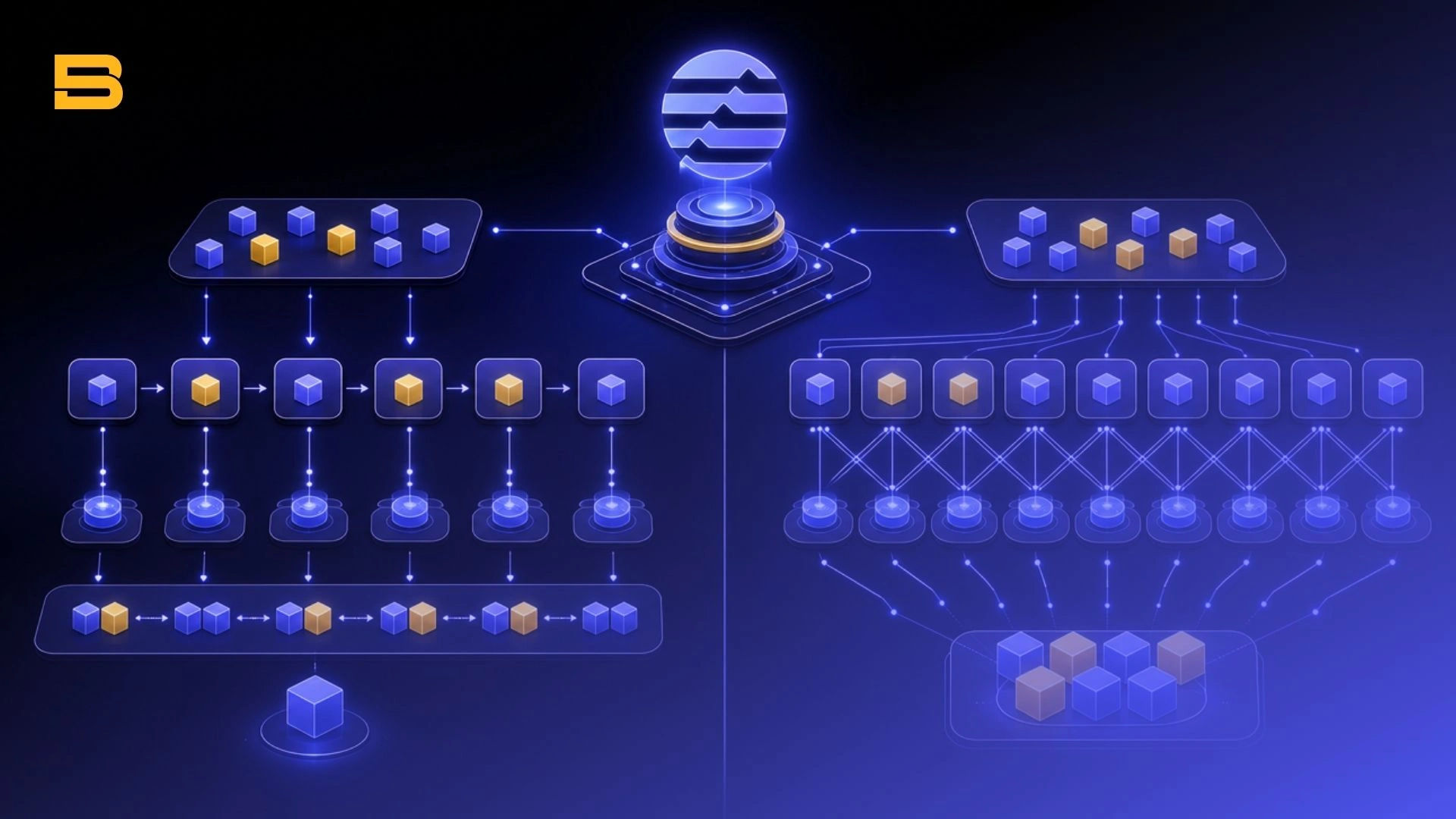
Aptos is a Layer-1 Proof-of-Stake (PoS) blockchain designed to maximize transaction throughput, minimize execution latency, and eliminate single points of failure through parallel processing. Unlike traditional blockchains that process transactions sequentially in a single queue, Aptos utilizes a decoupled architecture where transaction dissemination, block ordering, dynamic execution, and ledger storage happen independently.
This pipeline model allows the network to process complex smart contracts simultaneously, aiming for a theoretical throughput capacity exceeding 160,000 transactions per second (TPS), per Aptos's official technical documentation.
Traders moving between decentralized applications (dApps) or executing high-frequency arbitrage benefit from the network's sub-second finality. When you submit an order on an Aptos-based decentralized exchange (DEX), transaction verification happens almost instantaneously, significantly reducing execution slippage compared to congested networks.
If you are learning how to trade Bitcoin or exploring multi-chain asset allocation, recognizing how Layer-1 infrastructure handles order execution provides a clear edge in managing trade slippage and transaction costs.
The Move Language and Technical Architecture
At the core of the Aptos network is Move, a Rust-based programming language originally developed at Meta for the Diem project. Traditional smart contract environments like Ethereum’s Ethereum Virtual Machine (EVM) represent digital assets as internal balances within a contract state.
This structure leaves contracts vulnerable to re-entrancy attacks—the exact mechanism responsible for hundreds of millions of dollars in historical DeFi exploits.
Move introduces a resource-oriented programming model where digital assets are treated as distinct, non-copyable native resources. Assets cannot be accidentally duplicated, dropped, or re-entered through malicious logic.
For crypto traders, this language design translates directly into protocol-level security, reducing the risk of smart contract bugs compromising locked decentralized finance (DeFi) capital.
Block-STM Parallel Execution Engine
The engine driving Aptos’s speed advantage is Block-STM (Software Transactional Memory), an optimistic parallel execution engine. Traditional blockchains validate transactions sequentially, creating a bottleneck whenever demand spikes. Block-STM takes a different approach:
- Optimistic Execution: Transactions are executed simultaneously across multiple CPU cores under the assumption that most do not conflict.
- Conflict Detection: The engine tracks read and write operations across memory locations. If two transactions conflict (for instance, two traders buying from the same liquidity pool at identical timestamps), only the conflicting transaction is aborted and re-executed.
- Dynamic Ordering: Non-conflicting operations process concurrently without waiting for sequential validation, preventing network-wide gas price spikes during high-volatility events.
Understanding APT Tokenomics and Staking
The APT token serves as the utility and governance asset of the Aptos network. It pays for on-chain transaction gas fees, secures the network via Proof-of-Stake validation, and grants holders voting rights on protocol upgrades.
Aptos launched with an initial supply of 1 billion APT, allocated among the Community (51.02%), Core Contributors (19.00%), Foundation (16.50%), and Investors (13.48%). The Community and Foundation allocations support ecosystem grants, incentives, and growth initiatives, while Core Contributor and Investor tokens were subject to a four-year lock-up and gradual monthly vesting schedule beginning after the first year, per the Aptos Foundation's published token release schedule.
Traders must closely track the vesting schedule. Monthly cliff unlocks release tens of millions of dollars worth of APT into circulating supply. Historically, large token unlocks create temporary supply overhangs, introducing short-term sell pressure that derivatives traders actively price into perpetual futures markets.
The regulatory environment also plays a role in long-term token distribution transparency; regulatory frameworks established by authorities such as the US Securities and Exchange Commission (SEC) continue to emphasize clear disclosures regarding insider token distributions and market manipulation risks.
Aptos initially set its maximum staking reward rate at 7% annually, with the original schedule reducing the rate by 1.5% each year toward a 3.25% floor. However, Aptos has since modified its staking economics: the current annual reward rate stands at 2.6%, down from an earlier 5.19% rate, as part of a broader Aptos Foundation proposal that also introduces a 2.1 billion APT hard supply cap. APT holders can stake with validators to earn rewards, which may help offset dilution from new token issuance.
Similar to established layer-1 ecosystems like Polkadot, balancing staking yield against supply inflation is a key metric for long-term token valuation.
How to Safely Store and Trade APT
Managing custody is your primary defense line against operational losses. Trading APT typically occurs across two custody environments:
- Centralized Exchanges (CEXs): Platforms like Binance, Coinbase, and Bybit offer high liquidity and fiat onboarding. However, assets held on exchange order books carry counterparty risk.
- Self-Custody Wallets: Native non-custodial wallets like Petra Wallet or Pontem Wallet allow traders to interact directly with Aptos DEXs and liquid staking protocols. Hardware wallets (such as Ledger) can be connected to native software wallets to secure private keys offline.
When depositing or withdrawing funds in regions with dedicated digital asset frameworks, traders should choose platforms compliant with local regulations, such as the guidelines set by the Securities Commission Malaysia (SC) for digital asset exchanges, ensuring regulatory oversight and user protection measures.
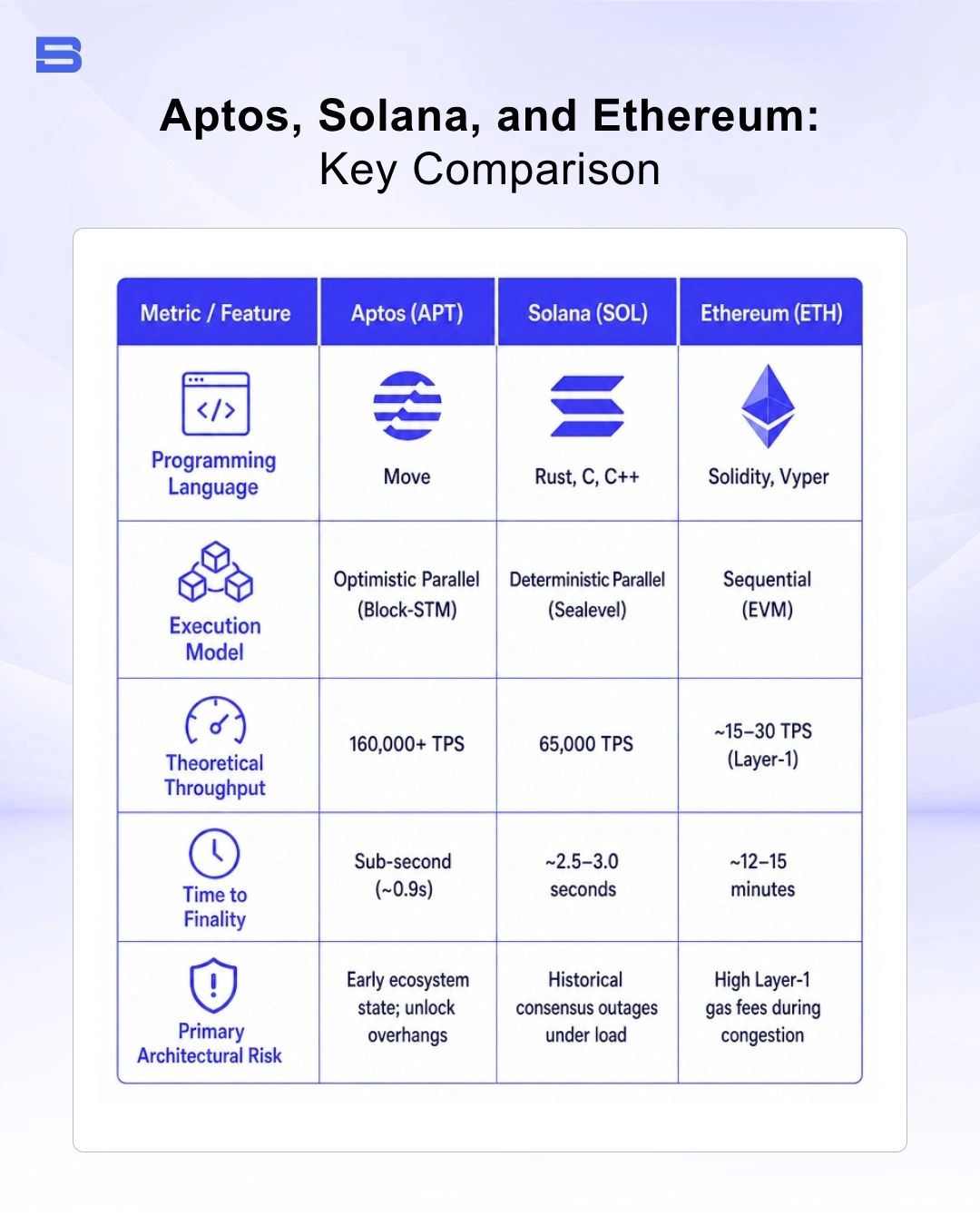
How Aptos Compares to Solana and Ethereum
To contextualize Aptos’s market positioning, traders must evaluate how its core infrastructure performs alongside existing Layer-1 giants like Ethereum and Solana, or peer networks like Cardano.
While Ethereum prioritizes maximal decentralization and security through a vast validator set—relying on Layer-2 rollups for scalability—Aptos and Solana target monolithic throughput at the base execution layer.
When analyzing execution speed, Solana processes transactions using a pipeline architecture powered by Proof-of-History (PoH). However, historical Solana network outages highlight the trade-offs of monolithic architecture under extreme state contention. Aptos uses Block-STM to handle transaction ordering dynamically, preventing a single congested dApp from bringing down the rest of the network.
If you are comparing smart contract platforms, examining network architecture reveals distinct trade-offs between execution speed, developer tools, and operational stability. Regional adoption patterns, such as the growing interest seen in Ethereum Malaysia, reflect how local markets adapt to varying Layer-1 trade-offs.
Aptos vs Sui: Comparing Next-Gen Layer-1 Blockchains
The debate over next-generation Layer-1s frequently pairs Aptos with Sui crypto. Both networks trace their origins back to Meta’s Diem initiative, and both use the Move programming language. However, their internal architectures handle state storage and transaction verification differently.
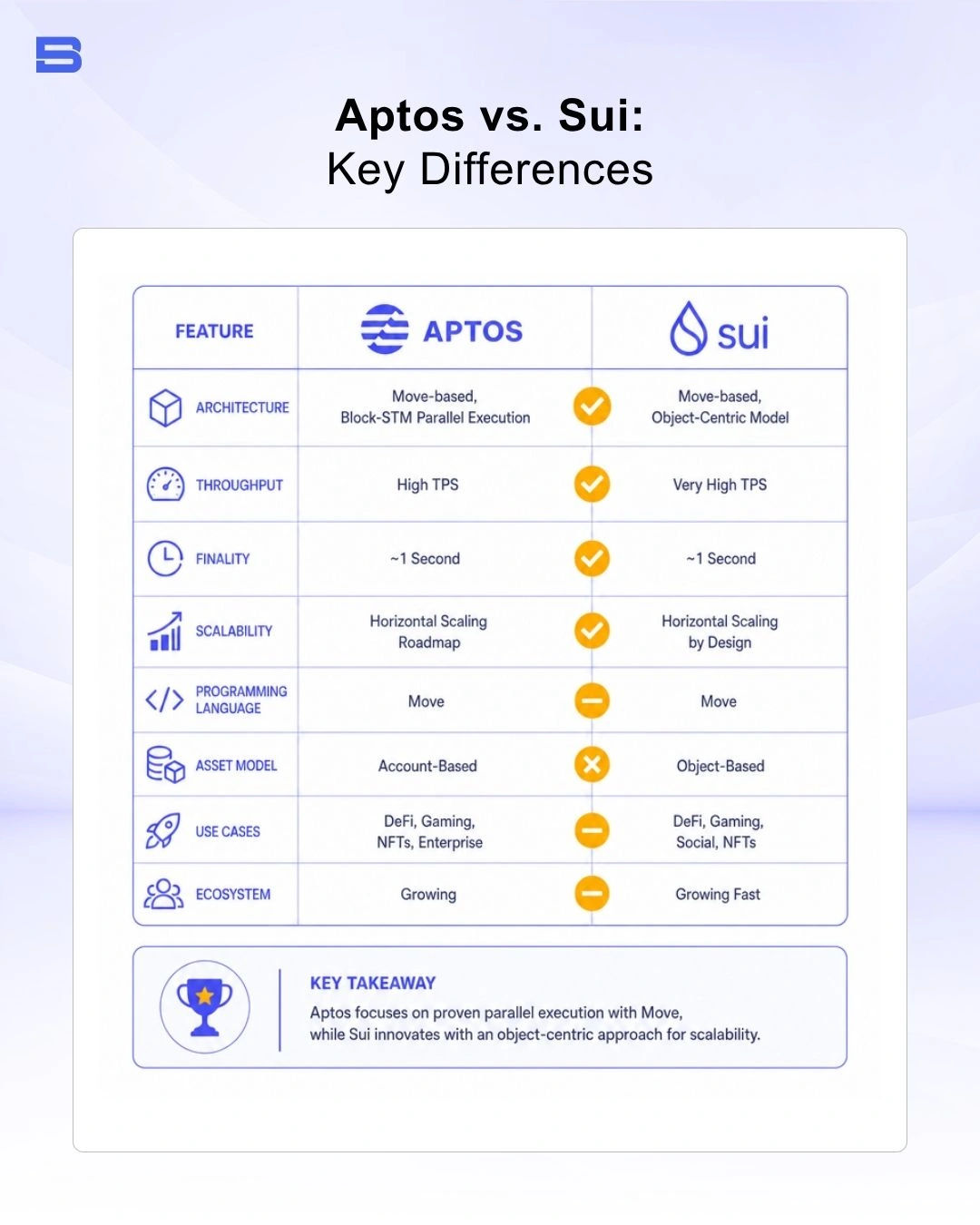
Aptos retains a traditional account-centric data model. State updates occur by modifying data associated with individual wallet addresses. This structure makes Aptos easier to navigate for developers transitioning from EVM chains, facilitating rapid dApp porting.
Sui, conversely, utilizes an object-centric model where data is stored as individual, unique objects within a Directed Acyclic Graph (DAG) architecture. Independent object transactions on Sui can bypass full network consensus entirely.
From a market perspective, Aptos has focused heavily on institutional liquidity partnerships, decentralization of its validator set, and Real-World Asset (RWA) tokenization. Sui has built strong momentum in web3 gaming and consumer-facing retail applications.
Similar to Telegram-integrated networks like Toncoin, both platforms are actively competing to onboard non-crypto-native users through simplified onboarding friction and fast execution.
Key Aptos Trading Strategies and Risk Management
Trading APT effectively requires matching your execution method to market conditions while strictly enforcing capital allocation controls. Market participants typically access APT through three primary approaches:
- Spot Accumulation: Buying physical APT on exchange order books for long-term holding or staking. Spot trading eliminates liquidation risk, making it suitable for fundamental position building.
- Perpetual Derivatives Trading: Utilizing leveraged perpetual futures contracts to speculate on short-term price movements or hedge spot portfolios. Leverage amplifies both profits and losses; a 10% market move against a 10x leveraged position results in a complete margin liquidation.
- Ecosystem Yield Strategies: Supplying APT to native lending protocols or liquid staking hubs to earn protocol emissions alongside base staking yields.
When building a broader portfolio strategy, comparing digital assets against traditional safe-haven instruments—such as evaluating gold vs. Bitcoin—helps frame where high-beta Layer-1 assets like APT fit on the risk spectrum.
Global regulatory bodies, including the International Organization of Securities Commissions (IOSCO), regularly emphasize that retail traders must employ rigorous risk management practices when engaging with complex derivatives markets.
Aptos Potential Rewards vs. Investment Risks
Evaluating APT requires an objective assessment of technological catalysts against macroeconomic and tokenomic headwinds.
Potential Upside & Ecosystem Growth:
- High-throughput Block-STM engine provides a stable environment for complex DeFi and enterprise dApps.
- Move language reduces smart contract security risks, attracting institutional capital and RWA issuers.
- Strategic backing from tier-one venture capital firms supports ongoing developer grants and ecosystem expansion.
Capital Loss & Market Risks:
- Substantial monthly token unlocks create consistent inflationary supply pressure that can suppress token price.
- Intense market competition from established platforms (Solana) and alternative Move-based chains (Sui).
- High asset price volatility exposes leveraged derivatives traders to liquidation during market-wide drawdowns.
Aptos: Final Takeaways
Aptos offers a high-performance Layer-1 blockchain built around fast transaction processing, low fees, and a growing ecosystem of DeFi, payments, and other applications. APT serves as the network’s native token for transaction fees, staking, and governance, giving it utility beyond trading.
APT presents opportunities but also carries risks from token unlocks, staking emissions, supply changes, market volatility, and evolving tokenomics. Aptos is transitioning toward performance-driven supply mechanisms, including lower staking emissions, increased transaction-fee burns, and a proposed 2.1 billion APT hard supply cap.
Overall, beginners should evaluate APT based on both Aptos network adoption and its changing token economics, while using sensible position sizing, stop-losses, and risk limits when trading.
- What Can You Trade? A Guide to Forex, Stocks, and More
- CFD Trading for Beginners
- What is CFD Trading and How Does It Work?
- Forex vs. Stocks: Which Market Suits You Best?
- How to Diversify a Portfolio Across Asset Classes
- How Dividend Stocks Work: Yields, Risks, and Strategies
- Silver Trading Explained: A Guide for Retail Investors
- Precious Metals Trading: A Complete Guide for Beginners
- Natural Gas Trading: A Guide to the Market
- Structured Warrants Malaysia: How They Work and Risks
- What Is the KLCI Index and How to Trade It
- Gold Investment in Malaysia: A Complete Guide for Beginners
- What Is Kijang Emas and How to Invest in It
- Value Investing Explained: How to Find Undervalued Stocks
- How to Trade Bitcoin Safely: A Complete Market Guide
- Growth Investing Explained: Strategies, Metrics, and Risks
- What Is Digital Gold Malaysia and How to Invest
- Crypto Trading Strategies for Beginners
- Gold vs Bitcoin: Key Differences, Risks, and Strategies
- Sukuk: A Guide for Beginners to Islamic Bonds
- What Is FCPO (Crude Palm Oil Futures) and How to Trade It
- How to Identify and Invest in Shariah-Compliant Stocks
- Timber Investment: Is It Worth It?
- Gold ETF Malaysia: A Guide for Beginners
- What Are Malaysian Government Securities (MGS)?
- Corporate Bonds Malaysia: A Guide for Beginners
- China A-Shares Trading Guide for Malaysian Investors
- What Is a Silver ETF and How to Invest in It?
- How to Trade XRP: A Practical Guide for Retail Investors
- How to Trade Solana (SOL): A Guide for Beginners
- What Are Gold Futures and How Do They Work?
- Money Market Fund in Malaysia: A Guide for Beginners
- Property Investment Malaysia: Direct Real Estate or M-REITs?
- What Is Binance Coin and How Does It Work?
- Green Sukuk: A Guide for Beginners to Islamic ESG Investing
- What Is Shiba Inu (SHIB) and How to Trade It
- What Is USDT? A Complete Guide to Tether for Beginners
- What Is Dogecoin and How to Trade It Safely for Beginners
- Cardano: A Guide for Beginners to Trade This Cryptocurrency
- Polkadot: A Guide to Trading This Cryptocurrency
- Tron: A Guide for Beginners to Trading This Cryptocurrency
- What Is Litecoin (LTC)? A Guide to Trading Digital Silver
- What Is Chainlink (LINK) and How to Trade It
- How to Trade Pepe Coin: Spot, Leverage, and Risk Management
- Near Protocol: A Guide to Trading This Cryptocurrency
- Trading Polygon Crypto: A Practical Guide for Beginners
- Trade Toncoin: Understanding the TON Ecosystem and Risks
- Cosmos Crypto: Ecosystem Architecture, Tokenomics, and Risks
- Stellar Crypto: A Guide to Trading This Cryptocurrency
- Avalanche Crypto Explained: A Practical Guide for Traders
- What Is Worldcoin? How to Trade WLD and Manage Risk
- Aptos: A Guide for Beginners to Trading This Cryptocurrency
- Sui Crypto Explained: Tokenomics and Trading Guide
- Celestia: A Guide to Trading This Cryptocurrency
- Decentraland: A Guide to Trading This Cryptocurrency
- What Is Arbitrum? How to Trade the Leading Layer 2 Network
- Sei Crypto: A Guide to Trading This Cryptocurrency
- What Is Injective Protocol and How to Trade INJ Safely
Disclaimer: The content on this page is intended for educational and informational purposes only. It does not constitute financial, investment, tax, or legal advice, and should not be interpreted as a recommendation to buy, sell, or hold any financial instrument or asset. Trading and investing involve significant risk, including the possible loss of your entire capital. Products such as forex, CFDs, and cryptocurrencies carry additional risks due to leverage, high volatility, and limited regulatory protection in some jurisdictions. Past performance of any financial instrument does not guarantee future results. Any market views, forecasts, or opinions expressed are those of the author at the time of writing and may not reflect current market conditions. Platform features, fees, and regulatory status are subject to change — always verify information directly with the relevant provider or regulator before making any financial decision. BrokerSpecs may receive compensation from third parties featured on this site. Always conduct your own due diligence and consider seeking advice from a licensed financial professional before investing.