



Related Tags
Imagine stepping onto a stock exchange floor where nobody is shouting buy or sell orders, and no broker matches your trade. Instead, you walk up to an automated, self-balancing digital vault, deposit one asset, and immediately withdraw another based on a mathematical formula. That self-funded reservoir is known as a liquidity pool, and it serves as the backbone of decentralized finance (DeFi) trading today.
What Is a Liquidity Pool and How Does It Work in DeFi?
A liquidity pool is a crowdsourced reservoir of digital tokens locked inside a smart contract (a self-executing program on a blockchain) to facilitate automated, peer-to-contract trading on a decentralized network.
In traditional markets, buyers and sellers rely on a centralized order book managed by a broker or market maker. If you want to buy an asset, someone else must be actively placing a matching sell order at an acceptable price. When trading volumes drop, liquidity can dry up, which may lead to wider spreads and slower execution.
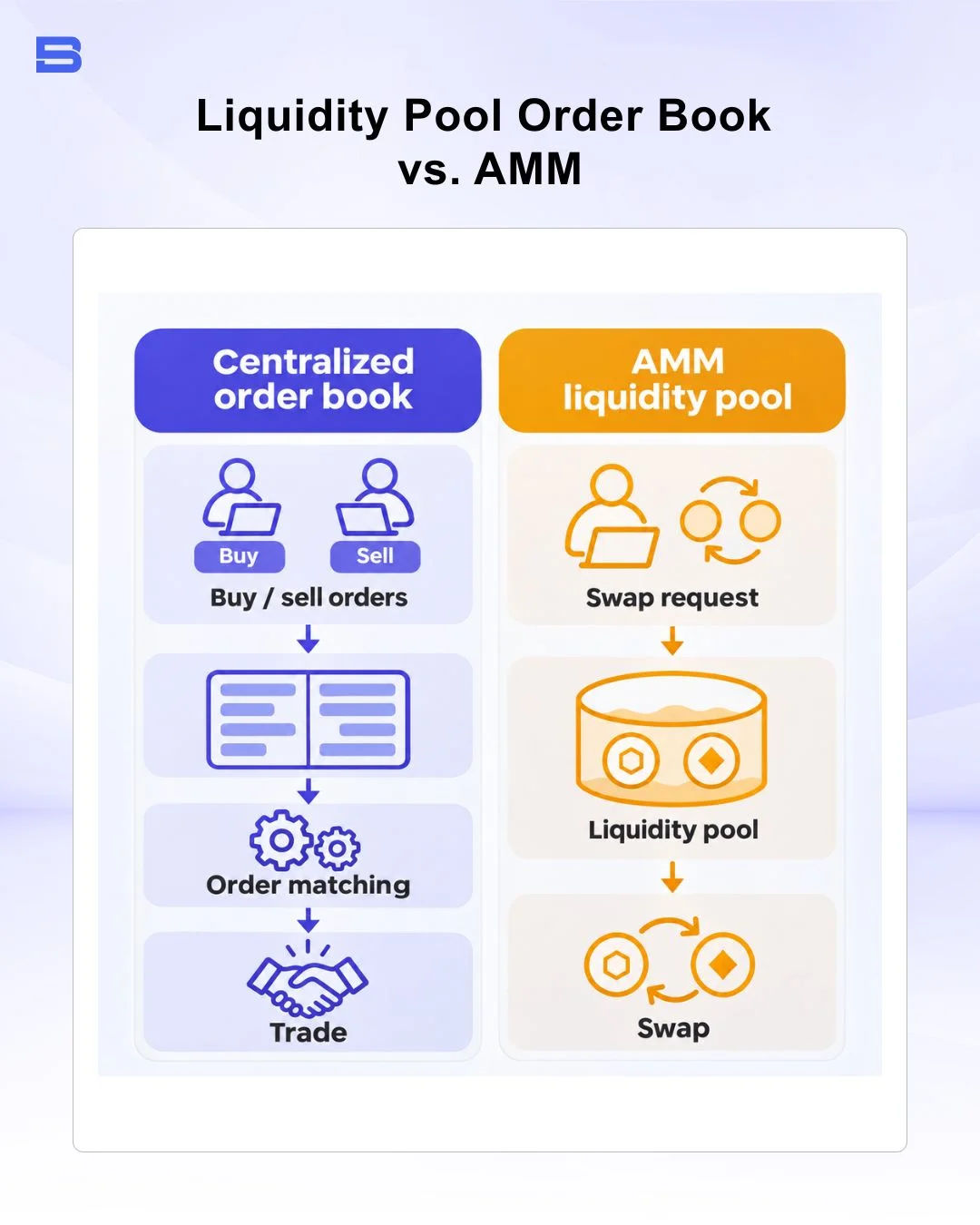
Liquidity pools eliminate the order book. Instead of trading against another individual (peer-to-peer), you trade directly against capital locked in the pool (peer-to-contract). In a standard pool, anyone can become a liquidity provider (LP) by depositing an equal value of two paired tokens, although some protocols, such as Balancer, also support pools with different weightings. In exchange, the protocol rewards providers with a share of every trading fee generated by that pair, creating a collaborative liquidity engine.
The Role of Automated Market Makers (AMMs) in Liquidity Pools
Liquidity pools do not manage themselves; they function via protocols called automated market makers (AMMs). Platforms such as Uniswap, Curve, and Balancer popularized AMMs, which use algorithms to set prices and manage the reserves held in each pool.
Rather than waiting for a counterparty, the AMM automatically quotes an execution price the moment a user initiates a swap. This design ensures that trades execute continuously 24/7 without centralized market makers or custody intermediaries. This structure also powers secondary decentralized yield mechanisms, including yield farming, where providers deploy their capital across protocols to earn supplemental token rewards.
How the Constant Product Formula Sets Market Prices
Most standard liquidity pools calculate token exchange rates using a constant product formula:
X x Y = K
In this equation:
- X represents the total balance of Token A in the pool.
- Y represents the total balance of Token B in the pool.
- K is a constant that stays the same after every swap, apart from a small increase caused by trading fees added to the pool.
When a trader swaps Token A for Token B, they deposit Token A into the pool, increasing X. To keep K constant, the pool must release a specific amount of Token B, reducing Y. Because Token B is now scarcer relative to Token A, its relative price automatically rises for the next trader. When the pool price drifts away from prices on other exchanges, traders called arbitrageurs buy the cheaper token and sell it where it is priced higher (arbitrage), which pushes the pool ratio back toward the wider market price.
What Are LP Tokens and How Do They Represent Your Share?
When you deposit assets into a pool, the smart contract mints and sends you liquidity pool tokens (LP tokens). These act as digital deposit receipts representing your proportional share of the overall pool reserves.
For example, if your deposit represents 2% of the total liquidity in an ETH/USDT pool (Ether paired with Tether, a US dollar stablecoin), you receive 2% of the circulating LP tokens for that pool. As trades take place, accumulated swap fees compound inside the pool. When you eventually redeem your LP tokens, you receive your proportional share of the pool’s reserves at that time, including any fees added to the pool. However, the value you withdraw may still be lower than simply holding the tokens if their prices have moved apart, a risk known as impermanent loss (explained below).
Understanding Impermanent Loss and Other Liquidity Pool Risks
While earning passive fee yields sounds compelling, providing liquidity carries significant financial downside that must be balanced against fee expectations. The most prominent hazard unique to AMMs is impermanent loss.
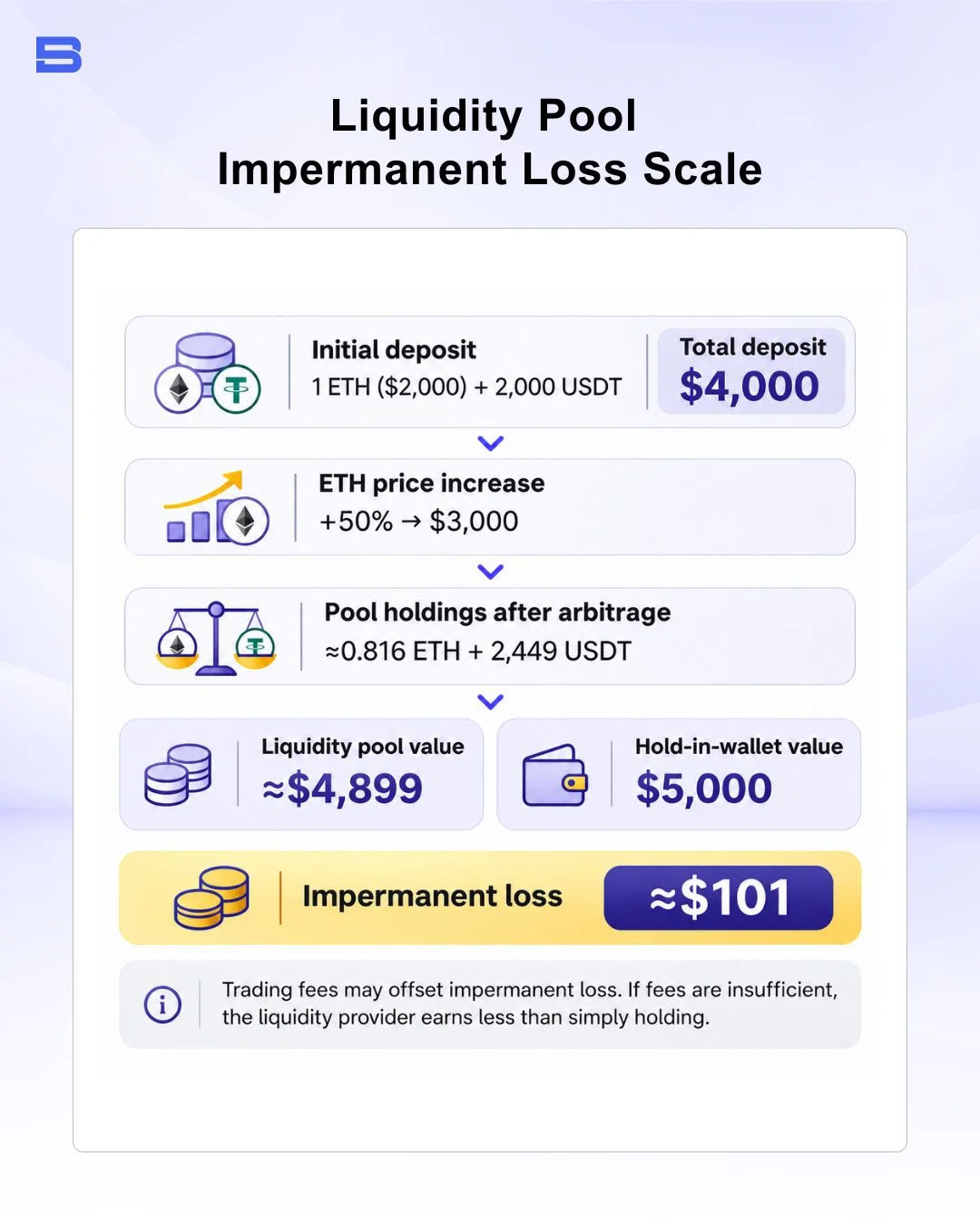
Impermanent loss occurs when the price ratio of your pooled tokens diverges from the price at which you deposited them. Because the AMM rebalances its reserves to maintain K, the pool continually sells off the appreciating asset while accumulating the depreciating asset.
Consider a practical scenario:
- You deposit 1 ETH (valued at $2,000) and 2,000 USDT into an equal-weight pool, representing a $4,000 deposit.
- The price of ETH rises 50% on external exchanges to $3,000.
- Arbitrageurs buy ETH from your pool until the internal ratio matches the external market price.
- Your pool share now holds approximately 0.816 ETH and 2,449 USDT, totaling roughly $4,899.
- If you had simply held your 1 ETH and 2,000 USDT in a personal wallet, your assets would now be worth $5,000.
The difference of about $101 is your impermanent loss. If earned trading fees fail to exceed this divergence loss before you withdraw, your net return will lag pure holding.
Smart Contract Vulnerabilities, Rug Pulls, and Slippage Risks
Market volatility is not the only hazard liquidity providers face. Protocol risk remains a serious reality:
- Smart Contract Exploits: Coding bugs or logic flaws can allow malicious actors to drain locked capital completely. Regulatory bodies such as the International Organization of Securities Commissions (IOSCO) have identified smart contract coding errors and security breaches among the key risks facing users of decentralized protocols.
- Rug Pulls and Malicious Developers: In unaudited pools, developers may retain administrative privileges that allow them to mint unlimited tokens or extract paired collateral, leaving LPs with worthless assets. Evaluating underlying tokenomics before depositing is essential to identifying central minting backdoors.
- Slippage in Shallow Pools: If a pool holds limited reserves, even moderate trade sizes cause substantial price impact, leading to execution slippage and unfavorable fills.
Liquidity Pool vs Staking: Which Model Fits Your Risk Profile?
Beginners often confuse liquidity provisioning with token staking (locking coins to help validate transactions on a proof-of-stake network in exchange for rewards), but the two serve fundamentally different functions in the digital asset ecosystem.
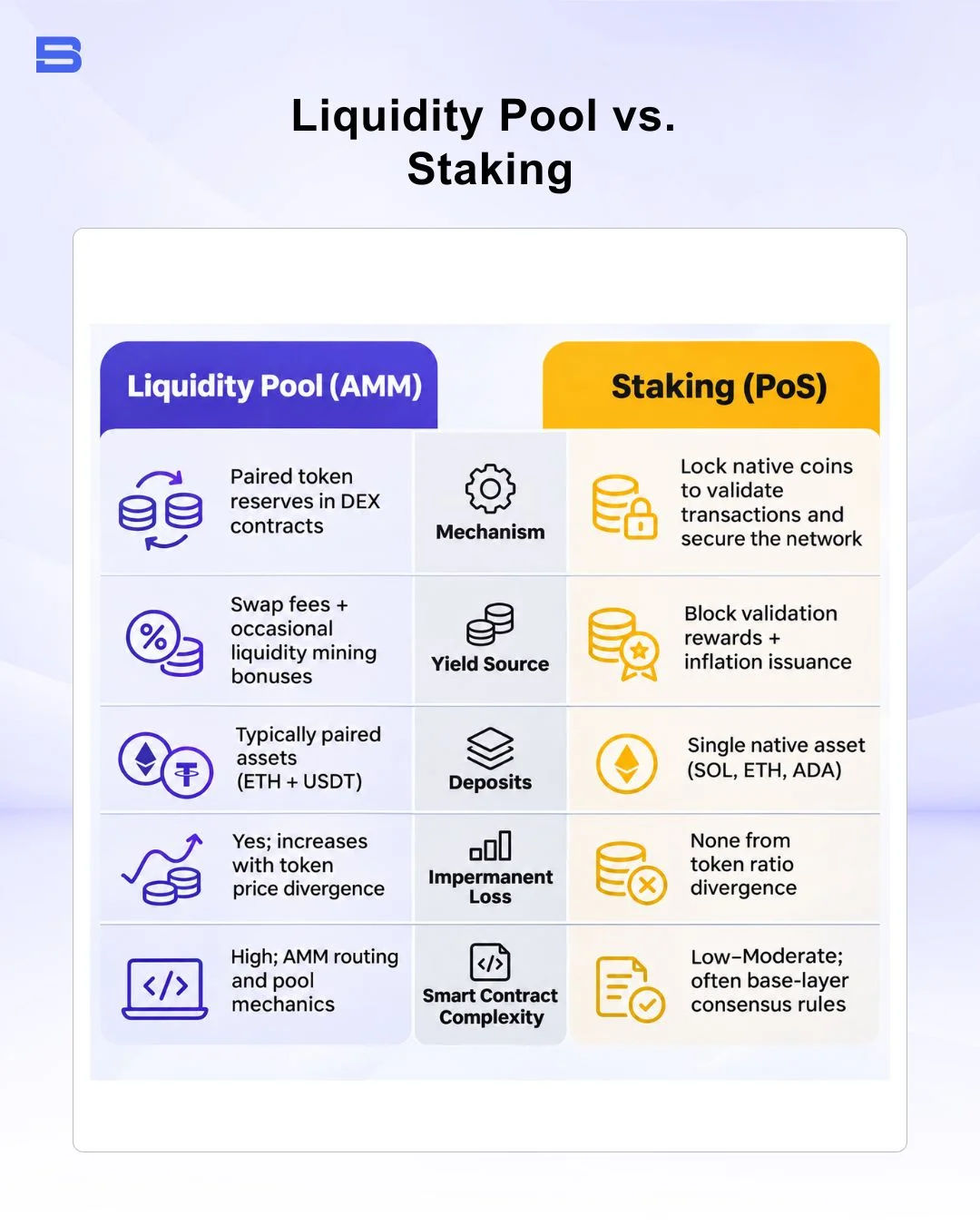
Choosing between the two depends on your market expectations. If you anticipate high trading volumes with minimal relative price divergence between paired tokens, liquidity pools offer continuous fee capture. Conversely, if you want passive yields on a single asset without monitoring price divergence ratios, single-sided network staking carries lower structural complexity.
Key Takeaways on Providing Liquidity
Liquidity pools transformed decentralized finance by enabling instant, autonomous asset exchange without traditional brokerage infrastructure. However, passive fee earnings should never be evaluated in isolation from impermanent loss and protocol vulnerabilities.
DeFi liquidity pools generally operate outside traditional financial regulation, so deposits usually lack the investor protection or compensation available through licensed providers. Commit only capital you can afford to lose, and consider spreading funds across more than one pool or protocol rather than concentrating them in a single smart contract.
- What Can You Trade? A Guide to Forex, Stocks, and More
- CFD Trading for Beginners
- What is CFD Trading and How Does It Work?
- Forex vs. Stocks: Which Market Suits You Best?
- How to Diversify a Portfolio Across Asset Classes
- How Dividend Stocks Work: Yields, Risks, and Strategies
- Silver Trading Explained: A Guide for Retail Investors
- Precious Metals Trading: A Complete Guide for Beginners
- Natural Gas Trading: A Guide to the Market
- Structured Warrants Malaysia: How They Work and Risks
- What Is the KLCI Index and How to Trade It
- Gold Investment in Malaysia: A Complete Guide for Beginners
- What Is Kijang Emas and How to Invest in It
- Value Investing Explained: How to Find Undervalued Stocks
- How to Trade Bitcoin Safely: A Complete Market Guide
- Growth Investing Explained: Strategies, Metrics, and Risks
- What Is Digital Gold Malaysia and How to Invest
- Crypto Trading Strategies for Beginners
- Gold vs Bitcoin: Key Differences, Risks, and Strategies
- Sukuk: A Guide for Beginners to Islamic Bonds
- What Is FCPO (Crude Palm Oil Futures) and How to Trade It
- How to Identify and Invest in Shariah-Compliant Stocks
- Timber Investment: Is It Worth It?
- Gold ETF Malaysia: A Guide for Beginners
- What Are Malaysian Government Securities (MGS)?
- Corporate Bonds Malaysia: A Guide for Beginners
- China A-Shares Trading Guide for Malaysian Investors
- What Is a Silver ETF and How to Invest in It?
- How to Trade XRP: A Practical Guide for Retail Investors
- How to Trade Solana (SOL): A Guide for Beginners
- What Are Gold Futures and How Do They Work?
- Money Market Fund in Malaysia: A Guide for Beginners
- Property Investment Malaysia: Direct Real Estate or M-REITs?
- What Is Binance Coin and How Does It Work?
- Green Sukuk: A Guide for Beginners to Islamic ESG Investing
- What Is Shiba Inu (SHIB) and How to Trade It
- What Is USDT? A Complete Guide to Tether for Beginners
- What Is Dogecoin and How to Trade It Safely for Beginners
- Cardano: A Guide for Beginners to Trade This Cryptocurrency
- Polkadot: A Guide to Trading This Cryptocurrency
- Tron: A Guide for Beginners to Trading This Cryptocurrency
- What Is Litecoin (LTC)? A Guide to Trading Digital Silver
- What Is Chainlink (LINK) and How to Trade It
- How to Trade Pepe Coin: Spot, Leverage, and Risk Management
- Near Protocol: A Guide to Trading This Cryptocurrency
- Trading Polygon Crypto: A Practical Guide for Beginners
- Trade Toncoin: Understanding the TON Ecosystem and Risks
- Cosmos Crypto: Ecosystem Architecture, Tokenomics, and Risks
- Stellar Crypto: A Guide to Trading This Cryptocurrency
- Avalanche Crypto Explained: A Practical Guide for Traders
- What Is Worldcoin? How to Trade WLD and Manage Risk
- Aptos: A Guide for Beginners to Trading This Cryptocurrency
- Sui Crypto Explained: Tokenomics and Trading Guide
- Celestia: A Guide to Trading This Cryptocurrency
- Decentraland: A Guide to Trading This Cryptocurrency
- What Is Arbitrum? How to Trade the Leading Layer 2 Network
- Sei Crypto: A Guide to Trading This Cryptocurrency
- What Is Injective Protocol and How to Trade INJ Safely
Disclaimer: The content on this page is intended for educational and informational purposes only. It does not constitute financial, investment, tax, or legal advice, and should not be interpreted as a recommendation to buy, sell, or hold any financial instrument or asset. Trading and investing involve significant risk, including the possible loss of your entire capital. Products such as forex, CFDs, and cryptocurrencies carry additional risks due to leverage, high volatility, and limited regulatory protection in some jurisdictions. Past performance of any financial instrument does not guarantee future results. Any market views, forecasts, or opinions expressed are those of the author at the time of writing and may not reflect current market conditions. Platform features, fees, and regulatory status are subject to change — always verify information directly with the relevant provider or regulator before making any financial decision. BrokerSpecs may receive compensation from third parties featured on this site. Always conduct your own due diligence and consider seeking advice from a licensed financial professional before investing. Portions of this article were prepared with the assistance of AI tools and reviewed by our editorial team before publication.